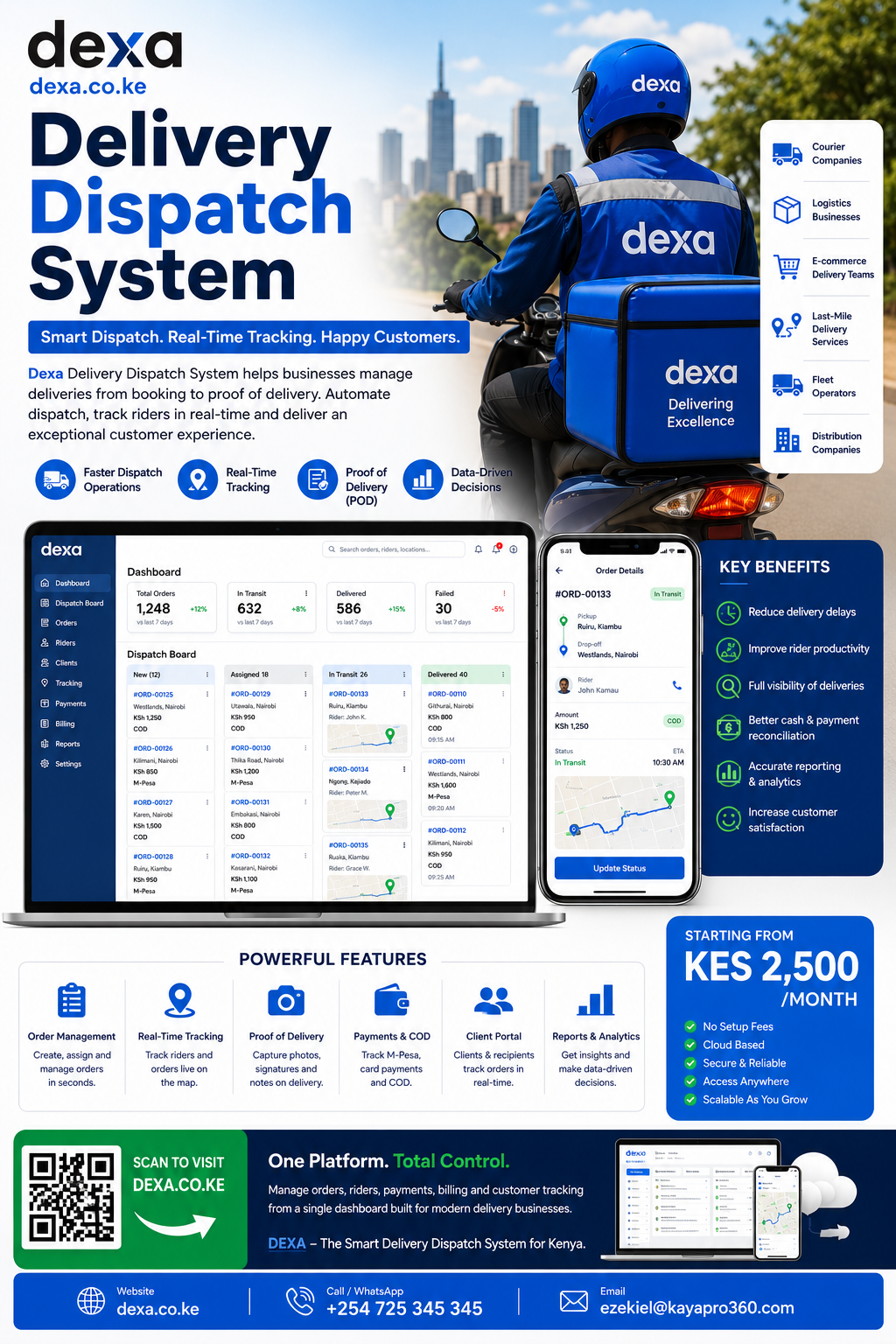
Last Mile Delivery Software Kenya helps businesses optimize final-mile logistics, improve delivery visibility, manage riders efficiently, reduce delivery delays, and enhance customer experiences across retail, e-commerce, distribution, courier, and logistics operations.
The last mile is one of the most important stages of the delivery process. It represents the final movement of goods from a distribution center, warehouse, or fulfillment location to the customer.
As customer expectations continue increasing, businesses require better tools to manage delivery operations efficiently.
Manual delivery coordination often leads to delays, communication gaps, failed deliveries, and limited operational visibility.
Modern last mile delivery platforms help businesses streamline dispatching, track deliveries in real time, improve route management, and ensure successful delivery completion.
Dexa provides businesses with technology designed to simplify last mile logistics and support long-term operational growth.
Organizations using Last Mile Delivery Software Kenya gain actionable insights for decision-making.
Industries That Benefit From Delivery Optimization
E-Commerce Businesses
Improve customer delivery experiences.
Courier Companies
Increase operational efficiency.
Retail Operations
Strengthen fulfillment processes.
Distribution Companies
Improve logistics visibility.
Healthcare Deliveries
Support time-sensitive deliveries.
Businesses using Last Mile Delivery Software Kenya improve service reliability and customer satisfaction.
Benefits of Last Mile Automation
Improve Delivery Speed
Reduce delays.
Improve Visibility
Track deliveries in real time.
Improve Customer Experience
Provide accurate updates.
Improve Productivity
Optimize rider performance.
Improve Scalability
Support business growth.
Organizations implementing Last Mile Delivery Software Kenya strengthen operational performance and delivery outcomes.
Why Choose Dexa
Dexa provides businesses with a comprehensive platform for managing final-mile logistics operations.
Features include:
Delivery dispatch management
Rider tracking
Real-time visibility
Route monitoring
Proof of delivery
Workflow automation
Reporting and analytics
Organizations using Last Mile Delivery Software Kenya through Dexa gain the tools needed to optimize delivery operations and improve customer experiences.
Future Trends in Delivery Technology
Last mile logistics continues evolving through innovation.
Future trends include:
AI-powered routing
Automated dispatching
Predictive analytics
Real-time optimization
Digital workflow automation
Advanced logistics reporting
Businesses investing in Last Mile Delivery Software Kenya position themselves for future growth and competitive advantage.
If your organization struggles with delivery delays, limited visibility, inefficient routing, and rising operational costs, now is the ideal time to modernize your final-mile operations.
Last Mile Delivery Software Kenya helps businesses improve delivery performance, increase visibility, optimize logistics workflows, and support long-term operational growth.
Dexa provides the technology needed to simplify last mile logistics and deliver exceptional customer experiences.
Delivery Dispatch System Kenya helps businesses streamline delivery operations, improve dispatch efficiency, manage riders effectively, increase visibility, and optimize logistics workflows across courier, retail, e-commerce, distribution, and service industries.
Modern businesses depend on fast and reliable deliveries to maintain customer satisfaction and operational efficiency. As delivery volumes increase, managing dispatch operations manually becomes more difficult and often results in delays, communication gaps, and reduced visibility.
Traditional delivery coordination methods such as spreadsheets, phone calls, and messaging applications can slow operations and create unnecessary complexity.
A modern delivery dispatch system centralizes delivery management, improves coordination, strengthens accountability, and provides real-time visibility into every stage of the delivery process.
Dexa provides businesses with a powerful platform designed to simplify delivery management and support operational growth.
If your organization experiences delivery delays, poor visibility, communication challenges, and increasing logistics complexity, now is the ideal time to modernize operations.
Delivery Dispatch System Kenya helps businesses improve delivery performance, optimize workflows, strengthen visibility, and support long-term operational growth.
Dexa provides the technology needed to manage deliveries efficiently and scale logistics operations with confidence.
Dispatch Management Software Kenya is transforming how businesses manage deliveries, riders, drivers, and customer orders. As customer expectations continue to rise, organizations across Kenya need reliable systems that streamline dispatch operations, improve visibility, and reduce delivery delays.
Whether you operate a courier company, e-commerce business, retail distribution network, or field service operation, modern dispatch technology provides the tools needed to manage orders efficiently from creation to completion.
Dexa offers a powerful dispatch management platform designed specifically for businesses seeking complete control over their delivery operations. By automating workflows, tracking deliveries in real time, and providing actionable insights, Dexa helps companies scale logistics operations while maintaining excellent customer service.
What is Dispatch Management Software?
Dispatch management software is a digital platform that enables businesses to plan, assign, monitor, and complete delivery tasks from a centralized dashboard.
Instead of relying on spreadsheets, phone calls, WhatsApp groups, or manual processes, dispatch teams can manage every order through a structured workflow. This improves visibility, accountability, and operational efficiency.
A modern dispatch system typically includes:
Order creation and assignment
Driver and rider management
Real-time GPS tracking
Route visibility
Delivery status updates
Proof of delivery collection
Reporting and analytics
Customer notifications
Businesses using dispatch management software gain better control over daily operations while reducing administrative workload.
Why Kenyan Businesses Need Dispatch Management Software
The logistics landscape in Kenya is becoming increasingly competitive. Customers expect faster deliveries, accurate updates, and reliable service.
Manual dispatch processes often create challenges such as:
Missed deliveries
Delayed assignments
Poor communication
Limited visibility
Lost delivery records
High operational costs
Dispatch Management Software Kenya solutions address these challenges by providing automation, transparency, and real-time operational control.
As delivery volumes grow, businesses require technology that can scale with demand while maintaining service quality.
Common Dispatch Challenges in Kenya
Many organizations face similar operational obstacles:
Manual Assignment Processes
Dispatchers spend significant time assigning jobs individually, creating delays and increasing the risk of human error.
Lack of Delivery Visibility
Without tracking tools, managers cannot easily determine the status of active deliveries.
Communication Gaps
Phone calls and messaging applications often create fragmented communication between dispatchers and riders.
Limited Performance Tracking
Businesses struggle to evaluate driver productivity and delivery success rates.
Customer Service Issues
Customers become frustrated when delivery updates are unavailable or inaccurate.
How Dexa Dispatch Management Software Works
Dexa centralizes dispatch operations into one easy-to-use platform.
Orders move through a structured workflow that enables teams to:
Create orders.
Assign riders or drivers.
Track deliveries in real time.
Capture proof of delivery.
Manage exceptions.
Generate reports.
This approach eliminates operational silos and ensures every delivery follows a consistent process.
Key Features of Dexa Dispatch Management Software
Order Management
Create, assign, monitor, complete, and archive deliveries through a single platform.
Dispatch Control
Move every order through a predictable workflow without relying on manual trackers.
Real-Time Visibility
Monitor active deliveries and dispatch performance from a centralized dashboard.
Rider Management
Assign deliveries efficiently and monitor rider performance.
Delivery Verification
Capture signatures, photos, and delivery confirmations.
Exception Handling
Manage failed deliveries and operational issues quickly.
Analytics and Reporting
Access insights that support continuous operational improvement.
Order Creation and Workflow Management
Dexa enables role-based order creation for administrators, dispatchers, clients, and operational teams.
Every order follows a structured process:
Awaiting assignment
Assigned
In transit
Delivered
Completed
Archived
This standardized workflow improves accountability and reduces operational confusion.
Real-Time Delivery Tracking
Real-time tracking is one of the most important components of Dispatch Management Software Kenya.
Managers can monitor delivery progress, identify delays, and respond quickly to operational issues.
Dispatch Management Software Kenya is no longer optional for businesses seeking operational efficiency and superior customer experiences. Organizations that rely on manual dispatch processes face increasing challenges as delivery volumes grow.
Dexa provides a modern dispatch management platform that streamlines workflows, improves visibility, enhances rider management, and supports scalable logistics operations. By adopting Dispatch Management Software Kenya, businesses can reduce costs, increase productivity, and deliver exceptional customer experiences.
Every courier entrepreneur in Kenya has heard some version of the pitch: “deploy multi-branch courier operations software and watch your revenues scale effortlessly.” What the pitch rarely tells you is the exact startup cost in KES, the realistic monthly revenue per branch, or how many months it will take before you stop bleeding money. This guide fixes that. We cut through the vague language, run the actual numbers, and give you an honest verdict on whether investing in multi-branch courier operations software in 2026 is truly worth your capital.
Whether you are running a single dispatch point in Nairobi’s CBD, managing three pickup stations across Mombasa, or dreaming of a national network, the math in this article applies directly to your situation. We model four real-world deployment scenarios, build a step-by-step break-even calculator, and surface every cost that most blog posts quietly ignore. Let’s begin.
multi-branch courier operations software
1. What Is Multi-Branch Courier Operations Software?
Multi-branch courier operations software is a centralised platform that lets a courier business manage shipment creation, driver dispatch, parcel tracking, COD (cash-on-delivery) settlement, invoicing, and branch-level reporting from a single dashboard — regardless of how many physical locations or delivery zones the business operates. Instead of each branch keeping its own spreadsheet or WhatsApp group, everything feeds into one database in real time.
The distinction between single-branch tools and true multi-branch courier operations software matters enormously at scale. A single-depot system breaks down the moment you open a second hub because order data, driver assignments, and financial reconciliation become siloed. Purpose-built multi-branch courier operations software eliminates those silos by linking every hub to one cloud backend while still giving branch managers their own localised view.
Industry analysts note that modern courier management platforms in 2026 go beyond basic tracking to offer on-demand dispatch, dynamic route recalculation, driver availability management, and white-label branding — all essential for hyperlocal, same-day, and express services in African urban markets. What most of those articles omit, however, is any concrete financial model for a Kenyan operator. That gap is what this article addresses.
2. Startup Cost Table: What You Need Before Day One
Before a single parcel moves through your multi-branch courier operations software, you need physical and digital infrastructure at every branch. Below is a realistic cost breakdown for a two-branch setup in Kenya (one main hub + one satellite station). Scale the figures proportionally for additional branches.
Hardware & Connectivity Costs (Per Branch)
Item
Purpose
Budget Option (KES)
Mid-Range (KES)
Notes
Dispatch Computer / Laptop
Running the software dashboard
28,000
55,000
Refurbished Core i5 works fine for most SaaS platforms
Wireless Router (main hub)
Local network for branch staff
3,500
8,000
TP-Link Archer or MikroTik hAP recommended
Access Points (×2 per branch)
Stable Wi-Fi for mobile scanners
4,800
12,000
Ubiquiti UniFi offers best range per shilling
Fibre Internet (monthly)
Primary connectivity — 10 Mbps plan
3,500/mo
6,500/mo
Safaricom Home Fibre or Zuku available in most towns
Starlink (monthly)
Backup / upcountry branches
6,500/mo
6,500/mo
KES ~21,000 hardware kit (one-off) + KES 6,500/mo
Thermal Label Printer
Printing waybills and parcel labels
9,500
18,000
Xprinter XP-350B is the Kenyan market standard
Barcode / QR Scanner
Scanning parcels at intake & delivery
3,200
6,500
USB or Bluetooth — 2D scanner covers all QR formats
Courier Management Software Subscription
Core SaaS platform licence
5,000/mo
18,000/mo
Per-branch pricing is common; negotiate annual contracts
UPS / Power Backup
Protecting equipment during outages
4,500
9,000
APC Back-UPS 650 VA covers a laptop + router for ~2 hrs
Staff Training (one-off)
Onboarding branch staff to new system
5,000
15,000
Many vendors offer free onboarding; budget anyway
Total One-Off Setup Cost (2-Branch Operation)
Scenario
Main Hub (KES)
Satellite Branch (KES)
Grand Total (KES)
Budget Build
58,500
41,000
99,500
Mid-Range Build
123,500
91,000
214,500
Key Insight: A functional two-branch setup running multi-branch courier operations software can be achieved for as little as KES 99,500 upfront. That number assumes fibre connectivity is available and a Starlink hardware kit is not required. Add KES 21,000 for the Starlink dish if the satellite branch is upcountry.
Most articles about multi-branch courier operations software say you “can earn up to” a certain amount without defining the delivery volume, pricing per parcel, or return rate. We break this down across four distinct business contexts that are common in Kenya in 2026. All figures use conservative-to-realistic assumptions, not best-case fantasies.
Pricing Assumptions Used Across All Scenarios
Same-city delivery: KES 200–350 per parcel
Inter-county delivery: KES 400–700 per parcel
Bulky parcel surcharge: KES 100–300 extra
COD handling fee: 2–3% of collected value
Driver cost per delivery: KES 50–80 (boda) or KES 120–180 (van per stop)
A courier branch embedded in or adjacent to a residential apartment block acts as a last-mile collection point and also handles outbound parcels for residents ordering online.
Metric
Conservative
Realistic
Resident units served
10
10
Avg parcels received per unit/month
4
8
Total inbound parcels/month
40
80
Outbound parcels/month (residents sending)
8
20
Revenue per inbound parcel (handling fee)
KES 50
KES 80
Revenue per outbound parcel (delivery charge)
KES 250
KES 300
Total Monthly Revenue
KES 4,000
KES 12,400
Verdict on Scenario A: Apartment complexes alone are not sufficient to justify a full software subscription. They work best as one of many revenue streams feeding the same multi-branch courier operations software installation — for example, combined with e-commerce merchant pickups from the same area.
A roadside branch near a market, matatu stage, or shopping strip serves both walk-in customers and small businesses in the area. This is the most common entry point for Kenyan courier entrepreneurs.
Metric
Conservative
Realistic
Parcels dispatched/day
12
28
Working days/month
26
26
Total monthly dispatches
312
728
Average revenue per parcel
KES 280
KES 310
Gross monthly revenue
KES 87,360
KES 225,680
Driver & fuel costs (40% of revenue)
KES 34,944
KES 90,272
Net Branch Contribution
KES 52,416
KES 135,408
Verdict on Scenario B: A well-located roadside kiosk is the workhorse of any courier network. At 28 parcels/day — achievable in a busy market area — the branch contributes KES 135,408 net before overheads. This scenario by itself justifies the investment in multi-branch courier operations software within months.
Scenario C: School-Based Courier Station
Schools generate consistent parcel flows — uniforms, textbooks, lab equipment, and increasingly, online orders for students and staff. A school-based branch typically operates during term time (about 9 months/year).
Metric
Conservative
Realistic
Parcels dispatched during term/month
80
200
Average revenue per parcel
KES 320
KES 350
Gross monthly revenue (term time)
KES 25,600
KES 70,000
Gross monthly revenue (holiday — 20% of term)
KES 5,120
KES 14,000
Driver & fuel costs (35%)
KES 8,960
KES 24,500
Net Branch Contribution (term month)
KES 16,640
KES 45,500
Verdict on Scenario C: Schools are a supplementary revenue stream, not a standalone justification for a branch. The key advantage is predictability — term dates are fixed, so cash-flow planning is straightforward. Combine a school station with a nearby roadside kiosk under the same multi-branch courier operations software umbrella for the best economics.
Scenario D: Event Space / Exhibition Centre
Event venues need courier services for equipment inbound, merchandise delivery, and urgent document dispatch. Revenue is highly irregular but per-transaction value is high.
Metric
Low Event Month (2 events)
High Event Month (8 events)
Parcels/shipments per event
30
45
Average revenue per parcel
KES 450
KES 500
Gross monthly revenue
KES 27,000
KES 180,000
Driver & logistics costs (45%)
KES 12,150
KES 81,000
Net Branch Contribution
KES 14,850
KES 99,000
Verdict on Scenario D: Event venues offer the highest per-parcel revenue but demand surge capacity that multi-branch courier operations software handles particularly well — especially the ability to temporarily redirect drivers from other branches to cover peak event loads.
4. Ongoing Monthly Costs
This is the section that separates profitable operators from those who discover six months later that their multi-branch courier operations software installation is costing more than it earns. Below is a realistic monthly cost structure for a two-branch operation.
Cost Item
Per Branch (KES/mo)
2 Branches (KES/mo)
Notes
Software SaaS Subscription
5,000 – 18,000
10,000 – 36,000
Multi-branch plans often offer 20–30% discount vs per-branch pricing
Internet (Fibre)
3,500 – 6,500
7,000 – 13,000
Some vendors bundle connectivity; negotiate this
Power (KPLC + UPS battery replacement)
1,200 – 2,500
2,400 – 5,000
UPS batteries need replacement every 18–24 months (~KES 2,500)
Platform Transaction Fee (e.g. 5% processing)
Varies
Varies
If using an integrated billing platform, a ~5% cut of processed transactions is typical; budget accordingly
Branch Staff (1–2 people)
18,000 – 35,000
36,000 – 70,000
Minimum wage in Kenya is ~KES 15,120; expect KES 18K–25K for trained counter staff
Maintenance & Consumables
1,500 – 3,000
3,000 – 6,000
Label rolls, printer heads, minor repairs
Marketing (SMS, social media)
1,000 – 4,000
2,000 – 8,000
Bulk SMS via Africa’s Talking: ~KES 0.8/SMS
Total Monthly Overhead
30,200 – 69,000
60,400 – 138,000
Excluding driver/fuel costs which are modelled as % of revenue above
Watch out for the 5% platform fee: If your multi-branch courier operations software provider takes a 5% cut on all processed transactions, and you are handling KES 500,000 in monthly COD, that is KES 25,000 per month going to the platform — KES 300,000 per year. Always model this fee explicitly against your expected transaction volume before signing any agreement.
5. Break-Even Calculator (In Months)
Let us now combine the one-off startup costs with the ongoing cost structure and the revenue models above to calculate a realistic break-even timeline for a two-branch deployment running multi-branch courier operations software.
Break-Even Formula
Break-Even (months) = Total One-Off Setup Cost ÷ (Monthly Net Contribution − Monthly Overhead)
Scenario B (Roadside Kiosk) — The Benchmark Case
Variable
Conservative
Realistic
Total One-Off Setup Cost (2 branches, budget build)
KES 99,500
KES 99,500
Monthly Net Branch Contribution (2 branches combined)
KES 104,832
KES 270,816
Monthly Overhead (mid-range)
KES 99,200
KES 99,200
Monthly Net Profit
KES 5,632
KES 171,616
Break-Even (months)
17.7 months
0.6 months
The wide range reflects how strongly parcel volume drives your economics. An operator averaging only 12 parcels/day per kiosk branch will take nearly 18 months to recoup setup costs. An operator at 28 parcels/day — the realistic target for a busy location — can theoretically break even in under one month once operations are running at capacity.
Blended 4-Scenario Operation (Roadside + School + Event)
Variable
Blended Conservative (KES)
Blended Realistic (KES)
Monthly Combined Net Contribution
84,000
280,000
Monthly Overhead (3-branch system)
90,600
138,000
Total One-Off Setup Cost (3 branches)
141,000
306,000
Monthly Net Profit
−6,600 (loss)
142,000
Break-Even (months)
Never (at low volume)
2.2 months
Takeaway: The break-even on properly deployed multi-branch courier operations software ranges from 1 to 18 months depending almost entirely on your parcel volume. Volume is the lever. Before investing, survey your target corridors for existing parcel demand — do not assume volume will appear simply because you open a branch.
6. Risk Section: What Can Go Wrong & How to Mitigate
No article on multi-branch courier operations software is complete without an honest assessment of failure modes. Here are the five biggest risks and practical mitigation strategies for each.
Risk 1: Low Parcel Volume at Launch
The single most common reason courier branches fail in Kenya is opening at a location without validating demand first. Operators invest in hardware, software, and staff — then wait for parcels that trickle in at 5 per day rather than 25.
Mitigation: Before signing a lease or buying hardware, spend two weeks manually counting parcel activity at your target location. Talk to existing boda-boda riders in the area — they know exactly how many deliveries happen daily. Aim for locations where at least 15 parcels/day already move without your involvement.
Risk 2: Internet Outage Halting Operations
Cloud-based multi-branch courier operations software is only as reliable as your connectivity. A 4-hour fibre outage can prevent waybill generation, driver dispatch, and payment processing.
Mitigation: Always run a primary fibre line plus a 4G/LTE failover SIM on a separate router. Configure the router for automatic failover. In upcountry locations, Starlink is a superior primary connection despite the higher monthly cost of KES 6,500.
Risk 3: Driver Attrition and Accountability Gaps
Driver fraud — including unreported COD collections and fabricated “failed delivery” statuses — can silently erode up to 8% of gross revenue in poorly managed networks.
Mitigation: Insist on software that provides real-time GPS tracking, mandatory proof-of-delivery photo uploads, and automated COD reconciliation. Platforms that surface per-driver delivery rates and COD discrepancies in branch-level reports make fraud far harder to sustain. Dereva, the Kenyan driver marketplace and hire-a-driver platform, can help you source vetted drivers for your courier network.
Risk 4: SaaS Vendor Lock-In or Price Increases
Some multi-branch courier operations software vendors offer attractive entry pricing then raise subscription fees 30–50% after Year 1, knowing that migrating years of shipment history is painful.
Mitigation: Before signing, ask the vendor two questions: (a) Do you own and can export your entire database at any time? (b) What is the price escalation clause in the contract? Prefer open-data policies and avoid vendors who cannot demonstrate data portability.
Risk 5: Hardware Theft and Damage
Roadside kiosk environments in Kenya carry real theft risk. A stolen laptop or label printer sets your branch back KES 28,000–55,000 and can take days to replace.
Mitigation: Bolt printers to desks. Use Kensington locks on laptops. Keep operational laptops behind a counter barrier. Budget KES 3,000–5,000/year per branch for petty cash repairs and theft insurance if available through your business insurer.
7. Is This Worth It? Honest Verdict
Short answer: Yes — but only if you commit to volume before committing to software.Here is the honest math. A two-branch courier operation running solid multi-branch courier operations software costs between KES 60,000 and KES 138,000 per month in overhead (excluding driver costs). At a combined realistic throughput of 56 parcels per day across two branches — which is entirely achievable in a high-footfall Kenyan town — your gross revenue exceeds KES 450,000 per month, leaving a healthy net margin after all costs.
The investment makes excellent sense for operators who already have a proven single-branch operation and are expanding. It is risky for operators trying to validate a brand-new market because the overhead is high relative to the early-stage revenue trickle. The software itself is not the risk — the risk is treating software capability as a substitute for demand generation.
If you are in the validation stage, start with a single branch, hit 20+ parcels/day consistently for three months, then expand to multi-branch and adopt a proper multi-branch courier operations software platform with the confidence that your revenue base can absorb the additional overhead.
8. The Dexa Ecosystem: Tools That Work Alongside Your Courier Software
Running a courier business in Kenya involves more than just dispatch software. You need staff management, financial tracking, and
multi-branch courier operations software
customer communication tools that integrate cleanly with your core multi-branch courier operations software. The Dexa platform and its family of SaaS products are built for exactly this reality. Here are the tools most relevant to courier operators:
Property and estate management — if you are embedded in an apartment complex (Scenario A), this manages the building side
This ecosystem approach means that as your courier business grows from two branches to ten, the operational software stack grows with you — without forcing you to stitch together incompatible third-party tools. All of Dexa’s products are built for the Kenyan market and support Mpesa-native payment workflows.
Q1. How much does multi-branch courier operations software cost per month in Kenya?
Expect to pay between KES 5,000 and KES 36,000 per month for a credible multi-branch courier operations software platform covering two branches. Entry-level plans start around KES 5,000 per branch; enterprise plans with full API integration, white-label branding, and unlimited driver accounts can reach KES 18,000 per branch. Most vendors offer an annual prepayment discount of 15–25%, which can save you KES 18,000–KES 50,000 per year on a mid-range plan. Always negotiate multi-branch pricing as a bundle rather than paying the per-branch rate multiplied by your branch count.
Q2. What is the minimum parcel volume needed to justify multi-branch courier operations software?
Based on our cost model, you need a combined minimum of roughly 35–40 parcels per day across all branches to cover software subscription costs, internet, power, and basic staff overhead at a two-branch operation. Below that threshold, the overhead exceeds your contribution margin and you will operate at a loss. At 60+ parcels/day combined — a realistic target for two well-located kiosk branches — the business generates meaningful profit. Use the break-even formula in Section 5 to calculate your own threshold with your actual local pricing and costs.
Q3. Can I start with one branch and add more branches later on the same software?
Yes — this is the recommended approach. Start with a single branch to validate demand and train staff. Once you hit consistent profitability, adding a second branch to your multi-branch courier operations software typically requires only an additional branch licence (KES 5,000–18,000/month), the hardware costs outlined in Section 2, and a branch onboarding session with your vendor. Data from your first branch — driver performance, parcel volumes, peak hours — gives you valuable intelligence for choosing the location and sizing the staffing of your second branch.
Q4. How does COD (cash-on-delivery) reconciliation work across multiple branches?
This is one of the most powerful features of dedicated multi-branch courier operations software versus generic tools. Each driver’s COD collections are recorded against specific waybills at delivery time. The system automatically calculates what each driver owes back to the branch at end-of-day. Branch managers see a real-time dashboard of collected vs outstanding COD. Discrepancies trigger alerts before they become write-offs. Without this feature, multi-branch COD fraud and accounting errors can quietly consume 5–10% of gross revenue, as detailed in the Risk section above.
Q5. Is Starlink worth the cost for a upcountry courier branch?
At KES 6,500 per month plus a one-off KES 21,000 hardware cost, Starlink is more expensive than Safaricom fibre where fibre is available. However, in towns where fibre is unreliable or unavailable — which covers a significant portion of Kenya outside Nairobi, Mombasa, Kisumu, and Nakuru — Starlink delivers consistent 50–150 Mbps speeds with under 40ms latency. For a courier branch handling KES 200,000+ in monthly transactions, a KES 6,500 internet bill is 3.25% of revenue and entirely justified. The risk of running multi-branch courier operations software on a 3G mobile data connection — dropped sessions, failed payment processing, slow waybill printing — far outweighs the Starlink premium in most upcountry scenarios.
Ready to Deploy Multi-Branch Courier Operations Software That Actually Pays Off?
Dexa and the Pawa platform give Kenyan courier entrepreneurs a complete, locally-built toolkit — from branch-level dispatch to driver management, staff HR, and customer communication. Stop guessing at numbers and start operating with real-time data across every branch you run.
Published by Dexa.co.ke · Last updated June 2026 · All KES figures are based on 2026 Kenyan market rates and are intended as planning estimates only. Actual results will vary by location, volume, and operational efficiency.
Why Rider Management in Kenya Is Broken — and What It’s Costing You
Understanding how to manage riders in Kenya starts with admitting something that most guides skip over: the majority of courier and delivery businesses in Kenya do not actually manage their riders at all. They coordinate them — through WhatsApp messages, voice calls, and a lot of hope.
how to manage riders in Kenya
A dispatcher calls a rider, the rider says “niko njiani,” and nobody really knows if that means the parcel is two minutes or two hours away. Cash collected from customers sits in a rider’s pocket until end of day, when it either gets remitted in full or — more often — remitted minus some untracked amount that shows up as a reconciliation gap. When a client calls to ask where their delivery is, the answer is essentially a guess.
This is not a small problem. It is a structural leak in your business. An operation running 10 riders doing 30 deliveries each per day — a modest, realistic scale — is processing around 6,600 orders per month. If just 3% of those orders have a problem (late delivery, COD dispute, unreported failed delivery), that is almost 200 problem events per month, each one requiring a phone call, a staff member, and a resolution. At 5 minutes per incident, that is 16 hours of operational waste every single month on avoidable firefighting.
Learning how to manage riders in Kenya properly is not about installing an app. It is about building a system where every rider, every order, and every payment is tracked, auditable, and visible — in real time, without a phone call. Every courier operator who has figured out how to manage riders in Kenya at scale will tell you the same thing: the system is the manager.
What Managing Riders in Kenya Actually Means in 2026
When you search how to manage riders in Kenya, you find plenty of generic HR advice: “hire responsibly,” “provide training,” “communicate clearly.” That is well-intentioned but largely useless for an operations manager running 15 riders across Nairobi.
What managing riders in Kenya actually requires in 2026 is a system that handles five distinct functions simultaneously:
Assignment: Who gets which order, based on their current location, available capacity, and zone expertise — decided in seconds, not after three WhatsApp messages.
Tracking: Where is each rider right now, and is the order they are carrying on schedule? Managing riders in Kenya without live location visibility means you are always one step behind a problem.
Proof of delivery: Was the parcel actually delivered? To whom? When? With what evidence?
Payment: Was cash collected? Has it been reconciled against the order? Is the M-Pesa STK push confirmed or still pending?
Performance: Over time, which riders have the best delivery success rates, fastest average times, and lowest COD disputes? Which ones should be given priority assignments — and which ones need a conversation?
None of these five functions work in a WhatsApp group. All five work inside Dexa, the courier SaaS platform built specifically for Kenyan operations. Knowing how to manage riders in Kenya at scale starts with recognising that a structured platform is not a luxury — it is the actual management system.
how to manage riders in Kenya
The Real Cost of Setting Up a Rider Operation in Kenya
Most articles on how to manage riders in Kenya either say “you’ll need KES 500,000 to start” without any breakdown, or they give itemised lists that somehow forget to include the actual cost of motorcycles, insurance, or digital tools. Here is an honest, itemised setup cost for a courier operation entering the market with 5–10 riders.
One-Time Setup Costs
Item
Low (KES)
High (KES)
Notes
Motorcycle purchase (per bike, used)
65,000
95,000
Honda CG or TVS Apache used market prices
Motorcycle branding + carrier rack
5,000
12,000
Per bike
Rider helmet + reflective vest + rain gear
3,500
7,500
Per rider
Android smartphone for rider app
4,000
8,000
Per rider
CAK courier operator licence
10,000
30,000
Annual; non-refundable application fee
Business registration (eCitizen)
950
18,000
Business name vs. limited company
County operating permit
3,000
8,000
Nairobi or county-specific
Personal accident insurance (per rider/year)
8,000
20,000
Per rider annually
Motorcycle insurance (comprehensive, per bike/year)
12,000
22,000
Per bike
Office rent deposit + first month
15,000
45,000
Small coordination office
Admin laptop
35,000
70,000
If not already owned
SaaS platform setup (Dexa onboarding)
0
0
No setup fee on Dexa
Total for 5-rider operation
~KES 350,000
~KES 580,000
Total for 10-rider operation
~KES 600,000
~KES 980,000
The single biggest line item is the motorcycles. Many operators starting out on a tight budget begin with rider-owned bikes, paying a higher per-delivery commission in exchange for not owning the asset. This brings starting costs down to KES 80,000–150,000 for a 5-rider operation but reduces your control over availability and bike condition.
Platform cost: Dexa’s Growth plan — appropriate for 5–20 riders — is KES 7,500 per month with no setup fee and onboarding completed in under 3 days. This is the management infrastructure cost for understanding how to manage riders in Kenya without chaos. If you are serious about managing riders in Kenya at scale, the platform subscription is the lowest-cost line on your entire cost sheet.
Rider Pay Models: KES Numbers, Not Vague Ranges
Every article about how to manage riders in Kenya mentions commission pay but none of them give the actual numbers. Here is how rider compensation works in the Kenyan market in 2026. Getting pay structures right is central to how to manage riders in Kenya sustainably — underpay and you lose good riders to competitors; overpay without productivity targets and your margins collapse.
Model 1: Pure Commission (Most Common for Gig Riders)
Riders earn per delivery, no base salary. Common for casual or gig-style arrangements.
Within CBD / same zone: KES 60–80 per delivery
Cross-zone Nairobi delivery (e.g., Westlands to South B): KES 100–130 per delivery
Inter-town delivery (e.g., Nairobi to Thika): KES 200–350 per delivery
A productive rider doing 25 in-zone deliveries per day earns KES 1,500–2,000 per day, or KES 33,000–44,000 per month on 22 working days. This is broadly in line with Kenyan job market data showing motorcycle rider income in the KES 38,000–55,000 range for active riders.
Model 2: Retainer + Commission (Most Common for Employee Riders)
Used when you own the motorcycles and want more reliable availability.
Monthly retainer: KES 8,000–15,000 (replaces NHIF + NSSF obligations if employment contract)
Per-delivery commission: KES 40–70
Total effective earnings for 20 deliveries/day: KES 25,000–35,000 per month in commission + retainer
This model costs more in base cost but creates accountability. A rider who is on retainer calls in sick — or more importantly, calls in — rather than simply disappearing. When thinking about how to manage riders in Kenya for the long term, retainer models build a more loyal and reliable team.
Model 3: Zone-Based Day Rate
Some operations pay a flat day rate for a defined zone, regardless of delivery count.
Full-day Nairobi CBD rate: KES 1,200–1,800
Half-day or shift: KES 600–900
This model works well for corporate document delivery where order volume is predictable but timing is not.
The key number that most guides on how to manage riders in Kenya miss: fuel. A boda boda covering 80–100 km per day (realistic for active Nairobi delivery) consumes roughly 2 litres of petrol per day at current prices of approximately KES 180/litre — that is KES 360/day or KES 7,920/month per company-owned bike. On rider-owned bikes, fuel is the rider’s responsibility and is why their per-delivery commission expectation is higher.
Monthly Revenue Model: 4 Real Courier Scenarios
Here is where articles on how to manage riders in Kenya consistently fail: they tell you how to manage the people but never connect that management to the business economics. These four models fix that. Knowing how to manage riders in Kenya is only half the picture — you also need to understand what properly managed riders generate in real KES revenue.
Scenario 4: Multi-Zone Operation (10 Riders + 1 Van, Nairobi)
A mid-sized courier company handling both intra-city parcels and pickup-from-client bulk orders.
Daily deliveries: 250 (10 riders × 25)
Total monthly orders: 5,500
Average blended revenue per order: KES 260
Gross Monthly Revenue: KES 1,430,000
Rider commissions (KES 75 × 5,500): KES 412,500
Fuel (10 bikes + 1 van): KES 98,000
SaaS platform (Dexa Scale): KES 18,000
Office rent + admin salary: KES 65,000
Insurance + maintenance: KES 45,000
Net Monthly Profit: ~KES 791,500
These numbers are built on real Nairobi market rates — not “industry averages” copied from global logistics reports. Mastering how to manage riders in Kenya at each of these scales requires a different structure, but all four benefit from the same core principle: orders, riders, and payments on one visible platform.
Break-Even Calculator: When Does It Start Paying?
Scenario
One-Time Startup (KES)
Monthly Net Profit (KES)
Break-Even
Scenario 1: 5-rider e-commerce
480,000
288,400
~1.7 months
Scenario 2: 3-rider corporate
280,000
287,540
~1 month
Scenario 3: 2-rider medical
210,000
253,500
<1 month
Scenario 4: 10-rider + van
820,000
791,500
~1 month
The pattern across all four scenarios: a well-run rider operation in Kenya, managed on a proper courier SaaS platform, breaks even within 1–2 months of reaching operational volume. The break-even point is not the risk — the risk is the ramp-up period before you have enough orders to fill your riders’ capacity.
This is why the first question for any new operator learning how to manage riders in Kenya is not “how many riders do I need?” but “how many confirmed orders do I have before I hire?” A rider sitting idle costs you KES 1,200–1,800 per day in retainer or opportunity cost. Start with fewer riders at high utilisation rather than more riders at low utilisation.
Ongoing Monthly Costs: The Full Picture
For a 10-rider operation using Dexa’s Scale plan, here is what the monthly cost structure looks like beyond rider pay:
Notice what is absent from this list: a dispatcher spending half their day on the phone, a finance person reconciling COD cash against a notebook, and a customer service rep answering “where is my parcel?” calls. Those costs are real — they are just hidden inside salary hours wasted on manual coordination. Knowing how to manage riders in Kenya on a platform like Dexa converts those hidden costs into margin. Every operator who learns how to manage riders in Kenya on a structured system reports the same thing: the platform pays for itself in the first month through recovered cash leakage and dispatcher time alone.
What Can Go Wrong — and How to Fix It Before It Does
How to manage riders in Kenya is never a solved problem — it is an ongoing operational discipline. These are the five failure modes that kill Kenyan courier businesses and how to address each.
1. Riders Working Multiple Platforms Simultaneously
Kenyan gig riders frequently register on Glovo, Bolt Food, and private courier companies at the same time. When a higher-paying gig arrives, your assigned delivery waits or gets abandoned. The rider’s availability reported to you in the morning is not the same as their actual availability at 2pm. This is one of the most common challenges when you are learning how to manage riders in Kenya in a gig-economy environment.
Fix: Use Dexa’s real-time rider status and capacity view before every assignment. Riders with active jobs visible in the system cannot be assigned new orders until current orders are marked complete or handed off. Platform-side visibility replaces trust-based assignment.
2. COD Cash Leakage
A rider collects KES 1,500 from a client. By end of day they remit KES 1,200. The KES 300 difference is explained as change given, airtime bought, or fuel spent — all plausible and all unverifiable without a paper trail. Across 10 riders doing 25 deliveries each, even a modest KES 50 average leakage per COD order represents KES 12,500 per month in untracked cash.
Fix: Every delivery with a COD component should have an M-Pesa STK push initiated at point of collection, or the collection amount logged in the Dexa system immediately. When the system amount and the rider’s remittance disagree, the discrepancy is visible and timestamped — not discovered three days later during a manual reconciliation. This is perhaps the most financially critical aspect of how to manage riders in Kenya effectively.
3. Failed Deliveries Not Reported
A rider arrives at a delivery address and the recipient is unavailable. Rather than logging a failed delivery attempt and returning the parcel for rescheduling, they leave the parcel with a neighbour, send a WhatsApp message to the client that never gets answered, or — worst case — mark it as delivered without delivery occurring. If your operation does 5,500 orders per month and 5% have delivery issues, that is 275 unresolved events creating client disputes, refund demands, and reputation damage.
Fix: Dexa’s proof-of-delivery module requires riders to capture a photo, signature, or GPS-verified confirmation before an order status can be changed to “delivered.” A delivery that cannot be completed must be logged as a failed attempt with a reason code — which triggers an automatic client notification and a rescheduling workflow.
4. Rider Churn During Peak Periods
During peak seasons — November pre-Christmas, Valentine’s Day, end of month pay days — order volume spikes 40–80% above normal. This is exactly when riders take advantage of higher demand elsewhere, or simply burn out. Losing three riders during a peak week can collapse your delivery commitments. Anyone figuring out how to manage riders in Kenya needs a churn strategy before peak season arrives, not during it.
Fix: Maintain a rider pool that is 30–40% larger than your regular daily need. Use Dexa’s availability tracking to pre-confirm rider presence the night before heavy days rather than calling each one individually. Offer a peak-day bonus (KES 200–500 per rider) as a structured incentive, paid via M-Pesa at end of shift — visible in the system and not left to verbal promises.
5. No Performance Data, So No Accountability
Without data on individual rider performance, every performance conversation is subjective. A rider who consistently takes longer than average, has a higher failed-delivery rate, and generates more COD disputes cannot be held accountable if you have no record of those metrics. Understanding how to manage riders in Kenya for growth means tracking performance at the individual rider level, not just at the fleet level.
Fix: Dexa tracks per-rider order history, delivery status records, and payment events over time. This creates a factual basis for performance conversations, promotion decisions (which riders get the high-value corporate accounts), and termination decisions where necessary.
How to Manage Riders in Kenya Using Dexa
Dexa is a courier SaaS platform built specifically for the operational realities of running a delivery business in Kenya. The core tools that directly answer how to manage riders in Kenya include a live dispatch board showing all active orders by status, a rider coordination module with per-rider capacity caps and availability tracking, M-Pesa payment integration for both STK push and COD recording, proof-of-delivery capture, branded public tracking for clients, and billing and invoicing that link directly to completed deliveries.
Onboarding takes under three days. Riders access the system through the same interface they use on their smartphones. Admins, dispatch staff, clients, and finance all use the same platform — there is no separate tool for each function. For operators who have been struggling with how to manage riders in Kenya across multiple WhatsApp groups and spreadsheets, Dexa replaces the entire fragmented setup with one clean workspace.
how to manage riders in Kenya
Dexa is developed by the same team behind a broad portfolio of Kenyan business software designed to digitise everyday operations at affordable, locally-priced plans. The ecosystem includes RentalDesk for property and estate management, Ratibu for school administration, Pawa for WiFi hotspot billing, Vega POS for retail point-of-sale, Vota for campaign and leadership management, Zivo/ZChat for WhatsApp shared inbox, Prim for salon management, and Dereva as a driver marketplace and hire-a-driver platform — among others. This shared infrastructure means Dexa inherits the same reliability and Kenyan-first product thinking that runs across all products in the suite.
Knowing how to manage riders in Kenya is not a theoretical question — it is the difference between a courier business that grows and one that stagnates at 5 riders for three years, losing clients to better-organised competitors.
The math is straightforward: a 5-rider e-commerce operation generates KES 288,400 in net profit per month. The SaaS platform to manage it costs KES 7,500. The break-even on initial setup is under two months. The hidden costs of not using a platform — COD leakage, failed-delivery disputes, dispatcher time waste, client attrition — likely exceed the KES 7,500/month subscription in the very first week of operation.
Figuring out how to manage riders in Kenya without structure is possible. You might do it for a while through sheer hustle and good WhatsApp discipline. But you will hit a ceiling around 8–12 riders where the coordination complexity becomes impossible to manage manually, and that ceiling arrives exactly when your business should be scaling. Every operator who has solved how to manage riders in Kenya beyond that ceiling has done it with a system — not a bigger WhatsApp group.
The verdict: invest in the platform before you feel the pain, not after you are already losing money trying to fix it.
Frequently Asked Questions onhow to manage riders in Kenya
1. How much should I pay courier riders in Kenya per delivery?
The market standard in 2026 for same-zone Nairobi deliveries is KES 60–80 per parcel for commission-only riders. Cross-zone deliveries pay KES 100–130. Inter-city routes (Nairobi to Mombasa, Thika, Nakuru) are KES 200–400 depending on distance and parcel weight. If you own the bikes and pay a retainer, commission per delivery is typically KES 40–70 because fuel and maintenance are your cost, not theirs. Getting pay structures right is a core part of how to manage riders in Kenya without constant churn.
2. How do I stop riders from stealing cash-on-delivery collections?
The only reliable method is system-level accountability, not trust. Every COD order should have the collection amount logged in your courier SaaS platform at the point of delivery, cross-referenced against the order value. M-Pesa STK push initiated by the rider at point of collection
how to manage riders in Kenya
— visible to the admin dashboard in real time — closes the most common COD leakage loop. Dexa how to manage riders in Kenya natively.
3. What happens when a rider doesn’t show up for work?
This is the most common operational shock in how to manage riders in Kenya. Build a standby pool of at least 30% extra capacity — if you need 10 riders on a given day, have 13 registered and available. Use a platform that shows you rider availability the night before. Dexa lets you track active vs available riders in a live dashboard, so you know your capacity gap before the first order is placed.
4. Do I need to give riders employment contracts in Kenya?
Under Kenyan labour law, anyone working for you regularly — even on a commission basis — may be considered an employee by the Employment Act, 2007. To avoid NSSF, NHIF, and NITA obligations on full-time commission riders, many operators use a formal independent contractor agreement. Consult a local labour lawyer before setting pay structures at scale. At minimum, every rider should have a signed terms-of-engagement document that covers commission rates, COD responsibilities, and equipment accountability. Legal structure is a dimension of how to manage riders in Kenya that is too often left until there is a problem.
5. How many orders does a rider need to do per day to be profitable for my business?
A rider doing fewer than 12 deliveries per day on this model is not covering their own operational cost — 12 is roughly your minimum viable productivity threshold per rider. Tracking this metric per rider is exactly what Dexa’s reporting module is built for when learning how to manage riders in Kenya at scale.
Start Managing Your Riders with Dexa Today
Understanding how to manage riders in Kenya is the first step. Building the systems to do it at scale — with real-time visibility, M-Pesa payment integration, proof-of-delivery, and a live dispatch board — is what separates growing courier businesses from ones that stay permanently stuck in chaos.
Dexa is designed for exactly this: courier teams in Kenya that want operational clarity without the cost or complexity of enterprise logistics software built for Europe or the US. Whether you are a 3-rider startup working out how to manage riders in Kenya for the first time, or a 20-rider operation that has outgrown WhatsApp, Dexa scales with you.
Starter plan from KES 2,500/month. Growth plan for teams of up to 20 users at KES 7,500/month. Scale plan for multi-branch operations at KES 18,000/month. Onboarding in under 3 days.
The courier business in Kenya rewards operators who are structured, visible, and fast. Dexa gives you the structure. Riders give you the speed. The combination is how you win.
What Is Courier SaaS in Kenya — and Why It Matters Now
Courier SaaS Kenya refers to cloud-based software-as-a-service platforms that help courier and delivery companies manage their operations — dispatch, rider coordination, payment collection, proof of delivery, billing, and client tracking — without building custom software from scratch.
courier SaaS Kenya
Kenya’s courier industry is no longer a quiet backwater. According to the Communications Authority of Kenya, private courier operators delivered over 3 million parcels in Q2 2025 alone — a 9% increase quarter-on-quarter — fuelled by the explosion in e-commerce, Jumia deliveries, hyperlocal grocery apps, and same-day business document transfers. The total private courier revenue in Kenya reached KES 6.28 billion in 2024 and is growing.
Yet most Kenyan courier companies still run on a dangerous combination of WhatsApp group messages, paper waybills, and Excel spreadsheets. Riders get called manually. Payments are tracked in notebooks. Clients call the office ten times a day asking “where is my parcel?” — and nobody has a clean answer.
This is exactly the gap that courier SaaS Kenya platforms like Dexa fill. But the real question — the one most blogs avoid with vague language like “you could potentially increase your revenue” — is: what does it actually cost to get on a courier SaaS platform in Kenya, and how long before it pays back?
courier SaaS Kenya
This article answers that with real KES figures.
The Honest Startup Cost Breakdown
Most guides on courier SaaS Kenya wave their hands and say things like “affordable to launch” or “minimal upfront investment.” That is not useful if you are sitting in Nairobi trying to decide whether to move your 8-rider operation onto a proper platform this quarter.
Here is a realistic cost breakdown for a small to mid-size Kenyan courier operation adopting a courier SaaS platform like Dexa from scratch.
One-Time Setup Costs
Item
Low Estimate (KES)
High Estimate (KES)
Notes
Smartphones for riders (Android, basic)
12,000
40,000
KES 4,000–8,000 per device × 5–10 riders
Admin laptop or desktop
35,000
80,000
If not already owned
M-Pesa Paybill or Till registration
2,000
5,000
One-time KRA + Safaricom setup fees
Business name registration (eCitizen)
950
950
Fixed government fee
Branded delivery bags/vests/helmets
15,000
45,000
Safety + professionalism
CAK courier operator licence
5,000
15,000
Varies by county and business size
Internet connection setup (fibre or Safaricom Home)
3,000
8,000
Installation + router
Total One-Time Costs
KES 72,950
KES 193,950
A realistic median for a 5–10 rider courier startup getting on courier SaaS Kenya is KES 100,000–130,000 in one-time setup — not the “as low as KES 20,000” figures you sometimes see online, which ignore rider equipment and licensing.
What the SaaS Platform Itself Costs (Dexa)
Dexa’s courier SaaS Kenya pricing is among the most transparent and affordable in the local market:
Plan
Monthly Cost (KES)
Orders / Month
Users
Starter
2,500
500
Up to 4
Growth
7,500
4,000
Up to 20
Scale
18,000
Unlimited
Unlimited
For a startup with 5–10 riders doing 300–1,200 orders a month, the Growth plan at KES 7,500/month is the right fit. For very early stages (under 500 orders/month), the Starter at KES 2,500 is enough to run a clean, professional operation with rider app access, M-Pesa payment tracking, public delivery tracking, and invoicing.
This is significantly cheaper than global alternatives — Onfleet starts at $599/month (approximately KES 77,000), Shipday’s paid tiers begin at $125/month (around KES 16,000), and none of them are built for the Kenyan M-Pesa-first payment environment.
Monthly Revenue Model: 4 Real Scenarios
Forget “you can earn up to X.” Here are four realistic courier business models with specific KES revenue projections, based on common Nairobi and Kenyan market rates.
A courier handling last-mile for online sellers — WhatsApp businesses, Instagram sellers, Jumia flex partners. Average delivery: KES 150–250 per parcel.
Daily orders: 80 parcels across 3 riders
Monthly orders: ~1,760
Average revenue per order: KES 180
Gross Monthly Revenue: KES 316,800
Rider commissions (KES 60/delivery × 1,760): KES 105,600
Fuel, bags, M-Pesa float: KES 28,000
SaaS platform (Growth plan): KES 7,500
Net Monthly Profit: ~KES 175,700
Scenario 3: Medical Supply Courier (Nairobi Clinics)
Pharmacy-to-patient or clinic-to-lab specimen delivery. Smaller volume, higher value per trip. Average charge: KES 500–800 per delivery.
Daily orders: 15 deliveries
Monthly orders: ~330
Average revenue per order: KES 600
Gross Monthly Revenue: KES 198,000
Rider commissions (KES 120/delivery × 330): KES 39,600
An operation handling intra-city routes plus Nairobi–Mombasa same-day business cargo. Higher ticket size, more complexity, requires the Scale plan.
Daily orders: 150 parcels across 10 riders + 2 vans
Monthly orders: ~3,300
Average revenue per order: KES 350
Gross Monthly Revenue: KES 1,155,000
Rider/driver wages (mix of commission + retainer): KES 280,000
Fuel, vehicle maintenance, insurance: KES 180,000
SaaS platform (Scale plan): KES 18,000
Office rent + utilities: KES 35,000
Net Monthly Profit: ~KES 642,000
The numbers above are not guarantees — they are models built on real Kenyan market rates. Your actual numbers will vary based on client acquisition, rider retention, and whether you are operating in a high-competition zone.
Break-Even Calculator: Months, Not Guesses
Using Scenario 2 (e-commerce last-mile) as the base case — the most common entry point for courier SaaS Kenya startups:
Amount (KES)
One-time startup cost
115,000
Monthly net profit
175,700
Break-even point
0.65 months (< 1 month)
Wait — that seems fast. That is because a courier SaaS business is not a capital-heavy physical business. You are not buying a warehouse. The main one-time cost is rider devices and setup, which is recovered very quickly once orders flow.
For Scenario 1 (corporate document courier):
Amount (KES)
One-time startup cost
115,000
Monthly net profit
119,700
Break-even point
~1 month
For Scenario 4 (multi-town operation with vehicles):
The pattern is consistent: courier businesses in Kenya, when run on proper courier SaaS Kenya platforms, tend to break even within 1–2 months of reaching operational capacity — not 12–18 months as some business plan templates imply. The risk is not profitability; it is getting to operational capacity quickly enough before cash runs out.
Ongoing Monthly Costs
Here is the full monthly cost picture for a Growth-tier courier SaaS Kenya operation (10 riders, ~1,500 orders/month):
Cost Item
Monthly (KES)
Dexa Growth plan subscription
7,500
Internet (fibre or 4G data bundle)
3,500
M-Pesa transaction charges (approx 0.5% of collections)
Total Monthly Operating Cost (excl. rider commissions)
~KES 34,500–43,000
The single biggest ongoing cost by far is rider commissions — not the software. Courier SaaS Kenya platforms like Dexa remove the hidden cost of operational chaos: the missed deliveries, the client calls that eat staff time, the payment disputes, the invoices that never get sent. These are real money losses that don’t show up in a spreadsheet but drain profitability every day.
What Can Go Wrong — and How to Protect Yourself
Running a courier business on courier SaaS Kenya is not risk-free. Here are the most common failure modes and how experienced operators handle them.
1. Rider Churn and No-Shows
Kenya’s gig economy means riders often work for multiple platforms. A rider who was reliable last week may be unavailable this morning — and has not told anyone.
Mitigation: Use Dexa’s rider capacity and availability tracking to see live who is active before assigning orders. Build a pool of 20–30% more riders than you need on any given day so you always have backup. Do not rely on a WhatsApp call to check availability — that is the manual approach courier SaaS Kenya is designed to replace.
2. Cash-on-Delivery Reconciliation Disputes
COD is the dominant payment model in Kenya, and it creates a real risk: riders collecting cash on behalf of the business and not remitting promptly — whether through dishonesty or poor record-keeping.
Mitigation: Dexa connects M-Pesa STK push and manual payment records directly to individual orders. Each collection event is timestamped and linked to the order. This creates a paper trail that makes disputes resolvable in minutes rather than days and makes dishonest behaviour visible immediately.
3. Platform Downtime on a Peak Day
Any SaaS platform can have downtime. On a busy Friday before the weekend, an hour of downtime could mean dozens of unassigned orders.
Mitigation: Dexa targets 99.9% uptime. Even so, every courier operation should have a simple offline fallback: a shared Google Sheet updated daily with pending orders that can be used as a backup for 1–2 hours if needed. The recovery is fast because Dexa’s order history is cloud-based and recoverable the moment the platform is back online.
4. Customer Complaints About Tracking
Clients who have paid for a delivery and cannot see its status will call — repeatedly. This kills staff productivity and damages the business’s reputation.
Mitigation: Dexa includes a public branded tracking page from the first plan. Share the tracking link at the point of order confirmation. This alone typically reduces “where is my parcel?” calls by 60–80% in the first month.
5. Underpricing Orders in Early Months
New couriers often price low to win clients and then discover their per-order margins are too thin to cover the SaaS subscription, rider costs, and fuel simultaneously.
Mitigation: Use the revenue models above before you agree to a corporate contract rate. At KES 150 per delivery with a rider commission of KES 60 and M-Pesa charges of KES 1.50, you are left with about KES 88.50 to cover everything else — which only works at scale. Minimum viable pricing for most Nairobi routes is KES 200–250 per parcel once you account for all real costs.
Courier SaaS Kenya vs. Running Operations Manually: A Real Comparison
The question most business owners actually ask is not “which courier SaaS Kenya platform should I use?” but rather: “Why not just keep using WhatsApp and call it a day?”
Here is the honest comparison.
A manual operation with 10 riders generates roughly 15–20 “where is my parcel?” calls per day. At 3 minutes per call for a staff member, that is 60 minutes of paid time lost daily — or about KES 1,500–3,000 per month in staff hours at a KES 30,000 admin salary, spent on nothing but status updates.
Invoicing manually means clients get invoiced late or not at all. A study by Kenyan logistics consultants found that courier businesses running manual invoicing typically have 15–25% of monthly revenue sitting in unpaid invoices that are never followed up. On a KES 200,000/month revenue business, that is KES 30,000–50,000 in cash that simply disappears.
Rider assignments made over WhatsApp have no record. When a client claims a parcel was never delivered and a rider says they delivered it, you have no proof either way. With Dexa, every delivery has a timestamped proof-of-delivery record, including photo capture and location data.
The KES 2,500–7,500/month that a courier SaaS Kenya platform like Dexa costs is not an expense — it is the cheapest operations manager you will ever hire.
Dexa Is Part of a Wider SaaS Ecosystem Built for Kenya
Dexa is developed by the same team behind a broad portfolio of Kenyan business software products designed to digitise everyday operations at affordable local prices. The product family includes tools ranging from RentalDesk for property and estate management to Ratibu for school administration, Pawa for WiFi hotspot billing, Vega POS for retail point-of-sale, and Zivo/ZChat for WhatsApp shared inbox and customer communication — among others.
courier SaaS Kenya
The shared technical foundation means Dexa benefits from the same reliability, local payment integrations, and Kenyan-first product thinking that runs across all sixteen products in the suite. When you use Dexa for courier SaaS Kenya, you are building on infrastructure that has already been proven across hundreds of Kenyan businesses in property, schools, churches, salons, and logistics.
Is This Worth It? An Honest Verdict
Running a courier business in Kenya without a courier SaaS Kenya platform in 2026 is like running a retail shop without a POS — technically possible, but you are flying blind, losing money invisibly, and handing market share to competitors who can serve clients better.
The numbers in this article are based on real Kenyan market rates, not hypotheticals. A 10-rider operation doing 1,500 orders a month can generate KES 150,000–200,000 in net profit monthly. The SaaS platform to run that operation costs KES 7,500. The return is not just profit — it is operational control, client trust, payment traceability, and the ability to scale without hiring a back-office coordinator for every 5 new riders.
The verdict: yes, courier SaaS Kenya is worth it — at every scale from a 4-rider startup to a 50-rider multi-city operation. The only scenario where it is not worth it is if you are doing fewer than 50 orders a month and have no plans to grow. In that case, the Starter plan at KES 2,500 is still defensible — you pay less per month than a single roadside lunch meeting and gain a fully structured operation.
The bigger question is not whether to use courier SaaS Kenya. It is how much longer you can afford not to.
Frequently Asked Questions on courier SaaS Kenya
1. How much does it cost to set up a courier SaaS Kenya platform for a 5-rider operation?
Realistically, KES 72,000–130,000 in one-time costs (devices, licensing, registration, gear) plus KES 2,500–7,500 per month for the SaaS subscription itself. You should budget for a 2-month cash buffer — approximately KES 80,000–150,000 — to cover operational costs while you build your client base. Courier businesses with existing clients can break even within the first month.
2. Does courier SaaS Kenya work with M-Pesa?
Yes. Dexa integrates M-Pesa STK push flows and manual payment records directly into the platform, linking each transaction to its corresponding order. This is a fundamental requirement for the Kenyan market and one of the primary reasons global courier software tools (Onfleet, Shipday) are not suitable as-is for Kenyan courier operations.
3. What is the difference between courier SaaS Kenya and a custom-built delivery app?
A custom app typically costs KES 500,000–2,000,000 to build and 6–12 months to deliver. Courier SaaS Kenya platforms like Dexa can have a team live in 3 days. For the vast majority of courier businesses, SaaS is faster, cheaper, more reliable (because it is maintained by a dedicated team), and immediately feature-complete. Custom apps only make sense once you reach very large scale with unique workflow requirements.
4. Can I run multiple courier businesses or branches on one platform?
Yes. Dexa’s Scale plan supports multi-tenant architecture, meaning you can run separate branches, brands, or even entirely separate courier businesses with isolated data and individual branded tracking experiences from a single admin panel. This is directly relevant to operators managing, for example, a Nairobi operation and a Mombasa satellite under different brand names.
5. What happens to my data if I stop using a courier SaaS Kenya platform?
With Dexa, your order history, payment records, and delivery evidence are stored in your account and exportable. Reputable courier SaaS Kenya providers do not hold your data hostage. Always confirm data export capabilities before signing up for any platform and ensure you can download a full CSV export of your order and payment history at any time.
Start Managing Your Courier Business with Dexa
If you are operating a courier business in Kenya on WhatsApp, spreadsheets, or manual waybills, you are not running a courier business — you are managing organised chaos. The difference between a profitable, scalable courier company and one that stalls at 10 riders is operational structure, and that is exactly what courier SaaS Kenya platforms are built to provide.
Dexa is designed specifically for courier teams that want clarity, not clutter. From the first order to proof-of-delivery, from M-Pesa payment collection to month-end billing statements, everything is in one workspace — readable, structured, and ready to scale.
Starter plan from KES 2,500/month. Onboarding in under 3 days.
Introduction to Last-Mile Logistics in East Africa
The Kenyan logistics sector is experiencing rapid digital growth, driven by booming e-commerce platforms and expanding corporate delivery demands. However, managing last-mile fulfillment efficiently remains a complex puzzle for many local delivery businesses. To thrive in this highly competitive space, businesses must adopt modern Courier Route Optimization Software Kenya tools to automate dispatching, reduce fuel expenses, and maximize daily delivery volumes.
As a dedicated courier management SaaS, Dexa provides localized digital solutions tailored specifically to logistics providers operating within East Africa.From navigating busy commercial corridors to streamlining driver assignments, implementing an automated approach eliminates manual bottlenecks, giving your enterprise a sustainable competitive advantage.
The Real Cost of Manual Routing for Kenyan Fleets
Relying on physical maps, driver intuition, or static spreadsheets to organize your delivery sequences creates hidden financial leaks across your entire courier operation. Without smart software platforms to oversee the dispatch process, operators consistently face several critical challenges:
Inflated Fuel and Maintenance Bills: Vehicles driven on unoptimized tracks waste precious fuel idling in gridlocks or doubling back on previously covered roads.
Underutilized Vehicle Capacity: Schedulers often struggle to balance parcel weights and volume capacities across available fleets, running half-empty trucks or overworking individual drivers.
Missed Delivery Timeframes: Unpredictable street conditions mean customer delivery windows are frequently missed, leading to poor customer retention and high customer service inbound call volumes.
Transitioning to dedicated route-mapping solutions targets these vulnerabilities directly, protecting your profit margins while ensuring predictable, reliable delivery times.
Key Features of Dexa SaaS Platforms
Dexa provides a powerful, cloud-based framework built to handle the rigorous everyday demands of localized delivery teams. Rather than treating delivery scheduling as an isolated administrative step, the SaaS dashboard connects each part of your logistical workflow:
Feature
Primary Logistical Value
Automated Dispatching
Assigns parcels instantly based on driver proximity, zone availability, and vehicle type.
Live Tracking Maps
Monitors active drivers, real-time shipment status updates, and vehicle positions on centralized operational maps.
Digital Proof of Delivery (POD)
Captures client signatures, timestamps, and camera evidence directly at the drop-off location.
Cash on Delivery (COD) Flows
Safely tracks, manages, and reconciles cash collections handled by delivery personnel.
Integrating these centralized functionalities into one interface removes administrative friction and minimizes human error across multi-branch courier hubs.
A static route plan created at 7:00 AM rarely survives the realities of the business day. Last-minute order cancellations, emergency delivery requests, and sudden scheduling changes require flexible tools. Modern routing software utilizes dynamic adjustments to help operators pivot instantly.
When a priority parcel enters the system mid-day, the dispatch console identifies the nearest compatible driver with available vehicle capacity and pushes the updated drop-off sequence straight to their mobile application. This fluid coordination ensures that your business consistently meets strict service level agreements (SLAs) without forcing you to deploy additional vehicles or pay unnecessary driver overtime.
Overcoming Unique Traffic Challenges in Nairobi and Beyond
Navigating the transport infrastructure in cities like Nairobi, Mombasa, and Kisumu requires deep familiarity with localized variables. Regular congestion on major highways like the Thika Superhighway, continuous urban infrastructural developments, and volatile weather variations mean that basic navigation programs often fall short for commercial use.
Advanced delivery tools resolve these challenges by processing historical data and real-time transit conditions. Fleet managers can actively avoid known gridlock zones, schedule drop-offs during optimal time windows, and provide customers with highly accurate Estimated Times of Arrival (ETAs). This active oversight builds strong brand reputation and long-term customer trust.
Why Cloud Accessibility Matters for Growing Courier Networks
Managing on-premise servers and clunky desktop installations restricts your logistical agility and presents clear barriers to scaling your operations. Utilizing a multi-tenant, cloud-accessible SaaS architecture ensures that your entire administration team, branch managers, and field staff remain connected through a single source of truth.
Whether your team is managing urban on-demand parcel shipments or orchestrating regional freight runs across counties, data synchronizes instantly across all connected mobile apps and central desktops. Furthermore, automatic cloud infrastructure updates mean your organization constantly benefits from the latest security protocols and feature patches without needing manual IT support.
Conclusion: Scaling Your Delivery Operations in the Region
To survive and lead in the fast-moving logistics landscape, modernizing outdated dispatch workflows is no longer optional. Moving away from manual scheduling and embracing automated solutions allows your business to control vehicle overhead, maximize fleet productivity, and offer premium customer experiences.
Investing in specialized Courier Route Optimization Software Kenya platforms protects your bottom line and builds an agile operational model positioned for long-term regional growth. Discover how implementing a professional courier management SaaS like Dexa can transform your daily dispatch efficiency, reduce overhead, and scale your business confidently.
Dispatch System for Delivery Companies helps delivery businesses automate dispatch processes, assign deliveries efficiently, improve operational visibility, coordinate drivers, track delivery progress, and enhance customer satisfaction. As delivery operations become increasingly complex, businesses require modern technology that simplifies dispatch management while improving efficiency and scalability.
Dispatch is the heart of every delivery operation. Every successful delivery begins with effective coordination between orders, dispatch teams, drivers, vehicles, and customers. Businesses that rely on manual dispatch methods often struggle with delays, communication breakdowns, operational inefficiencies, and limited visibility.
Modern customers expect faster deliveries, accurate updates, and reliable service. Meeting these expectations requires businesses to invest in technology that supports efficient dispatch workflows and real-time operational oversight.
Dexa provides a centralized dispatch platform designed specifically for delivery businesses seeking to improve delivery coordination, optimize workflows, increase visibility, and support long-term growth.
Why Dispatch System for Delivery Companies is Important
Delivery businesses manage multiple moving parts every day.
Operations typically involve:
Delivery requests
Dispatch assignments
Driver coordination
Route planning
Shipment tracking
Customer communication
Delivery confirmation
Performance monitoring
Without a structured dispatch system, businesses often face:
Dispatch delays
Delivery inefficiencies
Poor communication
Driver coordination challenges
Increased operational costs
Customer complaints
Limited visibility
Growth limitations
Implementing a Dispatch System for Delivery Companies helps businesses improve coordination and maintain operational control.
What is Dispatch System for Delivery Companies?
Dispatch System for Delivery Companies is a software solution designed to manage delivery assignments, coordinate dispatch workflows, monitor delivery execution, and improve operational visibility.
The system centralizes dispatch activities, allowing businesses to manage operations from a single platform.
Core functions typically include:
Delivery assignment
Dispatch automation
Driver management
Route coordination
Delivery tracking
Customer notifications
Reporting and analytics
Operational dashboards
This centralized approach improves efficiency while reducing manual work.
The Growing Need for Dispatch System for Delivery Companies
Delivery businesses face increasing operational demands.
Several factors are driving software adoption.
Rising Delivery Volumes
Businesses are processing more deliveries than ever before.
Efficient dispatch systems help manage increased workloads.
Increased Customer Expectations
Customers expect:
Faster deliveries
Accurate delivery updates
Reliable service
Real-time communication
Technology helps businesses meet these expectations.
If your delivery business still relies on spreadsheets, phone calls, manual dispatch assignments, and disconnected systems, now is the perfect time to modernize.
Dexa Dispatch System for Delivery Companies helps businesses automate dispatch workflows, improve delivery visibility, strengthen operational reporting, enhance customer satisfaction, and support sustainable growth.
Build a smarter delivery business with modern dispatch management technology.
Courier Tracking Software Kenya helps courier businesses, logistics providers, parcel delivery companies, and transport operators monitor shipments in real time, improve delivery visibility, enhance customer communication, and optimize operational performance. As delivery volumes continue growing across Kenya, customers increasingly expect transparency throughout the delivery process.
Modern courier customers want to know where their packages are, when deliveries will arrive, and whether shipments are progressing according to schedule. Businesses that cannot provide accurate delivery updates often experience increased customer inquiries, reduced trust, and operational inefficiencies.
Traditional tracking methods relying on phone calls, manual status updates, spreadsheets, and disconnected systems are no longer sufficient for modern courier operations.
Dexa provides a centralized courier tracking platform that enables businesses to monitor deliveries, provide real-time shipment visibility, improve customer experiences, and support operational growth.
Why Courier Tracking Software Kenya is Important
Shipment visibility has become one of the most important factors in courier service delivery.
Businesses manage:
Parcel deliveries
Customer orders
Driver assignments
Delivery routes
Shipment updates
Delivery confirmations
Customer communication
Operational reporting
Without proper tracking systems, businesses often experience:
Customer complaints
Increased support calls
Delivery uncertainty
Limited shipment visibility
Communication gaps
Operational inefficiencies
Reduced customer trust
Difficulty scaling operations
Implementing Courier Tracking Software Kenya helps businesses create transparency while improving delivery performance.
What is Courier Tracking Software Kenya?
Courier Tracking Software Kenya is a digital solution that enables courier businesses to monitor shipments throughout the delivery lifecycle.
The software provides visibility from the moment a delivery is booked until successful completion.
Key capabilities include:
Shipment tracking
Parcel monitoring
Delivery status updates
Driver visibility
Customer notifications
Dispatch integration
Delivery confirmation
Operational reporting
This centralized approach improves both customer experiences and internal operations.
The Growing Demand for Courier Tracking Software Kenya
Courier businesses face increasing pressure to provide visibility.
Several factors are driving adoption.
Increased Customer Expectations
Customers expect:
Real-time tracking
Delivery notifications
Shipment transparency
Faster communication
Tracking software helps businesses meet these expectations.
Growth of eCommerce
Online shopping has increased delivery demand.
Customers want visibility throughout the fulfillment process.
Operational Efficiency Requirements
Businesses require better oversight of delivery operations.
Tracking improves accountability and decision-making.
Competitive Market Environment
Visibility and communication have become competitive advantages.
Key Features of Courier Tracking Software Kenya
The right tracking software significantly improves courier performance.
Real-Time Shipment Tracking with Courier Tracking Software Kenya
If your courier business still relies on phone calls, manual updates, spreadsheets, and disconnected tracking methods, now is the perfect time to modernize.
Dexa Courier Tracking Software Kenya helps businesses improve shipment visibility, automate customer updates, strengthen operational control, enhance customer satisfaction, and support sustainable growth.
Build a smarter courier business with modern tracking technology.
Courier SaaS Platform solutions are helping courier businesses modernize operations, automate dispatch processes, improve shipment visibility, streamline delivery management, and scale efficiently without investing in expensive infrastructure. As courier and logistics businesses continue evolving, cloud-based software platforms have become essential for organizations seeking operational efficiency, flexibility, and growth.
Traditional courier management methods often rely on spreadsheets, manual dispatch coordination, paper records, disconnected applications, and phone-based communication. While these methods may work for smaller operations, they become increasingly difficult to manage as delivery volumes grow.
Customers today expect real-time tracking, faster deliveries, proactive communication, and seamless delivery experiences. Meeting these expectations requires modern software that centralizes operations and provides complete visibility across the delivery lifecycle.
Dexa provides a comprehensive Courier SaaS Platform designed to help courier businesses manage operations from a centralized cloud environment while improving productivity, customer satisfaction, and profitability.
Why Courier SaaS Platform is Important
Courier businesses operate in highly dynamic environments.
Daily operations involve:
Delivery order management
Dispatch coordination
Driver assignments
Shipment tracking
Customer communication
Billing and invoicing
Performance monitoring
Operational reporting
Without a centralized platform, businesses often experience:
Manual operational processes
Dispatch inefficiencies
Delivery delays
Customer complaints
Limited visibility
High administrative workload
Operational bottlenecks
Difficulty scaling
Implementing a Courier SaaS Platform helps businesses overcome these challenges and create a more efficient delivery operation.
What is Courier SaaS Platform?
Courier SaaS Platform refers to a cloud-based courier management solution delivered through a Software-as-a-Service (SaaS) model.
Instead of installing software on local servers, businesses access courier management tools through the internet using a centralized cloud platform.
This approach provides:
Anywhere access
Automatic updates
Lower infrastructure costs
Improved scalability
Centralized management
Better collaboration
A Courier SaaS Platform allows businesses to manage courier operations from any location while maintaining visibility and control.
Understanding SaaS in Courier Operations
Software-as-a-Service has transformed business operations across multiple industries.
In courier management, SaaS technology provides several advantages.
Cloud Accessibility
Users can access the platform from:
Offices
Warehouses
Branch locations
Delivery hubs
Remote environments
This improves operational flexibility.
Reduced Infrastructure Costs
Businesses do not need to maintain expensive servers.
Cloud platforms reduce technology costs while improving accessibility.
Automatic Software Updates
Updates are delivered automatically.
Businesses always access the latest features without manual installations.
Improved Scalability
As delivery volumes increase, SaaS platforms scale more easily.
Businesses can grow without significant infrastructure investments.
Key Features of Courier SaaS Platform
The right platform provides tools that improve delivery performance and operational efficiency.
Dispatch Management with Courier SaaS Platform
Dispatch is one of the most critical courier functions.
Dexa helps businesses:
Assign deliveries efficiently
Coordinate dispatch activities
Improve delivery workflows
Reduce operational delays
Increase dispatch visibility
Efficient dispatch improves service quality.
Delivery Order Management
Delivery operations begin with effective order processing.
Businesses can:
Create delivery requests
Track delivery progress
Manage operational workflows
Improve accountability
Order visibility strengthens operational control.
Shipment Tracking and Visibility
Customers expect transparency throughout the delivery process.
Track:
Shipment movement
Delivery milestones
Parcel status
Completion updates
Visibility improves customer trust and satisfaction.
If your courier business still relies on spreadsheets, manual dispatch processes, disconnected software, and limited visibility, now is the perfect time to modernize.
Dexa Courier SaaS Platform helps businesses automate operations, improve delivery coordination, strengthen reporting, enhance customer satisfaction, and support sustainable growth.
Build a smarter courier business with cloud-powered courier management technology.