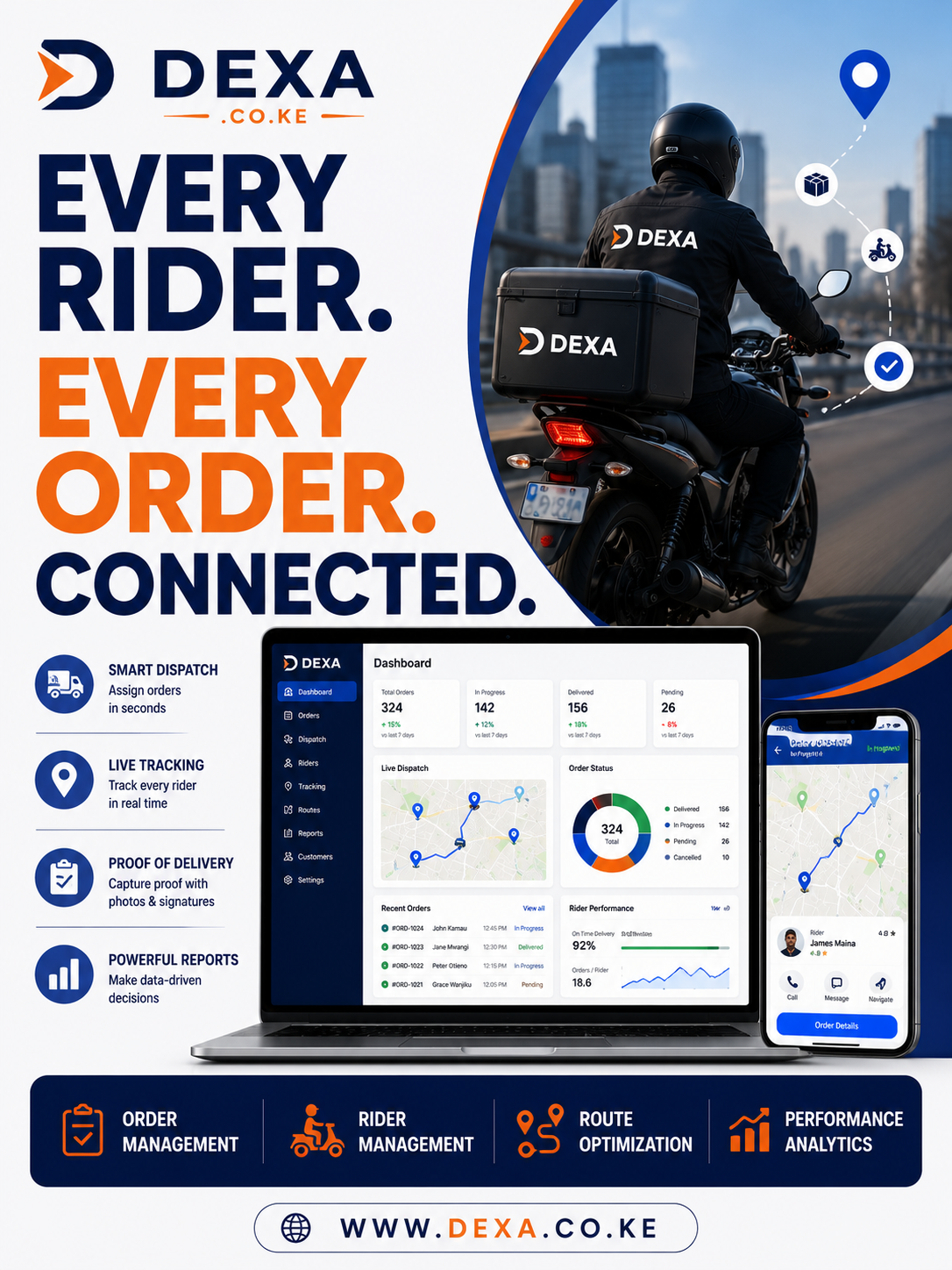
Last mile delivery software in Nairobi is becoming increasingly important for businesses that need to move products, parcels, documents, food, and other goods from warehouses, shops, fulfillment centers, or pickup locations to customers. As Nairobi businesses handle more online orders and same-day deliveries, managing riders and deliveries through phone calls, WhatsApp messages, spreadsheets, and paper records can become difficult to scale.
Modern last-mile delivery platforms bring orders, dispatching, riders, routes, tracking, proof of delivery, customer communication, and reporting into a centralized system. Current delivery platforms operating in Nairobi highlight features such as order management, rider dispatch, live tracking, ETA updates, proof of delivery, and delivery analytics.
For businesses serving customers across Nairobi, the objective is not simply to send a rider from point A to point B. A successful delivery operation needs to coordinate the order, customer, rider, route, timing, payment, delivery confirmation, and any problems that occur along the way.
This is where last-mile delivery software becomes valuable.
Table of Contents
ToggleWhat Is Last Mile Delivery Software?
Last mile delivery software in Nairobi is technology designed to manage the final stage of the delivery process, from the point where an order is ready for dispatch to the moment it reaches the customer.
The software can help businesses manage:
- Delivery orders
- Dispatching
- Rider assignments
- Route planning
- GPS tracking
- Customer addresses
- Delivery status
- Estimated arrival times
- Proof of delivery
- Cash on delivery
- Failed deliveries
- Returns
- Rider performance
- Delivery reports
Instead of having different pieces of information spread across phone calls, spreadsheets, WhatsApp conversations, and paper documents, the business can manage delivery activities through one centralized platform.
This creates a digital workflow that can look like:
Order Received → Dispatch → Rider Assigned → Pickup → In Transit → Customer Notified → Delivered → Proof of Delivery
That workflow is particularly useful for Nairobi businesses handling multiple deliveries every day.
Why Last Mile Delivery Is Challenging in Nairobi
Nairobi is a large and highly active commercial market with businesses serving customers across different neighborhoods and surrounding areas.
A single delivery operation may have orders going to:
- Nairobi CBD
- Westlands
- Kilimani
- Lavington
- Karen
- Lang’ata
- South B
- South C
- Eastlands
- Kasarani
- Roysambu
- Parklands
- Embakasi
- Runda
- Gigiri
- Ruaka
- Kiambu
- Other surrounding areas
A delivery team may therefore have dozens or hundreds of orders moving in different directions during the same day.
Traffic, changing customer availability, incomplete addresses, route changes, and delivery failures can make manual coordination difficult.
Recent Nairobi delivery platforms emphasize route planning, live rider tracking, ETA updates, and centralized dispatch specifically to address these operational challenges.
How Last Mile Delivery Software Works
A typical system starts when an order enters the business.
The order may come from:
- An online store
- A mobile application
- A sales team
- A physical shop
- An ERP
- An e-commerce platform
- An API
- A customer service department
The delivery team then creates or receives a delivery request.
The system can capture information such as:
- Customer name
- Phone number
- Pickup location
- Delivery location
- Order details
- Delivery instructions
- Payment status
- Delivery priority
The dispatcher can then assign the order to an appropriate rider.
Once the rider receives the job, the delivery can be tracked through its different stages.
This gives management visibility from the beginning of the delivery to completion.
Centralized Delivery Management
One of the biggest advantages of last mile delivery software in Nairobi is centralized management.
Instead of dispatchers communicating with every rider individually, they can view active deliveries from one dashboard.
The dashboard can show:
- Pending deliveries
- Assigned deliveries
- Pickups
- Deliveries in transit
- Completed deliveries
- Failed deliveries
- Cancelled orders
- Returned packages
This allows the operations team to quickly identify what requires attention.
Digital Order Management
Manual order management becomes difficult when order volumes increase.
A spreadsheet might work for a small number of deliveries, but larger volumes create problems.
Orders can be:
- Entered incorrectly
- Assigned twice
- Forgotten
- Delayed
- Missing customer information
- Difficult to track
Digital order management creates a central record for every delivery.
Each order can have a unique reference number and a complete history of its delivery activity.
Rider Management
Riders are at the center of many Nairobi last-mile operations.
A delivery platform should therefore provide tools for managing riders.
The system can maintain information such as:
- Rider name
- Phone number
- Assigned vehicle
- Current status
- Active delivery
- Completed deliveries
- Performance
- Earnings
- Availability
This makes it easier for dispatchers to know which riders are available.
Smart Rider Assignment
Assigning deliveries manually can consume considerable time.
A dispatcher may need to consider:
- Rider location
- Rider availability
- Delivery zone
- Current workload
- Vehicle type
- Delivery priority
A modern platform can help automate these decisions.
For example, if a new delivery comes into the system, the dispatcher can identify riders who are closest to the pickup location and currently available.
Some Nairobi delivery platforms describe automated or centralized dispatch based on available riders and live operational information.
Live GPS Tracking
Live GPS tracking provides visibility after a rider has been dispatched.
Instead of calling a rider and asking:
“Where are you?”
the dispatcher can view the rider’s location through the platform.
This can help answer:
- Has the rider collected the package?
- Is the rider moving?
- Is the rider delayed?
- Has the rider reached the customer?
- How far is the rider from the destination?
Real-time tracking and rider location visibility are now common features in modern last-mile delivery platforms serving Nairobi.
Customer Delivery Tracking
Customers increasingly expect visibility after placing an order.
A delivery system can provide customers with tracking information so they know the progress of their order.
For example:
Order Confirmed
↓
Rider Assigned
↓
Order Picked Up
↓
On the Way
↓
Arriving Soon
↓
Delivered
This reduces uncertainty and can reduce the number of customers calling the business to ask about their orders.
Some Nairobi-focused delivery platforms provide live tracking, rider location information, notifications, and ETA updates for customers.
Estimated Time of Arrival
Estimated arrival times can improve customer communication.
Instead of giving customers a broad delivery window, a platform can use available route and location information to provide a more useful estimate.
For example:
Your rider is approximately 15 minutes away.
This is especially useful for businesses selling products that customers need quickly.
Route Optimization
Route planning is another important capability.
A dispatcher managing 30 deliveries might manually arrange them based on location. However, manually creating routes can lead to unnecessary travel.
Route optimization software can consider:
- Delivery locations
- Rider availability
- Delivery windows
- Vehicle capacity
- Priority
- Existing routes
The objective is to create more efficient delivery sequences.
Modern last-mile platforms use automated route optimization to help businesses reduce unnecessary travel and complete more deliveries efficiently.
Why Route Optimization Matters in Nairobi
Traffic and distance can significantly affect delivery performance.
Two customers may appear geographically close but require very different travel times.
A good route-planning system helps businesses make better decisions about delivery sequencing.
For businesses with many daily deliveries, even small improvements in route efficiency can become significant over time.
Reduced unnecessary travel can potentially help businesses control:
- Fuel costs
- Rider working hours
- Vehicle wear
- Delivery delays
Proof of Delivery
A delivery should not simply be marked as complete without evidence.
Proof of delivery provides a digital record showing that the order reached the intended recipient.
Depending on the platform, proof of delivery may include:
- Customer signature
- Photo
- OTP
- PIN
- Delivery timestamp
- GPS location
- Recipient information
Some Kenyan last-mile platforms specifically provide OTP verification, digital signatures, photo evidence, and audit trails.
This can be particularly useful when handling customer disputes.
Digital Signatures
A customer can sign digitally on the rider’s device to confirm receipt.
The signature can be attached to the delivery record.
This eliminates the need for physical paperwork in many delivery workflows.
OTP Delivery Verification
One-time passwords can provide an additional layer of delivery verification.
The customer receives a code and provides it to the rider.
The delivery is completed after the code is successfully verified.
This can help reduce disputes involving incorrect recipients.
Photo Proof of Delivery
For certain deliveries, a photo can provide additional evidence.
For example, a rider may photograph a delivered package at an authorized location where appropriate.
The photo can be attached to the digital delivery record.
Cash on Delivery Management
Cash on delivery remains an important consideration for many businesses operating in Kenya.
A delivery platform can connect the payment status with the delivery record.
The system can track:
- Amount to collect
- Amount collected
- Payment status
- Rider cash balance
- Outstanding cash
- Settlement
This makes reconciliation easier.
Some delivery management platforms in Kenya specifically include COD accounting and cash reconciliation tools.
Managing Failed Deliveries
Not every delivery succeeds on the first attempt.
A customer may:
- Be unavailable
- Provide an incorrect address
- Fail to answer the phone
- Refuse the package
- Request another delivery time
The software should allow the rider to record the reason for failure.
This creates useful operational information.
Management can then identify patterns.
For example, if many deliveries fail because customers are unavailable during working hours, the business could introduce scheduled delivery windows.
Delivery Returns
Failed deliveries can lead to returns.
Without a digital system, returned packages can become difficult to track.
A delivery platform can create a return workflow.
For example:
Failed Delivery → Return Requested → Package Collected → Returned to Warehouse → Return Completed
This keeps the package connected to its original order.
Delivery Notifications
Automated notifications can improve customer communication.
Customers may receive notifications when:
- The order is dispatched
- A rider is assigned
- The package is picked up
- The rider is approaching
- Delivery is completed
- Delivery fails
Depending on the platform, notifications can be sent through SMS, WhatsApp, email, or other channels.
Some Kenyan delivery platforms currently advertise SMS and WhatsApp delivery alerts alongside live tracking.
Managing Multiple Riders
As a business grows, it may have several riders operating simultaneously.
A centralized platform allows management to monitor the entire rider team.
For example:
Rider 1 — 5 active deliveries
Rider 2 — Available
Rider 3 — On pickup
Rider 4 — Delayed
Rider 5 — Completed
This provides a much clearer picture than managing riders through separate phone conversations.
Managing Multiple Branches
Businesses with multiple branches can also benefit from centralized delivery software.
For example, a company may have:
- Nairobi CBD branch
- Westlands branch
- Industrial Area warehouse
- Karen outlet
Each branch can manage its own deliveries while management maintains overall visibility.
Role-based access can help ensure employees see only the information relevant to their responsibilities.
Delivery Analytics
Data generated by the software can be converted into operational reports.
Businesses can analyze:
- Number of deliveries
- Successful deliveries
- Failed deliveries
- Average delivery time
- Rider performance
- Delivery costs
- Route efficiency
- Customer locations
- COD collections
This helps management identify areas for improvement.
Why Businesses Are Moving Away From Manual Delivery Management
Traditional delivery operations often depend on:
- Phone calls
- WhatsApp groups
- Spreadsheets
- Paper delivery notes
- Manual route planning
These tools may work when delivery volumes are small.
However, as orders increase, problems become more common.
A dispatcher may miss a message.
A rider may receive the wrong address.
A customer may call multiple times for an update.
Management may struggle to determine why deliveries are delayed.
A centralized software system provides a structured alternative.
Last Mile Delivery Software for E-Commerce
E-commerce businesses are among the strongest users of last-mile delivery technology.
An online customer expects a smooth process from purchase to delivery.
The workflow can be:
Online Order → Payment → Order Processing → Dispatch → Rider → Tracking → Delivery → Confirmation
Integrating delivery software with the online store can reduce manual data entry.
Integrating With E-Commerce Platforms
A delivery platform can potentially connect with:
- Shopify
- WooCommerce
- Custom websites
- Mobile applications
- Marketplaces
Orders can automatically enter the delivery system.
This means staff do not have to manually copy every order into a spreadsheet.
API Integration
Businesses with custom systems can use APIs to connect their applications with delivery software.
For example, an e-commerce system can automatically send:
- Customer information
- Order number
- Pickup location
- Delivery location
- Package information
to the delivery platform.
The delivery platform can then send status information back.
This creates a two-way workflow.
Delivery Software for Retail Businesses
Retailers can use last mile delivery software in Nairobi to coordinate deliveries from physical stores.
A customer may purchase an item and request delivery.
The retailer can create a delivery request and assign a rider.
The system can then track the delivery until completion.
This can be useful for:
- Electronics stores
- Furniture businesses
- Fashion retailers
- Supermarkets
- Pharmacies
- Hardware stores
- Beauty businesses
Delivery Software for Pharmacies
Pharmacies often handle urgent customer orders.
Delivery software can help coordinate riders and track the movement of orders.
However, businesses handling medicines should also ensure that delivery workflows comply with applicable regulations and appropriate handling requirements.
Delivery Software for Restaurants
Restaurants can use last-mile systems to coordinate delivery orders.
The platform can help with:
- Order assignment
- Rider dispatch
- Customer tracking
- Delivery status
- Performance reporting
This is particularly useful for restaurants operating their own delivery teams.
Delivery Software for Courier Companies
Courier companies need to manage large numbers of parcels.
A centralized system can provide:
- Shipment creation
- Parcel tracking
- Rider assignment
- Proof of delivery
- Customer notifications
- COD management
- Returns
- Reports
This can replace fragmented manual processes with a unified workflow.
Delivery Software for Distributors
Distributors often deliver products to multiple retailers in one route.
Route optimization can help organize delivery sequences.
The software can also track:
- Vehicle
- Driver
- Customer
- Delivery status
- Time
- Proof of delivery
This creates stronger accountability.
Improving Delivery Productivity
The goal of delivery technology should be to help teams complete more successful deliveries without unnecessary operational complexity.
Productivity can improve when dispatchers have visibility into:
- Available riders
- Current rider locations
- Active orders
- Delivery priorities
- Route progress
Instead of spending most of the day coordinating information, the operations team can focus on exceptions and decisions.
Reducing Customer Service Calls
One of the hidden costs of delivery operations is customer communication.
Customers frequently ask:
“Where is my order?”
“When will it arrive?”
“Has the rider left?”
A tracking system can provide answers automatically.
This allows customer service teams to focus on more complex issues.
Improving Rider Accountability
GPS tracking and digital delivery records can provide objective information about rider performance.
Management can review:
- Completed deliveries
- Delivery times
- Route adherence
- Failed deliveries
- Customer complaints
- Proof of delivery
This creates a more transparent operating environment.
Delivery Performance KPIs
Businesses should monitor key performance indicators after implementing delivery software.
Important KPIs include:
On-Time Delivery Rate
Measures the percentage of deliveries completed within the promised timeframe.
First-Attempt Delivery Rate
Measures how many deliveries succeed on the first attempt.
Average Delivery Time
Shows how long deliveries take from dispatch to completion.
Failed Delivery Rate
Shows the percentage of deliveries that do not succeed.
Cost Per Delivery
Helps businesses understand the financial efficiency of delivery operations.
Rider Productivity
Measures the number of successful deliveries completed by individual riders.
Customer Complaints
Tracks delivery-related customer issues.
Choosing Last Mile Delivery Software in Nairobi
Businesses should not choose a platform simply because it has a map and GPS tracking.
A complete evaluation should consider:
- Order management
- Dispatching
- Rider management
- Route optimization
- GPS tracking
- Customer notifications
- Proof of delivery
- COD management
- Returns
- Analytics
- Mobile applications
- API integrations
- User permissions
The best solution depends on the business model and delivery volume.
What Small Businesses Should Look For
A small business may prioritize simplicity.
Important features could include:
- Easy order creation
- Rider assignment
- Live tracking
- Proof of delivery
- Customer notifications
- Basic reporting
The system should be easy for staff to learn.
What Growing Businesses Should Look For
A growing business may require:
- Automated dispatch
- Route optimization
- Multiple users
- Multiple branches
- API integration
- Advanced analytics
- Rider performance tracking
- COD management
Scalability becomes more important as delivery volumes increase.
What Large Businesses Should Look For
Larger organizations may require:
- Enterprise integrations
- Role-based access
- Advanced analytics
- Automated workflows
- Multiple branches
- Large rider fleets
- API access
- Detailed audit trails
- Custom reporting
The platform should be capable of supporting complex operations.
Security and Data Protection
Delivery software handles sensitive information.
This may include:
- Customer names
- Phone numbers
- Addresses
- Order details
- Payment information
- Rider information
- GPS locations
Businesses should therefore consider security and data-protection practices when selecting a platform.
Access should be restricted to authorized employees.
Strong passwords, appropriate permissions, secure communication, and responsible data retention should form part of the overall implementation strategy.
The Future of Last Mile Delivery Software in Nairobi
The future of last mile delivery software in Nairobi will increasingly involve automation and artificial intelligence.
AI can potentially help businesses with:
- Delivery forecasting
- Route optimization
- Rider assignment
- Demand prediction
- Delivery-time estimation
- Exception detection
Instead of simply recording what happened, software will increasingly help businesses decide what should happen next.
AI-Powered Delivery Operations
AI can analyze historical delivery data to identify patterns.
For example, a system may discover that deliveries to a particular area regularly experience delays during certain hours.
Management can use this information to adjust dispatch schedules.
AI can also help identify delivery exceptions before they become serious problems.
Automated Dispatch
Future systems will increasingly automate rider assignment.
Instead of a dispatcher manually choosing a rider, the software can evaluate:
- Rider location
- Availability
- Current workload
- Delivery priority
- Vehicle capacity
- Route
and recommend the best assignment.
Predictive Delivery Management
Historical data can also help businesses forecast delivery demand.
For example, an e-commerce business may experience higher order volumes during:
- Weekends
- Holidays
- Promotions
- Salary periods
- Special events
Predictive analytics can help businesses prepare enough riders and vehicles.
Why Last Mile Delivery Software Is Becoming Essential
As customers become accustomed to faster and more transparent deliveries, businesses need better operational systems.
Customers increasingly expect:
- Fast delivery
- Accurate ETAs
- Real-time tracking
- Reliable communication
- Easy returns
- Proof of delivery
Meeting these expectations manually becomes difficult as order volumes grow.
That is why businesses are increasingly looking at technology as a core part of their delivery infrastructure.
Conclusion
Last mile delivery software in Nairobi provides businesses with a centralized way to manage the complex process of moving products from a warehouse, store, fulfillment center, or pickup point to the customer’s doorstep.
Instead of relying entirely on phone calls, WhatsApp messages, spreadsheets, and paper records, businesses can create a connected delivery workflow covering orders, riders, dispatching, routes, GPS tracking, customer notifications, proof of delivery, payments, returns, and reporting.
The benefits extend beyond convenience.
A well-designed delivery system can help businesses improve operational visibility, reduce unnecessary travel, increase rider accountability, improve customer communication, and make better decisions using delivery data.
For Nairobi businesses, where delivery routes can change throughout the day and customer expectations continue to increase, having a centralized delivery management system can provide an important operational advantage.
The most effective approach is to select software based on the actual needs of the business.
A small retailer may need simple dispatching and tracking.
A growing e-commerce company may need route optimization, rider management, customer tracking, and automated notifications.
A large courier or distribution company may require advanced integrations, analytics, multiple branches, COD management, and automated workflows.
Ultimately, last mile delivery software in Nairobi should not simply tell a business where its riders are. It should help the business understand its entire delivery operation and make every stage—from order creation to final proof of delivery—more organized, visible, and efficient.
Last mile delivery software in Nairobi
Last mile delivery software in Nairobi
Last mile delivery software in Nairobi
Last mile delivery software in Nairobi
Last mile delivery software in Nairobi
Last mile delivery software in Nairobi
Last mile delivery software in Nairobi
Last mile delivery software in Nairobi
Last mile delivery software in Nairobi
Last mile delivery software in Nairobi
Last mile delivery software in Nairobi
Last mile delivery software in Nairobi
Last mile delivery software in Nairobi
Last mile delivery software in Nairobi
Last mile delivery software in Nairobi
Last mile delivery software in Nairobi
Last mile delivery software in Nairobi
Last mile delivery software in Nairobi
Last mile delivery software in Nairobi
Last mile delivery software in Nairobi
Last mile delivery software in Nairobi
Last mile delivery software in Nairobi
Last mile delivery software in Nairobi
Last mile delivery software in Nairobi
Last mile delivery software in Nairobi
Last mile delivery software in Nairobi
Last mile delivery software in Nairobi
Last mile delivery software in Nairobi
Last mile delivery software in Nairobi
Last mile delivery software in Nairobi
Last mile delivery software in Nairobi
Last mile delivery software in Nairobi
Last mile delivery software in Nairobi
Last mile delivery software in Nairobi
[…] Dexa also publishes information about last-mile delivery software in Nairobi, emphasizing centralized management of orders, dispatch, riders, tracking, proof of delivery and reporting. (Dexa) […]