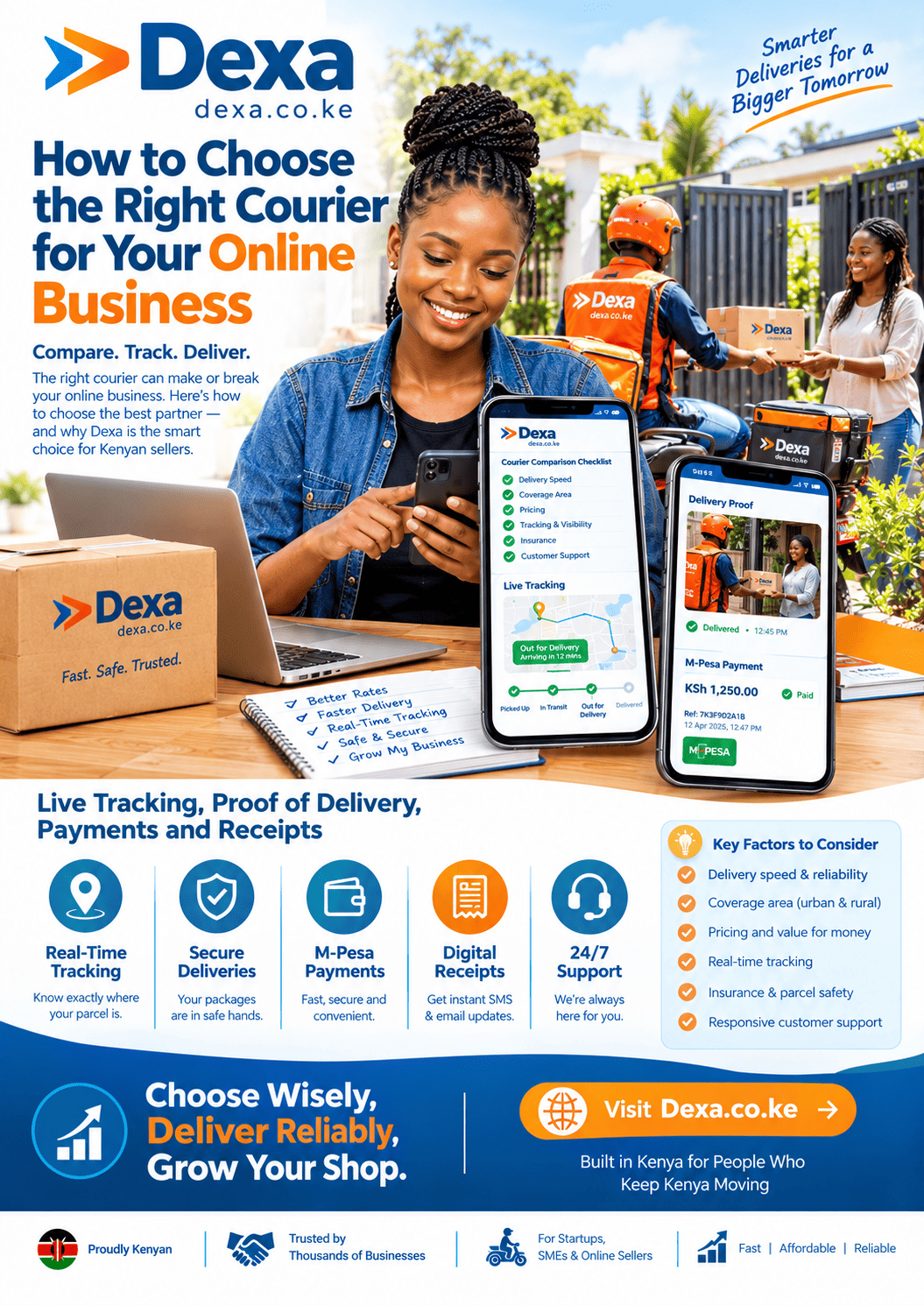
Knowing how to choose the right courier for your online business is one of the highest-stakes decisions an online seller makes, because the courier carries your brand into every customer’s hands. A product can be excellent, the packaging immaculate, the marketing sharp—and a single careless delivery erases all of it. The customer does not remember which rider arrived late. They remember which shop they bought from.
Learning how to choose the right courier for your online business therefore means looking well past price per parcel. The right partner brings reliability, visibility, accountability, and records that hold up when a dispute arises. The wrong one costs far more than the invoice suggests, in refunds, in reputation, and in hours spent chasing parcels that should have arrived yesterday.
What a Courier Actually Does for an Online Business
Many sellers think of a courier as transport. That framing undersells the role and leads to poor decisions. A courier is the last human interaction a customer has with your business, and often the only one. Every question the customer has after checkout—when will it arrive, who is bringing it, what if I miss them—is answered by whatever system the courier operates.
This is why how to choose the right courier for your online business is a question about systems rather than vehicles. A rider on a reliable motorcycle with no tracking and no proof of delivery will cause more problems than a rider on an ageing bike backed by live tracking and photographic confirmation. The vehicle matters, but the record-keeping matters more.
Why the Choice Matters More in Nairobi
Any practical approach to how to choose the right courier for your online business has to account for where you operate. Nairobi ranks among the most congested cities in Africa, and peak-hour journeys regularly stretch past an hour for distances that should take fifteen minutes. A courier that builds schedules on optimistic assumptions will miss them, repeatedly, and your customers will hear the excuses.
Addressing adds a second constraint. Large parts of the city have no formal street numbering, so delivery instructions arrive as landmarks—behind the blue gate, opposite the petrol station, call when you reach. Nationally, a substantial share of parcels are delayed or never delivered at all, and the inability to locate a destination precisely is a leading cause. A courier that treats landmark-based navigation as a normal part of the job will succeed where one that expects clean addresses will fail.
Cash on delivery completes the picture. Many Kenyan online buyers, particularly first-timers, prefer to pay on arrival. This means the courier handles money on your behalf, and any business serious about how to choose the right courier for your online business must ask how collections are recorded and reconciled. If the answer is vague, keep looking.
The Criteria That Actually Predict Performance
Reliability Over Time, Not on One Good Day
Every courier performs well occasionally. The question is whether they perform well consistently, including during rain, during peak season, and during the week your order volume doubles. Ask for references from sellers with similar volumes and similar delivery areas. Ask specifically about their worst week rather than their best.
Reliable performance is the foundation of how to choose the right courier for your online business, because your customers judge you on averages. A courier that succeeds nine times out of ten still produces a complaint every tenth order, and those complaints accumulate publicly.
Visibility Into Every Parcel
You should be able to answer “where is my order?” in seconds without calling anyone. Live tracking is the difference between a business that runs smoothly and one that spends its mornings on the phone. When you are working out how to choose the right courier for your online business, test the tracking before committing. Ask to see a live dashboard. Ask how often the data refreshes. Ask what happens when the network drops.
Proof of Delivery as Standard
Proof of delivery should not be an optional extra or an upsell. It should happen automatically on every single parcel. Digital signatures, photographs, and timestamps captured at handover create a record that protects you when a customer claims an order never arrived. In deciding how to choose the right courier for your online business, treat the absence of photographic proof as a disqualifying weakness rather than a minor gap.
Payment Handling You Can Audit
If your courier collects cash or M-Pesa payments, you need each collection logged against the specific order it belongs to. Anything less invites quiet losses. A shortfall here, an unrecorded delivery there—none of it dramatic, all of it expensive. Sound practice in how to choose the right courier for your online business includes reviewing the reconciliation process before signing anything, not after the first dispute.
Coverage That Matches Your Customers
A courier that serves your neighbourhood excellently but cannot reach half your customer base is not the right fit, however good the price. Map your last fifty orders. If they cluster in three areas, a local specialist may serve you well. If they spread across the city and beyond, you need a partner with genuine reach.
Pricing You Can Understand
Opaque pricing is a warning sign. You should know how rates are calculated, what triggers additional charges, and how fuel or distance adjustments work. Sellers evaluating how to choose the right courier for your online business should insist on written rates and ask what happens at month end when volumes are higher than expected.
Scalability Before You Need It
Your courier should be able to handle three times your current volume without collapsing. This is the most commonly overlooked factor in how to choose the right courier for your online business, because it only becomes visible when a promotion succeeds or a wholesale client arrives. Ask how they onboard additional riders and how quickly.
How Dexa.co.ke Fits Into the Picture
Dexa.co.ke was built for the Kenyan market rather than adapted from a foreign model, and its structure reflects how delivery actually works here. The platform splits into two products, each suited to a different stage of business growth, which gives sellers a genuine choice rather than a single rigid offering.
For sellers working with one or two trusted riders, the independent driver model fits naturally. This arrangement is relevant to how to choose the right courier for your online business because it lets a business build a relationship with a specific rider who learns the pickup routine, the packaging habits, and the regular customers. Familiarity reduces errors.
For sellers who have outgrown informal arrangements and now coordinate several riders, the courier team model provides the structure. Dispatch, rider assignment, pricing, payments, and delivery proofs live in one place. This matters when working through how to choose the right courier for your online business, because the coordination layer is where growing sellers most often come unstuck.
For Independent Drivers
Dexa Driver gives a rider their own customer channel. A driver can create a personal booking link, share it with sellers on WhatsApp, and receive direct bookings rather than competing for work in a crowded marketplace. From the seller’s side, this simplifies how to choose the right courier for your online business considerably: one known contact, one consistent standard, one person accountable for each parcel.
The rider benefits too. Instead of chasing one-off trips, a driver can build a roster of regular business clients, schedule pickups in advance, and track earnings in one place. That stability encourages reliability, and reliability is precisely what a seller needs.
For Courier Teams
Dexa Courier is built for teams managing several riders and a steady flow of orders. The platform keeps one operating record from request to receipt, so no order has to be reconstructed from scattered chats. Each parcel carries its customer details, assigned rider, agreed price, payment status, proof of delivery, and associated expense along with it.
For a seller working with a courier team, this makes how to choose the right courier for your online business a less anxious process. Dispatch is organised, riders know their assignments, and the business receives a clean record for every order. When a customer disputes a delivery, the answer is already in the system rather than in someone’s memory.
Testing a Courier Before Committing
Choosing well means testing rather than assuming. Start with a limited batch of orders—perhaps twenty across a fortnight—and watch carefully.
Track the failure rate first. How many attempts were needed per successful delivery? Then examine communication. Did customers receive updates without prompting? Next, review the proof of delivery for each parcel. Was it captured consistently, or only when convenient? Finally, check the money. Did payment records match your own count at the end of the test period?
A courier that performs well across all four areas during a small trial is far more likely to perform well at scale. A courier that struggles with twenty orders will not improve with two hundred. This trial approach is the practical core of how to choose the right courier for your online business, and it costs very little to run.
Red Flags Worth Taking Seriously
Certain signals should end a conversation immediately. Any courier unwilling to provide written rates is one. Any courier who cannot explain how proof of delivery is captured is another. If the answer to “how do you handle a customer dispute?” involves the phrase “we’ll sort it out,” that is not a process.
Other warnings include riders who cannot be reached when a customer calls, tracking that refreshes once a day rather than continuously, and payment reconciliation that relies on a notebook. Individually these may seem minor. Together they describe a business that will cost you more than it charges.
Switching Couriers Without Disrupting Customers
Many sellers stay with a poor courier far too long because switching feels risky. In practice, a managed transition is straightforward if handled in stages.
Run both arrangements in parallel for a fortnight, routing new orders to the new courier while existing commitments finish with the old one. Brief your customers on the change through a short, confident message rather than an apology. Keep your order records intact so nothing is lost between systems. Handled this way, most customers notice nothing except that deliveries improve.
Where Courier Services Are Heading
Several shifts are reshaping delivery economics in Kenya. Electric motorcycles are becoming more common, and their lower running costs are changing the maths of short-distance work. Charging costs a fraction of fuelling, maintenance is lighter, and riders report moving through traffic more quickly. For sellers watching margins, that difference is material.
Government investment in intelligent traffic management is another factor. A growing number of junctions are being connected to systems that adjust signal timing based on live congestion, which should gradually improve movement across Nairobi. Improvements will arrive over years rather than months, but the direction is clear.
What will not change is the need for visibility, accountability, and accurate records. Whatever vehicles are used and whatever the traffic conditions, sellers will still need to know where their parcels are and be able to prove they arrived. That requirement sits at the centre of how to choose the right courier for your online business, today and in future.
How to choose the right courier for your online business is not about finding the lowest rate or the largest fleet. It is about finding a partner whose systems match the way you work—one that shows you where every parcel is, captures proof on every delivery, records every payment against its order, and can grow when your volume does.
Whether you are dispatching five orders a week or fifty a day, the tools behind how to choose the right courier for your online business from dexa.co.ke give you the visibility and records that make delivery predictable. From the first order to the final confirmation, everything stays in one place.
The sellers who grow are the ones who treat delivery as part of the product rather than an afterthought. Choose carefully, test thoroughly, and let your courier become the reason customers come back.