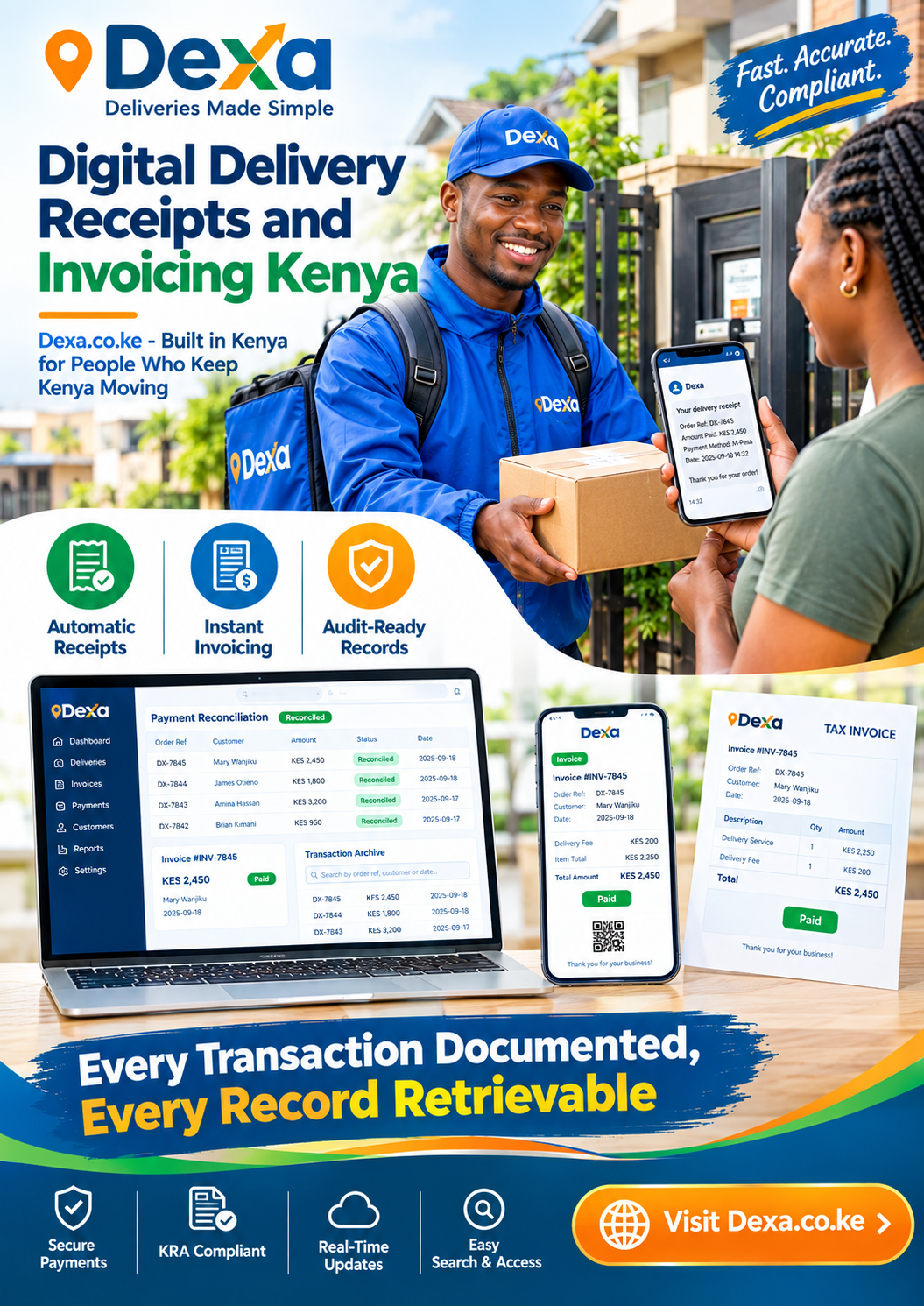
Digital delivery receipts and invoicing Kenya addresses one of the quietest yet most persistent inefficiencies in the country’s delivery sector: the reliance on paper. A rider completes a delivery, hands over a handwritten slip, and that slip begins a journey through pockets, glove compartments, and eventually a shoebox in the back office. Weeks later, when a customer disputes a payment or a business needs to reconcile its accounts, the trail has gone cold. Digital delivery receipts and invoicing Kenya replaces that fragile chain with records that are created automatically, stored centrally, and retrievable in seconds.
The shift matters more than most business owners initially realise. A receipt is not merely a courtesy to the customer. It is evidence of a transaction, a trigger for reconciliation, and a document that Kenya Revenue Authority may request during an audit. When the digital delivery receipts and invoicing Kenya process is handled properly, all three functions are served by the same automatic action at the point of delivery. When it is handled on paper, all three are compromised.
Why Paper Receipts Fail at Scale
At low volumes, paper works. A business handling ten deliveries a week can manage with a carbon-copy book and a weekly reconciliation session. The problems begin as volume rises, and they compound quickly.
The first failure is legibility. Handwritten slips are often illegible, particularly after a long day. Amounts become ambiguous, customer names are misspelled, and order references disappear. The digital delivery receipts and invoicing Kenya approach eliminates this entirely, because the record is generated from data rather than written by hand.
The second failure is loss. Paper slips are easily misplaced, damaged by rain, or simply discarded. Once lost, the transaction cannot be reconstructed with confidence. This is one of the most common reasons small delivery businesses struggle to reconcile their accounts, and it is one of the clearest arguments for digital delivery receipts and invoicing Kenya systems.
The third failure is delay. Paper receipts only enter the accounting system when someone physically collects them and types the details. That gap between delivery and record-keeping is where discrepancies hide. Digital systems close the gap to zero.
What Digital Receipts Actually Contain
A digital delivery receipt is more than a PDF version of a paper slip. It is a structured record containing several elements that together establish what happened.
The core elements are straightforward: customer name, order reference, items delivered, amount paid, payment method, date and time, and the rider who completed the delivery. The digital delivery receipts and invoicing Kenya process captures these automatically from the order record, which means the receipt is accurate by construction rather than dependent on someone remembering to fill it in correctly.
Beyond the basics, a well-designed receipt carries the delivery location, a photograph of the handover, and a signature where required. These additions turn a receipt into proof of delivery as well as proof of payment. The best digital delivery receipts and invoicing Kenya systems treat these as part of the same document rather than separate records, which is what makes them genuinely useful when a dispute arises.
Invoicing for Delivery Businesses
Invoicing sits on the other side of the same coin. Where a receipt confirms payment received, an invoice requests payment for services rendered. For delivery businesses, invoices typically cover two situations: charges to business clients for delivery services provided, and charges to customers for goods dispatched.
The first category is where digital delivery receipts and invoicing Kenya systems provide the greatest operational relief. A courier business serving multiple retail clients must issue regular invoices covering hundreds of individual deliveries. Compiling these manually from paper records is a task that consumes days each month and introduces errors at every step. Automated invoicing draws directly from completed delivery records, so the invoice is accurate and the time required drops to minutes.
The second category, invoicing customers for goods, matters most for online sellers. An invoice issued at the point of order or delivery gives the customer a formal record, supports any warranty claims, and provides the documentation KRA expects. Reliable digital delivery receipts and invoicing Kenya handling means this happens without manual intervention.
Compliance and Record-Keeping Requirements
Kenyan businesses operate under record-keeping obligations that paper systems struggle to satisfy. The Kenya Revenue Authority expects businesses to maintain accurate records of transactions, and the burden of proof falls on the business when questions arise.
This is where digital delivery receipts and invoicing Kenya provides protection that paper cannot match. Digital records are timestamped, searchable, and stored in a form that can be exported for audit purposes. When KRA requests documentation of a specific transaction from eighteen months ago, a business using paper records faces an unpleasant search. A business using digital delivery receipts and invoicing Kenya systems retrieves the record in seconds.
There is a practical dimension to this that goes beyond audit preparation. Businesses that maintain clean digital records find that other compliance obligations become simpler as well, including VAT reporting where applicable. The records already exist in the right form, so producing the required summaries becomes a matter of generating a report rather than compiling data from scratch.
How Dexa.co.ke Handles Receipts and Invoicing
Dexa.co.ke was built for the Kenyan market rather than adapted from a foreign model, and its structure reflects how money and documentation actually move here. The platform splits into two products, each suited to a different stage of business growth, and both treat receipts and invoicing as standard outputs rather than optional add-ons.
For sellers working with one or two trusted riders, the independent driver model fits naturally. Documentation in this arrangement matters because it protects a relationship built on familiarity. For operations that have outgrown informal arrangements and now coordinate several riders, the courier team model provides the reconciliation structure that digital delivery receipts and invoicing Kenya requires at volume.
For Independent Drivers
A rider using this arrangement creates their own customer channel, sharing a personal booking link with businesses on WhatsApp and receiving direct bookings rather than competing for work in a crowded marketplace. From the seller’s side, this simplifies matters considerably: one known contact, one consistent standard, one person accountable for each delivery.
The rider benefits as well. Rather than chasing one-off trips, a driver builds a roster of regular business clients, plans pickups in advance, and tracks earnings in one place. When receipts are issued automatically at the point of delivery, the rider’s own financial picture becomes clearer too, because every completed job produces a record of what was earned.
For Courier Teams
Teams managing several riders and a steady flow of orders need structure that informal arrangements cannot provide. The platform keeps one operating record from request to receipt, so no order has to be reconstructed from scattered chats. Each parcel carries its customer details, assigned rider, agreed price, payment status, proof of delivery, and associated expense along with it.
For a business working with a courier team, this makes digital delivery receipts and invoicing Kenya routine rather than burdensome. Dispatch is organised, riders know their assignments, receipts are generated automatically, and invoices to business clients can be compiled from the same records. When a customer disputes a charge, the documentation is already in the system.
Features That Make Digital Documentation Work
Automatic Receipt Generation
The receipt should appear the moment payment is recorded, without anyone needing to trigger it. The strongest digital delivery receipts and invoicing Kenya platforms generate the document from the order record, which means the details are accurate by design rather than reliant on manual entry.
Multiple Delivery Channels
Customers should receive their receipt through a channel they actually check. SMS remains the most widely used in Kenya, followed by email and WhatsApp. A platform that supports all three gives customers genuine choice while ensuring the record reaches them regardless of preference.
Payment Method Agnostic
Whether a customer pays in cash or through mobile money, the receipt should be issued with the same discipline. The best digital delivery receipts and invoicing Kenya systems record both methods identically, which matters because cash transactions are precisely where documentation tends to slip.
Consolidated Invoicing
For businesses serving multiple clients, the ability to generate a single invoice covering a month of deliveries is transformative. Rather than compiling records manually, the business selects a date range and a client, and the invoice is produced from completed delivery data. This feature of digital delivery receipts and invoicing Kenya systems converts a multi-day task into a few minutes of work.
Export and Archive
Records must remain accessible for years. A platform that stores documentation in a searchable, exportable format protects the business during audits and simplifies any retrospective analysis. This archive function is part of what makes digital delivery receipts and invoicing Kenya genuinely valuable beyond day-to-day operations.
The Reconciliation Advantage
Reconciliation is where digital documentation proves its worth most clearly. In a paper-based operation, reconciliation involves collecting slips, matching them against orders, identifying discrepancies, and investigating gaps. The process is slow, and it almost always finds problems that are too old to resolve cleanly.
When receipts are generated automatically and attached to orders, reconciliation becomes verification rather than investigation. The business checks that recorded payments match expected amounts, and any variance is flagged immediately rather than discovered weeks later. For a growing business, this shift in timing is significant, because problems caught the same day can be resolved with a phone call rather than a formal dispute.
Customer Trust and Professionalism
Customers notice how a business handles documentation. An order that arrives with a properly formatted digital receipt signals professionalism. It suggests that the business takes its records seriously, which in turn suggests that it will take customer concerns seriously.
This matters more in Kenya than many sellers realise, because the market has been shaped by experiences with informal vendors who provide no documentation at all. A business that issues clean digital receipts stands out, and that differentiation influences where customers choose to shop. Reliable digital delivery receipts and invoicing Kenya practices are therefore not merely an internal efficiency; they are a visible signal of quality.
Handling Refunds and Adjustments
Refunds and adjustments are where paper systems fail most visibly. A refund recorded on a slip is easily lost and difficult to trace. When a customer later questions whether the refund was processed, the business has no clean way to demonstrate that it was.
Digital documentation handles this with the same discipline as the original transaction. The refund is recorded against the original order, the customer receives confirmation, and the business has a complete record for its accounts. This symmetry between collection and refund is what makes the documentation system trustworthy from both directions.
Scaling Without Adding Administrative Staff
One of the practical reasons businesses adopt digital delivery receipts and invoicing Kenya systems is that it allows volume to grow without proportional growth in administrative overhead. A business handling fifty deliveries a week and one handling five hundred can both rely on the same automated processes.
This is significant because administrative hiring is expensive and slow. A business that needs to add a finance assistant every time delivery volume doubles will find its margins compressed even as revenue grows. Automation breaks that link, allowing the business to scale its operations without scaling its back office at the same rate.
Common Mistakes in Digital Documentation
Several mistakes appear repeatedly when businesses move from paper to digital. The first is issuing receipts inconsistently, only for some customers or only when asked. The value of digital documentation comes from its completeness, and gaps undermine the whole system.
The second mistake is storing receipts separately from order records. A receipt that cannot be linked to its order is only marginally more useful than a paper slip. The strongest approach keeps everything connected.
The third mistake is neglecting the archive. Documentation is only valuable if it can be retrieved months or years later. Businesses should verify that their chosen platform retains records in an accessible form and allows export when needed.
The Direction Digital Documentation Is Heading
Several shifts are reshaping how receipts and invoicing work in Kenya. Mobile money integration continues to deepen, and the connection between payment records and delivery records is becoming tighter. In the near future, a single automatic action will confirm that payment was received, that the parcel was delivered, and that the appropriate documentation has been issued.
Government integration with mobile money platforms for transaction-level traceability is also developing, which points toward a future where digital records serve compliance needs as well as operational ones. Businesses that have already moved to digital documentation will find that transition considerably easier than those still relying on paper.
What will not change is the underlying requirement: every transaction needs a record that both parties can rely on and that the business can produce on demand. That requirement sits at the centre of what digital delivery receipts and invoicing Kenya should deliver.
Digital delivery receipts and invoicing Kenya is not simply a matter of replacing paper with PDFs. It is about creating a documentation system that is automatic, connected, and retrievable, so that reconciliation takes minutes rather than days and disputes are settled with evidence rather than argument.
Whether you are dispatching five orders a week from a single room or fifty a day from a small warehouse, the tools behind digital delivery receipts and invoicing Kenya from dexa.co.ke give you the records that protect your business and satisfy your obligations. From the first order request to the final invoice, every transaction stays documented.
The businesses that grow are the ones that treat documentation as a foundation rather than an afterthought. Build the habit early, let it carry the weight as volume rises, and record-keeping becomes one of the easiest parts of the operation to manage.