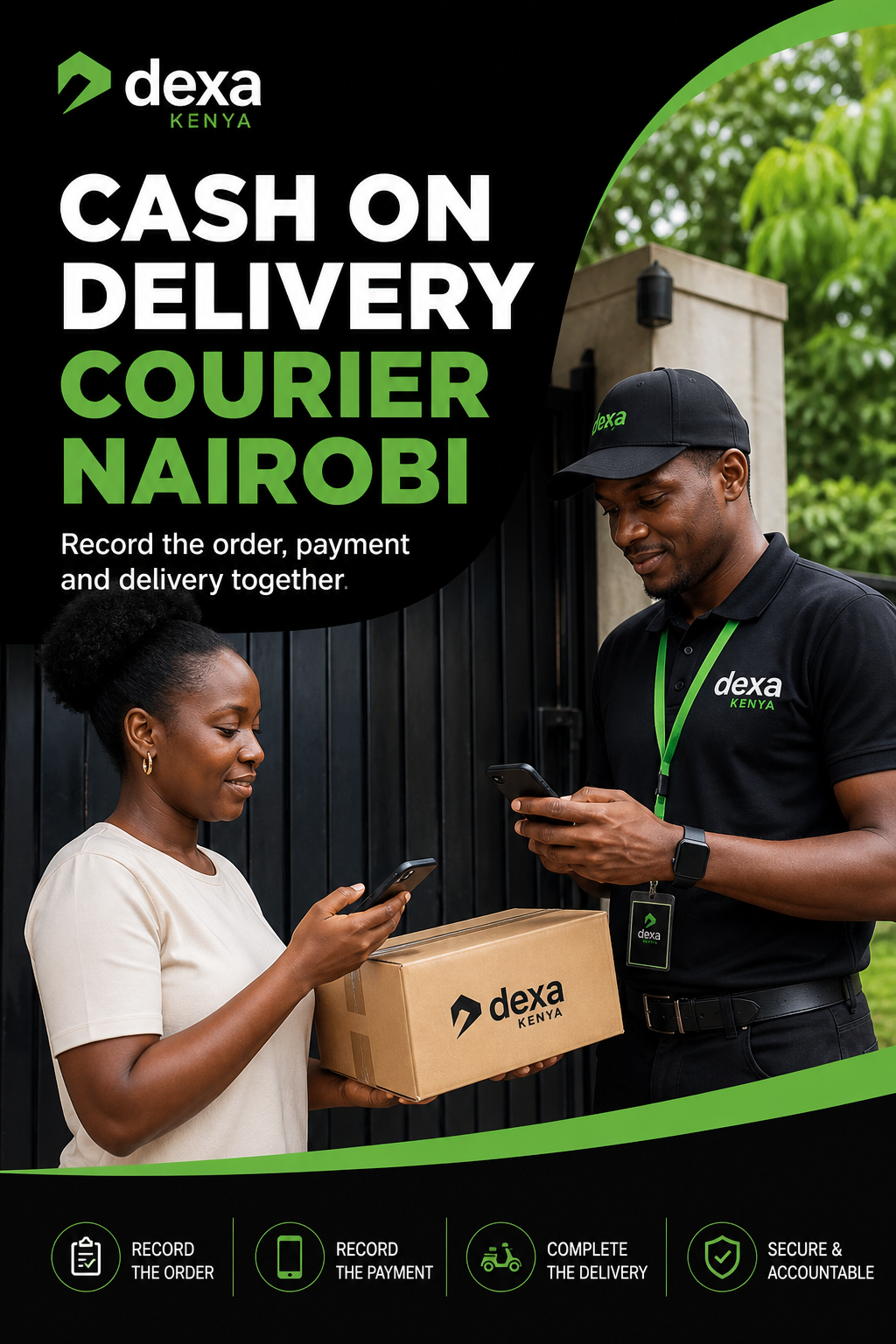
Learning how to manage both M-Pesa and cash deliveries is not a hypothetical exercise for Kenyan courier businesses. It is the daily operational reality. Mobile money is near-universal, yet cash on delivery persists because many customers, particularly first-time buyers, want to see a product before parting with money. A business that supports only one method loses orders. A business that supports both without a system for recording them loses money instead.
Understanding how to manage both M-Pesa and cash deliveries begins with recognising that the two methods create different problems. Mobile money leaves an automatic trace. Cash leaves none. When both flow through the same operation without discipline, the traced payments become easy to verify while the untraced ones quietly accumulate discrepancies. The skill lies in applying the same rigour to both, so that cash is recorded with the discipline that mobile money provides by default.
Why Cash Has Not Disappeared
There is a tendency to assume cash will fade as mobile money spreads. In Kenya, that assumption has proven premature. Several factors keep cash in circulation, and understanding them helps a business design processes that accommodate reality rather than fighting it.
The first factor is trust. A customer buying from an unfamiliar online seller often prefers to see the product before paying. Cash on delivery makes this possible, and the arrangement converts hesitant browsers into completed orders. Any business serious about how to manage both M-Pesa and cash deliveries treats cash as a legitimate payment method rather than a problem to be eliminated.
The second factor is coverage. Network connectivity remains uneven in some areas, and a customer who cannot reliably complete a mobile transaction will pay in cash instead. Refusing cash in these circumstances means refusing the order.
The third factor is habit. Many customers, particularly older buyers, simply prefer physical money for smaller transactions. Their preference is not irrational, and accommodating it expands the customer base rather than narrowing it.
The Problems Each Method Creates
Mobile money and cash generate different operational challenges, and a business needs to address both.
Mobile money problems are mostly technical. A payment prompt may time out. A customer may enter the wrong PIN. An app may close mid-transaction. A network may drop at the critical moment. Each of these creates a situation where the customer believes they have paid and the business has no record of it. Reliable how to manage both M-Pesa and cash deliveries practice includes clear procedures for confirming payment before a rider leaves, and for handling transactions that fail partway through.
Cash problems are mostly structural. Money collected at a doorstep must be carried, safeguarded, remitted, and reconciled. Each of those steps introduces risk. A rider carrying cash across a full day is exposed to loss. A business reconciling from memory is exposed to error. The discipline required for how to manage both M-Pesa and cash deliveries involves recording cash at the point of collection so that it becomes as traceable as a mobile transaction.
The Principle That Solves Both
There is a single principle that resolves most of the difficulty in managing two payment methods: record the transaction against the specific order at the moment it happens, regardless of method.
When a customer pays through mobile money, the transaction clears instantly and the confirmation attaches to the order. When a customer pays in cash, the rider records the collection against the same order before moving on. Both methods produce the same output: an order with a payment record attached, visible in real time.
This uniformity is what makes how to manage both M-Pesa and cash deliveries manageable rather than chaotic. The business does not maintain two separate processes. It maintains one discipline applied consistently. Reconciliation then covers both methods in a single review rather than two disconnected exercises.
How Dexa.co.ke Handles Both Methods
Dexa.co.ke was built for the Kenyan market rather than adapted from a foreign model, and its structure reflects how money actually moves here. The platform splits into two products, each suited to a different stage of growth, and both treat payment collection as a core function rather than a feature added later.
For sellers and operators working with one or two trusted riders, the independent driver model fits naturally. Managing two payment methods in this arrangement matters because a solo operator has no finance team to catch what is missed. For operations that have outgrown informal arrangements and now coordinate several riders, the courier team model provides the reconciliation structure that how to manage both M-Pesa and cash deliveries requires at volume, where no single person can personally verify every collection.
For Independent Drivers
A rider using this arrangement creates their own customer channel, sharing a personal booking link with businesses on WhatsApp and receiving direct bookings rather than competing for work in a crowded marketplace. From the business’s side, this simplifies matters considerably: one known contact, one consistent standard, one person accountable for each collection.
The rider benefits too. Rather than chasing one-off trips, a driver builds a roster of regular business clients, plans pickups in advance, and tracks earnings in one place. When both cash and mobile collections are recorded rather than remembered, the rider’s own financial picture becomes clearer as well, which reduces the friction that often surrounds end-of-day remittance. Clean how to manage both M-Pesa and cash deliveries practice protects the rider as much as the business, because a documented collection cannot be disputed later.
For Courier Teams
Teams managing several riders and a steady flow of orders need structure that informal arrangements cannot provide. The platform keeps one operating record from request to receipt, so no order has to be reconstructed from scattered chats. Each parcel carries its customer details, assigned rider, agreed price, payment status, proof of delivery, and associated expense along with it.
For a business working with a courier team, this makes how to manage both M-Pesa and cash deliveries routine rather than exceptional. Dispatch is organised, riders know their assignments, collections are logged as they occur, and the business receives a clean record for every order. When a customer disputes a payment, the answer is already in the system rather than in someone’s memory.
Setting Expectations Before Dispatch
Much of the difficulty in managing two payment methods can be resolved before the rider leaves. A clear statement of the expected amount, the accepted payment methods, and any delivery charges removes the ambiguity that causes doorstep negotiation.
When a customer books a delivery through a how to manage both M-Pesa and cash deliveries system that records the expected amount, both parties know what is due. The rider does not have to quote a figure, and the customer does not have to guess. This transparency reduces disputes dramatically, particularly for cash orders where the amount has historically been confirmed only at the door.
The same principle applies to the choice of method. A customer who has indicated a preference for mobile money should have the payment prompt ready when the rider arrives. A customer who prefers cash should have the amount prepared. The pre-booking record within how to manage both M-Pesa and cash deliveries practice makes both possible.
Recording Mobile Money Collections
Mobile money offers a natural advantage because the transaction generates its own record. The challenge lies in connecting that record to the correct order.
When a rider triggers a payment prompt at the doorstep, the confirmation should attach automatically to the order it belongs to. Manual recording, where a rider notes the transaction reference for later entry, introduces a step where detail is lost. The strongest how to manage both M-Pesa and cash deliveries systems make the connection automatic, so the payment appears against the order the moment it clears.
Failures require equal attention. A prompt that times out, a customer who enters the wrong PIN, or a network drop mid-transaction all create situations where the customer believes they have paid but no payment exists. Clear procedures for verifying payment before the rider departs, and for retrying failed transactions, are part of managing mobile money properly. Platforms built for how to manage both M-Pesa and cash deliveries typically include retry handling and transaction status visibility, which removes the guesswork.
Recording Cash Collections
Cash requires more deliberate discipline because nothing happens automatically. The rider must record the collection, and the record must attach to the order.
The timing matters. Recording cash at the end of the day invites error, because detail fades and memory becomes unreliable. Recording at the point of collection produces an accurate record. This is the single most important habit in how to manage both M-Pesa and cash deliveries practice, and the one that most directly determines whether reconciliation succeeds.
The receipt matters too. A customer who receives a confirmation of payment has a record, and so does the business. Where cash transactions have historically produced no documentation, issuing a receipt through the same system that handles mobile money creates uniformity. The receipt function within how to manage both M-Pesa and cash deliveries systems turns cash into a documented transaction rather than an informal one.
Reconciliation Across Both Methods
Reconciliation is where managing two payment methods becomes genuinely demanding. Two streams of money must be verified against one set of orders, and any gap must be identified and explained.
Automated reconciliation removes most of this burden. When every collection, whether cash or mobile, is attached to its order at the point of collection, the system can match payments to orders without manual effort. The business reviews a summary rather than reconstructing the day from receipts and memory. This is the practical benefit that makes how to manage both M-Pesa and cash deliveries systems worth adopting early rather than waiting until volume forces the issue.
Variance handling deserves attention. When a discrepancy appears, the business needs to identify which order it relates to and what went wrong. A system that flags specific variances rather than a monthly total makes this possible. A system that reports only aggregate figures leaves the business knowing something is wrong without knowing what.
Managing Remittance and Cash Flow
Cash collected must eventually reach the business, and the speed of that process affects cash flow materially. Money sitting in a rider’s pocket until the end of the week is money unavailable for restocking, advertising, or rider payments.
When collections are recorded as they happen, remittance can be verified in minutes rather than hours. This makes frequent settlement practical. A business that can verify a rider’s collections at the end of each day can settle daily. A business relying on memory can only settle weekly, because verification takes so long. The record-keeping discipline behind how to manage both M-Pesa and cash deliveries therefore has a direct effect on how quickly money moves through the business.
Mobile money settlement is faster by nature, since funds transfer directly. This is one practical argument for encouraging digital payment where customers have no strong preference. Both methods remain available, but the business benefits from a higher proportion of digital transactions.
Reducing Risk Without Refusing Cash
Some businesses attempt to eliminate cash handling by refusing cash orders. This is a mistake in the Kenyan market, because it turns away willing customers. The better approach is to reduce the risks associated with cash while continuing to accept it.
Several measures help. Recording collections at the point of collection reduces the amount of unverified cash in circulation. Frequent remittance reduces the amount carried at any time. Encouraging mobile money where the customer has no preference gradually shifts the mix. And clear documentation means that any loss is identifiable rather than absorbed silently. Each of these measures is part of mature how to manage both M-Pesa and cash deliveries practice.
Handling Refunds Across Two Methods
Refunds complicate the picture because the method used to pay influences how the refund should be processed. A customer who paid by mobile money expects a mobile refund. A customer who paid cash may accept either, though cash refunds are harder to document.
The principle remains the same: record the refund against the original order, regardless of method. A refund issued through mobile money clears automatically and attaches to the record. A refund issued in cash should be recorded with the same discipline as a collection, so the record shows what happened. This symmetry between collection and refund is what makes the payment side of a delivery operation trustworthy from both directions.
Building Customer Confidence
Customers notice how a business handles money. A rider who records payment on a device and issues a receipt appears professional, whether the payment was cash or mobile. A rider who pockets cash and promises to sort it out appears the opposite. The difference influences whether a customer orders again.
There is also a practical dimension for the customer. An automatic receipt gives them a record they can reference later. When a question arises weeks afterwards, both sides have evidence. The absence of this record is what makes cash disputes so difficult to resolve fairly, and it is one of the clearest reasons to adopt consistent practices across both payment methods.
Choosing the Right System
Businesses evaluating options should focus on a few practical questions. Can collections be recorded against specific orders at the point of payment, regardless of method? Are mobile money transactions attached automatically? Are receipts issued for both cash and digital payments? Does reconciliation cover both streams without separate processes? Are records retrievable months later?
A system that answers these well is one that will not create new problems as volume rises. A system that answers only some will leave gaps, and gaps are where money disappears. The difference between the two is rarely visible in a demonstration, which is why testing with real orders across a fortnight is worth the effort before committing.
The Direction Payment Handling Is Heading
Several shifts are reshaping how money moves in Kenyan delivery. Mobile money integration continues to deepen, and the connection between payment confirmation and delivery confirmation is becoming tighter, so a single automatic action will soon verify both. Cash will remain part of the picture for some time, but its share will decline as digital alternatives become more convenient.
Regulatory expectations around transaction records are also tightening, which favours businesses that maintain clean digital documentation across both payment methods. Operations relying on paper slips and memory will find compliance increasingly difficult as requirements become more specific.
What will not change is the underlying requirement: every shilling collected must be attributable to a specific order, visible in real time, and recoverable in a dispute. That requirement sits at the centre of how to manage both M-Pesa and cash deliveries.
How to manage both M-Pesa and cash deliveries is not about choosing between two methods. It is about applying one discipline to both, so that a cash collection is recorded with the same rigour as a mobile transaction. When every payment attaches to its order at the moment it happens, reconciliation becomes verification and disputes stop arising.
Whether you are running a single motorcycle from a single room or coordinating a fleet across the city, the tools behind how to manage both M-Pesa and cash deliveries from dexa.co.ke give you the records that protect your revenue, your riders, and your customers. From the first order request to the final remittance, every shilling stays attached to the delivery it belongs to.
The businesses that grow are the ones that treat money with the same care as parcels. Get the collection right across both methods, and the rest of the operation becomes considerably easier to manage.
- how to manage both M-Pesa and cash deliveries
- how to manage both M-Pesa and cash deliveries
- how to manage both M-Pesa and cash deliveries
- how to manage both M-Pesa and cash deliveries
- how to manage both M-Pesa and cash deliveries
- how to manage both M-Pesa and cash deliveries
- how to manage both M-Pesa and cash deliveries
- how to manage both M-Pesa and cash deliveries