A courier rider payroll app in Kenya addresses one of the most tedious and error-prone tasks in any delivery business: paying riders accurately and on time. In an informal operation, payroll is a monthly scramble. Someone gathers delivery counts from a notebook, cross-references them against WhatsApp messages, applies a commission rate from memory, subtracts advances that were handed out in cash, and hopes the total is close to right. It rarely is. A courier rider payroll app in Kenya replaces that scramble with a process that draws directly from delivery records, so every payment is calculated from what actually happened rather than what someone remembers.
The problem is not that courier businesses are careless. It is that rider pay has a structure that manual systems handle badly. Riders may be paid per trip, per day, per month, or a combination of all three. They may receive advances, fuel allowances, per diems, or bonuses for completing a certain number of deliveries. Some riders are employees subject to statutory deductions. Others are freelancers on a different arrangement entirely. A courier rider payroll app in Kenya handles this complexity because it draws from the order record rather than from a spreadsheet that has to be rebuilt every month.
Why Rider Pay Is Harder Than It Looks
At first glance, paying riders seems straightforward. Count the deliveries, multiply by the rate, and pay the total. In practice, several complications appear as soon as a business grows beyond two or three riders.
The first complication is the variety of pay structures. A rider working on a per-trip basis is easy to calculate until they also receive a fuel allowance on long routes and a bonus for completing more than a set number of deliveries in a week. A salaried rider is easy to calculate until overtime and rest-day work enter the picture. A casual loader paid by the day is easy to calculate until they work a half day and the rate needs adjusting. A courier rider payroll app in Kenya accommodates these variations because the rules are configured once and applied consistently thereafter.
The second complication is the connection between pay and delivery records. When commissions are calculated from a separate count rather than from the completed deliveries themselves, discrepancies appear. A rider claims twenty deliveries; the notebook shows eighteen; the customer records show nineteen. Nobody can establish which figure is correct, and the resulting argument damages trust. A courier rider payroll app in Kenya calculates pay from the same records that dispatch and proof of delivery use, so the count is verifiable rather than disputed.
The third complication is advances and deductions. Riders frequently request advances against future earnings, particularly when fuel prices rise or a personal expense arrives. Those advances must be tracked and recovered, and manual tracking almost always loses some of them. A courier rider payroll app in Kenya records each advance against the rider’s account and deducts it automatically at the next payroll cycle.
The Statutory Dimension
Kenyan employers face specific obligations when paying staff, and these obligations do not disappear because the work involves motorcycles. PAYE, NSSF, SHIF, and the Housing Levy must all be calculated correctly and remitted on time. Overtime must be computed according to the Employment Act. Leave entitlements must be tracked.
For a small courier business, handling these calculations manually is a burden that frequently produces errors. A courier rider payroll app in Kenya applies the statutory rules automatically, so the deductions are correct regardless of how complex the underlying pay structure happens to be. The system also produces the reports required for filing, which turns a task that once consumed days into one that takes minutes.
This matters more than many owners initially appreciate. A payroll error that understates statutory deductions can result in penalties from the Kenya Revenue Authority. A payroll error that overstates them shortchanges the rider. Neither outcome is acceptable, and both are avoidable when the calculations are automated.
What a Proper Payroll App Manages
The phrase covers more ground than most owners assume. A courier rider payroll app in Kenya is not simply a calculator that multiplies trips by a rate. It is the system that connects rider attendance, delivery records, allowances, advances, and statutory deductions into a single monthly process.
Attendance is the first element. A rider who did not work on a particular day should not be paid for it, and a rider who worked a rest day should be compensated accordingly. A courier rider payroll app in Kenya records attendance through the rider’s device, so the payroll calculation has an accurate basis rather than relying on a supervisor’s recollection.
Delivery records are the second element. Every completed trip carries its own record, including distance, time, and any special conditions that affect the rate. When pay is calculated from these records, the rider can see exactly how their earnings were derived, which reduces disputes considerably. A courier rider payroll app in Kenya that produces this transparency builds trust rather than suspicion.
Allowances and advances form the third element. Fuel reimbursements, per diems, and travel allowances all need to be captured and applied. Advances need to be recovered. A courier rider payroll app in Kenya keeps these running balances so that neither the business nor the rider loses track of what is owed.
Statutory deductions complete the picture. Once gross pay is calculated, the app applies PAYE, NSSF, SHIF, and the Housing Levy according to current rates. A courier rider payroll app in Kenya produces a payslip for each rider and the summary reports required for filing, so the employer can meet its obligations without reconstructing the calculations from scratch.
How Dexa.co.ke Handles Rider Payroll
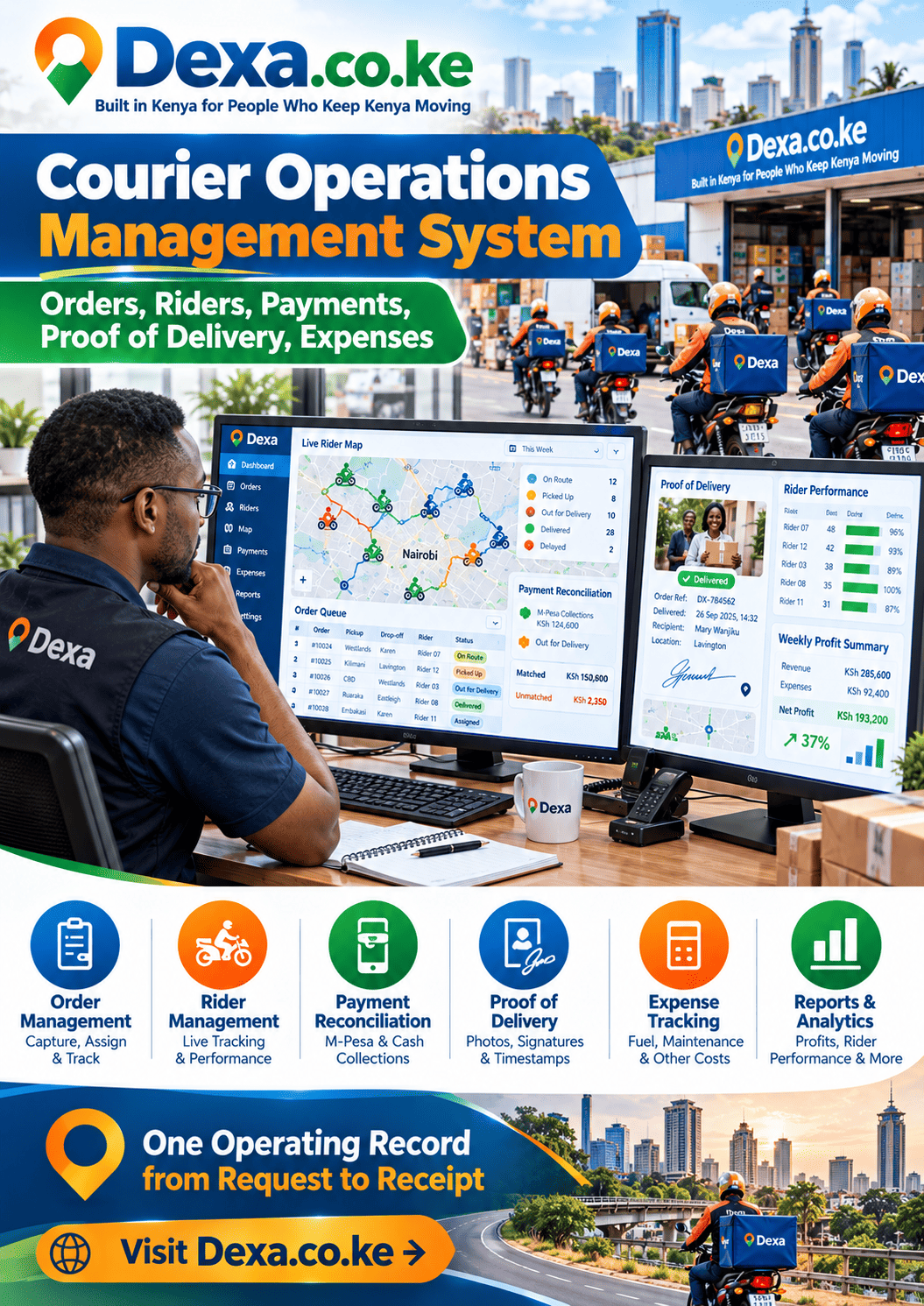
Dexa.co.ke was built for the Kenyan market rather than adapted from a foreign model, and its structure reflects how delivery businesses here actually pay their riders. The platform splits into two products, each suited to a different stage of growth, and both treat payroll as a natural output of the delivery record rather than a separate administrative exercise.
For sellers and operators working with one or two trusted riders, the independent driver model fits naturally. Payroll in this arrangement matters because a solo operator has no finance team to check the numbers. For operations that have outgrown informal arrangements and now coordinate several riders, the courier team model provides the aggregation structure that a courier rider payroll app in Kenya requires at volume.
For Independent Drivers
A rider using this arrangement creates their own customer channel, sharing a personal booking link with businesses on WhatsApp and receiving direct bookings rather than competing for work in a crowded marketplace. From the business’s side, this simplifies matters considerably: one known contact, one consistent standard, one person accountable for each delivery.
The rider benefits too. Rather than chasing one-off trips, a driver builds a roster of regular business clients, plans pickups in advance, and tracks earnings in one place. When every completed trip produces a record, the rider can see exactly what has been earned and what remains outstanding. A courier rider payroll app in Kenya that provides this visibility protects the rider as much as the business, because a documented trip cannot be disputed later.
For Courier Teams
Teams managing several riders and a steady flow of orders need structure that informal arrangements cannot provide. The platform keeps one operating record from request to receipt, so no order has to be reconstructed from scattered chats. Each parcel carries its customer details, assigned rider, agreed price, payment status, proof of delivery, and associated expense along with it.
For a business working with a courier team, this makes a courier rider payroll app in Kenya routine rather than burdensome. Dispatch is organised, riders know their assignments, deliveries are confirmed with proof, and payroll is generated from the same records. When a rider queries their pay, the answer is already in the system rather than in someone’s memory.
Pay Structures the App Must Support
Kenyan courier businesses pay riders in several different ways, and a payroll app that supports only one structure will fail as soon as the business changes its approach.
Per-trip pay is the most common arrangement for delivery riders. The rider receives a fixed amount for each completed delivery, sometimes adjusted for distance or special conditions. A courier rider payroll app in Kenya calculates this automatically from the trip records, so the rider’s earnings reflect exactly what they completed.
Daily or weekly rates suit riders who work fixed shifts regardless of delivery volume. The payroll app records attendance and applies the agreed rate, with adjustments for days not worked or days worked beyond the normal schedule.
Salaried arrangements apply to riders who are formally employed, and these require the full statutory calculation including overtime and leave entitlements. A courier rider payroll app in Kenya applies these rules automatically, so the employer remains compliant without needing to understand every detail of the legislation.
Hybrid structures combine elements of all three. A rider might receive a base salary plus a per-trip bonus, or a daily rate plus fuel reimbursement. The payroll app handles these combinations because the rules are configured once and applied consistently thereafter, regardless of how many variations exist across the fleet.
Why Transparency Changes Rider Relations
Riders who do not understand how their pay was calculated tend to assume the worst. A shortfall of a few hundred shillings that has a legitimate explanation still damages trust if nobody explains it. Over months, that accumulated suspicion leads to turnover, and replacing experienced riders costs money in recruitment and training.
A courier rider payroll app in Kenya that produces clear payslips changes this dynamic. The rider can see each trip, each allowance, each deduction, and the resulting total. If there is a question, the record answers it rather than requiring an argument. In practice, most businesses find that transparent payroll improves rider retention rather than increasing disputes, because ambiguity is removed from both directions.
The same transparency protects the business. A rider who claims they were underpaid can be shown the calculation. A rider who claims a trip was not recorded can be shown the record or the absence of one. The conversation shifts from accusation to verification, which is a considerably more productive place to start.
Payroll and Cash Flow
Rider payroll is often the largest single expense in a courier business, which means payroll timing has a direct effect on cash flow. A business that pays riders weekly needs to know exactly what those payments will be before the week begins. A business that pays monthly needs to budget for the total across the period.
A courier rider payroll app in Kenya provides this foresight because the running total is visible throughout the period. The owner can see what has accumulated by the middle of the month and plan accordingly, rather than discovering the figure on payday. For businesses operating on thin margins, that visibility is the difference between a smooth payroll and a difficult one.
The app also supports partial payments and advances, which many Kenyan courier businesses use to help riders manage their own cash flow. When advances are recorded against the rider’s account, they are recovered automatically at the next payroll cycle. Nothing is forgotten, and nothing is deducted twice.
Compliance and Record-Keeping
Kenyan labour law and tax regulations require employers to maintain accurate records of wages, deductions, and remittances. These records must be available for inspection and must be retained for several years. A manual system struggles to meet this requirement, particularly when the business has grown and records are scattered across notebooks and spreadsheets.
A courier rider payroll app in Kenya stores every payslip, every deduction, and every remittance in a searchable archive. When a question arises from a rider, a regulator, or an auditor, the record is retrievable in seconds. The system also produces the summary reports required for statutory filing, which reduces the time spent on compliance each month.
There is a practical benefit beyond compliance. Clean payroll records support conversations with lenders and investors, who want to see that the business understands its own costs. A business that can produce accurate payroll data is considerably more credible than one reconstructing figures from memory.
Common Mistakes in Rider Payroll
Several mistakes appear repeatedly when businesses handle rider pay without a proper system.
The first is calculating commissions from a separate count rather than from the delivery records. This creates discrepancies that are difficult to resolve and damaging to trust.
The second is losing track of advances. When advances are recorded in a notebook or remembered verbally, some are never recovered, and the business absorbs the loss silently.
The third is applying statutory deductions inconsistently. A business that calculates PAYE or NSSF manually will eventually make an error, and the resulting penalties are considerably more expensive than the cost of automating the calculation.
The fourth is failing to produce clear payslips. A rider who receives a lump sum with no breakdown has no way to verify it, and the absence of explanation breeds suspicion even when the payment is correct.
The Direction Payroll Is Heading
Several shifts are reshaping how courier businesses pay their riders in Kenya. Mobile money integration continues to deepen, and the connection between payroll records and payment disbursement is becoming tighter, so a single action will soon calculate the pay, disburse it to the rider’s wallet, and record the transaction.
Electric motorcycles are becoming more common, and their cost profile differs substantially from petrol machines. Businesses that track fuel allowances carefully will find that the switch changes their payroll structure in ways visible in the data well before they are visible in the bank balance.
Regulatory expectations around worker records are also tightening, which favours businesses that already maintain clean digital documentation. Operations relying on paper slips and memory will find compliance increasingly difficult as requirements become more specific.
What will not change is the underlying requirement: every rider must be paid accurately, on time, and in a way that can be explained and verified. That requirement sits at the centre of what a courier rider payroll app in Kenya should deliver.
Choosing the Right Payroll App
Businesses evaluating options should focus on a few practical questions. Does the app calculate pay from delivery records, or does it require manual entry? Can it handle per-trip, daily, and salaried structures within the same fleet? Does it record advances and recover them automatically? Are statutory deductions applied according to current Kenyan rates? Does it produce payslips that riders can understand?
An app that answers these well will not create new problems as the fleet grows. An app that answers only some will leave gaps, and gaps in payroll are where trust erodes. The difference between the two is rarely visible in a demonstration, which is why testing with real riders across a full pay cycle is worth the effort before committing.
It also helps to consider how payroll connects to the rest of the operation. A payroll tool that stands alone provides partial value. A platform that links payroll to dispatch, tracking, delivery records, and payment collection provides considerably more, because every rider’s pay becomes a view of work that actually happened rather than a reconstruction.
A courier rider payroll app in Kenya is not simply a calculator. It is the system that connects attendance, deliveries, allowances, advances, and statutory deductions into a single monthly process that is accurate, transparent, and defensible. When riders are paid correctly and can see how their pay was calculated, the relationship changes for the better.
Whether you are managing two riders from a single room or coordinating a fleet across the city, a courier rider payroll app in Kenya from dexa.co.ke connects every payment to the work that earned it. From the first delivery of the month to the final payslip, nothing has to be reconstructed from memory.
The businesses that grow are the ones that treat payroll as a foundation rather than a monthly ordeal. Build the habit early, let it carry the weight as the fleet grows, and paying riders stops being the part of the month everyone dreads.