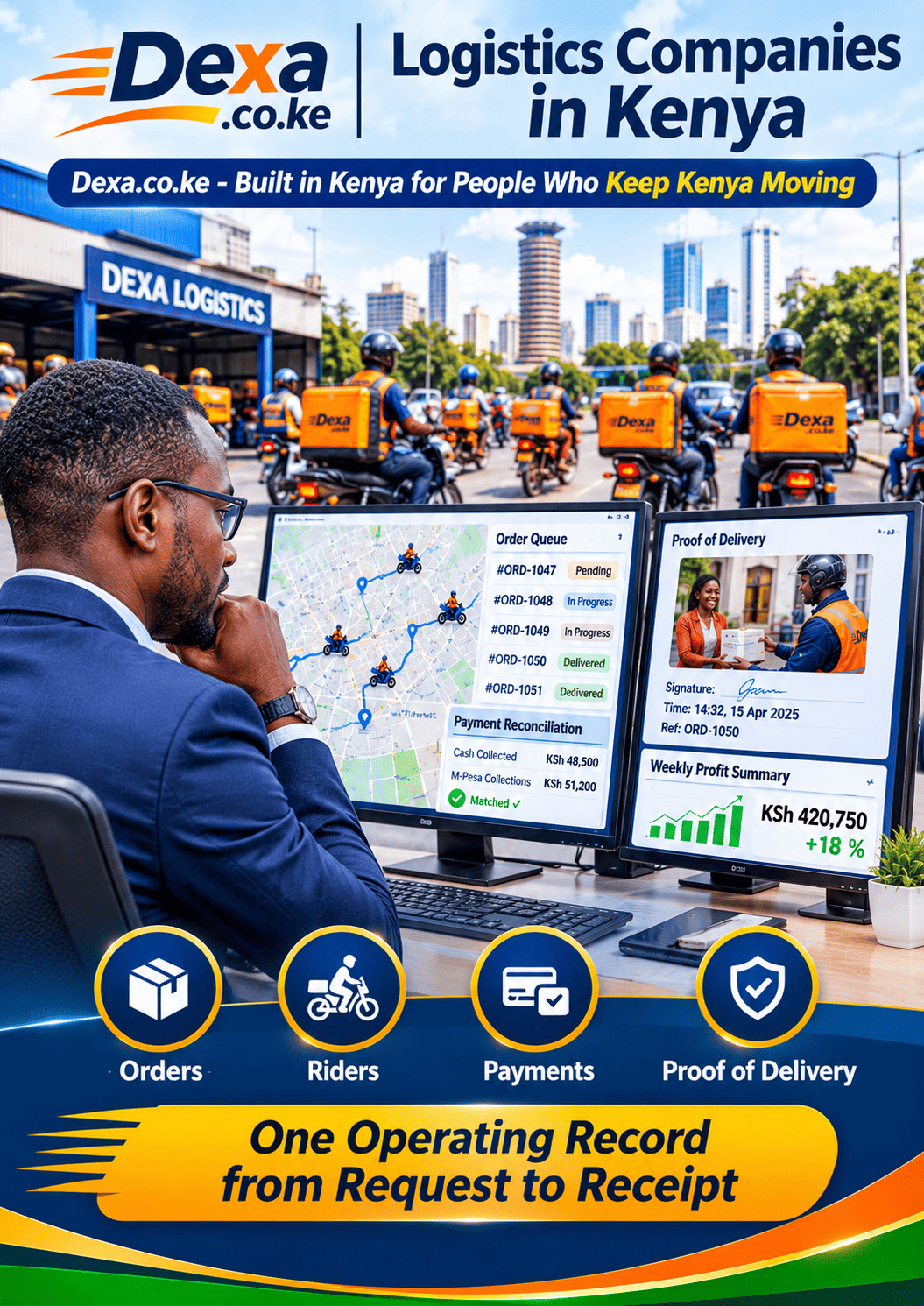
Logistics companies in Kenya have become the operational backbone of an economy that increasingly runs on delivery. E-commerce platforms, retailers, manufacturers, pharmacies, restaurants, and individual senders all depend on a logistics partner to move goods from one point to another, and the quality of that movement determines whether a business keeps its customers. Logistics companies in Kenya are therefore not simply transport providers. They are the layer that connects supply to demand, and the ones that operate well become essential to the businesses they serve.
The sector has matured rapidly over the past decade. Rising smartphone penetration, near-universal mobile money, and a customer base accustomed to buying without seeing the product have created demand for delivery that is faster, more transparent, and more accountable than what existed before. A logistics companies in Kenya sector that once ran on phone calls and notebooks now has access to tools that make every parcel visible, every payment recorded, and every delivery confirmed with evidence.
What Separates a Capable Logistics Company From the Rest
The difference between a logistics company that businesses trust and one they tolerate is rarely visible from the outside. Both have motorcycles, both have riders, and both quote rates. The distinction shows up in the details of what happens between pickup and handover.
A capable logistics companies in Kenya operation keeps the order, the rider, the payment, and the proof attached to the same record. The customer knows where their parcel is. The business knows whether it arrived. Nothing has to be reconstructed from memory when a question arises weeks later. A weaker operation handles the same delivery but leaves the record scattered across chat threads, notebooks, and recollection, and the gaps become visible only when something goes wrong.
This matters because logistics failures are rarely dramatic. They accumulate. A parcel that arrives a day late, a payment that cannot be reconciled, a delivery that is disputed because nobody has proof. Each instance is small, but together they erode the trust that a business has built with its customers. The stronger logistics companies in Kenya close those gaps by design rather than by hoping their riders remember.
The Conditions Logistics Must Handle
Any realistic discussion of logistics companies in Kenya has to account for the environment. Nairobi ranks among the most congested cities in Africa, and a peak-hour journey can stretch past an hour for a distance that should take fifteen minutes. Schedules built on optimistic assumptions collapse, repeatedly, and the customer hears every excuse.
Addressing adds a second constraint. Large parts of Kenyan cities have no formal street numbering, so delivery instructions arrive as landmarks—behind the blue gate, opposite the petrol station, call when you reach. Nationally, a substantial share of parcels are delayed or never delivered at all, and the inability to locate a destination precisely is a leading cause. Practical logistics companies in Kenya treat landmark-based navigation as normal rather than as an exception to be tolerated.
Payment habits complete the picture. Cash on delivery remains common, particularly among first-time buyers who want to see a product before paying. Mobile money is near-universal. A logistics companies in Kenya operation that treats cash as an inconvenience will create reconciliation problems that land on the client’s desk weeks later, and the client will eventually find a partner who handles both methods with equal discipline.
The Different Types of Logistics Provider
The phrase covers several distinct categories, and understanding the difference helps a business choose the right partner.
Courier companies handle parcels and documents, typically on motorcycles, and operate within a city or between cities. They are the most common type of logistics companies in Kenya that a small business will encounter, and they are the ones most relevant to e-commerce sellers.
Freight forwarders handle larger shipments, often involving customs clearance and international transport. They serve importers and exporters and operate on timelines measured in weeks rather than hours.
Warehousing and distribution companies store goods and manage inventory on behalf of clients. They are relevant to businesses that need to hold stock in a location other than their own premises.
Third-party logistics providers combine several of these functions, offering a single contract that covers storage, transport, and last-mile delivery. They suit larger businesses with complex requirements, though the logistics companies in Kenya serving small businesses increasingly offer similar bundled services at accessible prices.
What a Business Should Look For
Businesses evaluating logistics companies in Kenya should focus on a few practical questions rather than the size of the fleet or the slickness of the sales pitch.
The first is visibility. Can the provider show where a parcel is at any moment? Does the tracking update continuously, or only when someone remembers to check? A logistics companies in Kenya operation that provides live tracking removes an entire category of daily friction, because the client can answer customer questions without making a call.
The second is proof. Does every delivery produce a record, including a photograph, a signature, and a timestamp? Does that record attach to the order rather than sitting in a separate folder? A logistics companies in Kenya provider that captures proof as a standard step protects the client in disputes and gives the customer confidence that the transaction was handled properly.
The third is payment handling. Can the provider record both cash and mobile money collections against the orders they belong to? Does reconciliation happen automatically, or does the client have to reconstruct it from slips and messages? A logistics companies in Kenya partner that handles this well saves the client hours each week and prevents the quiet losses that accumulate when cash is recorded from memory.
The fourth is scalability. Can the provider handle three times the current volume without collapsing? This is the most commonly overlooked factor when selecting logistics companies in Kenya, because it only becomes visible when a promotion succeeds or a wholesale client arrives. A partner that cannot scale will cap the client’s growth precisely when momentum is strongest.
The fifth is pricing transparency. Does the provider explain how rates are calculated? Are additional charges clearly defined? A logistics companies in Kenya partner that provides written rates and clear terms is easier to work with than one that leaves the client guessing until the invoice arrives.
How Dexa.co.ke Approaches Logistics
Dexa.co.ke was built for the Kenyan market rather than adapted from a foreign model, and its structure reflects how logistics actually works here. The platform splits into two products, each suited to a different stage of growth, which gives a business a genuine choice rather than a single rigid offering.
For sellers working with one or two trusted riders, the independent driver model fits naturally. This arrangement matters when evaluating logistics companies in Kenya because it lets a business build a relationship with a specific rider who learns the pickup routine, the packaging habits, and the regular customers. Familiarity reduces errors, and errors are what erode customer trust.
For businesses that have outgrown informal arrangements and now coordinate several riders, the courier team model provides the structure. Dispatch, rider assignment, pricing, payments, and delivery proofs live in one place. This matters when working with logistics companies in Kenya at volume, because the coordination layer is where growing businesses most often come unstuck.
For Independent Drivers
A rider using this arrangement creates their own customer channel, sharing a personal booking link with businesses on WhatsApp and receiving direct bookings rather than competing for work in a crowded marketplace. From the business’s side, this simplifies matters considerably: one known contact, one consistent standard, one person accountable for each parcel.
The rider benefits too. Rather than chasing one-off trips, a driver builds a roster of regular business clients, plans pickups in advance, and tracks earnings in one place. When a rider works consistently with the same businesses, they become an extension of the operation rather than an anonymous courier. This is what the better logistics companies in Kenya feel like from the client’s perspective: not a service that is booked, but a partner that is relied upon.
For Courier Teams
Teams managing several riders and a steady flow of orders need structure that informal arrangements cannot provide. The platform keeps one operating record from request to receipt, so no order has to be reconstructed from scattered chats. Each parcel carries its customer details, assigned rider, agreed price, payment status, proof of delivery, and associated expense along with it.
For a business working with a courier team, this makes logistics companies in Kenya predictable rather than anxious. Dispatch is organised, riders know their assignments, and the business receives a clean record for every order. When a customer disputes a delivery, the answer is already in the system rather than in someone’s memory.
Order Capture Across Every Channel
The first function any logistics operation must handle is capturing orders consistently. Businesses in Kenya receive requests through several channels: WhatsApp messages, phone calls, Instagram DMs, marketplace listings, and their own websites. Each channel produces information in a different format, and details get lost in the translation.
A proper system standardises this by capturing every request into the same structured record, regardless of where it originated. The address, the landmark, the customer’s phone number, and any special instructions all end up in the same fields. This removes the ambiguity that otherwise consumes a dispatcher’s morning and reduces the back-and-forth that slows every dispatch. The order capture discipline behind capable logistics companies in Kenya is what makes everything downstream faster.
Customer records add another layer. When a customer orders repeatedly, the system already holds their details, so the rider does not have to ask for the landmark again. The business can see how many orders that customer has placed and whether they pay reliably. Over time, well-run logistics companies in Kenya build a customer history that supports better decisions about pricing, credit, and service levels.
Dispatch and Rider Assignment
Dispatch is where informal operations struggle most visibly. An order arrives, and someone has to decide who should carry it. In a business with one or two riders, that decision is made by whoever is holding the phone. In a business that has grown to five or six riders, it becomes a bottleneck that delays every delivery.
Reliable logistics companies in Kenya turn dispatch into a queue that assigns itself. A new order appears. A rider is selected based on location, availability, and current workload. The customer receives confirmation. The rider receives the job. None of this requires a phone call, and none of it depends on anyone remembering to pass the message along.
The assignment logic matters because it affects the whole day. A dispatcher who can see every rider’s position assigns the nearest available person to a new pickup, which reduces travel time and increases the number of deliveries completed per shift. In a city where a rider in Westlands should not be assigned a pickup in Karen, that geographic awareness matters considerably.
Live Tracking and Customer Communication
Once a rider leaves with a parcel, the business needs to know where they are and how the delivery is progressing. Without that visibility, every customer enquiry triggers a phone call, and every phone call interrupts a rider who should be focused on the road.
Live location visibility allows the business to see every rider on a map and answer customer questions without making a call. The same information can be shared with the customer directly, which reduces inbound enquiries dramatically. A customer who can see their rider approaching does not need to ask where the parcel is.
Automated notifications sent at dispatch, when the rider is nearby, and on arrival keep the customer informed without anyone having to remember to send a message. In a market where addresses are often landmarks and riders frequently need to call for directions, a prepared customer is a customer who answers the phone and gives clear guidance. The notification features within the better logistics companies in Kenya make that preparation automatic rather than dependent on the dispatcher’s memory.
Payments and Reconciliation
Payment is the most sensitive part of any delivery, and it is where businesses leak money most quietly. Mobile money leaves its own trace, but cash does not. When collections are recorded in a rider’s memory and reconciled at the end of the week, small discrepancies accumulate without anyone noticing until the total is significantly short.
Proper logistics companies in Kenya apply the same discipline to both payment methods. When a customer pays through mobile money, the transaction attaches to the order automatically. When a rider collects cash, the collection is logged against the same order before the rider moves on. The business sees both in the same place, and reconciliation covers the full picture rather than one convenient part of it.
Receipts are generated as a natural output. The customer receives confirmation, and the business keeps a copy. Nothing depends on a rider remembering to write something down or a customer keeping a paper slip. The documentation discipline built into logistics companies in Kenya that operate well is what allows a small operation to behave like a larger one without hiring administrative staff.
Proof of Delivery and Dispute Resolution
Proof of delivery has moved from an occasional courtesy to a standard output of every completed job. A rider captures a photograph of the parcel at the delivery location. The customer signs on the rider’s device. The system records the timestamp and GPS coordinates automatically. Together these elements produce a record that settles most disputes before they develop.
In a market where formal addresses are rare, the photograph often carries more weight than the signature. A picture of the parcel at the blue gate beside the petrol station establishes location in a way that written confirmation cannot. Comprehensive logistics companies in Kenya treat photographic capture as a routine step rather than an optional extra, because the moments when proof matters most are precisely the ones that go unrecorded when it is left to discretion.
Businesses that work with a logistics partner providing this discipline consistently report a sharp reduction in disputed deliveries. Claims that an order never arrived are answered with evidence rather than argument, and the business avoids refunds it would once have absorbed to preserve goodwill. Over a year, the sums involved are considerable for any operation handling meaningful volume.
Expense Tracking and Profit Visibility
Revenue is visible. Costs are not. This asymmetry is what allows a business to grow steadily while quietly losing money on every delivery. Fuel, rider commissions, maintenance, airtime, and failed delivery attempts all consume margin, and none of them appear as a line item unless someone records them.
Complete logistics companies in Kenya connect expenses to the orders that generated them, so the client can see cost at the level of the individual delivery. That granularity changes what decisions are possible. A business that discovers its long-distance deliveries cost more than they generate can adjust pricing or decline that work. A business that discovers one customer’s orders consistently run at a loss can renegotiate or walk away. None of those decisions are possible from a monthly total.
Failed deliveries deserve particular attention because they never appear as a transaction. The trip simply happens twice, and no invoice reflects the duplication. Each failed attempt roughly doubles the cost of that delivery. Logistics companies in Kenya that record these explicitly are often the difference between a route that appears profitable and one that is quietly draining the client’s business.
Common Mistakes When Choosing a Logistics Partner
Several mistakes appear repeatedly when businesses select a logistics partner without examining the details.
The first is choosing on price alone. A cheaper rate that produces more failed deliveries is not cheaper. Each failed attempt roughly doubles the cost of that delivery, because fuel is consumed twice and the rider is paid twice while revenue remains unchanged. A moderately priced provider that completes most deliveries on the first attempt is worth more than a bargain that does not.
The second is assuming all providers handle cash and mobile money the same way. They do not. Some record every collection against its order. Others rely on end-of-day reconciliation and hope for the best. The difference becomes visible in the accounts, usually months later.
The third is neglecting to test. A provider that performs well across twenty trial orders is far more likely to perform well at two hundred. A provider that struggles with twenty will not improve with volume. Running a small trial before committing is the most reliable way to assess any of the logistics companies in Kenya.
The fourth is failing to clarify who owns the customer relationship. A provider that keeps the customer locked inside its own system has effectively taken over part of the business. A provider that supports the client’s own customer relationships preserves what the business has built.
The Direction Logistics Is Heading
Several shifts are reshaping how logistics companies in Kenya operate. Mobile money integration continues to deepen, and the connection between payment confirmation and delivery confirmation is becoming tighter, so a single automatic action will soon verify both. Electric motorcycles are becoming more common, and their lower running costs and quicker movement through traffic change the economics of short-distance delivery.
Government investment in intelligent traffic management is gradually improving movement across Nairobi, which will make arrival estimates derived from tracking data more reliable over time. Regulatory expectations around record-keeping are tightening, favouring providers that already maintain clean digital documentation.
What will not change is the underlying requirement: a logistics partner needs to know where every parcel is, who is carrying it, whether it arrived, and whether payment was collected. That requirement sits at the centre of what logistics companies in Kenya should deliver, today and in the years ahead.
Logistics companies in Kenya are not simply a way to move parcels from one point to another. They are the operational layer that determines whether a business’s customers trust it enough to order again. The right partner gives visibility, accountability, and records that hold up when questions arise. The wrong one costs more than the invoice suggests.
Whether you are dispatching five orders a week from a single room or fifty a day from a small warehouse, logistics companies in Kenya that operate on dexa.co.ke keep the customer, the rider, the payment, and the proof attached to the same order. From the first booking to the final confirmation, nothing has to be reconstructed from memory.
The businesses that grow are the ones that treat delivery as part of the product rather than an afterthought. Choose carefully, test thoroughly, and let your logistics partner become the reason customers come back.