Courier SaaS for Modern Operators Is Transforming Logistics
The courier industry has changed dramatically over the last few years. Customers now expect real-time tracking, instant delivery notifications, digital proof of delivery, online payments, and faster response times. Courier companies that still rely on spreadsheets, paper manifests, WhatsApp messages, and manual dispatch processes often struggle to meet these expectations.
This is where Courier SaaS for modern operators becomes valuable. Instead of managing deliveries through disconnected tools, businesses can centralize dispatching, driver management, route optimization, customer communication, invoicing, and reporting inside a single cloud platform.
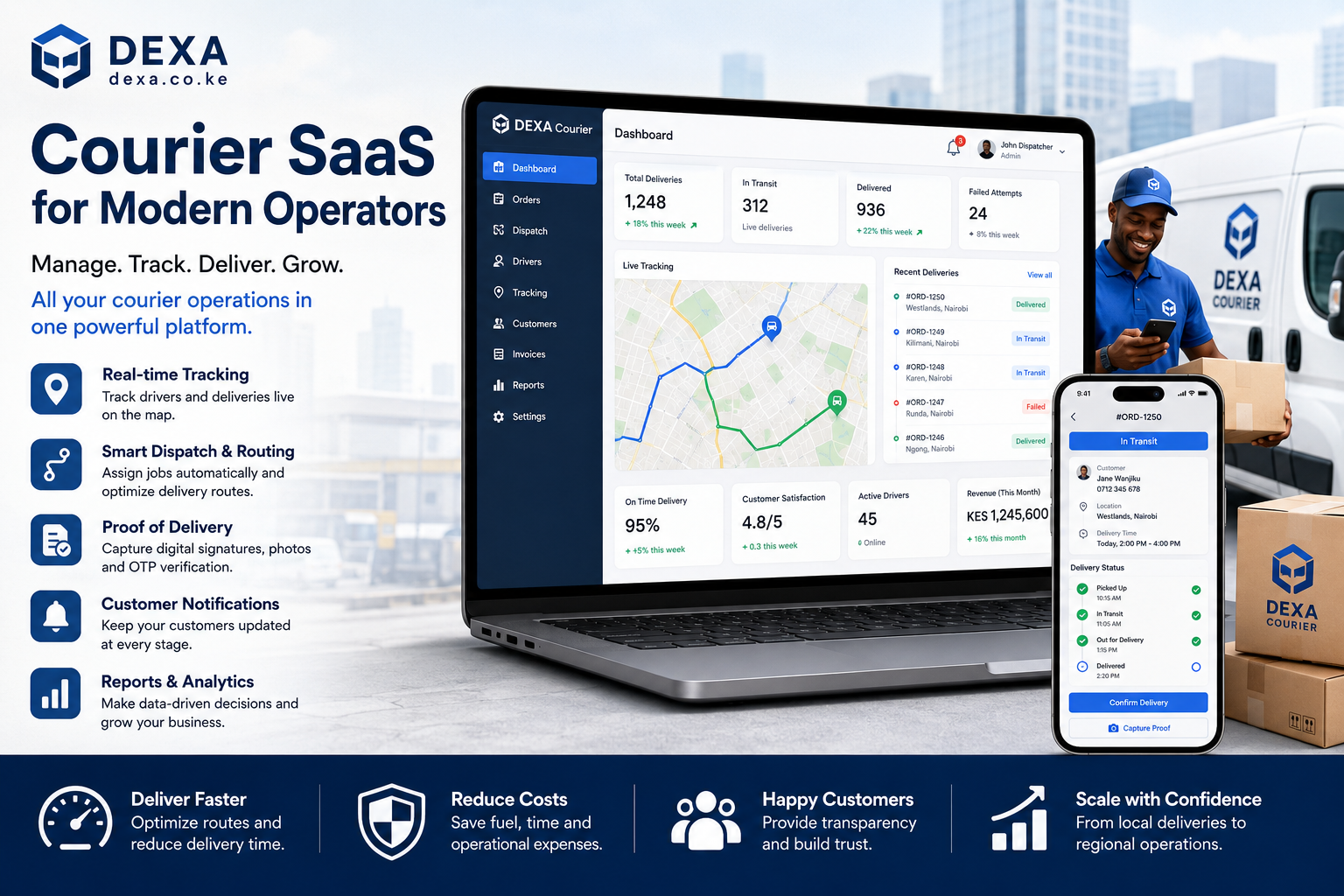
Recent courier software market reviews consistently highlight route optimization, proof of delivery, GPS tracking, automated notifications, and delivery management as the most demanded capabilities among courier businesses. Modern platforms are increasingly focused on helping operators improve visibility, efficiency, and customer satisfaction.
For courier businesses in Kenya, East Africa, and across the continent, adopting Courier SaaS for modern operators is becoming less of a competitive advantage and more of a business necessity.
What Is Courier SaaS for Modern Operators?
Courier SaaS for modern operators refers to cloud-based software specifically designed to manage courier and logistics operations.
Instead of installing software on office computers, operators access the platform through a web browser or mobile application. Drivers, dispatchers, warehouse teams, customer support staff, and management can all work from the same system regardless of location.
A modern courier SaaS platform typically includes:
- Delivery scheduling
- Route optimization
- Driver management
- GPS tracking
- Customer notifications
- Proof of delivery
- Online payments
- Billing and invoicing
- Reporting dashboards
- API integrations
Industry research shows that courier software increasingly focuses on automating collection, dispatch, delivery tracking, routing, expense tracking, and payment processing.
The goal is simple: reduce operational complexity while improving delivery performance.
Why Traditional Courier Management Is Failing
Many courier businesses started small. A few drivers, a dispatcher, and a phone were enough to run operations.
As order volumes grow, problems begin appearing.
Dispatch teams spend hours calling drivers for updates. Customer service teams repeatedly answer delivery status inquiries. Finance teams manually reconcile payments. Managers lack visibility into operational performance.
Without proper software, scaling becomes difficult.
A courier company handling 50 deliveries per day may manage manually. Once volumes increase to 300 or 500 deliveries daily, manual coordination starts creating delays, errors, customer complaints, and revenue leakage.
Many logistics professionals report that fragmented workflows, excessive paperwork, document chasing, and communication scattered across multiple channels are among the biggest operational challenges in delivery businesses.
This is exactly why Courier SaaS for modern operators is gaining popularity.
Core Features That Define Courier SaaS for Modern Operators
A successful Courier SaaS for modern operators platform must go beyond simple tracking.
Modern operators require complete operational visibility.
Intelligent Dispatch Management
Dispatching should not depend entirely on human judgment.
Modern systems automatically assign deliveries based on driver location, availability, delivery priority, vehicle type, and workload.
This reduces delays while ensuring resources are utilized effectively.
Real-Time GPS Tracking
Customers increasingly expect visibility.
Modern courier platforms allow operators and customers to track deliveries in real time.
This reduces customer inquiries and increases trust.
Route Optimization
Fuel remains one of the largest operational expenses for courier businesses.
Route optimization helps drivers complete more deliveries using fewer kilometres.
Research across courier software providers consistently identifies route optimization as a core feature for improving efficiency.
Proof of Delivery
Digital signatures, photos, OTP verification, and geolocation confirmation help eliminate disputes.
Proof of delivery protects both courier companies and customers.
Automated Customer Notifications
Customers receive updates when:
- Orders are dispatched
- Drivers are approaching
- Deliveries are completed
- Delays occur
This significantly reduces support workload.
Billing and Invoicing
Modern courier businesses need integrated invoicing.
Invoices can be generated automatically after delivery completion, improving cash flow and reducing administrative effort.
Performance Analytics
Management teams need answers to questions such as:
- Which drivers perform best?
- Which routes generate delays?
- What is the average delivery time?
- Which customers generate the most revenue?
Analytics dashboards provide these insights instantly.
How Courier SaaS for Modern Operators Improves Daily Operations
The biggest benefit of Courier SaaS for modern operators is operational efficiency.
Instead of switching between spreadsheets, WhatsApp groups, emails, and accounting systems, teams work from one platform.
Dispatchers can monitor all drivers on a live map.
Managers can review performance metrics in real time.
Customers can check delivery status without contacting support.
Finance teams can generate invoices automatically.
This unified workflow eliminates many bottlenecks that slow courier operations.
Cloud-based courier platforms are increasingly designed to provide centralized visibility, real-time coordination, and operational control from a single environment.
Customer Experience Has Become a Competitive Advantage
Customers rarely compare courier companies based solely on delivery speed.
They compare experiences.
If customers receive accurate updates, transparent tracking, delivery confirmations, and professional communication, they are more likely to become repeat customers.
A courier business that provides complete delivery visibility appears significantly more professional than one that relies on manual updates.
Modern consumers increasingly expect:
- Real-time tracking
- Delivery notifications
- Digital receipts
- Faster support responses
- Transparent delivery status
Courier SaaS for modern operators helps businesses deliver these expectations consistently.
Revenue Growth Opportunities Created by Courier SaaS
Many operators view software purely as an operational expense.
In reality, software often becomes a revenue growth tool.
When dispatch becomes more efficient, businesses can process more deliveries without increasing administrative staff.
When route optimization improves, drivers can complete additional deliveries daily.
When customer experience improves, retention rates increase.
When reporting improves, management identifies profitable opportunities faster.
The result is sustainable growth.
Several courier software platforms specifically focus on helping businesses scale delivery operations through automation, tracking, routing, and visibility improvements.
Courier SaaS for Modern Operators and Mobile Workforce Management
Most courier businesses operate outside the office.

Drivers spend their entire workday in the field.
This makes mobile functionality essential.
A modern driver application should allow:
- Delivery acceptance
- Route navigation
- Customer communication
- Proof of delivery capture
- Status updates
- Offline operation
Industry discussions frequently emphasize offline-first mobile applications as particularly valuable for emerging markets where connectivity can be inconsistent.
For African logistics businesses, this capability is especially important.
Integration Matters More Than Features
Many courier operators focus exclusively on feature lists.
The smarter approach is evaluating integrations.
A courier platform should connect seamlessly with:
- E-commerce platforms
- Payment gateways
- Accounting software
- CRM systems
- Warehouse systems
- Customer communication tools
Without integration capabilities, businesses create new operational silos.
A truly effective Courier SaaS for modern operators platform acts as a central operational hub rather than another isolated system.
Building a Complete Business Ecosystem
Businesses rarely operate using one software platform.
Organizations increasingly adopt integrated ecosystems.
Examples include:
- RentalDesk
- PMS Kenya
- EstateAdmin
- Prim Salon Software
- Vega POS
- Pawa WiFi Billing System
- Dereva Platform
- Vota Platform
- Zivo Customer Communication Platform
- Ratibu School Management System
- ChurchesAdmin
- Fama Platform
- Jaat Platform
- KayaPro360
These platforms demonstrate how SaaS ecosystems help businesses automate operations across multiple departments.
A courier company using Courier SaaS for modern operators can similarly connect logistics operations with accounting, customer communication, workforce management, and reporting systems.
Risks and Challenges
No technology investment is risk-free.
Before implementing Courier SaaS for modern operators, businesses should understand potential challenges.
Staff Resistance
Employees may resist new workflows.
Mitigation involves proper training and phased implementation.
Poor Data Quality
Migrating inaccurate customer or delivery data creates problems.
Clean data before implementation.
Internet Dependence
Cloud platforms require connectivity.
Choose solutions that support offline operation where possible.
Vendor Lock-In
Switching platforms later can be difficult.
Select providers with open APIs and export capabilities.
Cybersecurity Risks
Customer data and delivery information must remain secure.
Use providers that implement strong security controls and access management policies.
Is Courier SaaS for Modern Operators Worth It?
For most growing courier businesses, the answer is yes.
If your company handles only a handful of deliveries each week, manual processes may still work.
However, once delivery volumes begin increasing, inefficiencies become expensive.
Missed deliveries, delayed updates, customer complaints, manual invoicing, and operational blind spots all create hidden costs.
Courier SaaS for modern operators provides visibility, scalability, automation, and customer experience improvements that are difficult to achieve through manual management.
Businesses that adopt modern logistics technology typically gain stronger operational control and better customer satisfaction compared to businesses relying heavily on manual processes.
For operators serious about long-term growth, investing in modern courier software is increasingly becoming a strategic decision rather than an optional upgrade.
Future Trends Shaping Courier Operations in 2026 and Beyond
The courier industry is entering a new phase of digital transformation. Customer expectations continue to rise, fuel prices remain unpredictable, and competition is increasing in both urban and rural markets. As a result, Courier SaaS for modern operators is evolving from a simple delivery management tool into a complete logistics intelligence platform.
Businesses that invest in modern technology today are positioning themselves to take advantage of future opportunities. Instead of reacting to market changes, they can make proactive decisions using data gathered from their delivery operations.
One of the biggest trends is predictive logistics. Modern platforms are beginning to analyze historical delivery data to predict future demand patterns. For example, a courier company serving Nairobi’s business district may discover that deliveries increase by 35% during the last week of every month. With this information, managers can schedule additional drivers, allocate vehicles more effectively, and avoid service disruptions.
Artificial intelligence is also becoming more accessible. Rather than replacing employees, AI helps dispatchers make better decisions. Systems can recommend optimal delivery routes, identify delayed shipments, and predict traffic-related disruptions before they affect customers. As these technologies become more affordable, Courier SaaS for modern operators will continue helping businesses improve efficiency without dramatically increasing staffing costs.
Another major trend is customer self-service. Modern customers prefer checking delivery information themselves instead of calling customer support. Through customer portals and mobile applications, users can track parcels, reschedule deliveries, download invoices, and communicate directly with drivers. This reduces support costs while improving customer satisfaction.
Environmental sustainability is also influencing courier operations. Companies are under increasing pressure to reduce fuel consumption and lower emissions. Route optimization features available within Courier SaaS for modern operators help businesses reduce unnecessary travel distances and improve vehicle utilization. Even small improvements can create meaningful savings over time.
For example, if a delivery vehicle normally travels 180 kilometres per day and route optimization reduces that distance by 15%, daily travel decreases by 27 kilometres. Across a fleet of ten vehicles operating six days per week, this reduction becomes substantial over a year. Beyond fuel savings, vehicle wear and maintenance expenses also decline.
Managing Last-Mile Delivery Challenges
Last-mile delivery remains one of the most expensive and difficult parts of logistics operations. It refers to the final stage where a package moves from a distribution point to the customer.
Many courier companies lose time and money during this phase because of inaccurate addresses, unavailable recipients, traffic congestion, and communication breakdowns.
Courier SaaS for modern operators helps reduce these challenges by improving coordination between dispatchers, drivers, and customers.
Customers can receive delivery notifications before arrival. Drivers can access digital delivery instructions. Dispatchers can monitor progress in real time and intervene when issues occur.
This level of visibility reduces failed deliveries and improves first-attempt success rates.
The importance of last-mile efficiency continues to grow because e-commerce volumes are increasing across Africa. More businesses are selling products online, creating higher demand for reliable delivery services.
Courier companies that can provide transparent tracking and dependable delivery experiences are likely to attract more business clients and long-term contracts.
Why Data Is Becoming a Competitive Asset
Many courier operators collect large amounts of information without fully utilizing it.
Delivery records, driver performance metrics, customer locations, payment histories, and route data all contain valuable insights.
A strong Courier SaaS for modern operators platform transforms this information into actionable intelligence.
Managers can identify which delivery zones generate the highest profits. They can discover recurring causes of delays. They can measure driver productivity and evaluate customer retention trends.
Instead of making decisions based on assumptions, businesses can rely on evidence.
For instance, reporting tools may reveal that deliveries within one region consistently take longer than expected. Further analysis could show that traffic congestion during certain hours causes delays. Managers can then adjust scheduling practices or route assignments accordingly.
Data-driven decision making is becoming one of the most important advantages of modern courier software.
Scaling from Local Deliveries to Regional Operations
Many courier businesses begin by serving a single town or city. As demand grows, expansion opportunities emerge.
However, expansion often exposes weaknesses in manual processes.
A business that successfully manages fifty deliveries per day manually may struggle when handling five hundred deliveries across multiple regions.
This is where Courier SaaS for modern operators becomes essential.
Cloud-based platforms allow operators to manage multiple branches, warehouses, dispatch teams, and driver fleets from a centralized dashboard.
Management can monitor operations across different locations without being physically present.
This visibility is especially important for businesses planning to expand into multiple counties or countries.
The ability to standardize processes across all locations improves consistency and reduces operational risk.
Customers receive the same quality of service regardless of where their deliveries originate.
Choosing the Right Courier SaaS Platform
Not all courier platforms are designed for the same type of business.
Some solutions focus on small delivery startups, while others target enterprise logistics providers.
Before selecting a system, operators should evaluate several factors.
The first consideration is scalability. A platform should support future growth without requiring a complete replacement after a few years.
The second consideration is ease of use. Drivers, dispatchers, and customer service teams should be able to learn the system quickly.
Third, integration capabilities are critical. Businesses often use accounting software, payment gateways, CRM systems, and communication platforms. A courier solution should work seamlessly with these tools.
Fourth, mobile functionality should be carefully evaluated. Since most courier work occurs outside the office, mobile applications must provide reliable performance.
Finally, support quality matters. Technology issues can disrupt operations if assistance is unavailable when needed.
Businesses evaluating Courier SaaS for modern operators should focus on long-term operational value rather than selecting software solely based on price.
A cheaper platform that lacks essential functionality may ultimately cost more through inefficiencies and lost business opportunities.
The Strategic Advantage of Early Adoption
Many business owners wait until operational problems become severe before investing in software.
Unfortunately, by that stage, customer complaints, missed deliveries, and internal inefficiencies may already be affecting profitability.
Early adoption provides a strategic advantage.
Businesses can establish efficient workflows before volumes become difficult to manage. Staff become comfortable using digital tools. Data accumulates over time, creating valuable insights for future decision making.
Organizations that implement Courier SaaS for modern operators early often find it easier to scale because the operational foundation is already in place.
Rather than constantly reacting to problems, management can focus on growth initiatives, customer acquisition, and service improvement.
As logistics markets become increasingly competitive, operational excellence will separate industry leaders from struggling operators.
Technology alone does not guarantee success, but the right platform can provide the tools needed to deliver faster service, improve visibility, strengthen customer relationships, and support sustainable expansion.
For courier businesses aiming to remain competitive over the coming years, investing in Courier SaaS for modern operators is not simply a technology decision. It is a business strategy that supports growth, efficiency, and long-term resilience in a rapidly evolving logistics landscape.
Frequently Asked Questions
1. What is Courier SaaS for modern operators?
Courier SaaS for modern operators is cloud-based software that helps courier companies manage dispatching, tracking, routing, invoicing, proof of delivery, and customer communication from a centralized platform.
2. Can small courier businesses benefit from Courier SaaS for modern operators?
Yes. Even small businesses benefit from automated dispatch, customer notifications, and digital delivery records that reduce manual work and improve service quality.
3. Does Courier SaaS for modern operators require special hardware?
Most platforms only require smartphones, tablets, or computers with internet access. Some solutions also support GPS integrations and barcode scanners.
4. Is Courier SaaS for modern operators suitable for African markets?
Yes. Many modern platforms support mobile-first workflows, offline functionality, mobile money integrations, and scalable deployment models suitable for African logistics operations.
5. How long does implementation take?
Implementation timelines vary depending on company size, data migration requirements, integrations, and staff training needs. Smaller businesses can often begin within days, while larger organizations may require several weeks.
Final Thoughts
The logistics industry is moving rapidly toward automation, visibility, and customer-centric operations.
Businesses that continue relying on spreadsheets, manual dispatching, and fragmented communication systems will increasingly struggle to compete against technology-enabled operators.
Courier SaaS for modern operators provides a practical path toward operational efficiency, delivery visibility, better customer experiences, and scalable growth.
Whether you manage local deliveries, regional distribution networks, e-commerce fulfillment, or enterprise logistics operations, adopting Courier SaaS for modern operators can position your business for long-term success.
Ready to Modernize Your Courier Business?
Visit Dexa.co.ke