Table of Contents
ToggleTransport and Logistics Software Kenya
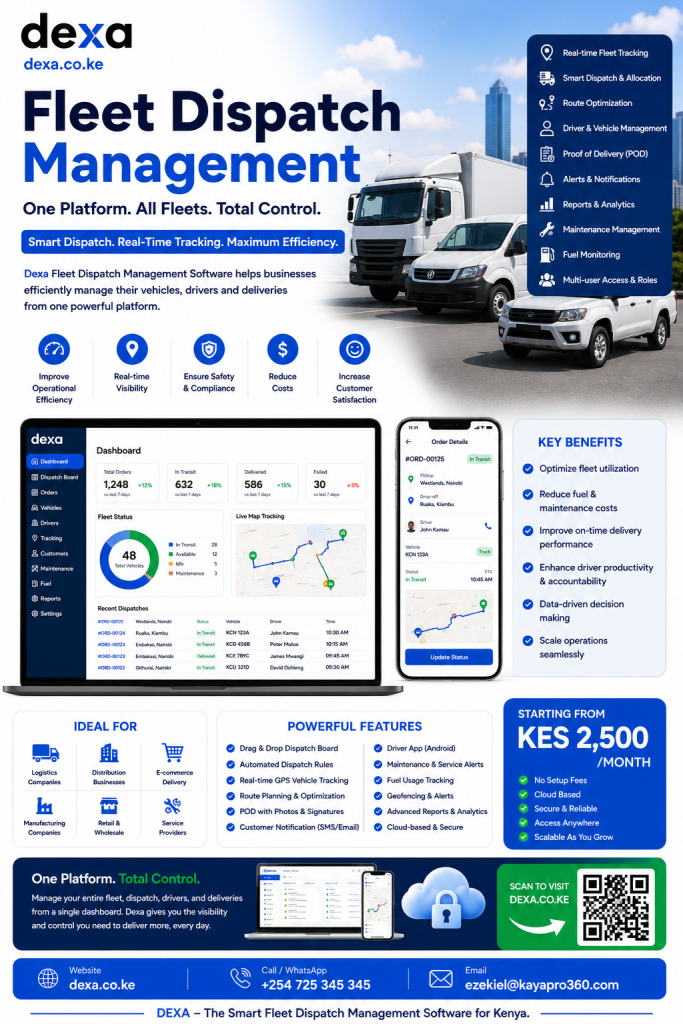
The transport and logistics industry in Kenya is changing rapidly. Companies that once relied on phone calls, spreadsheets, paper delivery notes, and manual dispatch systems are increasingly adopting Transport and logistics software Kenya solutions to improve efficiency, reduce costs, and increase customer satisfaction.
Whether you operate a courier company in Nairobi, a trucking business moving cargo between Mombasa and Kampala, a wholesale distribution company serving multiple counties, or a last-mile delivery business handling online orders, technology has become a critical competitive advantage.
Many transport operators still lose money through fuel theft, poor route planning, delayed invoicing, lost delivery notes, vehicle downtime, and inefficient communication between dispatchers and drivers. Modern Transport and logistics software Kenya platforms address these challenges through automation, real-time visibility, and centralized operations management.
Recent logistics technology providers emphasize features such as fleet tracking, dispatch management, shipment visibility, route optimization, proof of delivery, and financial management. However, many vendors make broad claims about efficiency improvements without providing practical operational examples. Businesses should focus on measurable outcomes such as reduced fuel consumption, faster invoicing cycles, lower vehicle downtime, and improved delivery completion rates.
This guide explains how Transport and logistics software Kenya works, the key features businesses should prioritize, potential risks, implementation challenges, and whether investing in such a system makes financial sense.
What Is Transport and Logistics Software?
Transport and logistics software Kenya refers to a centralized platform that helps businesses manage transportation operations, fleets, drivers, deliveries, customers, invoices, dispatch activities, and logistics workflows from a single system.
Instead of operating separate spreadsheets for vehicles, drivers, fuel records, deliveries, and payments, companies use one integrated platform to manage everything.
Modern logistics systems typically include:
- Fleet management
- Vehicle tracking
- Driver management
- Dispatch operations
- Delivery tracking
- Route planning
- Customer communication
- Fuel monitoring
- Maintenance scheduling
- Invoicing
- Reporting and analytics
Leading logistics platforms increasingly combine fleet management, shipment tracking, route optimization, financial visibility, and operational reporting into one solution.
For growing businesses, Transport and logistics software Kenya provides operational visibility that is difficult to achieve using manual methods.
Why Kenyan Transport Companies Need Digital Systems
Kenya’s logistics sector serves manufacturers, wholesalers, retailers, construction companies, e-commerce businesses, FMCG distributors, agricultural exporters, and importers.
As businesses grow, operational complexity increases.
A company operating five vehicles may manage manually. However, once the fleet expands to twenty, fifty, or one hundred vehicles, manual coordination becomes difficult.
Common operational problems include:
- Missing delivery records
- Fuel misuse
- Late customer updates
- Delayed invoicing
- Driver accountability issues
- Vehicle breakdowns
- Route inefficiencies
- Lost paperwork
- Poor communication
Many transport companies also struggle with coordinating drivers, dispatchers, customers, and finance teams across multiple locations. Integrated systems provide centralized visibility and reduce reliance on phone calls and paper records.
This is where Transport and logistics software Kenya becomes essential.
Core Features of Transport and Logistics Software Kenya
When evaluating Transport and logistics software Kenya, businesses should prioritize practical operational features rather than marketing promises.
The most important capabilities include:
Fleet Tracking
Real-time vehicle monitoring helps management know:
- Vehicle location
- Travel history
- Idle time
- Route deviations
- Arrival estimates
Dispatch Management
Dispatch teams can assign jobs digitally rather than relying on multiple phone calls.
Route Optimization
Software identifies efficient delivery routes, reducing fuel consumption and travel time.
Driver Management
Managers can track:
- Driver assignments
- Trip history
- Safety records
- Performance metrics
Digital Proof of Delivery
Customers can sign electronically, reducing paperwork.
Automated Billing
Invoices are generated automatically once deliveries are completed.
Reporting
Management receives performance insights across operations.
These capabilities are increasingly becoming standard within modern transport management systems.
Fleet Management and Vehicle Tracking
One of the biggest benefits of Transport and logistics software Kenya is improved fleet visibility.
Without proper systems, businesses often discover problems after losses have already occurred.
Fleet management functionality helps businesses monitor:
- Vehicle utilization
- Fuel consumption
- Maintenance schedules
- Driver activity
- Route compliance
- Trip completion
Advanced platforms can also identify unusual fuel usage, mileage discrepancies, and operational inefficiencies that may otherwise go unnoticed.
For transport companies operating across Kenya, Uganda, Tanzania, Rwanda, and South Sudan, centralized fleet visibility significantly improves operational control.
This makes Transport and logistics software Kenya a critical management tool rather than merely a reporting system.
Dispatch and Route Optimization
Dispatch operations often determine whether deliveries are profitable.
Manual dispatch introduces challenges such as:
- Missed assignments
- Duplicate trips
- Delayed departures
- Poor communication
- Route confusion
With Transport and logistics software Kenya, dispatchers assign jobs digitally.
Drivers receive instructions instantly.
Managers can monitor job status in real time.
Modern systems increasingly provide route optimization capabilities that reduce unnecessary travel and improve delivery efficiency.
For companies handling daily deliveries across Nairobi, Mombasa, Kisumu, Nakuru, Eldoret, and surrounding regions, route optimization can significantly improve operational performance.
Driver Management and Performance Monitoring
Drivers play a critical role in logistics success.
However, managing large driver teams manually can be difficult.
Transport and logistics software Kenya helps organizations manage:
- Driver profiles
- License records
- Trip assignments
- Performance metrics
- Attendance
- Safety compliance
Managers gain visibility into operational performance across the entire fleet.
The system creates accountability because every trip is recorded digitally.
Many fleet platforms also support driver settlements, trip reconciliation, and operational reporting to simplify management processes.
As a result, businesses improve consistency and reduce disputes.
Delivery Tracking and Proof of Delivery
Customers increasingly expect shipment visibility.
When customers repeatedly call asking:
“Where is my package?”
“Has the delivery arrived?”
“Who received the goods?”
Operational efficiency suffers.
Transport and logistics software Kenya provides:
- Real-time delivery tracking
- Status updates
- Delivery confirmation
- Electronic signatures
- Delivery history
Digital proof of delivery helps eliminate disputes while improving customer confidence.
Several modern logistics platforms now emphasize live shipment visibility and proof-of-delivery functionality as core features.
This improves both customer service and operational accountability.
Financial Management and Billing Automation
Many logistics companies lose revenue because invoicing occurs days or weeks after deliveries.
Manual billing processes create delays and increase errors.
A strong Transport and logistics software Kenya solution automates:
- Invoice generation
- Customer billing
- Trip costing
- Expense tracking
- Payment monitoring
- Financial reporting
Once deliveries are completed, invoices can be generated immediately.
This shortens payment cycles and improves cash flow.
Financial visibility also allows management to identify profitable and unprofitable routes.
Warehouse and Inventory Integration
Many logistics businesses operate warehouses alongside transportation services.
Inventory management becomes difficult when systems are disconnected.
Modern Transport and logistics software Kenya can integrate:
- Inventory management
- Warehouse operations
- Order fulfillment
- Dispatch activities
- Customer deliveries
Warehouse management integration reduces paperwork and improves operational coordination. Several logistics software providers now combine transportation and warehouse management capabilities within a single platform.
This creates a more efficient supply chain.
Customer Experience and Communication
Customer expectations continue to rise.
Businesses expect:
- Faster responses
- Delivery updates
- Accurate ETAs
- Digital records
Transport and logistics software Kenya improves communication by providing centralized customer information and delivery tracking.
Organizations can also integrate customer communication tools such as:
- WhatsApp support
- SMS notifications
- Email alerts
- Shared inbox systems
Businesses using communication platforms like Zivo and ZChat alongside logistics software often provide better customer experiences.
Challenges Facing Logistics Companies
Despite technological improvements, transport businesses continue to face challenges including:
- Rising fuel costs
- Driver shortages
- Vehicle maintenance expenses
- Traffic congestion
- Regulatory compliance
- Cash flow constraints
- Customer expectations
Technology cannot eliminate every challenge.
However, Transport and logistics software Kenya helps organizations respond faster and make better decisions.
Companies that continue relying solely on manual processes may struggle to scale effectively.
Risks and How to Mitigate Them
Poor User Adoption
Employees may resist change.
Mitigation: Provide proper training and management support.
Inaccurate Data Entry
Poor data creates poor reports.
Mitigation: Standardize processes and permissions.
System Downtime
Cloud systems occasionally experience outages.
Mitigation: Choose reliable vendors with support teams.
Cybersecurity Risks
Sensitive business information must be protected.
Mitigation: Use strong passwords, backups, and access controls.
Implementation Delays
Projects sometimes exceed timelines.
Mitigation: Roll out features gradually.
By planning carefully, businesses can maximize the benefits of Transport and logistics software Kenya while minimizing implementation risks.
Advanced Reporting and Business Intelligence for Logistics Companies
One of the most valuable yet overlooked benefits of Transport and logistics software Kenya is advanced reporting. Many transport companies generate large amounts of operational data every day but fail to convert that information into actionable business intelligence.
Without proper reporting tools, managers often make decisions based on assumptions rather than facts. They may not know which vehicles generate the highest revenue, which routes consume excessive fuel, or which customers consistently delay payments.
Modern Transport and logistics software Kenya provides detailed dashboards that allow management teams to monitor operational performance from a single location. Instead of waiting for weekly reports, managers can view live operational data and respond immediately when problems arise.
Reports can include fleet utilization, delivery completion rates, fuel consumption trends, vehicle downtime, driver performance, maintenance schedules, customer order volumes, and revenue generated by different routes. This visibility helps transport businesses identify areas requiring improvement before they become costly problems.
For example, if one vehicle consistently records higher fuel consumption than similar vehicles operating the same route, management can investigate whether the issue is caused by mechanical faults, unauthorized fuel usage, poor driving habits, or route inefficiencies. Such insights are difficult to obtain when relying on spreadsheets and manual reporting systems.
As businesses grow, reporting becomes increasingly important. A company managing five vehicles may easily track performance manually. However, a fleet of fifty or one hundred vehicles requires automated reporting tools to maintain operational efficiency. This is why many growing organizations invest in Transport and logistics software Kenya as part of their expansion strategy.
Maintenance Management and Vehicle Lifecycle Tracking
Vehicle maintenance is one of the largest operating expenses in the transport industry. Unexpected breakdowns can lead to delayed deliveries, customer complaints, lost contracts, and expensive emergency repairs.
A reliable Transport and logistics software Kenya solution helps businesses move from reactive maintenance to preventive maintenance. Instead of waiting for vehicles to fail, managers receive alerts when service intervals are approaching.
The system can track:
- Engine service schedules
- Tire replacement dates
- Insurance renewals
- Vehicle inspections
- License renewals
- Maintenance history
- Spare parts usage
- Repair costs
Preventive maintenance reduces downtime and extends vehicle lifespan. A truck that receives regular servicing is more likely to remain operational and generate revenue than one that is only repaired when problems occur.
Maintenance records also improve accountability. Every repair, service, and inspection is documented within the system, creating a complete history for each vehicle. This information becomes valuable when selling vehicles, negotiating insurance coverage, or evaluating fleet performance.
Many transport operators underestimate the financial impact of vehicle downtime. A truck that remains idle for several days due to preventable mechanical issues not only incurs repair costs but also loses revenue opportunities. Transport and logistics software Kenya helps organizations minimize these losses through proactive maintenance management.
Compliance and Regulatory Management
Transport businesses operate within a highly regulated environment. Companies must comply with numerous requirements involving vehicle licensing, insurance coverage, driver qualifications, safety standards, and operational permits.
Managing compliance manually can be challenging, especially for organizations with large fleets.
A comprehensive Transport and logistics software Kenya platform helps businesses maintain compliance by storing important documentation and generating automatic reminders before expiration dates.
Examples include:
- Vehicle inspection certificates
- Insurance policies
- Driver licenses
- Transport permits
- Safety certifications
- Contract documentation
Failure to maintain compliance can result in fines, operational disruptions, or reputational damage. By automating compliance management, businesses reduce administrative workloads while improving operational reliability.
Compliance tracking is particularly important for logistics providers handling high-value cargo, cross-border transportation, government contracts, and large corporate clients. Many customers now require documented compliance before awarding transport contracts.
Integration with Accounting and ERP Systems
As logistics companies grow, isolated software systems often create operational challenges. Information becomes fragmented across multiple platforms, increasing administrative workloads and reducing efficiency.
Modern Transport and logistics software Kenya can integrate with accounting, ERP, inventory, and customer relationship management systems.
This integration allows businesses to synchronize data across departments without duplicate data entry.
For example:
- Completed deliveries automatically generate invoices.
- Customer records remain synchronized across departments.
- Financial transactions flow directly into accounting systems.
- Inventory updates occur automatically after deliveries.
- Management reports consolidate data from multiple sources.
Integration reduces human error while improving visibility throughout the organization.
Companies using integrated business ecosystems often achieve higher operational efficiency because information flows seamlessly between departments. Instead of spending time transferring data manually, employees focus on customer service and business growth.
The Growing Role of Mobile Applications in Logistics
Mobile technology has transformed logistics operations worldwide. Drivers, dispatchers, warehouse personnel, and customers increasingly expect access to information from smartphones and tablets.
A modern Transport and logistics software Kenya platform should include mobile capabilities that support field operations.
Mobile functionality may include:
- Driver trip updates
- Delivery confirmations
- Electronic signatures
- Vehicle inspections
- Incident reporting
- Route navigation
- Customer communication
- Real-time notifications
Drivers no longer need to return to the office to submit paperwork. Delivery confirmations can be uploaded immediately after job completion, allowing invoices to be generated faster and customers to receive updates in real time.
Mobile access also improves communication between dispatchers and drivers. Changes to delivery schedules, routes, or customer instructions can be communicated instantly, reducing delays and misunderstandings.
As smartphone adoption continues to increase across Kenya, mobile-enabled Transport and logistics software Kenya solutions will become even more important.
Future Trends in Transport and Logistics Software Kenya
Technology continues to reshape the logistics industry. Businesses investing in Transport and logistics software Kenya today should also consider future developments that may influence operations over the coming years.
Several trends are already emerging.
Artificial Intelligence and Predictive Analytics
Artificial intelligence is helping logistics companies analyze operational data more effectively.
AI-powered systems can identify patterns related to:
- Vehicle breakdown risks
- Fuel consumption trends
- Delivery delays
- Route efficiency
- Customer demand forecasting
These insights allow businesses to make proactive decisions rather than reacting to problems after they occur.
Automation of Routine Tasks
Administrative tasks such as scheduling, dispatching, invoicing, and reporting are becoming increasingly automated.
Automation reduces human workloads and improves operational consistency.
Enhanced Customer Visibility
Customers increasingly expect real-time shipment tracking and instant status updates.
Future Transport and logistics software Kenya platforms will continue expanding customer self-service capabilities through web portals and mobile applications.
Cloud-Based Infrastructure
Cloud technology provides scalability, security, and accessibility advantages.
Businesses can access operational information from anywhere without investing heavily in on-premise infrastructure.
Data-Driven Decision Making
Organizations that leverage operational data effectively will gain significant competitive advantages.
The future of logistics management will depend heavily on accurate reporting, analytics, and performance monitoring.
Building a Competitive Logistics Business Through Technology
The transport industry is becoming more competitive every year. Customers demand faster deliveries, better communication, lower costs, and higher service reliability.
Companies that continue relying solely on manual systems may find it difficult to meet these expectations consistently.
Implementing Transport and logistics software Kenya helps businesses establish standardized processes, improve operational visibility, and create scalable workflows that support long-term growth.
Technology alone does not guarantee success. Strong leadership, disciplined operations, and excellent customer service remain essential. However, software provides the tools needed to execute these strategies effectively.
Organizations that invest in modern logistics technology position themselves for sustainable growth, improved profitability, and stronger customer relationships.
For businesses seeking to modernize operations, reduce inefficiencies, and gain better control over transportation activities, adopting Transport and logistics software Kenya represents one of the most practical investments available in today’s competitive logistics environment.
Is Transport and Logistics Software Kenya Worth It?
For most growing transport companies, the answer is yes.
If your business experiences:
- Frequent dispatch confusion
- Delivery delays
- Fuel monitoring challenges
- Invoice delays
- Customer complaints
- Fleet visibility problems
Then investing in Transport and logistics software Kenya is often justified.
The software does not replace good management.
However, it provides the visibility and automation needed for efficient operations.
Businesses that continue operating manually often spend more time solving avoidable problems rather than growing revenue.
Why Choose Dexa?
At Dexa, we understand the operational challenges facing transport and logistics companies in Kenya.
Our platform helps organizations automate workflows, improve accountability, and centralize business operations.
Beyond logistics operations, businesses can also integrate with other powerful solutions within the broader SaaS ecosystem:
- Dexa
- Sibed
- RentalDesk
- PMS Kenya
- Estate Admin
- Prim Salon Software
- Vega POS
- Pawa Hotspot Billing
- Dereva Driver Marketplace
- Vota Platform
- Ratibu School Management System
- ChurchesAdmin
- Fama Platform
- Jaat Platform
- KayaPro360
Frequently Asked Questions
1. What businesses need Transport and logistics software Kenya?
Courier companies, fleet operators, distributors, wholesalers, manufacturers, e-commerce businesses, trucking companies, and delivery services.
2. Can small transport businesses use Transport and logistics software Kenya?
Yes. Even companies with a few vehicles benefit from improved visibility and operational control.
3. Does Transport and logistics software Kenya support GPS tracking?
Most modern systems support real-time vehicle tracking and trip monitoring.
4. Can the software generate invoices automatically?
Yes. Many platforms automate billing and financial reporting.
5. How long does implementation take?
Depending on complexity, implementation can take from a few days to several weeks.
Final Verdict
Transport and logistics software Kenya is no longer a luxury reserved for large corporations. It has become an operational necessity for transport companies, courier services, distributors, and logistics providers seeking growth and efficiency.
The best systems help businesses improve fleet visibility, automate dispatch operations, manage drivers effectively, track deliveries in real time, generate invoices faster, and improve customer satisfaction. Modern platforms increasingly combine fleet management, financial reporting, route optimization, warehouse operations, and delivery visibility into a single ecosystem.
For businesses planning long-term growth, implementing Transport and logistics software Kenya today can provide a significant competitive advantage tomorrow.
Ready to modernize your logistics operations? Visit Dexa.co.ke and request a demo today.