Table of Contents
ToggleCourier Dispatch Software Explained
If you operate a courier company, parcel delivery service, logistics business, e-commerce fulfillment operation, or last-mile delivery company, understanding Courier Dispatch Software Explained concepts can help you improve efficiency, reduce costs, and increase customer satisfaction.
Many courier businesses begin with simple tools such as spreadsheets, WhatsApp groups, phone calls, notebooks, and manual delivery records. While these methods may work initially, they become increasingly difficult to manage as delivery volumes grow.
As businesses scale, dispatchers struggle to assign drivers efficiently, customers constantly request delivery updates, invoices are delayed, and delivery errors become more frequent.
This is where Courier Dispatch Software Explained becomes important. Modern dispatch systems centralize operations by connecting dispatchers, drivers, customers, deliveries, billing, and reporting into a single platform. The result is improved visibility, faster operations, and greater accountability. Modern courier software platforms typically combine dispatch boards, route optimization, driver tracking, shipment management, billing, and customer communication in one integrated system.
In this guide, we provide a complete Courier Dispatch Software Explained overview for courier startups, logistics companies, investors, and business owners looking to modernize their delivery operations.
Courier Dispatch Software Explained: What Is It?
Courier Dispatch Software Explained simply means understanding the technology used to manage courier operations digitally.
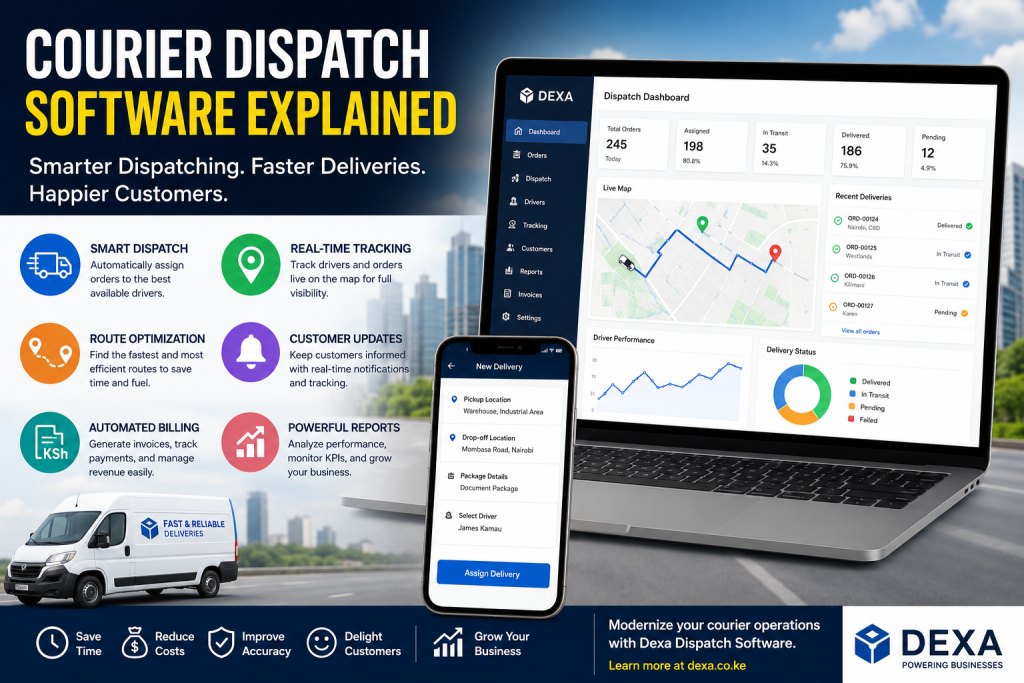
Courier dispatch software is a platform that allows delivery businesses to:
- Receive orders
- Assign drivers
- Track deliveries
- Monitor vehicles
- Communicate with customers
- Generate invoices
- Analyze performance
Instead of relying on multiple disconnected systems, all courier activities are managed from a centralized dashboard.
Industry courier platforms describe dispatch software as a system that manages the entire delivery lifecycle from order creation to proof of delivery while maintaining real-time communication between dispatchers, drivers, and customers.
This is the foundation of Courier Dispatch Software Explained and why it has become essential for modern delivery businesses.
Why Manual Dispatching Fails
Before discussing advanced features, it is important to understand why manual dispatching creates problems.
Many courier companies still rely on:
- Phone calls
- Printed manifests
- Excel spreadsheets
- WhatsApp groups
- Paper delivery notes
Initially these methods appear affordable.
However, as deliveries increase, problems become obvious.
Dispatchers spend hours coordinating drivers.
Customers repeatedly call asking:
“Where is my package?”
Drivers sometimes receive incomplete instructions.
Invoices get delayed.
Delivery records go missing.
Manual dispatching often results in delays, inefficient routing, lost paperwork, communication challenges, and reduced customer satisfaction.
This is one of the most important lessons within Courier Dispatch Software Explained.
How Courier Dispatch Software Works
Understanding workflow is a major part of Courier Dispatch Software Explained.
The process generally follows these steps:
A customer creates an order.
The dispatch system receives the request.
A dispatcher reviews the delivery.
The system recommends available drivers.
The job is assigned.
The driver receives instructions instantly.
GPS tracking begins.
The package is collected.
Status updates are shared automatically.
The customer receives notifications.
Proof of delivery is captured.
The invoice is generated.
Modern dispatch platforms often automate much of this workflow, reducing manual intervention while improving accuracy and speed.
Key Features of Courier Dispatch Software Explained
When discussing Courier Dispatch Software Explained, several features consistently appear across leading platforms.
Live Dispatch Board
A dispatch board provides a centralized view of:
- Active deliveries
- Available drivers
- Pending assignments
- Delivery statuses
- Customer requests
Many leading systems use a live dispatch board that combines jobs, drivers, and maps into a single operational view.
Real-Time Driver Tracking
Managers can monitor driver locations continuously.
Automatic Assignment
Jobs can be assigned automatically based on location and availability.
Delivery Status Tracking
Every stage is recorded digitally.
Customer Notifications
Customers receive delivery updates automatically.
Proof of Delivery
Electronic signatures and photos confirm delivery completion.
These capabilities define modern Courier Dispatch Software Explained systems.
Courier Dispatch Software Explained for Driver Management
Drivers represent the operational backbone of any courier company.
Managing drivers manually becomes increasingly difficult as fleets grow.
Courier Dispatch Software Explained includes tools for:
- Driver scheduling
- Driver assignments
- Route management
- Attendance monitoring
- Performance reporting
- Delivery tracking
Dispatch systems allow drivers to receive assignments directly on mobile devices, eliminating delays caused by phone calls and manual coordination.
Managers gain visibility into:
- Driver productivity
- Delivery completion rates
- Response times
- Route compliance
This creates accountability throughout operations.
Route Optimization and Delivery Planning
One of the most valuable sections of Courier Dispatch Software Explained involves route optimization.
Many courier companies lose money through inefficient routing.
Drivers may:
- Take longer routes
- Miss deliveries
- Backtrack unnecessarily
- Waste fuel
Modern dispatch software automatically calculates efficient routes.
Industry dispatch solutions increasingly provide route optimization, stop sequencing, ETA prediction, and automated route adjustments.
For businesses handling hundreds of daily deliveries, route optimization can significantly improve operational performance.
This makes route planning a critical aspect of Courier Dispatch Software Explained.
Customer Experience and Transparency
Customers expect visibility.
They want to know:
- Has the package been picked up?
- Is the driver on the way?
- What is the estimated arrival time?
- Has delivery been completed?
Without software, answering these questions requires multiple phone calls.
With Courier Dispatch Software Explained, customers can receive:
- SMS notifications
- Email updates
- Tracking links
- Delivery confirmations
Real-time customer visibility is one of the primary reasons courier businesses invest in dispatch technology.
Improved communication often leads to higher customer retention.
Courier Dispatch Software Explained for Proof of Delivery
Delivery disputes are expensive.
Customers occasionally claim:
- Goods were not received
- Deliveries were late
- Wrong packages arrived
Without evidence, resolving disputes becomes difficult.
Courier Dispatch Software Explained includes proof-of-delivery functionality.
Drivers can capture:
- Electronic signatures
- Delivery photos
- GPS coordinates
- Delivery timestamps
These records become part of the shipment history.
Many courier platforms now treat proof of delivery as a standard feature because it improves accountability and dispute resolution.
Billing and Financial Automation
Another important component of Courier Dispatch Software Explained is billing automation.
Many courier businesses experience delayed invoicing.
Manual billing often creates:
- Revenue leakage
- Accounting errors
- Payment delays
- Administrative workloads
Modern dispatch software links completed deliveries directly to billing workflows.
Some systems combine dispatch, shipment management, customer accounts, and invoicing within a single platform.
Benefits include:
- Faster invoicing
- Better cash flow
- Reduced errors
- Improved financial reporting
Business Intelligence and Reporting
Many courier businesses collect operational data but fail to use it effectively.
A major benefit of Courier Dispatch Software Explained is reporting.
Managers can analyze:
- Daily deliveries
- Driver productivity
- Revenue trends
- Delivery times
- Customer activity
- Route efficiency
Reporting helps identify operational weaknesses.
For example, management may discover:
- One route consistently causes delays.
- Certain customers generate most revenue.
- Specific vehicles require frequent maintenance.
Data-driven decision-making has become a major advantage of modern dispatch systems.
Mobile Applications and Field Operations
Mobile technology has transformed delivery operations.
A complete Courier Dispatch Software Explained solution typically includes mobile applications for drivers.
Drivers can:
- Receive assignments
- Update delivery status
- Capture signatures
- Upload photos
- Communicate with dispatchers
- Access navigation tools
Mobile integration reduces paperwork while improving operational visibility.
Field teams remain connected to dispatch centers in real time.
Integration With Other Business Systems
As businesses grow, software integration becomes increasingly important.
Many organizations connect Courier Dispatch Software Explained solutions with:
- Accounting software
- CRM systems
- Inventory systems
- Warehouse systems
- Customer communication tools
For customer communication, businesses increasingly use platforms such as:
For driver recruitment and management:
For broader business automation:
Integration reduces duplicate data entry and improves operational efficiency.
Risks and Challenges
Although the benefits are substantial, Courier Dispatch Software Explained would be incomplete without discussing risks.
Employee Resistance
Some staff members resist new systems.
Mitigation: Provide training and ongoing support.
Poor Data Quality
Incorrect information produces inaccurate reports.
Mitigation: Establish clear data-entry standards.
Technology Dependence
System outages can disrupt operations.
Mitigation: Choose reliable vendors and maintain backup procedures.
Cybersecurity Risks
Customer and operational data must be protected.
Mitigation: Use secure passwords and access controls.
Poor Implementation Planning
Rushed deployments often fail.
Mitigation: Implement gradually with defined milestones.
How Courier Dispatch Software Improves Last-Mile Delivery Operations
One of the fastest-growing segments of the logistics industry is last-mile delivery. This is the final stage of the delivery process where goods move from a distribution center, warehouse, or retail outlet to the customer’s location. Last-mile delivery is often the most expensive and operationally challenging part of the supply chain because it involves direct interaction with customers, unpredictable traffic conditions, and tight delivery timelines.
A practical understanding of Courier Dispatch Software Explained shows how modern dispatch platforms solve these challenges. Instead of manually assigning deliveries, dispatchers can use intelligent scheduling systems that automatically allocate jobs based on driver availability, location, workload, and delivery priority.
This reduces delays and ensures deliveries are completed efficiently. When customers receive accurate delivery updates and estimated arrival times, they are more likely to trust the service provider and continue using the business.
Many courier companies also handle urgent same-day deliveries. Without dispatch software, managing urgent requests can disrupt the entire operation. A properly configured dispatch platform allows dispatchers to quickly identify the nearest available driver and assign high-priority deliveries without affecting other scheduled routes.
As customer expectations continue to rise, businesses that understand Courier Dispatch Software Explained and implement the right tools are better positioned to compete in increasingly demanding markets.
Courier Dispatch Software Explained for E-Commerce Businesses
The growth of online shopping has dramatically increased demand for delivery services. E-commerce businesses rely heavily on efficient courier operations to maintain customer satisfaction.
When customers place orders online, they expect timely delivery, real-time updates, and transparent communication throughout the process. Any delay or communication failure can negatively affect customer reviews and future sales.
This is where Courier Dispatch Software Explained becomes highly relevant for online retailers.
A dispatch platform can automatically receive orders from an e-commerce store and convert them into delivery assignments. Dispatchers no longer need to manually enter order details, reducing administrative workloads and minimizing human errors.
Customers can receive automated notifications when:
- Orders are confirmed
- Packages are picked up
- Drivers are dispatched
- Deliveries are approaching
- Deliveries are completed
This level of transparency significantly improves the customer experience.
Many successful e-commerce businesses use dispatch software as part of a larger digital ecosystem that integrates inventory management, customer communication, billing, and delivery operations. Understanding Courier Dispatch Software Explained helps online businesses create a more efficient fulfillment process.
Reducing Operational Costs Through Automation
Cost control remains one of the most important objectives for courier companies.
Fuel expenses, driver wages, vehicle maintenance, customer service costs, and administrative overhead can quickly reduce profit margins.
A key lesson within Courier Dispatch Software Explained is that automation helps reduce unnecessary operational expenses.
For example, automated dispatching reduces the amount of time employees spend coordinating deliveries. Instead of making dozens of phone calls each day, dispatchers can assign jobs through a centralized dashboard.
Route optimization reduces unnecessary mileage, helping businesses lower fuel consumption. Digital proof-of-delivery systems reduce paperwork and eliminate printing costs. Automated notifications reduce the volume of customer support calls because customers can track deliveries independently.
Over time, these efficiencies create measurable operational improvements. While dispatch software requires an initial investment, many businesses find that reduced administrative workloads and improved efficiency justify the cost.
Companies seeking sustainable growth should view Courier Dispatch Software Explained not merely as a technology investment but as an operational improvement strategy.
Scaling a Courier Business With Dispatch Technology
Growth is often a major challenge for courier businesses.
Processes that work effectively for a small company may become problematic when delivery volumes increase.
A courier company handling twenty deliveries per day may manage operations manually. However, handling two hundred or two thousand deliveries daily requires more sophisticated systems.
Understanding Courier Dispatch Software Explained helps business owners prepare for growth.
Dispatch software creates standardized workflows that can be replicated as the company expands. New drivers can be onboarded more quickly. Additional service areas can be managed without significantly increasing administrative workloads. Managers can monitor operations across multiple branches from a single dashboard.
Scalability is one of the primary reasons many investors and business owners prioritize technology adoption. Rather than continuously hiring additional administrative staff, companies can leverage software to support growth more efficiently.
Organizations that delay digital transformation often encounter operational bottlenecks that restrict expansion. By implementing dispatch software early, businesses create a stronger foundation for long-term growth.
Courier Dispatch Software Explained and Customer Retention
Acquiring new customers is often more expensive than retaining existing ones.
Customer retention depends heavily on service quality, reliability, communication, and consistency.
When deliveries arrive late or customers struggle to obtain shipment updates, trust declines.
A comprehensive Courier Dispatch Software Explained strategy focuses not only on operational efficiency but also on customer satisfaction.
Customers appreciate:
- Real-time tracking
- Accurate delivery estimates
- Fast communication
- Reliable service
- Delivery confirmation
Dispatch software supports all these objectives.
When customers receive consistent service, they are more likely to place repeat orders and recommend the business to others. Positive customer experiences often translate into higher retention rates and stronger brand reputation.
This is particularly important in competitive markets where customers have multiple delivery providers to choose from.
Businesses that understand Courier Dispatch Software Explained recognize that customer satisfaction and operational efficiency are closely connected.
The Future of Courier Dispatch Software
Technology continues to evolve rapidly.
The future of Courier Dispatch Software Explained will likely include even greater automation, deeper analytics, and enhanced customer experiences.
Artificial intelligence is already being used to improve route planning and delivery forecasting. Predictive analytics can identify operational risks before they become serious problems. Machine learning algorithms can recommend more efficient dispatch decisions based on historical performance data.
Customer expectations are also changing. Many customers now expect live tracking, instant notifications, and flexible delivery options. Future dispatch platforms will continue expanding these capabilities.
Cloud-based software will become even more important because it allows businesses to access operational information from anywhere. Mobile applications will continue improving communication between drivers, dispatchers, customers, and management teams.
Organizations that embrace innovation and stay informed about emerging trends will be better positioned to remain competitive.
Ultimately, Courier Dispatch Software Explained is not just about understanding software features. It is about understanding how technology can improve delivery operations, increase customer satisfaction, support business growth, and create a stronger competitive advantage in an increasingly digital economy.
For courier companies planning to expand operations, improve service quality, and modernize workflows, investing in dispatch technology remains one of the most practical and impactful business decisions available today.
Is Courier Dispatch Software Worth It?
This is perhaps the most important section of Courier Dispatch Software Explained.
For most courier businesses, the answer is yes.
If your company experiences:
- Delivery delays
- Driver coordination issues
- Customer complaints
- Lost paperwork
- Billing delays
- Limited operational visibility
Then courier dispatch software usually provides measurable benefits.
The software itself will not fix poor management.
However, it gives management better tools for decision-making and operational control.
Companies that continue relying entirely on spreadsheets and manual processes often struggle to scale efficiently.
For growing delivery businesses, investing in dispatch technology is generally worthwhile.
Why Businesses Choose Dexa
At Dexa, we help organizations digitize operations and improve business efficiency.
Beyond courier management, businesses can leverage an ecosystem of SaaS solutions including:
- Dexa – https://dexa.co.ke
- Sibed – HR, HSSE, attendance, and workflow automation
- RentalDesk – https://rentaldesk.co.ke
- PMS Kenya – https://pms.co.ke
- Estate Admin – https://estateadmin.co.ke
- Prim Salon Software – https://prim.co.ke
- Vega POS – https://vega.co.ke
- Pawa Hotspot Billing – https://pawa.co.ke
- Dereva Driver Marketplace – https://dereva.co.ke
- Vota Campaign Platform – https://vota.co.ke
- Zivo Customer Communication – https://zivo.co.ke
- ZChat Shared Inbox – https://zchat.zamacore.com
- Ratibu School Management – https://ratibu.co.ke
- ChurchesAdmin – https://churchesadmin.com
- Fama – https://fama.co.ke
- Jaat – https://jaat.co.ke
- KayaPro360 – https://kayapro360.com
Whether you are running deliveries, managing staff, handling customer communications, or automating workflows, these solutions help businesses scale efficiently.
Frequently Asked Questions
1. What is courier dispatch software?
Courier dispatch software is a platform used to assign drivers, manage deliveries, track shipments, automate workflows, and improve operational visibility.
2. Can small courier companies use courier dispatch software?
Yes. Even businesses with a few drivers benefit from improved organization and delivery tracking.
3. Does courier dispatch software support GPS tracking?
Most modern systems include real-time GPS tracking and route monitoring capabilities.
4. How long does implementation take?
Implementation can take anywhere from a few days to several weeks depending on business complexity.
5. Can courier dispatch software automate invoicing?
Yes. Many platforms automatically generate invoices after successful delivery completion.
Final Verdict
This Courier Dispatch Software Explained guide demonstrates why dispatch technology has become a necessity rather than a luxury for modern courier businesses. As delivery volumes grow, manual coordination becomes increasingly difficult and expensive.
Organizations that invest in Courier Dispatch Software Explained solutions gain better visibility, faster dispatching, improved customer communication, stronger driver accountability, automated billing, and data-driven reporting. Industry platforms consistently emphasize live dispatch boards, route optimization, proof of delivery, customer tracking, and workflow automation as the foundation of successful courier operations.
Ready to modernize your courier operations? Start with Zama and Dexa today to streamline dispatch, automate workflows, and scale your delivery business efficiently.