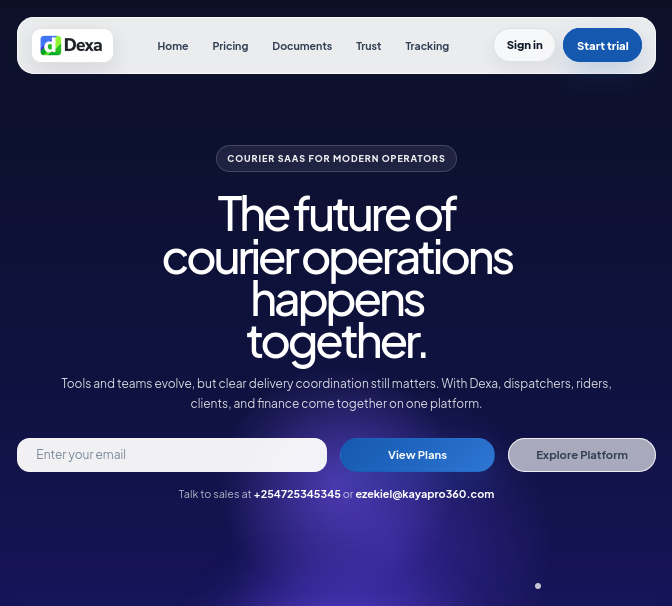
, a structured courier operations system designed to unify dispatch, riders, clients, and finance into a single coordinated workflow.
This blog explores how modern courier SaaS platforms are reshaping logistics operations in Kenya, why they matter, and how businesses can benefit from adopting systems like Dexa.
Understanding Courier Management SaaS in Kenya
Courier Management Software as a Service (SaaS) is a cloud-based platform that helps logistics companies manage:
- Order intake and dispatch
- Rider assignment and tracking
- Proof of delivery (POD)
- Billing and payment reconciliation
- Customer tracking and communication
- Reporting and operational analytics
Unlike traditional systems, SaaS platforms are accessible anywhere, scale easily, and reduce dependency on manual processes.
In Kenya, where courier services are heavily tied to e-commerce, retail delivery, pharmaceuticals, and food logistics, SaaS platforms are becoming essential infrastructure rather than optional tools.
The Problem with Traditional Courier Operations
Before platforms like Dexa, most courier companies in Kenya relied on fragmented systems:
1. WhatsApp-Based Dispatching
Orders are received via chat, assigned manually, and tracked informally. This leads to:
- Missed deliveries
- Confused riders
- No audit trail
2. Spreadsheet Tracking
Operations teams maintain Excel sheets for:
- Orders
- Riders
- Payments
But spreadsheets cannot handle real-time updates or multi-user coordination effectively.
3. Disconnected Payments
Finance teams often operate separately from dispatch, causing:
- Payment mismatches
- Missing transaction records
- Delayed reconciliations
4. Lack of Visibility
Clients constantly call to ask:
- “Where is my parcel?”
- “Has it been delivered?”
- “Who received it?”
This increases operational load and reduces efficiency.
Why Courier SaaS Platforms Are Becoming Essential
Courier SaaS platforms solve the above challenges by introducing structure, automation, and visibility.
A system like Dexa
focuses on bringing every operational layer into one platform:
- Dispatch control
- Rider workflows
- Live tracking
- Payment linkage
- Reporting dashboards
This eliminates fragmentation and replaces it with a unified operational model.
Introducing Dexa: A Modern Courier Operations Platform
is built specifically for courier operators who want structured dispatch and scalable operations.
Instead of using multiple tools for different tasks, Dexa consolidates everything into one system.
It connects:
- Dispatchers
- Riders
- Clients
- Finance teams
All in a single operational flow.
Core Features of Dexa Courier SaaS
1. Dispatch Control System
The dispatch module ensures that every order follows a clear lifecycle:
- Creation
- Assignment
- In-transit tracking
- Completion
- Archiving
Each stage is tracked in real time, reducing confusion and delays.
Key benefits include:
- Role-based order creation
- Full status history
- Exception handling for failed deliveries
- Proof-of-delivery support
This structured workflow ensures that nothing gets lost in communication gaps.
2. Live Dispatch Board
One of the most powerful features in Dexa is the live dispatch board.
It gives managers real-time visibility into:
- Awaiting assignments
- Orders in transit
- Completed deliveries
- Queue health per stage
Instead of guessing operational status, managers can see everything at a glance.
This improves:
- Decision-making speed
- Resource allocation
- Customer communication
3. Rider Workflow Management
Riders are often the most under-supported part of courier operations. Dexa solves this by providing structured rider workflows.
Riders can:
- View assigned orders
- Update delivery status
- Upload proof of delivery
- Track workload limits
Managers can:
- Monitor rider availability
- Control workload caps
- Track performance and delivery speed
This reduces confusion and improves accountability in field operations.
4. Payments and Billing Integration
One of the biggest challenges in courier operations is separating financial records from delivery operations.
Dexa solves this by linking every payment directly to an order.
Features include:
- M-Pesa STK integration
- Manual payment logging
- Invoice generation
- Billing statements
- Exportable reports for reconciliation
This ensures finance teams always work with accurate operational data.
5. SaaS Multi-Tenant Architecture
Dexa is designed not just for one company, but for many courier businesses.
This means:
- Multiple courier companies can operate independently
- Each business has its own branding and settings
- Central admin can manage multiple tenants
This makes Dexa ideal for:
- Courier startups
- Logistics franchises
- SaaS resellers
6. Client Tracking and Transparency
Customers can track their deliveries without calling support teams.
They get:
- Real-time status updates
- Delivery progress visibility
- Proof of delivery confirmation
This improves trust and reduces customer service workload.
How Dexa Improves Courier Business Efficiency
Using a platform like Dexa
introduces measurable improvements:
1. Faster Dispatch Cycles
Orders move from intake to assignment in minutes instead of hours.
2. Reduced Operational Errors
Automation reduces manual mistakes in assignment and tracking.
3. Better Rider Utilization
Workload balancing ensures no rider is overloaded while others are idle.
4. Improved Cash Flow Visibility
Finance teams can see exactly what has been delivered and paid for.
5. Enhanced Customer Experience
Clients receive accurate updates without delays.
Onboarding Process in Dexa
One of the strongest advantages of Dexa is its structured onboarding flow.
Step 1: Setup Workspace
- Create users
- Assign roles (admin, rider, client)
- Configure operational rules
Step 2: Begin Live Operations
- Start dispatching real orders
- Track delivery progress in real time
- Capture payment data automatically
Step 3: Optimize Operations
- Review reports
- Identify bottlenecks
- Scale operations gradually
This ensures businesses do not struggle during transition.
Pricing Structure Overview
Dexa offers flexible pricing for different business sizes:
Starter Plan – KES 2,500/month
- Up to 4 users
- 500 orders/month
- Basic reporting
Growth Plan – KES 7,500/month
- Up to 20 users
- 4,000 orders/month
- Payment integration
Scale Plan – KES 18,000/month
- Unlimited users
- Unlimited orders
- Priority support
This allows courier companies to grow without switching platforms.
Why Kenyan Courier Companies Need SaaS Now
Kenya’s logistics sector is evolving rapidly due to:
- E-commerce growth
- Same-day delivery demand
- Mobile money adoption (especially M-Pesa)
- Increased customer expectations
Manual systems cannot keep up with this speed.
Platforms like Dexa
provide the structure needed to compete in this environment.
Real Operational Impact of Dexa
Courier companies using structured SaaS systems typically experience:
- Up to 40% reduction in dispatch delays
- Improved rider accountability
- Faster payment reconciliation cycles
- Reduced customer complaints
- Higher delivery success rates
These improvements directly impact revenue and customer retention.
Security, Trust, and Data Control
Dexa also emphasizes secure operations:
- Role-based access control
- Centralized admin oversight
- Secure login routing
- Audit logs for all activity
This ensures that sensitive operational and financial data is protected.
The Future of Courier Operations in Kenya
The future of logistics is not just about faster delivery—it is about structured intelligence in operations.
We are moving toward systems where:
- Every delivery is traceable
- Every payment is linked
- Every rider action is logged
- Every client has visibility
Dexa is part of this transition toward structured courier ecosystems.
1. Real-Time Logistics Visibility Reduces Operational Blind Spots
Modern courier systems like Dexa
eliminate guesswork in operations by giving managers a live view of every order stage. This prevents situations where parcels are “lost in transit” or delayed without explanation.
With real-time visibility:
- Dispatchers can instantly reassign stalled deliveries
- Managers can detect bottlenecks early
- Clients receive accurate live updates
This creates a fully transparent logistics chain.
2. Centralized Courier Operations Improve Team Coordination
One of the biggest inefficiencies in courier businesses is working in silos—dispatch, riders, and finance operating separately.
A centralized system ensures:
- All teams work from the same data source
- No duplicated or conflicting records
- Faster communication between departments
This improves overall operational harmony and reduces internal friction.
3. Automated Proof of Delivery Builds Customer Trust
Proof of Delivery (POD) is critical in courier businesses, especially in e-commerce and medical deliveries.
With Dexa-style SaaS systems:
- Riders upload delivery confirmation instantly
- Customers can verify delivery in real time
- Disputes are reduced significantly
This builds long-term trust between courier companies and clients.
4. Courier Analytics Help Businesses Make Data-Driven Decisions
Instead of guessing performance, courier SaaS platforms provide actionable insights such as:
- Average delivery time per zone
- Rider performance metrics
- Order completion rates
- Revenue per client or route
This helps management identify profitable areas and fix underperforming operations.
5. Scalability Without Increasing Operational Chaos
Traditional courier systems break down when order volume increases.
With platforms like Dexa
:
- You can scale from 100 to 10,000 orders without switching tools
- New riders can be added instantly
- Multiple branches can operate under one system
This makes growth predictable instead of chaotic.
6. Reduced Customer Support Load Through Self-Service Tracking
Courier companies often spend too much time answering “Where is my parcel?” calls.
A SaaS tracking system allows:
- Customers to track orders themselves
- Automatic status updates
- Reduced inbound support calls
This frees staff to focus on core logistics tasks instead of repetitive inquiries.
7. Faster Cash Flow Through Integrated Payments
When delivery and payment systems are disconnected, businesses face delays in reconciliation.
Integrated systems ensure:
- Instant linking of payment to delivery
- Faster invoice generation
- Clear financial reporting
This improves cash flow stability and reduces financial confusion.
8. Role-Based Access Improves Security and Control
Not every user should access all data in a courier system.
Role-based systems allow:
- Riders only see assigned jobs
- Clients only see their deliveries
- Admins manage full operations
This reduces errors, fraud risk, and unauthorized access.
9. Better Resource Allocation Through Rider Capacity Tracking
Instead of overloading riders or leaving them idle, modern systems track:
- Rider availability
- Active workload
- Delivery capacity limits
This leads to:
- Balanced workload distribution
- Improved rider performance
- Fewer missed deliveries
10. Digital Transformation Gives Courier Firms a Competitive Edge
Courier companies that adopt SaaS platforms early gain a major advantage:
- Faster service delivery
- More professional client experience
- Better scalability than competitors still using manual systems
In competitive logistics markets like Kenya, this advantage can define long-term success.
Conclusion
Courier businesses in Kenya are entering a new era where efficiency, transparency, and scalability are no longer optional.
Adopting a Courier Management SaaS like Dexa
helps businesses move away from fragmented systems and toward a unified operational model.
From dispatch control to rider management, billing integration, and real-time tracking, Dexa provides the foundation for modern courier success.
If you are building or scaling a courier business in Kenya, the shift to SaaS is no longer a future consideration—it is a present necessity.
Contact & Demo
For demos, onboarding, or sales inquiries:
- 📞 +254725345345
- ✉️ ezekiel@kayapro360.com