Introduction: What Dexa Really Is in Modern Business Systems
In today’s competitive business environment, companies in Kenya are shifting from manual processes to fully integrated digital systems. One of the most impactful tools in this transformation is dexa, a structured business automation ecosystem designed to unify operations, improve efficiency, and reduce operational costs.
Unlike traditional software that solves only one problem, dexa combines multiple business functions into a single environment. These include HR management, attendance tracking, accounting workflows, and internal communication systems.
For example, a mid-sized company spending KES 60,000 monthly on manual HR processes can reduce that cost by nearly 40% through automation. This means savings of approximately KES 24,000 every month, or KES 288,000 annually.
This is why systems like dexa are increasingly becoming essential infrastructure rather than optional tools.
Why Businesses Are Moving Toward Systems Like Dexa
The shift toward digital transformation is not just a trend—it is a response to operational inefficiencies.
Most SMEs in Kenya still rely on fragmented tools such as Excel sheets, WhatsApp communication, and manual payroll processing. This creates inefficiencies that cost both time and money.
A typical business with 20 employees spends around 2–3 hours daily on repetitive administrative tasks. If we assume an average labor cost of KES 400 per hour, this translates to approximately KES 24,000–36,000 monthly in lost productivity.
By implementing dexa, these processes are automated, reducing manual workload by up to 50%. This allows businesses to redirect staff time toward revenue-generating activities.
Core Functions of Dexa in Business Operations
The strength of dexa lies in its modular structure. Instead of relying on multiple disconnected systems, businesses can manage everything from one platform.
1. Human Resource Management
HR departments often struggle with attendance tracking, leave management, and payroll calculations. Manual systems are prone to errors that can lead to financial discrepancies.
With automation, payroll accuracy improves significantly. For example, correcting payroll errors manually may cost a business KES 10,000–50,000 monthly in overpayments or underpayments. A structured system eliminates most of these issues.
2. Attendance and Workforce Tracking
Time theft and inaccurate attendance records are common challenges in many organizations. Businesses often lose productivity without realizing it.
If an employee costing KES 25,000 monthly underperforms by just 10% due to inefficiency or untracked absenteeism, the business loses KES 2,500 per employee monthly. Multiply this across 10 employees, and losses reach KES 25,000 monthly.
A system like dexa ensures accountability through automated tracking mechanisms.
3. Accounting Workflow Automation
Financial reporting is another area where businesses lose significant time. Manual reconciliation processes can take days, increasing the risk of errors.
Automation reduces reporting time by up to 70%, improving decision-making speed. Faster reporting also allows businesses to identify cash flow issues early, preventing financial strain.
For reference on financial automation standards, global accounting systems such as IFRS frameworks are documented here:
https://www.ifrs.org
Financial Impact: Real ROI of Using Dexa
When evaluating systems like dexa, businesses should focus on measurable financial impact rather than just features.
Consider a company with:
- Monthly operational inefficiency costs: KES 50,000
- HR inefficiency losses: KES 20,000
- Manual reporting delays: KES 15,000
Total monthly loss: KES 85,000
After implementing automation:
- Efficiency improves by 40–60%
- Monthly savings: KES 34,000–50,000
If implementation costs KES 150,000–250,000, the system pays for itself within 4–6 months in many cases.
This makes dexa not just a software tool but a cost-reduction engine.
Risks of Poor System Implementation
Even powerful systems can fail if poorly implemented.
1. Poor User Adoption
Employees may resist change if not properly trained. This reduces system effectiveness.
2. Data Migration Issues
Moving from manual systems to digital platforms can lead to data inconsistencies if not handled properly.
3. Over-Complex Configuration
Some businesses over-customize systems, making them harder to maintain.
How to Mitigate These Risks
- Conduct structured onboarding training
- Start with phased implementation
- Avoid unnecessary customization
- Use professional deployment support
Without proper implementation, even a strong system like dexa may underperform.
Is Dexa Worth It for Businesses in Kenya?
The answer depends on business maturity.
For small businesses with fewer than 5 employees, manual systems may still be manageable. However, once operations grow beyond that point, inefficiencies start compounding rapidly.
For medium and large businesses, dexa becomes highly valuable because it centralizes operations and reduces hidden costs.
If a business is losing even KES 30,000 monthly due to inefficiencies, investing in automation becomes financially logical within a short period.
How Dexa Improves Productivity Across Every Department
One of the biggest reasons organizations invest in automation is to increase productivity without necessarily increasing employee numbers. Many Kenyan businesses experience growth in customers and revenue but continue using the same manual processes they started with years earlier. Eventually, paperwork, repetitive approvals, spreadsheet management, and disconnected communication channels become obstacles instead of assets. This is where dexa creates measurable value by connecting departments into one digital workflow.
For instance, when an employee submits a leave request manually, it may require several signatures, email exchanges, and HR updates before approval. With an automated workflow, the request can be routed instantly to the relevant manager, approved digitally, reflected in attendance records, and synchronized with payroll. Instead of taking several days, the entire process may take only a few minutes.
This improvement may appear small, but when multiplied across hundreds of employee requests each year, businesses recover hundreds of productive working hours that can be redirected toward customer service, sales, and operational growth.
Better Decision Making Through Real-Time Business Intelligence
Many managers struggle because they receive reports after problems have already occurred. Monthly reports prepared manually often become available several weeks after the reporting period ends, making it difficult to respond quickly.
With dexa, management gains access to dashboards that update continuously as employees perform their daily tasks. Attendance trends, leave balances, departmental performance, workflow bottlenecks, and operational statistics become visible in real time.
Consider a company employing 60 people across three branches. If absenteeism suddenly increases in one location, management can identify the trend immediately instead of discovering it after payroll has already been processed. Early intervention reduces productivity losses while maintaining service quality.
Real-time reporting also improves financial planning. Rather than relying on assumptions, executives can make investment decisions using current operational data, improving confidence in budgeting and expansion planning.
Supporting Compliance and Audit Requirements
Businesses operating in Kenya must maintain accurate employee records, payroll documentation, tax information, and operational reports. Manual filing systems increase the likelihood of missing records, duplicated information, or inconsistent documentation during audits.
Digital record management simplifies compliance because every transaction is stored electronically and can be retrieved when required. Employee attendance history, approval records, workflow logs, and payroll adjustments remain accessible without searching through paper files.
Organizations preparing for audits often spend weeks gathering documentation manually. A centralized platform dramatically shortens this preparation period while improving document accuracy.
Businesses that maintain organized digital records also reduce regulatory risks because required information is available whenever needed.
Remote Workforce Management
Hybrid and remote work models have become increasingly common across Kenya. Businesses with field sales representatives, technicians, consultants, or distributed teams require accurate methods of tracking employee activities without relying entirely on physical office attendance.
The capabilities offered through dexa help organizations monitor attendance, work schedules, approvals, and productivity regardless of employee location.
Managers can review attendance records, approve requests, monitor departmental activities, and generate reports without requiring staff members to visit the office physically. This flexibility supports modern work environments while maintaining accountability.
Companies operating multiple branches benefit even more because management gains centralized visibility across every office without travelling between locations.
Business Growth Without Administrative Growth
Many businesses assume expansion requires hiring additional administrative staff. While growth certainly increases workload, automation changes this equation.
Imagine a company growing from 25 employees to 80 employees over three years. Under manual administration, HR personnel may struggle to maintain accurate attendance, payroll adjustments, leave tracking, and employee documentation.
Instead of hiring multiple administrative employees immediately, implementing dexa allows existing staff to manage significantly larger workforces through automation.
This reduces overhead costs while maintaining service quality.
The financial difference becomes substantial over several years because salary savings accumulate while operational efficiency continues improving.
Improving Employee Experience
Employees also benefit from digital business systems.
Instead of visiting HR departments repeatedly to request leave balances, employment letters, attendance reports, or payroll clarifications, many processes become self-service.
Employees appreciate transparency because they can view their own records, submit requests electronically, and receive faster responses from management.
A better employee experience contributes to higher workplace satisfaction and improved staff retention.
Organizations that invest in modern systems often create stronger employer brands, making it easier to recruit talented professionals in competitive industries.
Scalability for Growing Organizations
Every successful company eventually reaches a point where manual administration becomes unsustainable.
Businesses opening additional branches, hiring new employees, expanding service offerings, or entering new counties require systems capable of growing alongside operations.
One advantage of dexa is scalability.
Rather than replacing software every few years, businesses can continue expanding their operational processes using the same integrated platform.
Whether an organization manages 15 employees or several hundred, standardized workflows ensure consistency across departments.
Scalability also reduces future migration costs because businesses avoid repeatedly implementing entirely new systems as they grow.
Integration with the Broader Digital Ecosystem
Modern businesses rarely rely on one software platform.
Instead, they combine multiple specialized tools for communication, accounting, productivity, customer relationship management, and cloud storage.
The flexibility of dexa allows organizations to integrate these technologies into one efficient operational environment.
For example, businesses may continue using Microsoft 365 or Google Workspace for collaboration while synchronizing employee workflows through Dexa. Financial teams may integrate accounting processes while HR departments manage workforce operations from the same centralized environment.
This interconnected approach minimizes duplicate data entry while improving consistency across the organization.
Digital Transformation Is Becoming a Competitive Requirement
Digital transformation is no longer reserved for multinational corporations.
Small and medium-sized businesses throughout Kenya increasingly recognize that operational efficiency directly influences profitability.
Customers expect faster service.
Employees expect digital workplaces.
Management expects accurate reporting.
Investors expect structured governance.
Meeting all these expectations simultaneously becomes difficult without automation.
Organizations that continue depending exclusively on spreadsheets, handwritten attendance registers, and fragmented communication channels may eventually struggle to compete against digitally mature competitors.
Businesses embracing automation today position themselves for stronger long-term growth.
Supporting the Wider SaaS Ecosystem
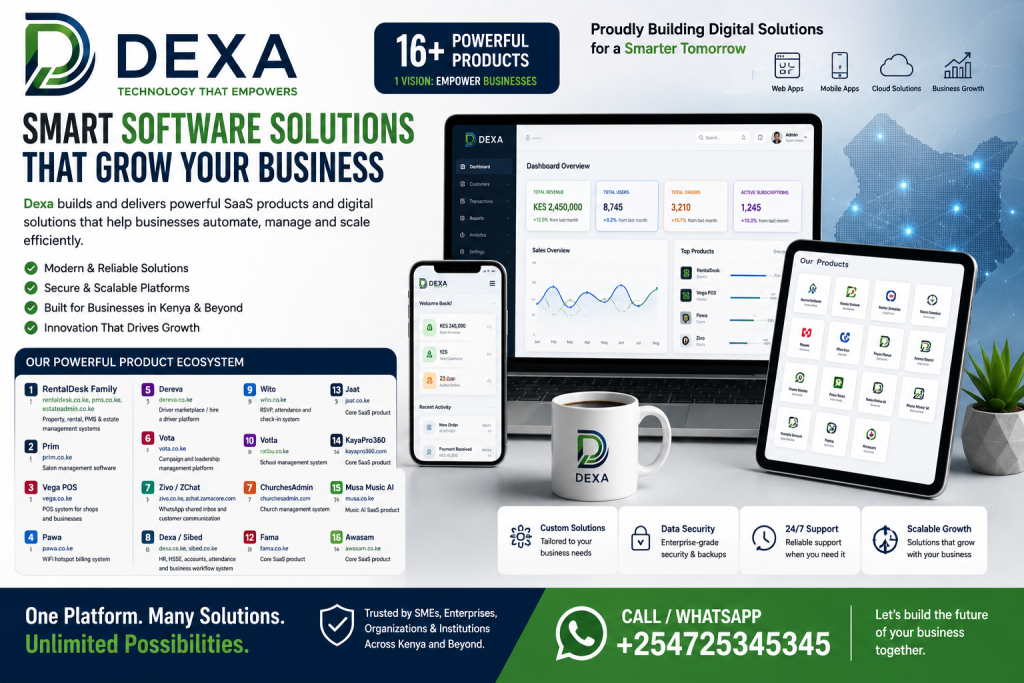
One of the strengths surrounding dexa is its connection with a broader ecosystem of specialized business software developed for different industries.
Organizations managing rental properties may benefit from RentalDesk together with PMS and EstateAdmin solutions for property operations.
Beauty businesses often integrate Prim salon management software for appointment scheduling and customer management.
Retail businesses can utilize Vega POS to streamline sales processing and inventory management.
Companies providing internet services may incorporate Pawa for WiFi hotspot billing and subscriber management.
Organizations requiring transportation solutions can leverage Dereva for driver recruitment and management, while political organizations may utilize Vota for campaign and leadership management.
Customer communication becomes more efficient through Zivo and ZChat shared WhatsApp platforms, allowing support teams to collaborate effectively.
Schools may deploy Ratibu for education management, churches can adopt ChurchesAdmin for congregation administration, while RSVP management is simplified through Wito.
Additional platforms such as Fama, Jaat, KayaPro360, Musa Music AI, and Awasam further demonstrate how specialized SaaS products can complement broader business automation strategies.
Together, these interconnected platforms create a comprehensive digital ecosystem capable of supporting organizations across multiple industries while reducing dependence on fragmented software solutions.
Why Businesses Continue Choosing Automation
Technology investments should always produce measurable business outcomes rather than simply introducing new software.
Organizations implementing automation consistently report improvements in operational consistency, reporting speed, employee accountability, management visibility, and customer service.
Although implementation requires planning, staff training, and organizational commitment, the long-term operational improvements generally outweigh the initial investment.
Businesses that standardize workflows today place themselves in a stronger position to scale tomorrow without experiencing administrative bottlenecks.
As Kenya’s digital economy continues expanding, structured business systems will increasingly become a requirement rather than a competitive advantage. Companies that adopt automation early are better positioned to respond quickly to market opportunities, changing customer expectations, and future technological innovations.
Building a Sustainable Business with Dexa
Sustainable business growth depends on more than increasing sales. Companies must also improve internal efficiency, control operating costs, and maintain consistent service quality as they expand. This is where dexa continues to deliver long-term value by creating standardized processes that remain effective even as the organization grows.
A growing business often experiences challenges such as inconsistent reporting, duplicated work, delayed approvals, and communication gaps between departments. Without a centralized platform, these issues become more frequent as new employees join and additional branches are opened. By implementing dexa, businesses establish repeatable workflows that reduce confusion and ensure every department follows the same operational standards.
Another important advantage is business continuity. When key employees resign or take leave, organizations relying on manual records often struggle to maintain operations because critical information exists only in individual spreadsheets or paper files. With a centralized digital system, business records, approvals, employee data, and operational history remain securely stored and accessible to authorized personnel. This reduces operational disruption and protects valuable institutional knowledge.
Ultimately, investing in dexa is not simply about adopting new technology—it is about building a resilient organization capable of adapting to growth, supporting better decision-making, and maintaining high operational standards. Businesses that embrace structured automation today are better prepared for tomorrow’s opportunities, whether expanding into new markets, increasing staff, or serving a larger customer base while maintaining efficiency and professionalism.
Industry Applications of Dexa
The flexibility of dexa allows it to be used across different sectors:
Retail Businesses
- Inventory tracking
- Staff scheduling
- Sales reporting
Service Companies
- Client management
- Billing automation
- Project tracking
Corporate Organizations
- HR management
- Payroll processing
- Compliance tracking
Each industry benefits differently, but the underlying advantage remains the same—efficiency improvement.
Internal Ecosystem Integration
Dexa is part of a broader ecosystem of business tools designed to work together.
Explore related systems:
- https://dexa.co.ke/hr-management
- https://dexa.co.ke/business-automation
- https://dexa.co.ke/workflow-systems
This interconnected structure ensures that businesses can scale without switching platforms.
External Tools That Complement Dexa
To maximize performance, businesses often integrate external tools such as:
- Google Workspace: https://workspace.google.com
- Cloud infrastructure services: https://aws.amazon.com
- Analytics tools: https://analytics.google.com
These integrations enhance reporting, storage, and communication capabilities.
Future of Business Automation in Kenya
The Kenyan business landscape is rapidly evolving. Companies that once relied on manual systems are now transitioning to fully automated platforms.
Within the next 5 years, businesses that fail to adopt automation will likely face competitive disadvantages, particularly in sectors such as retail, logistics, and professional services.
Systems like dexa represent the foundation of this shift.
Long-Term Strategic Value of Dexa
Beyond immediate cost savings, the long-term value of automation includes:
- Better decision-making through real-time data
- Reduced dependency on manual labor
- Improved scalability
- Higher business valuation due to structured operations
Investors often value businesses higher when they demonstrate strong digital infrastructure because it indicates efficiency and scalability.
Final Perspective
Modern businesses are no longer competing only on products or services—they are competing on systems.
A company using structured automation like dexa operates faster, more accurately, and more efficiently than one relying on manual processes.
The financial impact is measurable, the risks are manageable, and the long-term benefits are substantial.
Final CTA
If your business is ready to move beyond manual inefficiencies and adopt structured automation, now is the time to upgrade.
Start here: https://dexa.co.ke/