Delivery Route Planning Software
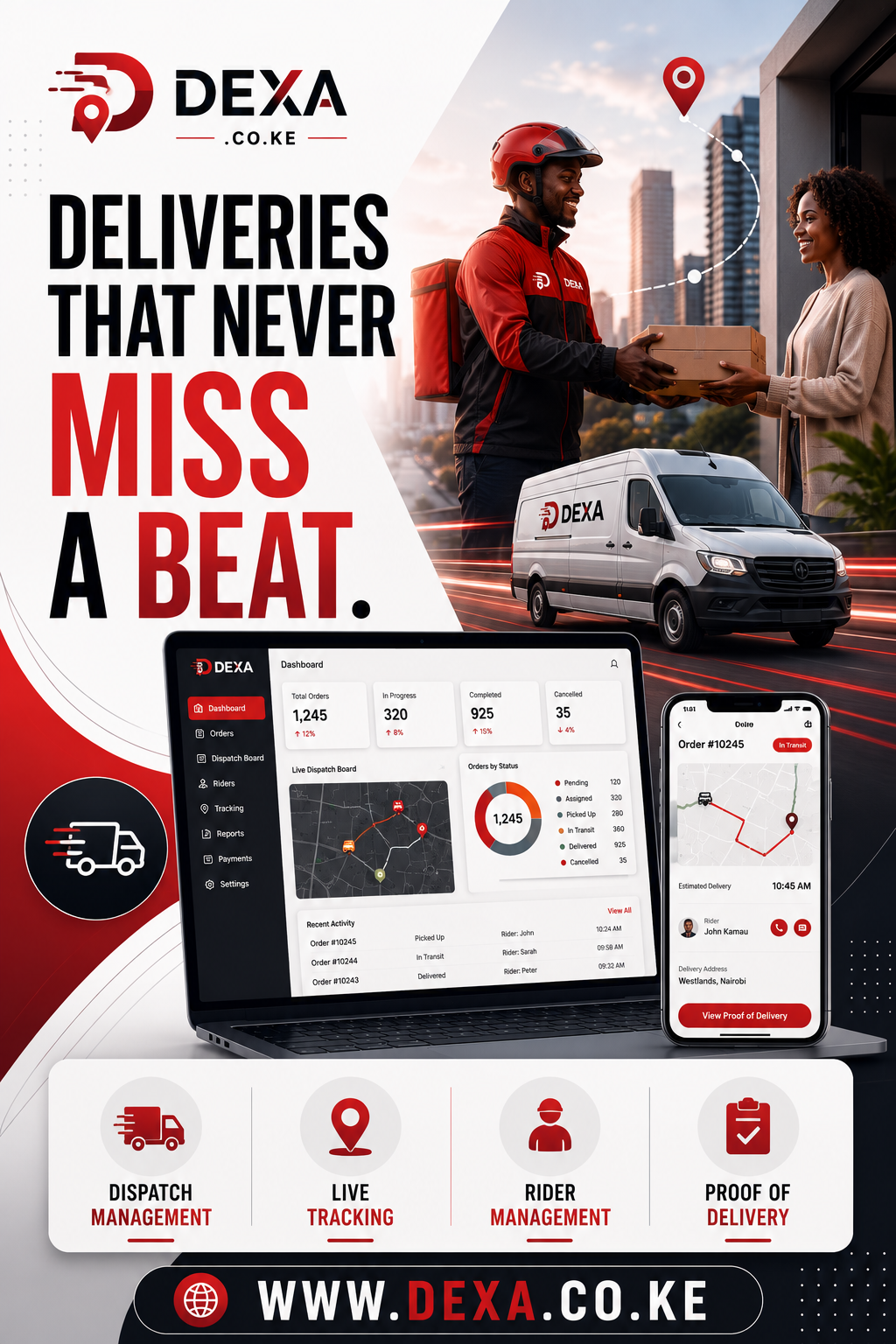
Delivery Route Planning Software has become one of the most valuable technologies for businesses that rely on transportation, courier services, field operations, and product distribution. Whether a company manages ten deliveries a day or thousands across multiple counties in Kenya, efficient route planning directly affects fuel consumption, driver productivity, customer satisfaction, and overall profitability.
Many businesses still rely on manual route planning using spreadsheets, phone calls, or basic navigation applications. While these methods may work for very small operations, they become increasingly inefficient as delivery volumes grow. Delays, unnecessary mileage, missed deliveries, and rising fuel costs quickly become significant challenges.
Modern businesses require intelligent systems capable of analyzing multiple delivery locations, vehicle capacities, traffic conditions, customer priorities, and delivery schedules within seconds. This is exactly where Delivery Route Planning Software creates measurable value by transforming complex delivery operations into organized, data-driven workflows.
For Kenyan businesses operating in Nairobi, Mombasa, Kisumu, Nakuru, Eldoret, and other growing commercial centres, route optimization is becoming increasingly important as traffic congestion, customer expectations, and operational costs continue to rise. Companies that embrace digital route planning are often able to deliver more orders using the same fleet while maintaining higher service standards.
Table of Contents
- Understanding Route Planning
- Why Businesses Need Intelligent Routing
- Core Features of Modern Solutions
- Industries That Benefit
- How Route Optimization Works
- Business Benefits
- Choosing the Right Platform
Understanding Route Planning
Route planning is the process of determining the most efficient path for drivers to complete deliveries while minimizing travel time, fuel usage, and operational expenses. Although the concept appears straightforward, modern logistics involves far more than simply finding the shortest distance between two locations.
A comprehensive Delivery Route Planning Software solution evaluates numerous variables simultaneously, including delivery priorities, customer time windows, vehicle capacity, road restrictions, driver schedules, traffic patterns, weather conditions where applicable, and the location of each destination.
Instead of dispatch managers spending hours manually organizing delivery schedules, intelligent software performs these calculations in seconds, allowing teams to focus on customer service and operational management.
The result is a more predictable delivery operation where drivers spend less time on the road while completing more deliveries within the same working hours.
Why Businesses Need Intelligent Routing
The growth of e-commerce, online ordering, wholesale distribution, and same-day delivery services has significantly increased the complexity of logistics operations. Customers now expect accurate delivery estimates, real-time communication, and consistent service regardless of order size.
Without Delivery Route Planning Software, dispatch teams often face several operational challenges, including duplicated routes, excessive fuel consumption, inefficient driver allocation, delayed deliveries, and poor fleet visibility.
Businesses also struggle to respond quickly when unexpected events occur. A vehicle breakdown, traffic congestion, road closures, or urgent customer requests may require immediate route adjustments. Manual planning simply cannot provide the flexibility required in today’s competitive environment.
Automated route planning allows dispatchers to recalculate routes instantly, ensuring minimal disruption while maintaining customer satisfaction.
Core Features of Modern Solutions
A reliable Delivery Route Planning Software platform combines multiple technologies into one centralized system that supports dispatchers, drivers, managers, and customers.
Intelligent Route Optimization
Advanced algorithms calculate the fastest and most cost-effective delivery sequence while considering multiple operational constraints. Rather than relying solely on distance, the software balances travel time, delivery priorities, and vehicle availability.
Multi-Stop Planning
Businesses frequently manage dozens or hundreds of deliveries daily. Efficient planning ensures every stop contributes to maximum productivity while reducing unnecessary travel.
Real-Time GPS Tracking
Managers gain complete visibility of vehicle locations throughout the day. This improves accountability while enabling accurate customer updates.
Driver Navigation
Drivers receive optimized routes directly on their mobile devices, reducing navigation errors and ensuring consistent service delivery.
Dynamic Route Adjustments
Unexpected delays are inevitable in logistics. Modern systems automatically recommend alternative routes whenever road conditions change or urgent deliveries arise.
Delivery Performance Analytics
Comprehensive reports provide valuable insights into delivery times, vehicle utilization, fuel efficiency, completed orders, and overall operational performance.
Industries That Benefit
Although courier companies are among the biggest users of Delivery Route Planning Software, many industries benefit from intelligent routing technologies.
Courier and Parcel Delivery
Courier companies manage high delivery volumes every day. Automated route planning helps maximize daily deliveries while improving customer satisfaction.
Wholesale Distribution
Manufacturers and wholesalers delivering products to retailers require efficient scheduling to reduce transportation costs and maintain inventory availability.
Retail Chains
Retail businesses operating multiple branches depend on reliable distribution to ensure products arrive on time and shelves remain stocked.
Food and Beverage Distribution
Restaurants, supermarkets, beverage suppliers, and food distributors benefit from optimized routes that reduce delivery times while preserving product quality.
Pharmaceutical Distribution
Healthcare suppliers require reliable transportation for medicines and medical equipment. Route optimization supports timely deliveries while maintaining compliance with delivery schedules.
E-commerce Businesses
Online shopping continues to expand across Kenya. Businesses handling increasing order volumes rely on optimized routing to maintain fast and accurate deliveries.
How Route Optimization Works
The effectiveness of Delivery Route Planning Software comes from its ability to process large amounts of operational data almost instantly.
When new delivery orders enter the system, the software evaluates customer addresses, delivery priorities, available vehicles, driver schedules, estimated travel times, and traffic conditions. Using optimization algorithms, it determines the most efficient delivery sequence for every driver.
Instead of assigning deliveries manually, dispatchers receive optimized recommendations that reduce unnecessary mileage and maximize daily productivity.
As deliveries progress, GPS tracking continuously updates vehicle locations. If delays occur, dispatchers can immediately adjust assignments or reroute nearby drivers without disrupting the entire operation.
This dynamic approach allows businesses to respond quickly to changing conditions while maintaining service quality.
Business Benefits
Organizations implementing Delivery Route Planning Software frequently experience measurable improvements across multiple operational areas.
Lower fuel consumption results from shorter travel distances and reduced idle time.
Driver productivity increases because more deliveries can be completed within normal working hours.
Customers receive more accurate delivery estimates and improved communication throughout the delivery process.
Dispatch teams spend less time manually organizing schedules and more time monitoring operations and resolving exceptions.
Fleet utilization improves because vehicles are assigned more efficiently based on workload and location.
Management gains access to detailed operational reports that support better strategic decision-making.
These combined benefits contribute to lower operating costs, improved customer retention, and stronger competitive positioning.
Choosing the Right Platform
Selecting the right Delivery Route Planning Software requires more than comparing feature lists. Businesses should evaluate whether the solution can scale alongside future growth, integrate with existing systems, and support local operational requirements.
Key considerations include ease of use, mobile accessibility, GPS accuracy, route optimization capabilities, reporting features, customer communication tools, integration with dispatch management systems, proof of delivery functionality, and ongoing technical support.
For businesses operating in Kenya, compatibility with local addressing systems, mobile networks, and regional logistics workflows is equally important. A platform designed to accommodate local delivery environments will provide greater long-term value than a generic international solution.
Solutions such as Dexa combine route planning with dispatch management, driver tracking, proof of delivery, customer updates, and operational reporting, allowing businesses to manage the entire delivery lifecycle from a single platform rather than relying on disconnected tools.
Benefits for Different Stakeholders
A well-implemented Delivery Route Planning Software solution delivers value across every level of an organization. From executives and dispatch managers to drivers and customers, each stakeholder experiences improvements that contribute to a more efficient and profitable delivery operation.
Business Owners
Business owners need visibility into operational performance, costs, and profitability. Delivery Route Planning Software provides comprehensive dashboards and reports that reveal how efficiently the fleet is operating. Owners can monitor delivery completion rates, fuel usage, driver productivity, vehicle utilization, and customer satisfaction without relying solely on manual reports.
These insights support informed decision-making, allowing businesses to identify opportunities for cost reduction, optimize fleet investments, and plan for future expansion.
Dispatch Managers
Dispatch managers are responsible for ensuring deliveries are assigned efficiently and completed on time. Without automation, route planning can consume hours every day, especially during peak periods.
With Delivery Route Planning Software, dispatchers can automatically assign deliveries, monitor vehicle locations in real time, respond to unexpected disruptions, and communicate directly with drivers. This significantly reduces administrative work while improving operational accuracy.
Drivers
Drivers benefit from clear navigation instructions, optimized delivery sequences, and fewer unnecessary trips. Instead of receiving last-minute route changes through phone calls, drivers can access updated schedules through mobile applications.
Optimized routes reduce stress, shorten travel times, and help drivers complete more deliveries within standard working hours while minimizing fuel consumption.
Customers
Today’s customers expect accurate delivery times, regular updates, and reliable service. Delivery Route Planning Software enhances the customer experience by providing estimated arrival times, real-time delivery tracking, and timely notifications.
Satisfied customers are more likely to become repeat clients, leave positive reviews, and recommend the business to others.
Improving Efficiency Through Automation
Automation is transforming logistics across industries, and Delivery Route Planning Software is at the center of this transformation.
Instead of manually reviewing delivery addresses and assigning drivers, intelligent systems automate repetitive tasks while maintaining high levels of accuracy. Orders can be imported directly from sales systems, automatically assigned based on location and vehicle availability, and optimized for maximum efficiency.
Automation also minimizes human errors such as duplicate deliveries, missed customer addresses, incorrect route assignments, and inefficient scheduling.
As delivery operations grow, manual planning becomes increasingly difficult. A business managing twenty daily deliveries may cope with spreadsheets, but managing hundreds or thousands of deliveries requires sophisticated automation to maintain performance.
Integrated platforms like Dexa further streamline operations by connecting order management, dispatch scheduling, GPS tracking, proof of delivery, customer communication, and reporting within a single system.
Supporting Fleet Growth
Business growth often brings additional vehicles, drivers, customers, and delivery locations. Managing this complexity manually can quickly overwhelm dispatch teams.
Delivery Route Planning Software supports scalable operations by automatically balancing workloads across the fleet. As new drivers join or additional vehicles become available, the system adjusts assignments without disrupting existing schedules.
Businesses can expand into new counties across Kenya while maintaining consistent service quality and operational control.
Whether serving Nairobi, Kiambu, Machakos, Mombasa, Kisumu, Eldoret, Nakuru, or multiple regions simultaneously, scalable route planning helps organizations maintain efficiency as delivery volumes increase.
Data-Driven Decision Making
Modern logistics generates valuable operational data. Every completed delivery provides information about travel time, delivery duration, vehicle utilization, customer locations, and route performance.
Delivery Route Planning Software transforms this data into actionable insights through comprehensive reporting and analytics.
Managers can identify:
Frequently delayed delivery areas
High-performing drivers
Fuel consumption trends
Vehicle utilization rates
Customer delivery patterns
Peak delivery periods
Route efficiency improvements
Operational bottlenecks
These insights support continuous improvement rather than relying on assumptions or outdated reporting methods.
Compliance, Security and Risk Management
Delivery operations involve valuable goods, customer information, and financial transactions. Maintaining security and compliance is essential for protecting both the business and its customers.
A robust Delivery Route Planning Software solution includes user authentication, role-based permissions, encrypted data storage, secure communication channels, and comprehensive audit trails.
Managers can track who created orders, modified delivery schedules, approved dispatches, and confirmed deliveries. This improves accountability while reducing opportunities for fraud or unauthorized system access.
Proof of delivery features such as digital signatures, photographs, timestamps, and GPS coordinates provide additional verification that deliveries were completed successfully.
For Kenyan businesses operating in regulated industries such as pharmaceuticals, healthcare, food distribution, and financial services, maintaining accurate delivery records also supports compliance requirements.
Integration with Business Systems
Route planning should not operate independently from the rest of the business.
Modern Delivery Route Planning Software integrates with inventory management systems, customer relationship management (CRM) platforms, enterprise resource planning (ERP) software, accounting applications, online ordering platforms, and dispatch management systems.
These integrations eliminate duplicate data entry, reduce administrative work, and ensure every department has access to accurate operational information.
For example, when a customer places an order, it can automatically appear in the dispatch queue, be assigned to an optimized route, tracked throughout delivery, and marked as completed once proof of delivery is received.
This seamless information flow improves efficiency across the organization.
Why Dexa is an Ideal Solution
Businesses require more than route optimization alone—they need complete visibility into the entire delivery process.
Dexa brings together Delivery Route Planning Software, dispatch management, live GPS tracking, driver management, proof of delivery, customer notifications, delivery history, and operational reporting in one centralized platform.
Instead of switching between multiple disconnected applications, businesses can manage the complete delivery lifecycle from a single dashboard.
Dexa is particularly suitable for:
Courier companies
Logistics providers
E-commerce businesses
Wholesale distributors
Manufacturers
Pharmaceutical suppliers
Retail distribution companies
Food and beverage distributors
Field service organizations
Because the platform supports growing delivery operations, businesses can expand confidently without significantly increasing administrative overhead.
Future Trends in Delivery Route Planning
The logistics industry continues to evolve rapidly, driven by technological innovation and changing customer expectations.
Future Delivery Route Planning Software solutions are expected to incorporate artificial intelligence, machine learning, predictive analytics, and advanced automation to further improve efficiency.
Some emerging trends include:
AI-powered demand forecasting
Predictive traffic analysis
Automated driver scheduling
Electric vehicle route optimization
Carbon emission reporting
Drone-assisted deliveries
Autonomous delivery technologies
Enhanced customer communication
Voice-assisted driver navigation
Advanced business intelligence dashboards
Businesses that embrace these innovations early will be better positioned to compete in increasingly demanding markets.
Getting Started
Successfully implementing Delivery Route Planning Software begins with understanding your organization’s delivery processes.
Businesses should evaluate:
Current delivery volumes
Fleet size
Customer locations
Delivery time requirements
Existing software systems
Reporting needs
Growth objectives
Choosing a scalable platform ensures the software continues supporting operations as the business expands.
Implementation should include employee training, workflow optimization, data migration, and performance monitoring to maximize long-term benefits.
Organizations that invest in proper implementation typically experience improved operational efficiency, lower transportation costs, enhanced customer satisfaction, and stronger overall business performance.
Conclusion
Delivery Route Planning Software is no longer a luxury reserved for large logistics companies. It has become an essential technology for businesses seeking to improve efficiency, reduce costs, and deliver exceptional customer experiences.
From intelligent route optimization and real-time fleet visibility to automation, reporting, and customer communication, the right solution enables organizations to operate more effectively in increasingly competitive markets.
For businesses across Kenya, adopting modern route planning technology represents an opportunity to streamline logistics, improve service quality, and build a foundation for sustainable growth. As delivery expectations continue to rise, organizations that invest in intelligent routing solutions will be better equipped to meet customer demands while maintaining operational excellence.
Benefits for Different Stakeholders
A well-implemented Delivery Route Planning Software solution delivers value across every level of an organization. From executives and dispatch managers to drivers and customers, each stakeholder experiences improvements that contribute to a more efficient and profitable delivery operation.
Business Owners
Business owners need visibility into operational performance, costs, and profitability. Delivery Route Planning Software provides comprehensive dashboards and reports that reveal how efficiently the fleet is operating. Owners can monitor delivery completion rates, fuel usage, driver productivity, vehicle utilization, and customer satisfaction without relying solely on manual reports.
These insights support informed decision-making, allowing businesses to identify opportunities for cost reduction, optimize fleet investments, and plan for future expansion.
Dispatch Managers
Dispatch managers are responsible for ensuring deliveries are assigned efficiently and completed on time. Without automation, route planning can consume hours every day, especially during peak periods.
With Delivery Route Planning Software, dispatchers can automatically assign deliveries, monitor vehicle locations in real time, respond to unexpected disruptions, and communicate directly with drivers. This significantly reduces administrative work while improving operational accuracy.
Drivers
Drivers benefit from clear navigation instructions, optimized delivery sequences, and fewer unnecessary trips. Instead of receiving last-minute route changes through phone calls, drivers can access updated schedules through mobile applications.
Optimized routes reduce stress, shorten travel times, and help drivers complete more deliveries within standard working hours while minimizing fuel consumption.
Customers
Today’s customers expect accurate delivery times, regular updates, and reliable service. Delivery Route Planning Software enhances the customer experience by providing estimated arrival times, real-time delivery tracking, and timely notifications.
Satisfied customers are more likely to become repeat clients, leave positive reviews, and recommend the business to others.
Improving Efficiency Through Automation
Automation is transforming logistics across industries, and Delivery Route Planning Software is at the center of this transformation.
Instead of manually reviewing delivery addresses and assigning drivers, intelligent systems automate repetitive tasks while maintaining high levels of accuracy. Orders can be imported directly from sales systems, automatically assigned based on location and vehicle availability, and optimized for maximum efficiency.
Automation also minimizes human errors such as duplicate deliveries, missed customer addresses, incorrect route assignments, and inefficient scheduling.
As delivery operations grow, manual planning becomes increasingly difficult. A business managing twenty daily deliveries may cope with spreadsheets, but managing hundreds or thousands of deliveries requires sophisticated automation to maintain performance.
Integrated platforms like Dexa further streamline operations by connecting order management, dispatch scheduling, GPS tracking, proof of delivery, customer communication, and reporting within a single system.
Supporting Fleet Growth
Business growth often brings additional vehicles, drivers, customers, and delivery locations. Managing this complexity manually can quickly overwhelm dispatch teams.
Delivery Route Planning Software supports scalable operations by automatically balancing workloads across the fleet. As new drivers join or additional vehicles become available, the system adjusts assignments without disrupting existing schedules.
Businesses can expand into new counties across Kenya while maintaining consistent service quality and operational control.
Whether serving Nairobi, Kiambu, Machakos, Mombasa, Kisumu, Eldoret, Nakuru, or multiple regions simultaneously, scalable route planning helps organizations maintain efficiency as delivery volumes increase.
Data-Driven Decision Making
Modern logistics generates valuable operational data. Every completed delivery provides information about travel time, delivery duration, vehicle utilization, customer locations, and route performance.
Delivery Route Planning Software transforms this data into actionable insights through comprehensive reporting and analytics.
Managers can identify:
Frequently delayed delivery areas
High-performing drivers
Fuel consumption trends
Vehicle utilization rates
Customer delivery patterns
Peak delivery periods
Route efficiency improvements
Operational bottlenecks
These insights support continuous improvement rather than relying on assumptions or outdated reporting methods.
Compliance, Security and Risk Management
Delivery operations involve valuable goods, customer information, and financial transactions. Maintaining security and compliance is essential for protecting both the business and its customers.
A robust Delivery Route Planning Software solution includes user authentication, role-based permissions, encrypted data storage, secure communication channels, and comprehensive audit trails.
Managers can track who created orders, modified delivery schedules, approved dispatches, and confirmed deliveries. This improves accountability while reducing opportunities for fraud or unauthorized system access.
Proof of delivery features such as digital signatures, photographs, timestamps, and GPS coordinates provide additional verification that deliveries were completed successfully.
For Kenyan businesses operating in regulated industries such as pharmaceuticals, healthcare, food distribution, and financial services, maintaining accurate delivery records also supports compliance requirements.
Integration with Business Systems
Route planning should not operate independently from the rest of the business.
Modern Delivery Route Planning Software integrates with inventory management systems, customer relationship management (CRM) platforms, enterprise resource planning (ERP) software, accounting applications, online ordering platforms, and dispatch management systems.
These integrations eliminate duplicate data entry, reduce administrative work, and ensure every department has access to accurate operational information.
For example, when a customer places an order, it can automatically appear in the dispatch queue, be assigned to an optimized route, tracked throughout delivery, and marked as completed once proof of delivery is received.
This seamless information flow improves efficiency across the organization.
Why Dexa is an Ideal Solution
Businesses require more than route optimization alone—they need complete visibility into the entire delivery process.
Dexa brings together Delivery Route Planning Software, dispatch management, live GPS tracking, driver management, proof of delivery, customer notifications, delivery history, and operational reporting in one centralized platform.
Instead of switching between multiple disconnected applications, businesses can manage the complete delivery lifecycle from a single dashboard.
Dexa is particularly suitable for:
Courier companies
Logistics providers
E-commerce businesses
Wholesale distributors
Manufacturers
Pharmaceutical suppliers
Retail distribution companies
Food and beverage distributors
Field service organizations
Because the platform supports growing delivery operations, businesses can expand confidently without significantly increasing administrative overhead.
Future Trends in Delivery Route Planning
The logistics industry continues to evolve rapidly, driven by technological innovation and changing customer expectations.
Future Delivery Route Planning Software solutions are expected to incorporate artificial intelligence, machine learning, predictive analytics, and advanced automation to further improve efficiency.
Some emerging trends include:
AI-powered demand forecasting
Predictive traffic analysis
Automated driver scheduling
Electric vehicle route optimization
Carbon emission reporting
Drone-assisted deliveries
Autonomous delivery technologies
Enhanced customer communication
Voice-assisted driver navigation
Advanced business intelligence dashboards
Businesses that embrace these innovations early will be better positioned to compete in increasingly demanding markets.
Getting Started
Successfully implementing Delivery Route Planning Software begins with understanding your organization’s delivery processes.
Businesses should evaluate:
Current delivery volumes
Fleet size
Customer locations
Delivery time requirements
Existing software systems
Reporting needs
Growth objectives
Choosing a scalable platform ensures the software continues supporting operations as the business expands.
Implementation should include employee training, workflow optimization, data migration, and performance monitoring to maximize long-term benefits.
Organizations that invest in proper implementation typically experience improved operational efficiency, lower transportation costs, enhanced customer satisfaction, and stronger overall business performance.
Conclusion
Delivery Route Planning Software is no longer a luxury reserved for large logistics companies. It has become an essential technology for businesses seeking to improve efficiency, reduce costs, and deliver exceptional customer experiences.
From intelligent route optimization and real-time fleet visibility to automation, reporting, and customer communication, the right solution enables organizations to operate more effectively in increasingly competitive markets.
For businesses across Kenya, adopting modern route planning technology represents an opportunity to streamline logistics, improve service quality, and build a foundation for sustainable growth. As delivery expectations continue to rise, organizations that invest in intelligent routing solutions will be better equipped to meet customer demands while maintaining operational excellence.