Delivery Operations Tracking System
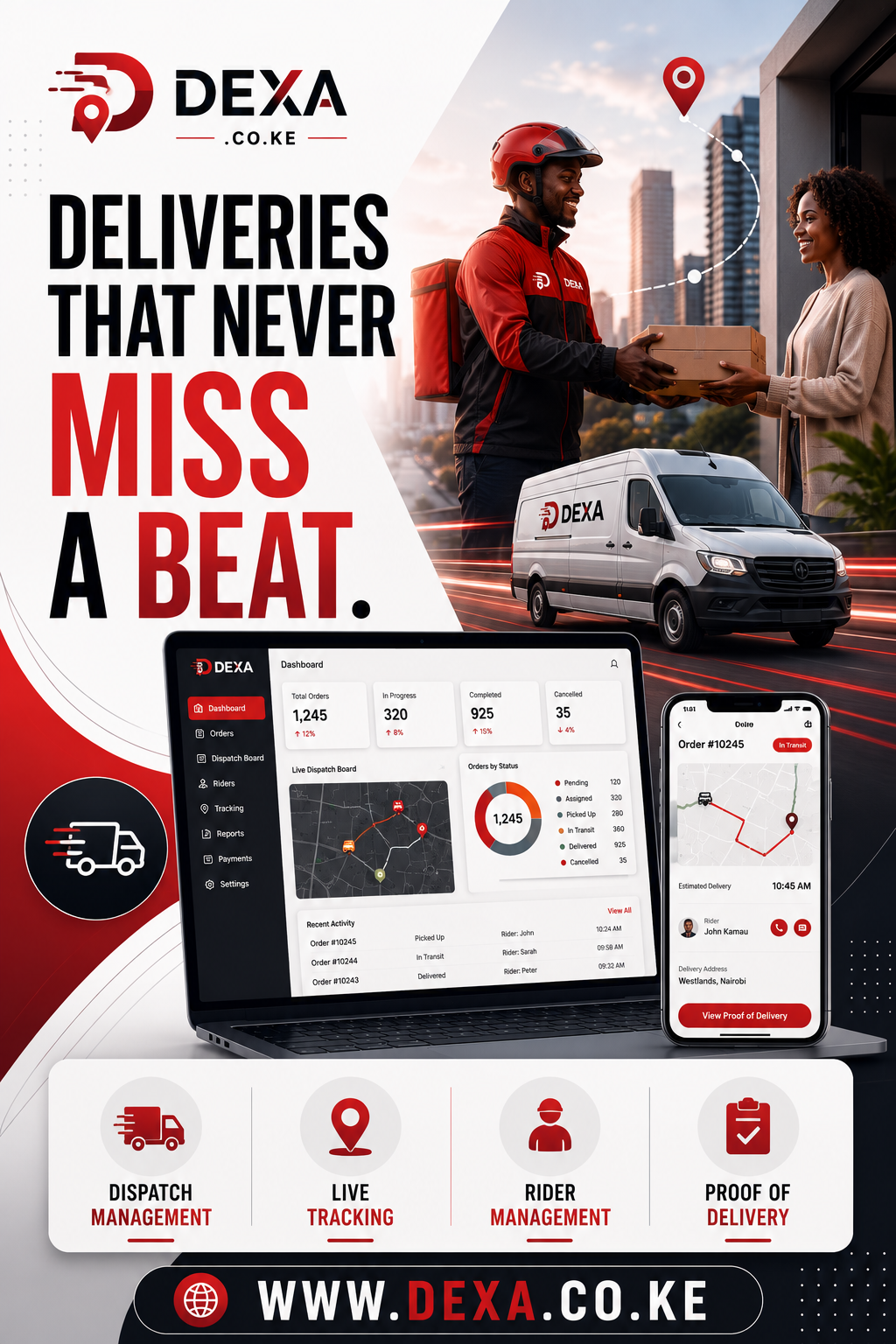
A Delivery Operations Tracking System is one of the most valuable technologies for businesses that depend on timely deliveries, accurate order fulfillment, and efficient fleet coordination. Whether managing a courier company, e-commerce logistics, wholesale distribution, food delivery, or field service operations, organizations require complete visibility into every delivery from dispatch to successful completion.
Across Kenya, businesses are experiencing increased customer expectations for faster deliveries, real-time updates, and accurate delivery records. Manual tracking methods involving phone calls, spreadsheets, WhatsApp messages, and paper logs often create delays, communication gaps, and operational inefficiencies. A modern Delivery Operations Tracking System solves these challenges by providing a centralized platform that connects dispatchers, drivers, managers, and customers in real time.
Companies that invest in digital delivery management gain greater operational control, improved customer satisfaction, lower operational costs, and better decision-making through accurate reporting and analytics. Rather than reacting to delivery problems after they occur, businesses can monitor ongoing operations, identify issues immediately, and take corrective action before customer service is affected.
For growing businesses in Kenya, implementing a comprehensive delivery management solution is no longer just a competitive advantage—it has become a necessity for maintaining efficiency and meeting modern customer expectations.
Table of Contents
- Introduction to Modern Delivery Management
- Understanding Delivery Workflows
- Key Features of Modern Tracking Platforms
- Real-Time Fleet Visibility
- Order Assignment and Dispatch Automation
- Driver Management and Performance
- Customer Communication and Notifications
- Proof of Delivery Management
- Reporting and Business Intelligence
- Applications Across Different Industries
Introduction to Modern Delivery Management
The logistics industry has evolved significantly over the past decade. Businesses are expected to deliver products quickly while maintaining transparency throughout the entire delivery journey. Customers increasingly expect to know when their order has been dispatched, where it is currently located, and when it will arrive.
A Delivery Operations Tracking System provides this visibility by integrating order management, dispatch coordination, driver tracking, route management, and customer communication into one centralized platform.
Instead of relying on multiple disconnected systems, organizations can manage every stage of delivery from a single dashboard. Managers can monitor active deliveries, identify delays, communicate with drivers, and ensure customers receive timely updates.
This centralized approach improves operational efficiency while reducing administrative workload and minimizing costly delivery errors.
Understanding Delivery Workflows
Every successful delivery operation follows several important stages that require coordination between multiple teams.
The process typically begins when a customer places an order. The order is verified, assigned to a dispatcher, allocated to an available driver, collected from the warehouse or store, transported to the destination, delivered to the customer, and finally confirmed through proof of delivery.
Without automation, each stage introduces opportunities for mistakes including incorrect assignments, delayed dispatching, missed deliveries, duplicate orders, and poor communication.
A Delivery Operations Tracking System standardizes these workflows by automating repetitive tasks while providing real-time visibility into every delivery stage.
Managers can easily identify bottlenecks, optimize workflows, and ensure every delivery follows standardized operational procedures.
Key Features of Modern Tracking Platforms
An effective Delivery Operations Tracking System includes a comprehensive set of features designed to simplify logistics management.
Core capabilities often include:
- Centralized order management
- Automated dispatching
- Driver assignment
- GPS tracking
- Delivery status updates
- Route optimization
- Proof of delivery
- Customer notifications
- Digital signatures
- Photo verification
- Fleet monitoring
- Delivery scheduling
- Performance reporting
- Analytics dashboards
- Role-based access controls
These capabilities work together to provide complete operational visibility while reducing manual administrative tasks.
As businesses expand, these features become increasingly valuable because they support larger delivery volumes without requiring proportional increases in administrative staff.
Real-Time Fleet Visibility
One of the greatest advantages of implementing a Delivery Operations Tracking System is the ability to monitor delivery vehicles in real time.
Operations managers no longer need to repeatedly call drivers to determine their locations. Instead, GPS tracking provides continuous updates directly on a centralized dashboard.
Real-time visibility allows businesses to:
- Monitor driver locations
- Identify delivery delays
- Detect route deviations
- Estimate arrival times
- Improve dispatch decisions
- Respond quickly to emergencies
- Reduce unnecessary travel
This visibility also enables customer service teams to answer delivery inquiries with confidence, improving the overall customer experience.
Order Assignment and Dispatch Automation
Manual dispatching becomes increasingly difficult as delivery volumes grow.
Dispatchers often struggle to balance workloads fairly while ensuring urgent deliveries receive priority.
A Delivery Operations Tracking System automates order allocation using configurable rules such as:
- Driver availability
- Delivery location
- Vehicle capacity
- Delivery priority
- Driver workload
- Delivery deadlines
- Geographic proximity
Automation reduces assignment errors while helping dispatchers coordinate larger fleets efficiently.
Businesses handling hundreds of daily deliveries particularly benefit from automated dispatch because it minimizes delays and improves overall operational consistency.
Driver Management and Performance
Drivers play a critical role in delivery success. Managing their schedules, workloads, performance, and accountability is essential for maintaining reliable service.
Modern systems provide managers with valuable driver performance insights including:
- Completed deliveries
- Failed deliveries
- Average delivery times
- Route efficiency
- Customer ratings
- Attendance
- Delivery accuracy
- Idle time
- Fuel efficiency
These insights help organizations identify high-performing drivers while providing coaching opportunities where improvements are needed.
Managers can also balance workloads more fairly, reducing employee burnout while maintaining service quality.
Customer Communication and Notifications
Customer expectations continue to evolve. Modern consumers appreciate timely updates regarding their deliveries.
A Delivery Operations Tracking System supports automated customer communication through:
- Order confirmations
- Dispatch notifications
- Estimated arrival times
- Driver updates
- Delivery completion alerts
- Delay notifications
Providing proactive communication significantly reduces customer inquiries while improving trust.
Businesses that keep customers informed throughout the delivery process generally experience higher satisfaction levels and increased repeat business.
Proof of Delivery Management
Verifying successful deliveries is critical for preventing disputes.
Traditional paper delivery notes can easily become lost or damaged, making it difficult to resolve customer disagreements.
Digital proof of delivery allows drivers to capture:
- Customer signatures
- Delivery photos
- GPS coordinates
- Time stamps
- Recipient names
- Delivery notes
This digital evidence protects both businesses and customers by providing accurate delivery records.
A Delivery Operations Tracking System stores this information securely for future reference, simplifying dispute resolution and audit processes.
Reporting and Business Intelligence
Operational data becomes valuable only when organizations can analyze and act upon it.
A modern Delivery Operations Tracking System generates comprehensive reports covering all aspects of delivery performance.
Examples include:
- Daily delivery volumes
- Driver productivity
- Fleet utilization
- Delivery success rates
- Average delivery times
- Failed deliveries
- Customer satisfaction trends
- Geographic delivery analysis
- Revenue performance
- Operational costs
Managers can use these insights to identify trends, optimize resources, improve planning, and support long-term business growth.
Historical reporting also helps organizations measure improvements after implementing new operational strategies.
Applications Across Different Industries
Delivery tracking technology supports a wide variety of industries across Kenya.
E-commerce retailers rely on accurate order tracking to improve customer confidence and reduce delivery inquiries.
Courier companies coordinate hundreds of daily deliveries while maintaining visibility across multiple drivers.
Wholesale distributors monitor deliveries to supermarkets, retail stores, and commercial customers.
Pharmacies and healthcare providers ensure medicines and medical supplies reach patients quickly.
Restaurants and food delivery businesses depend on accurate dispatching to maintain food quality and customer satisfaction.
Manufacturers coordinate deliveries between factories, warehouses, distributors, and retailers.
Field service companies manage technicians delivering equipment, performing installations, or completing maintenance visits.
A platform such as Dexa naturally supports these diverse operational requirements by combining dispatch management, driver coordination, order tracking, proof of delivery, workflow automation, and operational reporting within a single system. Rather than replacing existing business processes, it helps organizations standardize and streamline them as delivery volumes grow.
Benefits of a Delivery Operations Tracking System for Different Stakeholders
A Delivery Operations Tracking System creates value for every participant involved in the delivery process. While many organizations initially adopt such a platform to improve logistics, they soon discover that the benefits extend across the entire business. From management and dispatch teams to drivers and customers, every stakeholder enjoys greater visibility, accountability, and efficiency.
Business Owners
Business owners require complete oversight of their operations without becoming involved in every delivery. A Delivery Operations Tracking System provides executive-level dashboards that summarize key performance indicators, allowing owners to monitor business health at a glance.
Owners benefit from:
- Increased operational transparency
- Better resource utilization
- Reduced operational costs
- Improved customer satisfaction
- Higher delivery success rates
- Data-driven decision making
- Easier business expansion
- Better profitability analysis
With accurate reports available at any time, business leaders can identify opportunities for growth while addressing operational challenges before they affect customer service.
Operations Managers
Operations managers coordinate daily logistics and ensure deliveries are completed efficiently. A centralized system allows them to monitor every active order from one dashboard.
Managers can:
- Track all deliveries in real time
- Allocate resources efficiently
- Monitor driver workloads
- Resolve delivery issues quickly
- Balance delivery assignments
- Analyze operational performance
- Generate management reports
- Improve service consistency
Instead of spending time gathering information manually, managers focus on improving service delivery.
Dispatch Teams
Dispatchers are responsible for ensuring drivers receive the correct assignments at the right time.
Using a Delivery Operations Tracking System, dispatch teams can:
- Assign deliveries instantly
- View available drivers
- Monitor active trips
- Handle urgent deliveries
- Reassign delayed orders
- Communicate with drivers
- Reduce dispatch errors
- Improve response times
Automation reduces repetitive administrative work while increasing dispatch accuracy.
Delivery Drivers
Drivers benefit significantly from digital delivery management.
Instead of relying on printed delivery notes or constant phone calls, drivers receive assignments directly through a mobile application.
Advantages include:
- Clear delivery instructions
- Optimized delivery routes
- Navigation assistance
- Digital proof of delivery
- Easy status updates
- Reduced paperwork
- Faster communication
- Improved productivity
Drivers spend more time completing deliveries and less time handling administrative tasks.
Customers
Customers are increasingly expecting transparency throughout the delivery process.
A Delivery Operations Tracking System enhances customer experience through:
- Real-time delivery updates
- Estimated arrival times
- Faster deliveries
- Improved communication
- Delivery confirmation
- Better service reliability
Satisfied customers are more likely to become repeat customers while recommending the business to others.
Improving Efficiency Through Automation
Automation is transforming logistics worldwide. Businesses that automate repetitive delivery processes gain a significant competitive advantage by reducing manual errors and increasing operational speed.
A Delivery Operations Tracking System automates numerous workflows that traditionally consume valuable staff time.
Automated Order Assignment
Orders can be assigned automatically based on configurable rules such as:
- Driver availability
- Geographic proximity
- Vehicle capacity
- Delivery priority
- Current workload
- Delivery deadlines
This eliminates delays associated with manual scheduling.
Automated Status Updates
As drivers progress through deliveries, the system automatically updates order statuses.
Examples include:
- Order Received
- Ready for Dispatch
- Assigned
- Picked Up
- In Transit
- Delivered
- Delivery Failed
- Returned
These updates ensure everyone involved has access to accurate, real-time information.
Automated Customer Notifications
Customers appreciate proactive communication.
Notifications can be sent automatically when:
- Orders are confirmed
- Drivers are dispatched
- Deliveries are approaching
- Deliveries are completed
- Unexpected delays occur
This reduces customer support inquiries while improving customer confidence.
Automated Reporting
Managers no longer need to compile spreadsheets manually.
Reports can be generated automatically for:
- Daily operations
- Weekly performance
- Monthly delivery summaries
- Driver productivity
- Fleet utilization
- Customer satisfaction
- Failed deliveries
- Revenue analysis
Automated reporting saves time while improving decision-making.
Compliance, Security and Risk Management
As delivery businesses grow, protecting operational data becomes increasingly important.
A modern Delivery Operations Tracking System includes multiple security features that help businesses maintain operational integrity while safeguarding sensitive information.
Role-Based Access Control
Different employees require different levels of access.
Examples include:
- Administrators
- Operations Managers
- Dispatchers
- Drivers
- Customer Service Teams
- Finance Teams
Each role only accesses the information necessary for their responsibilities.
Secure Data Storage
Delivery records often contain valuable customer information.
Modern systems securely store:
- Customer details
- Delivery history
- GPS records
- Proof of delivery
- Driver information
- Transaction history
This ensures important operational records remain available for future reference.
Audit Trails
Every action performed within the system can be logged.
Audit trails improve accountability by recording:
- User logins
- Order modifications
- Dispatch changes
- Delivery confirmations
- Status updates
- Administrative actions
This simplifies investigations whenever operational questions arise.
Backup and Disaster Recovery
Reliable systems automatically back up operational data.
Should unexpected hardware failures occur, businesses can recover critical information without major disruptions.
Fraud Prevention
Digital workflows significantly reduce opportunities for fraud.
Businesses can verify deliveries using:
- GPS coordinates
- Customer signatures
- Delivery photographs
- Time stamps
- Driver identification
These records help resolve disputes quickly and accurately.
Why Dexa is an Ideal Delivery Operations Tracking System
Businesses across Kenya require software that grows alongside their operations. Rather than relying on disconnected spreadsheets, messaging apps, and paper records, organizations benefit from having a single platform that centralizes every aspect of delivery management.
Dexa has been designed to support businesses handling deliveries of all sizes, from small courier services to large logistics providers. The platform combines dispatch management, order processing, rider coordination, workflow automation, and reporting into one integrated solution.
Key capabilities include:
- Centralized order management
- Real-time dispatch dashboard
- Role-based user permissions
- Driver and rider management
- Live delivery tracking
- Digital proof of delivery
- Delivery queue monitoring
- Customer status updates
- Performance analytics
- Operational reporting
- Mobile-friendly workflows
- Scalable architecture
Because the platform is built with flexibility in mind, businesses can adapt workflows to match their operational processes rather than changing their business to fit the software.
For organizations seeking to modernize delivery operations without unnecessary complexity, Dexa provides an efficient and scalable foundation for long-term growth.
Future Trends in Delivery Operations Tracking Systems
Technology continues to reshape the logistics industry. Businesses adopting digital delivery management today will be better positioned to take advantage of future innovations.
Several emerging trends are expected to influence delivery operations over the coming years.
Artificial Intelligence
AI will help businesses:
- Predict delivery delays
- Recommend optimal routes
- Forecast delivery demand
- Optimize resource allocation
- Detect operational anomalies
Predictive Analytics
Historical delivery data will increasingly be used to anticipate:
- Seasonal demand
- Fleet requirements
- Driver scheduling
- Delivery volumes
- Customer purchasing patterns
Smarter Route Optimization
Advanced algorithms will consider:
- Traffic conditions
- Weather patterns
- Road closures
- Driver availability
- Delivery priorities
This will further improve delivery efficiency while reducing fuel consumption.
Greater Mobile Integration
Drivers will continue relying on mobile applications for:
- Navigation
- Communication
- Delivery verification
- Customer interactions
- Incident reporting
Mobile-first experiences will become the industry standard.
Enhanced Customer Self-Service
Customers increasingly expect to manage deliveries independently through online portals where they can:
- Track deliveries
- Update delivery instructions
- Reschedule deliveries
- View delivery history
- Download confirmations
These capabilities improve convenience while reducing customer support workloads.
Getting Started with a Delivery Operations Tracking System
Successfully implementing a Delivery Operations Tracking System begins with understanding your organization’s operational requirements.
Businesses should first evaluate their current delivery processes, identify areas where manual work causes delays, and determine which workflows would benefit most from automation. Mapping existing operations helps ensure that the new system aligns with business objectives and supports future growth.
The next step is selecting a platform that is scalable, user-friendly, and capable of supporting evolving operational needs. It is equally important to involve dispatch teams, drivers, and management during implementation so they understand how the system improves their daily responsibilities.
Training employees, configuring user roles, importing existing delivery data, and testing workflows before full deployment all contribute to a successful rollout. Businesses should also monitor performance after implementation by reviewing delivery times, customer feedback, and operational reports. Continuous improvement ensures the system delivers maximum value as the organization grows.
For businesses operating in Kenya, adopting a modern delivery management platform such as Dexa provides an opportunity to improve operational efficiency, strengthen customer relationships, and remain competitive in an increasingly digital logistics environment.
Conclusion
The demand for faster, more reliable, and transparent delivery services continues to grow across Kenya. Businesses that rely on manual processes often struggle to maintain efficiency as order volumes increase, leading to delays, communication gaps, and higher operational costs.
A Delivery Operations Tracking System addresses these challenges by bringing together dispatch management, driver coordination, order tracking, customer communication, proof of delivery, and reporting within a single platform. This centralized approach empowers organizations to improve productivity, reduce operational risks, and deliver a better customer experience.
Whether serving e-commerce customers, managing courier fleets, distributing wholesale goods, or coordinating field service teams, businesses that embrace digital delivery management are better equipped to adapt to changing market demands and scale with confidence. Investing in the right technology today lays the foundation for sustainable growth, stronger customer trust, and long-term operational success.
Benefits of a Delivery Operations Tracking System for Different Stakeholders
A Delivery Operations Tracking System creates value for every participant involved in the delivery process. While many organizations initially adopt such a platform to improve logistics, they soon discover that the benefits extend across the entire business. From management and dispatch teams to drivers and customers, every stakeholder enjoys greater visibility, accountability, and efficiency.
Business Owners
Business owners require complete oversight of their operations without becoming involved in every delivery. A Delivery Operations Tracking System provides executive-level dashboards that summarize key performance indicators, allowing owners to monitor business health at a glance.
Owners benefit from:
- Increased operational transparency
- Better resource utilization
- Reduced operational costs
- Improved customer satisfaction
- Higher delivery success rates
- Data-driven decision making
- Easier business expansion
- Better profitability analysis
With accurate reports available at any time, business leaders can identify opportunities for growth while addressing operational challenges before they affect customer service.
Operations Managers
Operations managers coordinate daily logistics and ensure deliveries are completed efficiently. A centralized system allows them to monitor every active order from one dashboard.
Managers can:
- Track all deliveries in real time
- Allocate resources efficiently
- Monitor driver workloads
- Resolve delivery issues quickly
- Balance delivery assignments
- Analyze operational performance
- Generate management reports
- Improve service consistency
Instead of spending time gathering information manually, managers focus on improving service delivery.
Dispatch Teams
Dispatchers are responsible for ensuring drivers receive the correct assignments at the right time.
Using a Delivery Operations Tracking System, dispatch teams can:
- Assign deliveries instantly
- View available drivers
- Monitor active trips
- Handle urgent deliveries
- Reassign delayed orders
- Communicate with drivers
- Reduce dispatch errors
- Improve response times
Automation reduces repetitive administrative work while increasing dispatch accuracy.
Delivery Drivers
Drivers benefit significantly from digital delivery management.
Instead of relying on printed delivery notes or constant phone calls, drivers receive assignments directly through a mobile application.
Advantages include:
- Clear delivery instructions
- Optimized delivery routes
- Navigation assistance
- Digital proof of delivery
- Easy status updates
- Reduced paperwork
- Faster communication
- Improved productivity
Drivers spend more time completing deliveries and less time handling administrative tasks.
Customers
Customers are increasingly expecting transparency throughout the delivery process.
A Delivery Operations Tracking System enhances customer experience through:
- Real-time delivery updates
- Estimated arrival times
- Faster deliveries
- Improved communication
- Delivery confirmation
- Better service reliability
Satisfied customers are more likely to become repeat customers while recommending the business to others.
Improving Efficiency Through Automation
Automation is transforming logistics worldwide. Businesses that automate repetitive delivery processes gain a significant competitive advantage by reducing manual errors and increasing operational speed.
A Delivery Operations Tracking System automates numerous workflows that traditionally consume valuable staff time.
Automated Order Assignment
Orders can be assigned automatically based on configurable rules such as:
- Driver availability
- Geographic proximity
- Vehicle capacity
- Delivery priority
- Current workload
- Delivery deadlines
This eliminates delays associated with manual scheduling.
Automated Status Updates
As drivers progress through deliveries, the system automatically updates order statuses.
Examples include:
- Order Received
- Ready for Dispatch
- Assigned
- Picked Up
- In Transit
- Delivered
- Delivery Failed
- Returned
These updates ensure everyone involved has access to accurate, real-time information.
Automated Customer Notifications
Customers appreciate proactive communication.
Notifications can be sent automatically when:
- Orders are confirmed
- Drivers are dispatched
- Deliveries are approaching
- Deliveries are completed
- Unexpected delays occur
This reduces customer support inquiries while improving customer confidence.
Automated Reporting
Managers no longer need to compile spreadsheets manually.
Reports can be generated automatically for:
- Daily operations
- Weekly performance
- Monthly delivery summaries
- Driver productivity
- Fleet utilization
- Customer satisfaction
- Failed deliveries
- Revenue analysis
Automated reporting saves time while improving decision-making.
Compliance, Security and Risk Management
As delivery businesses grow, protecting operational data becomes increasingly important.
A modern Delivery Operations Tracking System includes multiple security features that help businesses maintain operational integrity while safeguarding sensitive information.
Role-Based Access Control
Different employees require different levels of access.
Examples include:
- Administrators
- Operations Managers
- Dispatchers
- Drivers
- Customer Service Teams
- Finance Teams
Each role only accesses the information necessary for their responsibilities.
Secure Data Storage
Delivery records often contain valuable customer information.
Modern systems securely store:
- Customer details
- Delivery history
- GPS records
- Proof of delivery
- Driver information
- Transaction history
This ensures important operational records remain available for future reference.
Audit Trails
Every action performed within the system can be logged.
Audit trails improve accountability by recording:
- User logins
- Order modifications
- Dispatch changes
- Delivery confirmations
- Status updates
- Administrative actions
This simplifies investigations whenever operational questions arise.
Backup and Disaster Recovery
Reliable systems automatically back up operational data.
Should unexpected hardware failures occur, businesses can recover critical information without major disruptions.
Fraud Prevention
Digital workflows significantly reduce opportunities for fraud.
Businesses can verify deliveries using:
- GPS coordinates
- Customer signatures
- Delivery photographs
- Time stamps
- Driver identification
These records help resolve disputes quickly and accurately.
Why Dexa is an Ideal Delivery Operations Tracking System
Businesses across Kenya require software that grows alongside their operations. Rather than relying on disconnected spreadsheets, messaging apps, and paper records, organizations benefit from having a single platform that centralizes every aspect of delivery management.
Dexa has been designed to support businesses handling deliveries of all sizes, from small courier services to large logistics providers. The platform combines dispatch management, order processing, rider coordination, workflow automation, and reporting into one integrated solution.
Key capabilities include:
- Centralized order management
- Real-time dispatch dashboard
- Role-based user permissions
- Driver and rider management
- Live delivery tracking
- Digital proof of delivery
- Delivery queue monitoring
- Customer status updates
- Performance analytics
- Operational reporting
- Mobile-friendly workflows
- Scalable architecture
Because the platform is built with flexibility in mind, businesses can adapt workflows to match their operational processes rather than changing their business to fit the software.
For organizations seeking to modernize delivery operations without unnecessary complexity, Dexa provides an efficient and scalable foundation for long-term growth.
Future Trends in Delivery Operations Tracking Systems
Technology continues to reshape the logistics industry. Businesses adopting digital delivery management today will be better positioned to take advantage of future innovations.
Several emerging trends are expected to influence delivery operations over the coming years.
Artificial Intelligence
AI will help businesses:
- Predict delivery delays
- Recommend optimal routes
- Forecast delivery demand
- Optimize resource allocation
- Detect operational anomalies
Predictive Analytics
Historical delivery data will increasingly be used to anticipate:
- Seasonal demand
- Fleet requirements
- Driver scheduling
- Delivery volumes
- Customer purchasing patterns
Smarter Route Optimization
Advanced algorithms will consider:
- Traffic conditions
- Weather patterns
- Road closures
- Driver availability
- Delivery priorities
This will further improve delivery efficiency while reducing fuel consumption.
Greater Mobile Integration
Drivers will continue relying on mobile applications for:
- Navigation
- Communication
- Delivery verification
- Customer interactions
- Incident reporting
Mobile-first experiences will become the industry standard.
Enhanced Customer Self-Service
Customers increasingly expect to manage deliveries independently through online portals where they can:
- Track deliveries
- Update delivery instructions
- Reschedule deliveries
- View delivery history
- Download confirmations
These capabilities improve convenience while reducing customer support workloads.
Getting Started with a Delivery Operations Tracking System
Successfully implementing a Delivery Operations Tracking System begins with understanding your organization’s operational requirements.
Businesses should first evaluate their current delivery processes, identify areas where manual work causes delays, and determine which workflows would benefit most from automation. Mapping existing operations helps ensure that the new system aligns with business objectives and supports future growth.
The next step is selecting a platform that is scalable, user-friendly, and capable of supporting evolving operational needs. It is equally important to involve dispatch teams, drivers, and management during implementation so they understand how the system improves their daily responsibilities.
Training employees, configuring user roles, importing existing delivery data, and testing workflows before full deployment all contribute to a successful rollout. Businesses should also monitor performance after implementation by reviewing delivery times, customer feedback, and operational reports. Continuous improvement ensures the system delivers maximum value as the organization grows.
For businesses operating in Kenya, adopting a modern delivery management platform such as Dexa provides an opportunity to improve operational efficiency, strengthen customer relationships, and remain competitive in an increasingly digital logistics environment.
Conclusion
The demand for faster, more reliable, and transparent delivery services continues to grow across Kenya. Businesses that rely on manual processes often struggle to maintain efficiency as order volumes increase, leading to delays, communication gaps, and higher operational costs.
A Delivery Operations Tracking System addresses these challenges by bringing together dispatch management, driver coordination, order tracking, customer communication, proof of delivery, and reporting within a single platform. This centralized approach empowers organizations to improve productivity, reduce operational risks, and deliver a better customer experience.
Whether serving e-commerce customers, managing courier fleets, distributing wholesale goods, or coordinating field service teams, businesses that embrace digital delivery management are better equipped to adapt to changing market demands and scale with confidence. Investing in the right technology today lays the foundation for sustainable growth, stronger customer trust, and long-term operational success.