Table of Contents
ToggleCourier Management Software Kenya: A Smarter Way to Manage Courier Operations
The courier and delivery industry in Kenya continues to grow as more businesses depend on fast and reliable transportation of parcels, products, documents, and other goods.
Courier companies must manage many activities every day, including:
- Receiving customer orders
- Registering parcels
- Assigning riders and drivers
- Planning delivery routes
- Tracking parcels
- Communicating with customers
- Managing payments
- Confirming successful deliveries
As the number of deliveries increases, managing these activities manually can become difficult.
Businesses that rely heavily on spreadsheets, paper records, phone calls, and manual dispatching may experience delays, lost records, communication problems, and higher operational costs.
This is where Courier Management Software Kenya becomes important.
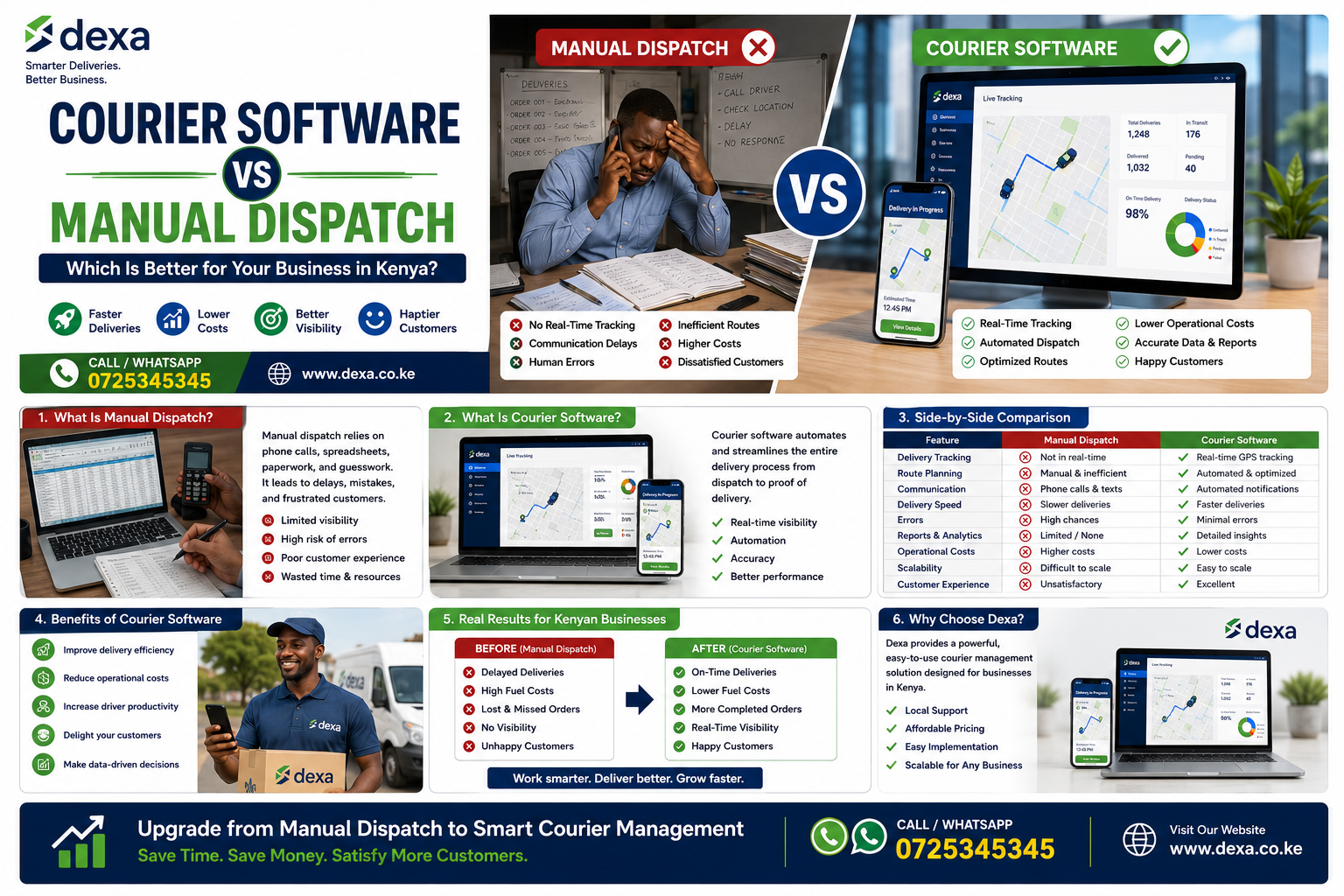
A modern courier management system helps businesses automate operations and manage the entire delivery process from one centralized platform.
What Is Courier Management Software?
Courier management software is a digital platform designed to help courier and delivery businesses manage parcels, customers, riders, drivers, routes, payments, and delivery activities.
Instead of using different systems for every task, businesses can manage operations through one dashboard.
The software can help with:
- Parcel registration
- Order management
- Dispatch management
- Rider assignment
- Driver management
- Route planning
- Parcel tracking
- Customer notifications
- Proof of delivery
- Payment tracking
- Reporting and analytics
This improves organization and gives managers better visibility into daily operations.
Why Courier Businesses Need Management Software
As a courier business grows, managing deliveries becomes more complex.
A company may have hundreds of parcels moving between different locations while multiple riders and drivers are working simultaneously.
Without a centralized system, managers may struggle to answer important questions such as:
- Where is a customer’s parcel?
- Which rider is handling the delivery?
- Has the package been delivered?
- Which deliveries are delayed?
- Which riders are available?
- How many deliveries were completed today?
- What are the main causes of failed deliveries?
Courier management software helps businesses access this information more quickly.
Common Challenges Facing Courier Businesses
1. Manual Parcel Tracking
Tracking parcels using paper records or spreadsheets can be difficult.
A digital system allows businesses to record and monitor parcel movement more efficiently.
2. Delivery Delays
Delays can be caused by:
- Poor route planning
- Traffic congestion
- Incorrect addresses
- Rider shortages
- Communication problems
- Vehicle breakdowns
Courier software helps businesses organize and monitor delivery activities.
3. Poor Customer Communication
Customers want to know the status of their parcels.
Without an organized communication system, customer support teams may spend significant time responding to tracking requests.
Automated updates can improve communication.
4. Difficult Rider Management
Managing multiple riders manually can become complicated.
A centralized platform helps businesses organize:
- Rider availability
- Assigned deliveries
- Completed deliveries
- Performance
- Work schedules
5. Lost or Incomplete Delivery Records
Paper-based delivery records can be lost or damaged.
Digital records provide a more organized way to store delivery information.
Key Features of Courier Management Software Kenya
Parcel Management
Courier businesses can register and manage parcel information, including:
- Sender details
- Recipient details
- Pickup location
- Delivery location
- Parcel status
- Delivery instructions
This creates a clear record for every shipment.
Dispatch Management
Dispatchers can assign parcels to riders or drivers based on:
- Current location
- Availability
- Delivery priority
- Workload
- Vehicle capacity
This helps businesses distribute work more efficiently.
Real-Time Parcel Tracking
Tracking tools provide better visibility into the delivery process.
Managers and customer service teams can monitor whether a parcel is:
- Awaiting pickup
- In transit
- Out for delivery
- Delivered
- Delayed
- Returned
Rider and Driver Management
Courier businesses can manage their delivery teams from one platform.
Important information can include:
- Rider profiles
- Assigned deliveries
- Delivery history
- Availability
- Performance records
Route Optimization
Route optimization helps delivery teams identify more efficient travel routes.
Potential benefits include:
- Reduced travel time
- Lower fuel costs
- Faster deliveries
- Improved rider productivity
- Better vehicle utilization
Automated Customer Notifications
Customers can receive updates throughout the delivery process.
Notifications may include:
- Parcel received
- Parcel dispatched
- Out for delivery
- Delivery completed
- Delivery delayed
Better communication improves transparency and customer satisfaction.
Digital Proof of Delivery
Courier businesses need reliable confirmation that a parcel reached the intended recipient.
Digital proof of delivery may include:
- Customer signatures
- Delivery photographs
- GPS location
- Delivery notes
- Delivery timestamps
This improves accountability and helps resolve disputes.
Payment Management
Courier businesses can organize financial information related to deliveries.
The system may help manage:
- Delivery charges
- Customer payments
- Outstanding balances
- Invoices
- Payment history
Benefits of Courier Management Software
Improved Operational Efficiency
Automation reduces repetitive administrative work and helps teams manage deliveries faster.
Faster Parcel Deliveries
Better dispatching and route planning can improve delivery performance.
Reduced Operating Costs
Businesses can reduce unnecessary expenses through better planning and resource utilization.
Better Customer Experience
Customers benefit from improved communication and greater visibility into their deliveries.
Increased Accountability
Digital records make it easier to track delivery activities and identify operational issues.
Easier Business Growth
A scalable courier management system can support businesses as they add:
- More customers
- More parcels
- More riders
- More vehicles
- More delivery locations
How Parcel Tracking Improves Customer Satisfaction
Parcel tracking is one of the most valuable features of modern courier services.
Customers no longer need to call repeatedly to ask about the location of their packages.
Instead, they can receive updates about the delivery status.
This improves:
- Customer confidence
- Transparency
- Communication
- Customer satisfaction
- Trust in the courier company
A better delivery experience can also encourage repeat business.
How Courier Software Reduces Failed Deliveries
Failed deliveries can be expensive for courier businesses.
Common reasons include:
- Incorrect customer addresses
- Customers being unavailable
- Unreachable phone numbers
- Incorrect delivery instructions
- Payment problems
- Customer rescheduling
A courier management system helps businesses record these reasons and identify recurring problems.
Managers can then improve delivery processes and reduce future failures.
Mobile Technology for Riders and Drivers
Mobile technology is essential for modern courier operations.
A rider or driver application can allow delivery teams to:
- Receive delivery assignments
- View customer information
- Access delivery addresses
- Update parcel status
- Capture proof of delivery
- Communicate with dispatchers
This reduces manual communication and improves coordination.
Important KPIs for Courier Businesses
Courier companies should monitor important performance indicators, including:
- Total parcels processed
- Delivery completion rate
- Failed delivery rate
- Average delivery time
- Rider productivity
- Cost per delivery
- Customer satisfaction
- Number of delayed deliveries
These metrics help managers understand how well the business is performing.
Courier Management Software for E-Commerce Businesses
E-commerce businesses need reliable courier systems to deliver customer orders.
A typical process may involve:
- Customer places an order.
- The order is prepared.
- Parcel information is registered.
- A rider or driver is assigned.
- The parcel is dispatched.
- The customer receives updates.
- Delivery is completed.
- Proof of delivery is recorded.
Courier management software helps connect these activities into a more organized workflow.
How Automation Improves Courier Operations
Automation can reduce the amount of manual work required to manage deliveries.
Businesses can automate:
- Parcel registration
- Delivery assignment
- Status updates
- Customer notifications
- Delivery reminders
- Invoice generation
- Performance reports
This allows employees to focus more on customer service and business growth.
Industries That Can Benefit From Courier Management Software
Courier management technology can support:
- Courier companies
- E-commerce businesses
- Retail stores
- Pharmacies
- Medical suppliers
- Supermarkets
- Wholesalers
- Manufacturers
- Distribution companies
- Food delivery businesses
- Document delivery services
How to Choose the Right Courier Management System
Before selecting a courier software solution, businesses should consider several factors.
Ease of Use
Employees, dispatchers, and riders should be able to use the system without unnecessary complexity.
Scalability
The system should continue supporting the business as delivery volumes increase.
Mobile Accessibility
Riders and drivers should be able to access important delivery information while working.
Security
Customer, delivery, and payment information should be properly protected.
Reporting
The platform should provide useful reports for business decision-making.
Customer Support
Reliable support can help businesses resolve technical issues quickly.
The Future of Courier Management in Kenya
Technology will continue to transform how courier companies operate.
Important trends include:
- Artificial intelligence
- Automated dispatching
- Smart route optimization
- Advanced GPS tracking
- Predictive analytics
- Mobile delivery applications
- Digital proof of delivery
- Cloud-based logistics systems
Businesses that adopt digital solutions can improve efficiency and prepare for future growth.
Why Choose Dexa for Courier Management?
Dexa provides businesses with digital tools designed to simplify courier and delivery operations.
A centralized platform can help businesses improve:
- Parcel management
- Delivery coordination
- Dispatch operations
- Rider management
- Customer communication
- Delivery tracking
- Operational reporting
- Business visibility
By reducing dependence on manual processes, courier businesses can improve efficiency and create a better experience for their customers.
Frequently Asked Questions
What is courier management software?
Courier management software is a digital platform that helps businesses manage parcels, deliveries, riders, drivers, customers, and courier operations.
Can courier software track parcels?
Yes. Modern systems can provide parcel status updates and delivery tracking features.
Can small courier businesses use management software?
Yes. A scalable system can support small businesses as well as larger courier operations.
Does courier software help manage riders?
Yes. Businesses can organize rider assignments, workloads, availability, and performance.
Can courier software reduce delivery costs?
Better route planning, automation, and resource management can help businesses identify and reduce unnecessary operational expenses.
[…] internal links: Use Dexa, Dexa Pricing, Dexa Trust, Courier Management Software Kenya, Dispatch Management Software Kenya and Driver Dispatch Management […]