
What Is Cash on Delivery Management Courier Africa?
Cash on delivery management courier Africa refers to the systems, processes, software, couriers, pickup points, payment reconciliation tools, and logistics operations used to manage orders where customers pay when receiving products.
Across Kenya, Nigeria, Tanzania, Uganda, Ghana, Zambia, and South Africa, COD remains one of the most trusted payment methods because many consumers still prefer seeing goods before paying.
The rise of cash on delivery management courier Africa solutions has created opportunities for:
- Courier companies
- Pickup stations
- E-commerce sellers
- Delivery startups
- Logistics aggregators
- Collection agents
- Franchise operators
Companies such as Codirect Courier, DLIVAD and Tracit are helping businesses manage COD deliveries more efficiently across African markets. (dlivad)
Why COD Remains Dominant in Africa
Despite the growth of mobile money and card payments, COD remains popular because:
- Buyers trust physical verification.
- Return rates are easier to negotiate.
- Many first-time online shoppers prefer cash.
- Some regions have low card penetration.
- Fraud concerns still exist.
Many logistics providers promote COD growth using phrases like:
- “Increase sales dramatically.”
- “Grow your business faster.”
- “Earn more from every parcel.”
- “Scale without limits.”
The problem is that these statements rarely include actual financial calculations. Several leading COD websites discuss growth, profitability, and expansion without showing exact revenue formulas or break-even timelines. (ssascod.com)
Instead of vague promises, let’s look at real numbers.
The Role of Automation in Cash on Delivery Management Courier Africa
One of the biggest differences between profitable and struggling logistics businesses is the level of automation used in daily operations. As parcel volumes increase, manually managing orders, customer confirmations, delivery assignments, payment tracking, and reporting becomes increasingly difficult.
This is where cash on delivery management courier Africa solutions provide significant value. Automated systems can instantly notify customers when orders are dispatched, send reminders before delivery, capture digital proof of delivery, and update merchants in real time. Instead of relying on spreadsheets, paper receipts, and manual reconciliation processes, courier companies can centralize all delivery information within a single platform. This reduces human error and improves accountability across the organization.

Automation also helps businesses improve cash flow management. In many COD operations, delays in reconciling collections can create financial challenges for merchants who depend on fast access to their revenue. Modern cash on delivery management courier Africa software can automatically record collections, calculate commissions, generate settlement reports, and trigger payments to merchants.
This transparency strengthens trust between couriers and sellers while reducing disputes over missing or delayed funds. In addition, automated dashboards allow managers to monitor delivery performance, identify failed delivery trends, and measure profitability by region, product category, or delivery agent.
Another advantage is scalability. A courier company handling 50 deliveries per day may be able to manage operations manually, but the same approach becomes unsustainable at 500 or 5,000 deliveries daily. Automation allows businesses to grow without increasing administrative costs at the same rate as order volume.
Features such as route optimization, customer self-service portals, inventory synchronization, and automated communication significantly improve efficiency. As competition in African logistics continues to increase, companies that invest in automated cash on delivery management courier Africa systems will be better positioned to deliver faster service, reduce operating costs, improve customer satisfaction, and maintain profitability while expanding into new markets and regions.
Startup Costs Breakdown
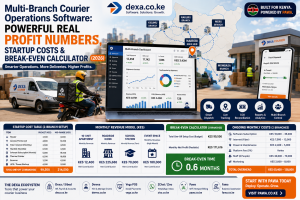
Below is a realistic startup budget for a small cash on delivery management courier Africa operation in Kenya.
| Item | Cost (KES) |
|---|---|
| Business registration | 15,000 |
| Website & domain | 10,000 |
| Delivery management software | 25,000 |
| Initial marketing | 40,000 |
| Smartphone devices (2) | 30,000 |
| Receipt printer | 12,000 |
| Working capital | 100,000 |
| Rider equipment | 25,000 |
| Training & setup | 18,000 |
| Miscellaneous | 25,000 |
| Total Startup Cost | 300,000 KES |
A professionally managed cash on delivery management courier Africa business can realistically start between KES 250,000 and KES 500,000 depending on fleet size.
Revenue Models With Real KES Calculations
Most COD operators earn from:
- Delivery fees
- Collection commissions
- Return handling fees
- Storage fees
- Merchant subscriptions
- Fulfillment services
Assumptions:
- Average delivery fee = KES 250
- Collection commission = KES 30
- Average orders per day varies by scenario
- 26 working days monthly
Monthly revenue formula:
Orders × Revenue Per Order × Working Days
Average revenue per order:
250 + 30 = KES 280
Scenario 1: 10-Unit Apartment
A residential pickup point serving a 10-unit apartment block.
Assumptions
- 5 parcels daily
- Revenue per parcel = KES 280
Monthly Revenue:
5 × 280 × 26
= KES 36,400
Monthly expenses:
| Expense | Cost |
|---|---|
| Internet | 2,000 |
| Transport | 5,000 |
| Phone | 1,500 |
| Miscellaneous | 2,500 |
| Total | 11,000 |
Net monthly profit:
36,400 − 11,000
= KES 25,400
This is a modest entry-level cash on delivery management courier Africa operation.
Scenario 2: Roadside Kiosk
A busy kiosk handling neighborhood parcel collections.
Assumptions
- 20 parcels daily
- Revenue per parcel = KES 280
Monthly revenue:
20 × 280 × 26
= KES 145,600
Monthly expenses:
| Expense | Cost |
|---|---|
| Rent contribution | 10,000 |
| Staff support | 15,000 |
| Internet | 3,000 |
| Utilities | 2,000 |
| Miscellaneous | 5,000 |
| Total | 35,000 |
Net profit:
145,600 − 35,000
= KES 110,600
Many pickup-point networks in Africa operate on a model similar to this. (dlivad)
Scenario 3: School Collection Point
Schools increasingly receive deliveries for students and staff.
Assumptions
- 30 parcels daily
- Revenue per parcel = KES 280
Monthly revenue:
30 × 280 × 26
= KES 218,400
Monthly expenses:
| Expense | Cost |
|---|---|
| Staff allowance | 20,000 |
| Software | 5,000 |
| Connectivity | 3,000 |
| Administration | 7,000 |
| Total | 35,000 |
Net profit:
218,400 − 35,000
= KES 183,400
This model shows why cash on delivery management courier Africa continues attracting entrepreneurs.
Scenario 4: Event Space Collection Hub
Large conferences, exhibitions, expos, and festivals generate parcel demand.
Assumptions
- 50 parcels daily
- Revenue per parcel = KES 280
Monthly revenue:
50 × 280 × 26
= KES 364,000
Monthly expenses:
| Expense | Cost |
|---|---|
| Staff | 40,000 |
| Rent allocation | 15,000 |
| Software | 10,000 |
| Connectivity | 5,000 |
| Security | 5,000 |
| Total | 75,000 |
Net profit:
364,000 − 75,000
= KES 289,000
Monthly Operating Costs
Every cash on delivery management courier Africa business faces recurring expenses.
| Cost Category | Monthly KES |
|---|---|
| Software subscriptions | 5,000–30,000 |
| Rider management | 20,000–100,000 |
| Fuel | 15,000–80,000 |
| Internet | 2,000–10,000 |
| Customer support | 15,000–50,000 |
| Maintenance | 5,000–25,000 |
| Payment reconciliation | 3,000–15,000 |
| Marketing | 10,000–100,000 |
Maintenance often gets ignored.
Typical maintenance includes:
- Smartphone replacement
- Printer servicing
- POS repairs
- Software updates
- Motorbike servicing
- Storage equipment replacement
Break-Even Analysis
Let’s use the roadside kiosk example.
Startup cost:
300,000 KES
Monthly profit:
110,600 KES
Break-even formula:
300,000 ÷ 110,600
= 2.71 months
Break-Even Results
| Scenario | Monthly Profit | Break-Even |
|---|---|---|
| Apartment | 25,400 | 11.8 months |
| Kiosk | 110,600 | 2.7 months |
| School | 183,400 | 1.6 months |
| Event Hub | 289,000 | 1.0 month |
Realistically, most operators experience slower growth initially.
A safer estimate is:
- Apartment: 12–15 months
- Kiosk: 3–5 months
- School: 2–4 months
- Event Hub: 2–3 months
Technology Needed
Successful cash on delivery management courier Africa businesses depend heavily on software.
Core tools include:
- Order management
- Rider tracking
- Cash reconciliation
- Customer notifications
- Inventory management
- Delivery confirmation
- Reporting dashboards
Useful business systems include:
- Dexa HR & Workflow System
- Pawa Hotspot Billing Platform
- Vega POS
- RentalDesk Property Management
- EstateAdmin
- Ratibu School Management
- ChurchesAdmin
- Zivo Customer Communication Platform
These platforms help businesses automate operations, customer communication, accounting, attendance, inventory control, workflow approvals, and reporting.
Risk Analysis
Every cash on delivery management courier Africa operation carries risk.
1. Fake Orders
A major challenge reported by many COD merchants is poor order confirmation rates. Some businesses receive large numbers of inquiries that never convert into completed deliveries. (Reddit)
Mitigation:
- SMS verification
- Phone confirmation
- Customer scoring
2. Cash Theft
Drivers or agents may mishandle cash.
Mitigation:
- Daily reconciliation
- Mobile money settlements
- Audit trails
3. Delivery Failures
Wrong addresses create losses.
Mitigation:
- GPS verification
- Address validation
- Customer confirmation
4. High Return Rates
Returns reduce margins.
Mitigation:
- Better product descriptions
- Verification calls
- Customer education
5. Fraud & Scams
Fraudulent courier messages and fake delivery notifications are increasingly common. (Reddit)
Mitigation:
- Official tracking systems
- Secure communication channels
- Customer awareness
How SaaS Improves COD Operations
Modern cash on delivery management courier Africa companies increasingly use SaaS platforms to reduce manual work.
Examples include:
- Merchant portals
- Dispatch management
- Delivery tracking
- Cash reconciliation
- Inventory monitoring
- Reporting automation
Platforms such as Tracit and Curfox focus on reducing manual reconciliation and improving visibility of COD transactions. (Curfox)
For internal operations, businesses can integrate:
- Dexa
- Vega
- Zivo
- Ratibu
- RentalDesk
- Prim
- Wito
- Fama
- Jaat
- KayaPro360
- Musa Music AI
- Awasam
These systems help streamline accounting, CRM, HR, customer support, attendance tracking, communication, and business intelligence.

Is Cash on Delivery Management Courier Africa Worth It?
Yes—but only if managed professionally.
The biggest mistake is believing marketing claims without examining actual numbers.
A small apartment-based operation generating KES 25,400 monthly profit may take almost a year to recover investment.
A kiosk, school, or event-based model can break even much faster.
The businesses that succeed in cash on delivery management courier Africa focus on:
- Automation
- Cash control
- Customer verification
- Reliable software
- Accurate reporting
- Efficient delivery networks
If you cannot manage reconciliation and delivery tracking effectively, profits disappear quickly.
If you implement strong systems, COD remains one of Africa’s most resilient logistics opportunities.
FAQ
1. How much capital do I need to start?
Most operators can begin with between KES 250,000 and KES 500,000 depending on scale.
2. What is the biggest cost?
Staff, riders, fuel, and reconciliation processes are usually the largest expenses.
3. How long does break-even take?
Anywhere from 1 to 15 months depending on parcel volume and operating efficiency.
4. Can COD work alongside mobile money?
Yes. Most successful courier businesses support both COD and digital payments.
5. What software should I use?
A combination of delivery management, accounting, CRM, communication, and workflow software is recommended for scaling operations.
Visit:
You can also explore:
By combining strong software, disciplined cash management, and accurate reporting, a cash on delivery management courier Africa business can become a scalable and profitable operation in 2026 and beyond.