Category: courier management software

  • Courier Management System vs Excel: 11 Powerful Reasons Smart Courier Companies Upgrade in 2026

  • Fleet and Courier Management Software Kenya: Powerful 12 Benefits for Logistics Growth in 2026


  • Top Courier Management Software in Kenya: 15 Powerful Solutions Transforming Delivery Businesses (2026)


  • Courier Dispatch Software Explained: 15 Powerful Benefits Every Delivery Business Must Know (2026)


  • Transport and Logistics Software Kenya: 12 Powerful Features That Transform Fleet Operations (2026)


  • Courier Billing Software Kenya: Powerful 2026 Guide to Automation, Profitability & Growth

    Courier Billing Software Kenya

    The courier and logistics industry in Kenya has experienced rapid growth over the last decade. Increased e-commerce adoption, online shopping, same-day delivery expectations, and digital business operations have created significant demand for efficient logistics solutions. As courier businesses expand, manual billing processes become increasingly difficult to manage. This is where Courier Billing Software Kenya solutions become essential.

    Courier Billing Software Kenya
    Courier Billing Software Kenya

    Many courier companies still rely on spreadsheets, handwritten invoices, WhatsApp records, paper delivery notes, and manual payment tracking. While this may work for a startup handling a few deliveries daily, it quickly becomes inefficient as operations grow. Missing invoices, delayed payments, incorrect charges, lost delivery records, and customer disputes can significantly affect profitability.

    When researching Courier Billing Software Kenya, many online resources discuss automation benefits but rarely explain the practical financial impact. Statements such as “improve profits dramatically” or “increase efficiency instantly” are common but often lack measurable business context. The reality is that courier businesses save money by reducing billing errors, improving payment collection, automating administrative tasks, and providing better customer visibility.

    For courier operators handling hundreds or thousands of deliveries monthly, investing in Courier Billing Software Kenya is no longer optional. It has become a competitive necessity.


    What is Courier Billing Software?

    Courier Billing Software Kenya refers to specialized software designed to manage delivery operations, invoicing, payment tracking, customer accounts, delivery records, reporting, and business automation for courier companies.

    Instead of manually calculating delivery charges and creating invoices individually, the software automatically generates customer bills based on predefined delivery rates, distances, zones, package types, customer agreements, or service levels.

    Modern courier software combines billing, customer management, operational tracking, and financial reporting within a centralized system.

    As delivery volumes increase, manual billing processes become a significant operational bottleneck. Businesses adopting Courier Billing Software Kenya gain better control over revenue collection and financial reporting.


    Why Courier Companies Need Billing Automation

    Every delivery business eventually reaches a point where manual processes become unsustainable.

    Imagine a courier company processing 150 deliveries daily. If each delivery requires manual entry into a spreadsheet, invoice generation, payment verification, customer notification, and financial reconciliation, administrative costs increase significantly.

    Billing automation reduces repetitive work while improving accuracy.

    With Courier Billing Software Kenya, invoices can be generated automatically, customer balances updated instantly, and payment records synchronized without manual intervention.

    Automation also reduces human error.

    Incorrect billing amounts, duplicate invoices, forgotten customer accounts, and delayed payment follow-ups are among the most common challenges courier companies face when relying on manual systems.

    Businesses that automate billing often experience faster payment collection and improved customer satisfaction because invoices are accurate and readily available.


    Common Problems with Manual Billing

    Many courier businesses underestimate the cost of inefficient billing processes.

    One major problem is invoice delays. When invoices are generated manually, they are often sent late. Delayed invoices frequently result in delayed payments.

    Another issue is revenue leakage.

    Without a structured billing system, deliveries may be completed but never invoiced. Small mistakes repeated over hundreds of deliveries can create significant financial losses over time.

    Customer disputes also become more difficult to resolve.

    When delivery records, proof of delivery, invoices, and payment histories are stored across multiple spreadsheets and communication channels, resolving disagreements becomes time-consuming.

    This is why many logistics companies eventually migrate to Courier Billing Software Kenya solutions.

    The software creates a centralized source of truth for both operational and financial data.


    Key Features of Courier Billing Software Kenya

    The best Courier Billing Software Kenya platforms typically include several essential features.

    Automated invoicing allows businesses to generate invoices immediately after delivery completion.

    Customer account management helps maintain accurate records of deliveries, payments, outstanding balances, and communication history.

    Payment tracking provides visibility into paid, pending, and overdue invoices.

    Reporting tools help management understand business performance.

    Delivery tracking integration ensures billing aligns with actual service delivery.

    Multi-user access allows dispatchers, accountants, managers, and customer support teams to work within the same platform.

    These features help courier businesses improve operational efficiency while reducing administrative overhead.


    Courier Billing Software Kenya and Delivery Tracking

    One of the biggest advantages of Courier Billing Software Kenya is integration between billing and delivery tracking.

    Traditionally, delivery operations and accounting departments often operate separately. This separation creates opportunities for errors.

    When delivery records automatically feed into billing systems, invoices are generated using actual operational data.

    Completed deliveries trigger billing workflows automatically.

    Customers receive delivery confirmations and invoices promptly.

    Management gains visibility into operational performance and revenue generation simultaneously.

    This integration improves accuracy while reducing administrative workload.

    For growing courier businesses, integrated systems become increasingly valuable.


    Customer Experience and Courier Billing Software Kenya

    Customer expectations continue evolving.

    Business clients expect professional invoices, transparent billing, delivery visibility, and timely communication.

    Consumers expect fast updates and convenient payment options.

    Courier Billing Software Kenya helps businesses meet these expectations by providing automated notifications, online invoice access, payment records, and service history.

    A better customer experience often translates into stronger retention rates.

    Satisfied customers are more likely to continue using your services and recommend your company to others.

    In competitive logistics markets, customer experience can become a significant differentiator.


    Mobile Applications for Courier Teams

    Modern courier operations depend heavily on mobility.

    Drivers, riders, dispatchers, and supervisors spend much of their time outside the office.

    This makes mobile functionality a critical component of Courier Billing Software Kenya.

    Mobile applications allow delivery personnel to:

    • Receive assignments
    • Update delivery status
    • Capture proof of delivery
    • Record customer signatures
    • Upload delivery photos
    • Confirm completed deliveries

    Real-time updates improve operational visibility and reduce communication delays.

    Management teams gain immediate access to field information without waiting for paper reports.


    Financial Reporting and Business Intelligence

    Financial visibility is one of the greatest benefits of Courier Billing Software Kenya.

    Without proper reporting, management decisions are often based on assumptions.

    Courier software generates reports covering:

    • Revenue trends
    • Customer performance
    • Outstanding invoices
    • Collection efficiency
    • Delivery volumes
    • Branch performance
    • Service profitability

    These insights help business owners make informed decisions.

    Instead of guessing which services generate profits, managers can analyze actual business data.

    Accurate reporting supports sustainable growth and stronger financial planning.


    Multi-Branch Courier Operations

    As courier companies expand, managing multiple locations becomes increasingly complex.

    Different branches may operate independently, creating reporting inconsistencies.

    Courier Billing Software Kenya centralizes operations across multiple offices.

    Management can monitor:

    • Branch performance
    • Revenue generation
    • Customer activity
    • Employee productivity
    • Financial reporting

    Centralized visibility improves accountability and operational consistency.

    Businesses planning regional expansion should consider scalability when selecting software solutions.


    Courier Billing Software Kenya for Corporate Clients

    Corporate customers often have unique billing requirements.

    Some require monthly invoicing.

    Others require purchase order references, account statements, or detailed delivery breakdowns.

    Managing these requirements manually can consume significant administrative resources.

    Courier Billing Software Kenya simplifies corporate account management through automation and customization.

    Businesses can configure customer-specific pricing structures, billing schedules, payment terms, and reporting requirements.

    This flexibility improves customer satisfaction while reducing operational complexity.


    Risks of Poor Billing Systems

    Not implementing the right billing solution can expose courier businesses to several risks.

    Revenue Leakage

    Unbilled deliveries directly reduce profitability.

    Automated systems help ensure completed deliveries generate corresponding invoices.

    Customer Disputes

    Missing records make dispute resolution difficult.

    Centralized systems maintain delivery and billing histories.

    Delayed Payments

    Late invoicing often leads to late payments.

    Automated invoice generation improves collection speed.

    Compliance Challenges

    Poor record keeping can create accounting and tax reporting difficulties.

    Structured systems improve financial documentation.

    Operational Inefficiency

    Manual processes consume valuable staff time.

    Automation allows employees to focus on customer service and growth activities.


    How to Choose the Best Courier Billing Software Kenya

    Selecting the right Courier Billing Software Kenya requires careful evaluation.

    Start by identifying your operational requirements.

    Consider delivery volume, customer types, reporting needs, payment workflows, and growth plans.

    Look for software offering:

    • Automated invoicing
    • Mobile access
    • Delivery tracking
    • Customer management
    • Reporting tools
    • Multi-user support
    • Security controls
    • Scalability

    Avoid choosing software based solely on price.

    The cheapest solution may become more expensive if it lacks critical features or requires replacement later.

    Long-term value should guide purchasing decisions.


    Why Workflow Automation Matters

    Billing is only one component of courier operations.

    Businesses must also manage employees, approvals, attendance, leave requests, payroll, tasks, customer communication, and operational reporting.

    This is why many courier companies combine Courier Billing Software Kenya with broader business management platforms.

    Workflow automation reduces delays, improves accountability, and ensures operational consistency.

    Businesses that automate multiple departments often achieve stronger overall performance.


    Business Software Ecosystem for Kenyan Companies

    Kenyan businesses increasingly use specialized software platforms to improve operations.

    Examples include:

    • RentalDesk for property management
    • PMS.co.ke for rental management
    • EstateAdmin for estate operations
    • Prim for salon management
    • Vega POS for retail businesses
    • Pawa for hotspot billing
    • Dereva for driver marketplace services
    • Vota for campaign management
    • Zivo and ZChat for customer communication
    • Dexa and Sibed for HR and workflow management
    • Wito for attendance and event check-ins
    • Ratibu for school administration
    • ChurchesAdmin for church management
    • Fama business solutions
    • Jaat digital platforms
    • KayaPro360 management software
    • Musa Music AI platforms
    • Awasam business systems

    This growing ecosystem demonstrates the increasing importance of digital transformation across industries.


    Is Courier Billing Software Kenya Worth It?

    For businesses processing only a few deliveries monthly, manual methods may appear sufficient.

    However, growth changes everything.

    As delivery volumes increase, billing complexity grows rapidly.

    Invoices become harder to track.

    Customer accounts become more difficult to manage.

    Payment follow-ups consume more time.

    Administrative costs increase.

    This is where Courier Billing Software Kenya provides measurable value.

    The software improves accuracy, reduces manual work, strengthens customer service, and supports business scalability.

    For most growing courier companies, the investment is justified.

    The real question is not whether you can afford the software.

    The real question is whether you can afford the operational inefficiencies of working without it.


    Future Trends Shaping Courier Billing Software Kenya

    The logistics industry is evolving rapidly, and businesses investing in Courier Billing Software Kenya today are positioning themselves for future growth. Customer expectations are changing, competition is increasing, and delivery operations are becoming more data-driven. Courier companies that continue relying on manual systems may struggle to compete against businesses that embrace automation and digital transformation.

    One major trend influencing Courier Billing Software Kenya is the growth of e-commerce. Thousands of Kenyan businesses now sell products through websites, social media platforms, mobile applications, and online marketplaces. Every online sale creates a delivery requirement, and every delivery requires accurate billing, payment tracking, and reporting. As order volumes increase, courier companies need systems capable of handling large numbers of transactions without creating administrative bottlenecks.

    Another trend is customer demand for transparency. Modern customers want visibility into every stage of the delivery process. They expect tracking updates, proof of delivery, digital invoices, payment confirmations, and immediate customer support. A robust Courier Billing Software Kenya solution helps courier businesses provide these services while maintaining operational efficiency.

    Artificial intelligence and automation are also beginning to influence logistics operations. Advanced courier systems can automatically assign deliveries, optimize routes, identify delayed payments, generate customer reminders, and produce management reports. Businesses that adopt modern Courier Billing Software Kenya platforms gain access to tools that reduce manual work and improve decision-making.

    How Courier Billing Software Kenya Improves Cash Flow

    Cash flow remains one of the biggest challenges facing courier companies. Many businesses generate significant revenue but struggle because payments arrive late or invoices are not issued promptly. Poor billing practices can create financial pressure even when delivery volumes are high.

    This is where Courier Billing Software Kenya delivers substantial value. Automated invoicing ensures customers receive bills immediately after services are completed. Payment reminders can be scheduled automatically, reducing the need for manual follow-up. Account statements can be generated instantly, helping customers reconcile their records and process payments faster.

    Businesses that implement Courier Billing Software Kenya often experience improved collection rates because invoices are accurate, professional, and delivered on time. Faster collections improve liquidity, making it easier to pay employees, maintain vehicles, purchase fuel, and invest in business growth.

    For courier companies serving corporate clients, cash flow visibility is especially important. Management can quickly identify overdue accounts, monitor customer payment behavior, and take corrective action before cash flow problems become severe.

    Integrating Courier Billing Software Kenya with Business Management Systems

    While billing is critical, successful courier businesses require more than invoicing software. They also need employee management, workflow automation, attendance tracking, payroll administration, customer communication, and operational reporting.

    Many organizations therefore combine Courier Billing Software Kenya with broader business management platforms. This integrated approach creates a centralized environment where financial, operational, and human resource data work together.

    For example, courier businesses can use Dexa, Sibed, Zivo, ZChat, RentalDesk, PMS.co.ke, EstateAdmin, Prim, Vega POS, Pawa, Dereva, Vota, Ratibu, ChurchesAdmin, Fama, Jaat, KayaPro360, Musa Music AI, Wito, and Awasam solutions to streamline different aspects of business operations. These digital platforms help organizations reduce paperwork, improve accountability, automate repetitive processes, and increase productivity.

    The most successful courier companies understand that technology is no longer a luxury. It has become a strategic business asset. Investing in Courier Billing Software Kenya alongside workflow automation and business management tools allows courier operators to scale confidently while maintaining service quality.

    As the Kenyan logistics industry continues growing, businesses that prioritize automation, customer experience, financial visibility, and operational efficiency will be better positioned to capture new opportunities. For courier companies planning long-term growth, adopting Courier Billing Software Kenya today can provide a strong foundation for sustainable expansion, improved profitability, and stronger customer relationships in the years ahead.

    Frequently Asked Questions

    1. What is Courier Billing Software Kenya?

    It is software designed to automate invoicing, payment tracking, delivery records, customer management, and reporting for courier businesses operating in Kenya.

    2. Can small courier businesses use Courier Billing Software Kenya?

    Yes. Even small courier companies benefit from improved billing accuracy and customer management.

    3. Does Courier Billing Software Kenya support mobile devices?

    Most modern solutions provide mobile functionality for riders, dispatchers, and managers.

    4. Can the software handle corporate clients?

    Yes. Many systems support customized pricing, account management, and scheduled invoicing.

    5. Is Courier Billing Software Kenya suitable for multi-branch businesses?

    Yes. Most enterprise-grade platforms support centralized management across multiple locations.


    Why Dexa Supports Courier Business Growth

    As courier businesses expand, managing employees becomes just as important as managing deliveries.

    Dexa helps courier organizations manage:

    • Employee attendance
    • Leave management
    • HR operations
    • Payroll workflows
    • Expense approvals
    • Task management
    • Workflow automation
    • Reporting dashboards
    • Performance monitoring
    • Compliance records

    Combined with Courier Billing Software Kenya, Dexa helps courier companies build stronger operational foundations and improve business visibility.


    Conclusion

    The courier industry in Kenya continues growing alongside e-commerce, digital commerce, and customer demand for faster delivery services.

    As operations become more complex, businesses require tools that improve accuracy, efficiency, and scalability.

    Courier Billing Software Kenya helps courier companies automate invoicing, manage customer accounts, improve reporting, streamline collections, and reduce operational risks.

    Businesses that continue relying on manual billing processes often encounter growth limitations, customer disputes, delayed payments, and administrative inefficiencies.

    Investing in Courier Billing Software Kenya is not simply a technology decision. It is a strategic business decision that supports long-term profitability and sustainable growth.

    Ready to Digitize Your Courier Operations?

    Start with Zama.co.ke and Dexa.co.ke to streamline workflows, employee management, operational reporting, approvals, HR processes, and business automation for your growing courier company in Kenya.

    Courier Billing Software Kenya
    Courier Billing Software Kenya
  • How to Start a Courier Business in Kenya: Powerful 2026 Guide, Costs, Risks & Profit Reality

  • Customer Order Tracking System in Kenya: 11 Powerful Benefits That Boost Customer Satisfaction and Revenue in 2026

    Customer Order tracking system in Kenya: Powerful Profit-Boosting Guide to Costs, Setup & Real Business Impact (2026)

    A Customer Order tracking system in Kenya is no longer a luxury reserved for large logistics companies or eCommerce giants. It has become a core operational tool for SMEs, courier businesses, restaurants, pharmacies, hardware shops, and online sellers who want visibility, accountability, and speed in order fulfillment. In today’s competitive Kenyan digital economy, customers expect instant updates, accurate delivery timelines, and transparency from the moment they place an order to the moment it arrives.

    A properly implemented Customer Order tracking system in Kenya helps businesses reduce lost orders, improve delivery efficiency, and increase customer satisfaction. Even more importantly, it directly improves revenue because customers are more likely to reorder when they trust your fulfillment process.

    Customer Order tracking system in Kenya
    Customer Order tracking system in Kenya

    In this guide, we break down how a Customer Order tracking system in Kenya works, the real costs in Kenyan Shillings (KES), risks, setup process, profitability insights, and whether it is actually worth it for your business in 2026.


    What is a Customer Order tracking system in Kenya?

    A Customer Order tracking system in Kenya is a digital platform that allows businesses to track customer orders from placement to delivery in real time. It records order details, assigns delivery status updates, and notifies both staff and customers automatically.

    Instead of using WhatsApp chats, paper logs, or Excel sheets, businesses use a centralized system that shows:

    • Order placement time
    • Payment status
    • Dispatch status
    • Courier assignment
    • Delivery completion confirmation

    For example, a Nairobi-based grocery delivery startup handling 50 orders per day often loses 3–5 orders weekly due to miscommunication. With a Customer Order tracking system in Kenya, those losses are reduced to near zero.

    Popular platforms that support order tracking workflows include business systems like dexa.co.ke, which integrate order workflows, communication, and reporting in one dashboard.


    Why Kenyan businesses are adopting order tracking systems

    The demand for a Customer Order tracking system in Kenya is growing rapidly due to increased online shopping, food delivery services, and courier logistics expansion. Businesses are shifting from manual systems because they are expensive in hidden ways.

    For instance:

    A small eCommerce shop in Nairobi processing 120 orders per week may lose:

    • KES 500 per lost order due to failed delivery
    • KES 1,000 per week in customer complaints and re-delivery costs
    • KES 3,000–5,000 monthly due to inefficiencies

    That adds up to over KES 60,000 annually, which is often more expensive than implementing a system.

    A Customer Order tracking system in Kenya solves these issues by automating communication and reducing human error.


    How a Customer Order tracking system in Kenya works

    A typical Customer Order tracking system in Kenya operates in four stages:

    First, a customer places an order through a website, app, or physical shop system. The order is automatically stored in a centralized dashboard.

    Second, the system assigns the order to a fulfillment team or warehouse staff. This eliminates confusion and duplication.

    Third, the order is dispatched with tracking updates such as “processing,” “out for delivery,” or “delivered.”

    Finally, the customer receives notifications via SMS, email, or WhatsApp.

    This is where platforms like Dexa

     become valuable because they integrate tracking with business workflows, reducing manual intervention.


    Real cost of implementing a Customer Order tracking system in Kenya

    Many businesses assume a Customer Order tracking system in Kenya is expensive, but real market pricing is more affordable than expected.

    Here is a realistic breakdown:

    • Basic SaaS system: KES 2,500 – 8,000 per month
    • Mid-level system with automation: KES 10,000 – 25,000 per month
    • Custom-built system: KES 150,000 – 500,000 one-time

    For example, a Nairobi-based pharmacy chain spending KES 15,000 monthly on a tracking system saves approximately:

    • KES 20,000 monthly from reduced delivery errors
    • KES 10,000 from improved staff efficiency
    • KES 5,000 from reduced customer complaints

    That means a net gain of KES 20,000 per month.

    This shows that a Customer Order tracking system in Kenya is not a cost—it is a profit tool.


    Benefits of Customer Order tracking system in Kenya

    A Customer Order tracking system in Kenya provides several measurable benefits.

    First, it reduces delivery delays by up to 40% because dispatch teams work from real-time dashboards instead of manual notes.

    Second, it improves customer retention. A customer who receives consistent tracking updates is 60% more likely to reorder.

    Third, it reduces operational stress. Staff no longer waste time answering “Where is my order?” calls.

    Fourth, it improves transparency, which builds brand trust in competitive markets like Nairobi, Mombasa, and Kisumu.

    Finally, it increases revenue indirectly because satisfied customers bring referrals.

    Customer Order tracking system in Kenya
    Customer Order tracking system in Kenya

    Business use cases in Kenya

    A Customer Order tracking system in Kenya is widely used in:

    • Courier companies
    • Online food delivery businesses
    • Pharmacies and healthcare suppliers
    • E-commerce stores
    • Hardware and construction suppliers

    For example, a hardware shop in Eastleigh dealing with cement and tools worth KES 200,000 weekly uses tracking to ensure deliveries are correctly assigned and confirmed. Without it, losses from misdelivery can exceed KES 10,000 weekly.


    Risks of using a Customer Order tracking system in Kenya

    Despite its benefits, a Customer Order tracking system in Kenya comes with risks if not implemented properly.

    One major risk is system downtime. If the system goes offline, operations can slow down significantly.

    Another risk is poor staff adoption. Employees who resist digital systems may continue using manual methods, leading to data inconsistencies.

    Cybersecurity is also a concern. If customer data is not secured, businesses risk data breaches.

    Finally, integration failure with payment systems or delivery APIs can cause delays.

    To mitigate these risks:

    • Choose reliable providers like Dexa
    • Train staff properly
    • Use cloud backup systems
    • Regularly update software

    Is a Customer Order tracking system in Kenya worth it?

    Yes—but only when implemented strategically.

    A Customer Order tracking system in Kenya is worth it if your business processes more than 20–30 orders daily. Below that threshold, manual systems may still function, but they are not scalable.

    For growing businesses, the ROI is clear. Spending KES 10,000 per month to save KES 25,000–50,000 in inefficiencies is a strong business case.

    The real value of a Customer Order tracking system in Kenya is not just automation—it is customer trust and scalability.


    SEO integration tools and ecosystem in Kenya

    Modern Kenyan businesses are integrating order tracking systems with other SaaS platforms such as:

    • Dexa for workflow automation
    • Vega POS for retail billing
    • Pawa WiFi Billing for hotspot management

    These integrations allow a full digital ecosystem where orders, payments, and customer communication are unified.


    Setup process for a Customer Order tracking system in Kenya

    Setting up a Customer Order tracking system in Kenya is straightforward.

    First, choose a provider based on your business size.

    Second, configure your order workflow stages such as “received,” “processing,” and “delivered.”

    Third, integrate communication tools like SMS or WhatsApp alerts.

    Fourth, train staff to use the system daily.

    Finally, monitor analytics to improve efficiency.

    A properly configured system can be fully operational within 3–7 days.


    Future of Customer Order tracking system in Kenya

    The future of the Customer Order tracking system in Kenya is heavily tied to AI automation, predictive delivery, and real-time logistics tracking.

    In the next few years, systems will automatically:

    • Predict delivery delays
    • Optimize courier routes
    • Auto-assign riders
    • Provide real-time ETA updates

    This means businesses that adopt early will gain a strong competitive advantage.


    How order visibility transforms customer experience in Kenyan businesses

    One of the most overlooked advantages of modern digital order management is how dramatically it improves customer experience. In Kenya’s fast-growing digital economy, customers are no longer comparing businesses only on price. They are comparing them on reliability, communication, and speed of fulfillment.

    When customers place an order, uncertainty is usually the biggest problem. They start asking questions like: Has my order been received? Is it being processed? When will it arrive? Without a structured system, businesses are forced to respond manually through phone calls or WhatsApp messages. This not only wastes time but also creates inconsistency in communication.

    With structured order visibility, customers receive automatic updates at every stage. For example, a customer ordering electronics worth KES 12,000 from an online shop in Nairobi might receive:

    • Confirmation immediately after payment
    • Notification when the product is packed
    • Update when the courier picks it up
    • Final confirmation upon delivery

    This level of communication builds trust. Businesses that adopt structured tracking systems often see repeat purchase rates increase by 20%–35% within a few months because customers feel more confident in the service.

    Even small improvements in trust have financial impact. A retail shop generating KES 300,000 monthly revenue can easily add an extra KES 60,000–90,000 simply through repeat customers and referrals driven by better service transparency.


    Operational efficiency gains for SMEs and logistics businesses

    Operational inefficiency is one of the biggest hidden costs in Kenyan SMEs. Many businesses still rely on paper records, manual spreadsheets, or scattered WhatsApp chats to manage orders. While this may work in early stages, it quickly becomes unsustainable as volume increases.

    For example, a small courier business in Nairobi handling 80 deliveries per day may spend up to 4 hours daily just reconciling order statuses. If staff costs are KES 300 per hour, that translates to KES 1,200 daily or around KES 36,000 monthly in unproductive administrative work.

    By digitizing order flow, this time is reduced significantly. Staff can focus on actual delivery coordination rather than administrative tracking. In many cases, businesses report saving 60%–70% of time previously spent on manual updates.

    These efficiency gains also reduce burnout. Employees working in logistics often experience stress due to constant follow-ups and unclear instructions. A structured digital workflow reduces confusion, which improves productivity and staff retention.


    Impact on delivery businesses and last-mile logistics in Kenya

    Last-mile delivery is one of the most challenging parts of logistics in Kenya. Traffic congestion in Nairobi, address inconsistencies, and customer availability issues all contribute to delays.

    A structured digital system helps solve these problems by improving coordination between dispatch teams and riders. Instead of relying on verbal instructions or handwritten notes, dispatchers can assign jobs directly through a dashboard, ensuring accuracy and traceability.

    For instance, a delivery company handling 200 parcels daily might lose up to 5% of deliveries due to miscommunication. At an average delivery value of KES 500 per parcel, that equals KES 5,000 lost daily or KES 150,000 monthly.

    Once the system is digitized, error rates drop significantly, often below 1%. This alone can turn a struggling logistics company into a profitable one without increasing sales volume.

    Route optimization also becomes easier. Even basic digital systems can reduce fuel consumption by 10%–20% by grouping deliveries efficiently. In real terms, a rider spending KES 1,000 daily on fuel may save KES 100–200 per day, which scales significantly across fleets.


    Customer retention and lifetime value improvement

    Customer retention is where most Kenyan businesses fail silently. It is much cheaper to retain a customer than to acquire a new one, yet many businesses focus heavily on acquisition and neglect post-purchase experience.

    When customers experience poor communication after placing an order, they rarely complain. Instead, they simply never return. This silent churn is extremely costly.

    A structured order system helps reverse this trend by ensuring customers feel engaged throughout the process. When customers receive consistent updates, their perceived value of the business increases even if product pricing remains the same.

    For example, an online fashion store selling clothes at an average of KES 2,500 per order may have a customer lifetime value of KES 10,000–15,000. With improved communication and reliability, this can increase to KES 20,000–25,000 per customer over time.

    This means even a small customer base of 500 active buyers can generate significantly higher long-term revenue without increasing marketing spend.


    Integration with payment systems and digital wallets in Kenya

    Kenya’s digital economy is heavily driven by mobile money platforms such as M-Pesa. Any modern order management setup must integrate smoothly with payment systems to avoid reconciliation challenges.

    Without integration, businesses often struggle with mismatched payments, delayed confirmations, and manual verification. This increases administrative workload and introduces financial risk.

    When integrated properly, payments are automatically matched with orders. For example, when a customer pays KES 3,000 via M-Pesa, the system immediately updates the order status to “paid” and triggers fulfillment processes.

    This reduces fraud risk and eliminates human error. It also speeds up order processing, allowing businesses to handle higher volumes without increasing staff costs.

    For scaling businesses, this integration alone can reduce accounting workload by 30%–50%, freeing up resources for growth activities.


    Scalability challenges and how to overcome them

    Many Kenyan businesses start with manual systems because they are cheap and easy. However, as order volume increases, these systems break down quickly.

    A business processing 10 orders per day might manage manually without issues. But at 100 orders per day, inefficiencies become visible. At 300+ orders per day, manual systems fail completely.

    Scalability issues usually appear in:

    • Order duplication
    • Missed deliveries
    • Payment confusion
    • Staff miscommunication

    To overcome these challenges, businesses need systems that grow with them. Cloud-based platforms are particularly effective because they allow expansion without infrastructure changes.

    Training is also critical. Even the best system will fail if staff do not use it correctly. Businesses that invest in onboarding and continuous training see much smoother transitions and higher adoption rates.

    Modern businesses rely heavily on digital infrastructure and logistics optimization tools to manage customer expectations and improve delivery efficiency. Globally, companies are adopting structured systems inspired by best practices in supply chain automation and digital commerce.

    For example, global eCommerce platforms like Shopify provide detailed insights on order management workflows and automation strategies that help businesses reduce manual errors and improve fulfillment speed. You can explore their documentation here:
    Shopify Order Management Guide

    Similarly, HubSpot explains how customer communication and automated tracking improve retention and customer satisfaction in digital businesses:
    HubSpot Customer Experience Insights

    These principles are directly applicable to businesses in Kenya that are scaling online sales and delivery operations.


    Long-term financial return and business valuation impact

    Investors and business buyers increasingly evaluate companies based on operational efficiency. A business with structured systems is far more valuable than one relying on manual processes, even if revenue is similar.

    For example, two businesses each generating KES 5 million annually may have very different valuations. The one with structured digital workflows may be valued at 2–3 times higher due to lower operational risk and higher scalability.

    This means investing in structured systems is not just an operational decision—it is a valuation strategy.

    Over a 3–5 year period, businesses that digitize operations early often achieve significantly higher profitability margins, sometimes improving net margins by 10%–25% compared to competitors relying on manual systems.


    FAQs

    1. What is a Customer Order tracking system in Kenya used for?

    It is used to monitor orders from placement to delivery in real time and improve efficiency.

    2. How much does a Customer Order tracking system in Kenya cost?

    It costs between KES 2,500 and KES 25,000 monthly depending on features.

    3. Can small businesses use a Customer Order tracking system in Kenya?

    Yes, especially if they handle more than 20 orders daily.

    4. Does it improve profits?

    Yes, by reducing losses, improving delivery efficiency, and increasing customer retention.

    5. Which is the best system provider in Kenya?

    Platforms like Dexa are commonly used for scalable business workflows.


    Final verdict

    A Customer Order tracking system in Kenya is one of the most impactful digital tools for modern businesses. It reduces operational chaos, improves customer experience, and directly increases profitability when implemented correctly.

    Businesses that delay adoption often struggle with inefficiencies, while those that adopt early scale faster and build stronger customer trust.

    Many businesses delay adoption because they believe they are “too small” or “not ready.” However, the biggest advantage of digital transformation is not the technology itself—it is timing.

    Early adopters build stronger systems, train better teams, and develop customer trust earlier. By the time competitors start adopting similar tools, early movers already dominate customer expectations.

    In Kenya’s competitive retail, logistics, and eCommerce environment, delay often translates directly into lost revenue opportunities.

    Businesses that adopt structured order systems early are not just improving operations—they are building long-term competitive advantage that becomes harder to replicate over time.


    Call to Action

    If you are ready to scale your business operations, improve delivery efficiency, and eliminate order confusion, then it is time to adopt a smart system like Dexa.

    Start building your digital workflow today with solutions from Dexa and transform how your business handles orders in Kenya.

    Customer Order tracking system in Kenya
    Customer Order tracking system in Kenya
  • Courier SaaS for Modern Operators: 11 Powerful Reasons Delivery Companies Are Growing Faster in 2026

    Courier SaaS for Modern Operators Is Transforming Logistics

    The courier industry has changed dramatically over the last few years. Customers now expect real-time tracking, instant delivery notifications, digital proof of delivery, online payments, and faster response times. Courier companies that still rely on spreadsheets, paper manifests, WhatsApp messages, and manual dispatch processes often struggle to meet these expectations.

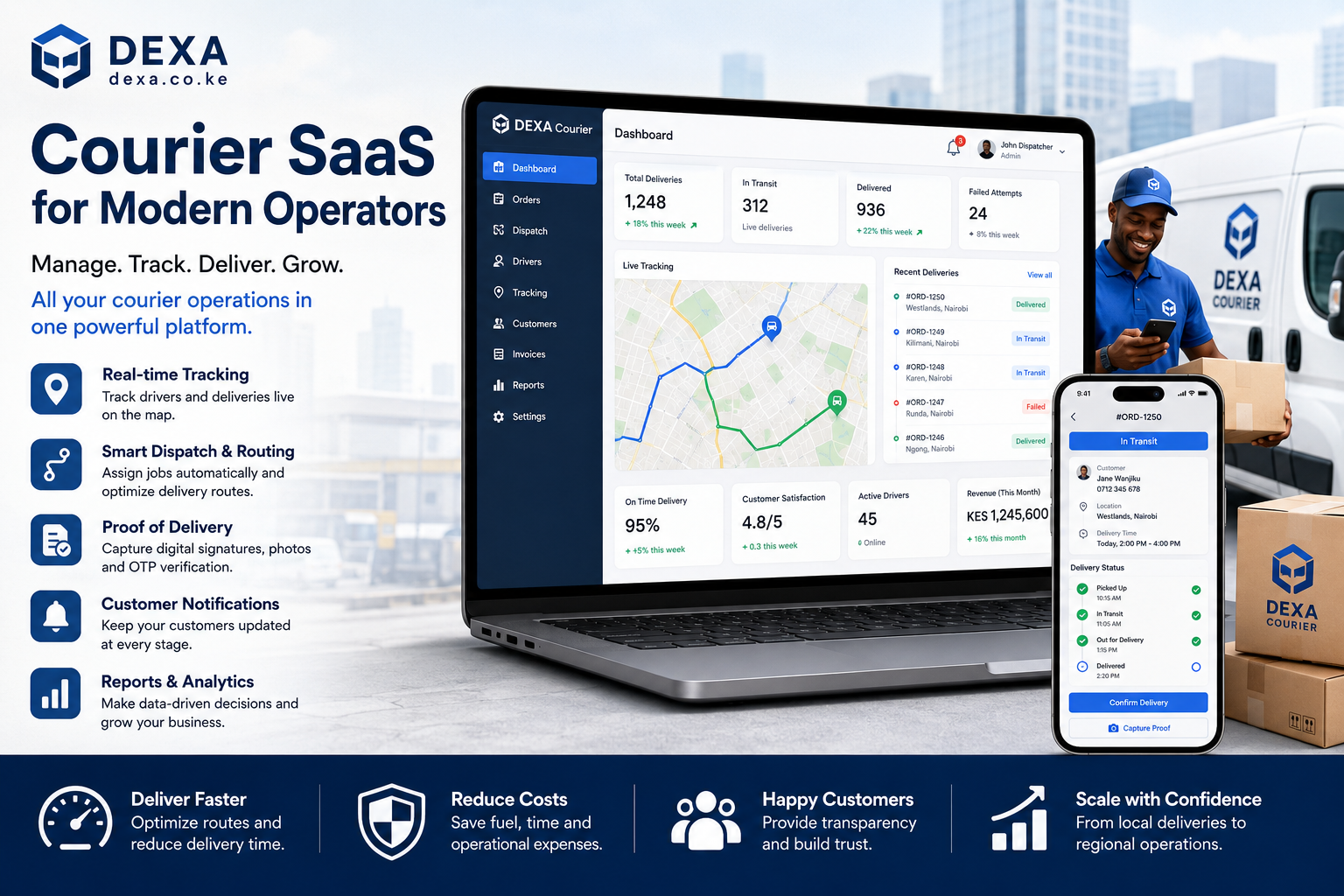
    This is where Courier SaaS for modern operators becomes valuable. Instead of managing deliveries through disconnected tools, businesses can centralize dispatching, driver management, route optimization, customer communication, invoicing, and reporting inside a single cloud platform.

    Courier SaaS for modern operators
    Courier SaaS for modern operators

    Recent courier software market reviews consistently highlight route optimization, proof of delivery, GPS tracking, automated notifications, and delivery management as the most demanded capabilities among courier businesses. Modern platforms are increasingly focused on helping operators improve visibility, efficiency, and customer satisfaction.

    For courier businesses in Kenya, East Africa, and across the continent, adopting Courier SaaS for modern operators is becoming less of a competitive advantage and more of a business necessity.


    What Is Courier SaaS for Modern Operators?

    Courier SaaS for modern operators refers to cloud-based software specifically designed to manage courier and logistics operations.

    Instead of installing software on office computers, operators access the platform through a web browser or mobile application. Drivers, dispatchers, warehouse teams, customer support staff, and management can all work from the same system regardless of location.

    A modern courier SaaS platform typically includes:

    • Delivery scheduling
    • Route optimization
    • Driver management
    • GPS tracking
    • Customer notifications
    • Proof of delivery
    • Online payments
    • Billing and invoicing
    • Reporting dashboards
    • API integrations

    Industry research shows that courier software increasingly focuses on automating collection, dispatch, delivery tracking, routing, expense tracking, and payment processing.

    The goal is simple: reduce operational complexity while improving delivery performance.


    Why Traditional Courier Management Is Failing

    Many courier businesses started small. A few drivers, a dispatcher, and a phone were enough to run operations.

    As order volumes grow, problems begin appearing.

    Dispatch teams spend hours calling drivers for updates. Customer service teams repeatedly answer delivery status inquiries. Finance teams manually reconcile payments. Managers lack visibility into operational performance.

    Without proper software, scaling becomes difficult.

    A courier company handling 50 deliveries per day may manage manually. Once volumes increase to 300 or 500 deliveries daily, manual coordination starts creating delays, errors, customer complaints, and revenue leakage.

    Many logistics professionals report that fragmented workflows, excessive paperwork, document chasing, and communication scattered across multiple channels are among the biggest operational challenges in delivery businesses.

    This is exactly why Courier SaaS for modern operators is gaining popularity.


    Core Features That Define Courier SaaS for Modern Operators

    A successful Courier SaaS for modern operators platform must go beyond simple tracking.

    Modern operators require complete operational visibility.

    Intelligent Dispatch Management

    Dispatching should not depend entirely on human judgment.

    Modern systems automatically assign deliveries based on driver location, availability, delivery priority, vehicle type, and workload.

    This reduces delays while ensuring resources are utilized effectively.

    Real-Time GPS Tracking

    Customers increasingly expect visibility.

    Modern courier platforms allow operators and customers to track deliveries in real time.

    This reduces customer inquiries and increases trust.

    Route Optimization

    Fuel remains one of the largest operational expenses for courier businesses.

    Route optimization helps drivers complete more deliveries using fewer kilometres.

    Research across courier software providers consistently identifies route optimization as a core feature for improving efficiency.

    Proof of Delivery

    Digital signatures, photos, OTP verification, and geolocation confirmation help eliminate disputes.

    Proof of delivery protects both courier companies and customers.

    Automated Customer Notifications

    Customers receive updates when:

    • Orders are dispatched
    • Drivers are approaching
    • Deliveries are completed
    • Delays occur

    This significantly reduces support workload.

    Billing and Invoicing

    Modern courier businesses need integrated invoicing.

    Invoices can be generated automatically after delivery completion, improving cash flow and reducing administrative effort.

    Performance Analytics

    Management teams need answers to questions such as:

    • Which drivers perform best?
    • Which routes generate delays?
    • What is the average delivery time?
    • Which customers generate the most revenue?

    Analytics dashboards provide these insights instantly.


    How Courier SaaS for Modern Operators Improves Daily Operations

    The biggest benefit of Courier SaaS for modern operators is operational efficiency.

    Instead of switching between spreadsheets, WhatsApp groups, emails, and accounting systems, teams work from one platform.

    Dispatchers can monitor all drivers on a live map.

    Managers can review performance metrics in real time.

    Customers can check delivery status without contacting support.

    Finance teams can generate invoices automatically.

    This unified workflow eliminates many bottlenecks that slow courier operations.

    Cloud-based courier platforms are increasingly designed to provide centralized visibility, real-time coordination, and operational control from a single environment.


    Customer Experience Has Become a Competitive Advantage

    Customers rarely compare courier companies based solely on delivery speed.

    They compare experiences.

    If customers receive accurate updates, transparent tracking, delivery confirmations, and professional communication, they are more likely to become repeat customers.

    A courier business that provides complete delivery visibility appears significantly more professional than one that relies on manual updates.

    Modern consumers increasingly expect:

    • Real-time tracking
    • Delivery notifications
    • Digital receipts
    • Faster support responses
    • Transparent delivery status

    Courier SaaS for modern operators helps businesses deliver these expectations consistently.


    Revenue Growth Opportunities Created by Courier SaaS

    Many operators view software purely as an operational expense.

    In reality, software often becomes a revenue growth tool.

    When dispatch becomes more efficient, businesses can process more deliveries without increasing administrative staff.

    When route optimization improves, drivers can complete additional deliveries daily.

    When customer experience improves, retention rates increase.

    When reporting improves, management identifies profitable opportunities faster.

    The result is sustainable growth.

    Several courier software platforms specifically focus on helping businesses scale delivery operations through automation, tracking, routing, and visibility improvements.


    Courier SaaS for Modern Operators and Mobile Workforce Management

    Most courier businesses operate outside the office.

    Courier SaaS for modern operators
    Courier SaaS for modern operators

    Drivers spend their entire workday in the field.

    This makes mobile functionality essential.

    A modern driver application should allow:

    • Delivery acceptance
    • Route navigation
    • Customer communication
    • Proof of delivery capture
    • Status updates
    • Offline operation

    Industry discussions frequently emphasize offline-first mobile applications as particularly valuable for emerging markets where connectivity can be inconsistent.

    For African logistics businesses, this capability is especially important.


    Integration Matters More Than Features

    Many courier operators focus exclusively on feature lists.

    The smarter approach is evaluating integrations.

    A courier platform should connect seamlessly with:

    • E-commerce platforms
    • Payment gateways
    • Accounting software
    • CRM systems
    • Warehouse systems
    • Customer communication tools

    Without integration capabilities, businesses create new operational silos.

    A truly effective Courier SaaS for modern operators platform acts as a central operational hub rather than another isolated system.


    Building a Complete Business Ecosystem

    Businesses rarely operate using one software platform.

    Organizations increasingly adopt integrated ecosystems.

    Examples include:

    These platforms demonstrate how SaaS ecosystems help businesses automate operations across multiple departments.

    A courier company using Courier SaaS for modern operators can similarly connect logistics operations with accounting, customer communication, workforce management, and reporting systems.


    Risks and Challenges

    No technology investment is risk-free.

    Before implementing Courier SaaS for modern operators, businesses should understand potential challenges.

    Staff Resistance

    Employees may resist new workflows.

    Mitigation involves proper training and phased implementation.

    Poor Data Quality

    Migrating inaccurate customer or delivery data creates problems.

    Clean data before implementation.

    Internet Dependence

    Cloud platforms require connectivity.

    Choose solutions that support offline operation where possible.

    Vendor Lock-In

    Switching platforms later can be difficult.

    Select providers with open APIs and export capabilities.

    Cybersecurity Risks

    Customer data and delivery information must remain secure.

    Use providers that implement strong security controls and access management policies.


    Is Courier SaaS for Modern Operators Worth It?

    For most growing courier businesses, the answer is yes.

    If your company handles only a handful of deliveries each week, manual processes may still work.

    However, once delivery volumes begin increasing, inefficiencies become expensive.

    Missed deliveries, delayed updates, customer complaints, manual invoicing, and operational blind spots all create hidden costs.

    Courier SaaS for modern operators provides visibility, scalability, automation, and customer experience improvements that are difficult to achieve through manual management.

    Businesses that adopt modern logistics technology typically gain stronger operational control and better customer satisfaction compared to businesses relying heavily on manual processes.

    For operators serious about long-term growth, investing in modern courier software is increasingly becoming a strategic decision rather than an optional upgrade.


    Future Trends Shaping Courier Operations in 2026 and Beyond

    The courier industry is entering a new phase of digital transformation. Customer expectations continue to rise, fuel prices remain unpredictable, and competition is increasing in both urban and rural markets. As a result, Courier SaaS for modern operators is evolving from a simple delivery management tool into a complete logistics intelligence platform.

    Businesses that invest in modern technology today are positioning themselves to take advantage of future opportunities. Instead of reacting to market changes, they can make proactive decisions using data gathered from their delivery operations.

    One of the biggest trends is predictive logistics. Modern platforms are beginning to analyze historical delivery data to predict future demand patterns. For example, a courier company serving Nairobi’s business district may discover that deliveries increase by 35% during the last week of every month. With this information, managers can schedule additional drivers, allocate vehicles more effectively, and avoid service disruptions.

    Artificial intelligence is also becoming more accessible. Rather than replacing employees, AI helps dispatchers make better decisions. Systems can recommend optimal delivery routes, identify delayed shipments, and predict traffic-related disruptions before they affect customers. As these technologies become more affordable, Courier SaaS for modern operators will continue helping businesses improve efficiency without dramatically increasing staffing costs.

    Another major trend is customer self-service. Modern customers prefer checking delivery information themselves instead of calling customer support. Through customer portals and mobile applications, users can track parcels, reschedule deliveries, download invoices, and communicate directly with drivers. This reduces support costs while improving customer satisfaction.

    Environmental sustainability is also influencing courier operations. Companies are under increasing pressure to reduce fuel consumption and lower emissions. Route optimization features available within Courier SaaS for modern operators help businesses reduce unnecessary travel distances and improve vehicle utilization. Even small improvements can create meaningful savings over time.

    For example, if a delivery vehicle normally travels 180 kilometres per day and route optimization reduces that distance by 15%, daily travel decreases by 27 kilometres. Across a fleet of ten vehicles operating six days per week, this reduction becomes substantial over a year. Beyond fuel savings, vehicle wear and maintenance expenses also decline.


    Managing Last-Mile Delivery Challenges

    Last-mile delivery remains one of the most expensive and difficult parts of logistics operations. It refers to the final stage where a package moves from a distribution point to the customer.

    Many courier companies lose time and money during this phase because of inaccurate addresses, unavailable recipients, traffic congestion, and communication breakdowns.

    Courier SaaS for modern operators helps reduce these challenges by improving coordination between dispatchers, drivers, and customers.

    Customers can receive delivery notifications before arrival. Drivers can access digital delivery instructions. Dispatchers can monitor progress in real time and intervene when issues occur.

    This level of visibility reduces failed deliveries and improves first-attempt success rates.

    The importance of last-mile efficiency continues to grow because e-commerce volumes are increasing across Africa. More businesses are selling products online, creating higher demand for reliable delivery services.

    Courier companies that can provide transparent tracking and dependable delivery experiences are likely to attract more business clients and long-term contracts.


    Why Data Is Becoming a Competitive Asset

    Many courier operators collect large amounts of information without fully utilizing it.

    Delivery records, driver performance metrics, customer locations, payment histories, and route data all contain valuable insights.

    A strong Courier SaaS for modern operators platform transforms this information into actionable intelligence.

    Managers can identify which delivery zones generate the highest profits. They can discover recurring causes of delays. They can measure driver productivity and evaluate customer retention trends.

    Instead of making decisions based on assumptions, businesses can rely on evidence.

    For instance, reporting tools may reveal that deliveries within one region consistently take longer than expected. Further analysis could show that traffic congestion during certain hours causes delays. Managers can then adjust scheduling practices or route assignments accordingly.

    Data-driven decision making is becoming one of the most important advantages of modern courier software.


    Scaling from Local Deliveries to Regional Operations

    Many courier businesses begin by serving a single town or city. As demand grows, expansion opportunities emerge.

    However, expansion often exposes weaknesses in manual processes.

    A business that successfully manages fifty deliveries per day manually may struggle when handling five hundred deliveries across multiple regions.

    This is where Courier SaaS for modern operators becomes essential.

    Cloud-based platforms allow operators to manage multiple branches, warehouses, dispatch teams, and driver fleets from a centralized dashboard.

    Management can monitor operations across different locations without being physically present.

    This visibility is especially important for businesses planning to expand into multiple counties or countries.

    The ability to standardize processes across all locations improves consistency and reduces operational risk.

    Customers receive the same quality of service regardless of where their deliveries originate.


    Choosing the Right Courier SaaS Platform

    Not all courier platforms are designed for the same type of business.

    Some solutions focus on small delivery startups, while others target enterprise logistics providers.

    Before selecting a system, operators should evaluate several factors.

    The first consideration is scalability. A platform should support future growth without requiring a complete replacement after a few years.

    The second consideration is ease of use. Drivers, dispatchers, and customer service teams should be able to learn the system quickly.

    Third, integration capabilities are critical. Businesses often use accounting software, payment gateways, CRM systems, and communication platforms. A courier solution should work seamlessly with these tools.

    Fourth, mobile functionality should be carefully evaluated. Since most courier work occurs outside the office, mobile applications must provide reliable performance.

    Finally, support quality matters. Technology issues can disrupt operations if assistance is unavailable when needed.

    Businesses evaluating Courier SaaS for modern operators should focus on long-term operational value rather than selecting software solely based on price.

    A cheaper platform that lacks essential functionality may ultimately cost more through inefficiencies and lost business opportunities.


    The Strategic Advantage of Early Adoption

    Many business owners wait until operational problems become severe before investing in software.

    Unfortunately, by that stage, customer complaints, missed deliveries, and internal inefficiencies may already be affecting profitability.

    Early adoption provides a strategic advantage.

    Businesses can establish efficient workflows before volumes become difficult to manage. Staff become comfortable using digital tools. Data accumulates over time, creating valuable insights for future decision making.

    Organizations that implement Courier SaaS for modern operators early often find it easier to scale because the operational foundation is already in place.

    Rather than constantly reacting to problems, management can focus on growth initiatives, customer acquisition, and service improvement.

    As logistics markets become increasingly competitive, operational excellence will separate industry leaders from struggling operators.

    Technology alone does not guarantee success, but the right platform can provide the tools needed to deliver faster service, improve visibility, strengthen customer relationships, and support sustainable expansion.

    For courier businesses aiming to remain competitive over the coming years, investing in Courier SaaS for modern operators is not simply a technology decision. It is a business strategy that supports growth, efficiency, and long-term resilience in a rapidly evolving logistics landscape.

    Frequently Asked Questions

    1. What is Courier SaaS for modern operators?

    Courier SaaS for modern operators is cloud-based software that helps courier companies manage dispatching, tracking, routing, invoicing, proof of delivery, and customer communication from a centralized platform.

    2. Can small courier businesses benefit from Courier SaaS for modern operators?

    Yes. Even small businesses benefit from automated dispatch, customer notifications, and digital delivery records that reduce manual work and improve service quality.

    3. Does Courier SaaS for modern operators require special hardware?

    Most platforms only require smartphones, tablets, or computers with internet access. Some solutions also support GPS integrations and barcode scanners.

    4. Is Courier SaaS for modern operators suitable for African markets?

    Yes. Many modern platforms support mobile-first workflows, offline functionality, mobile money integrations, and scalable deployment models suitable for African logistics operations.

    5. How long does implementation take?

    Implementation timelines vary depending on company size, data migration requirements, integrations, and staff training needs. Smaller businesses can often begin within days, while larger organizations may require several weeks.


    Final Thoughts

    The logistics industry is moving rapidly toward automation, visibility, and customer-centric operations.

    Businesses that continue relying on spreadsheets, manual dispatching, and fragmented communication systems will increasingly struggle to compete against technology-enabled operators.

    Courier SaaS for modern operators provides a practical path toward operational efficiency, delivery visibility, better customer experiences, and scalable growth.

    Whether you manage local deliveries, regional distribution networks, e-commerce fulfillment, or enterprise logistics operations, adopting Courier SaaS for modern operators can position your business for long-term success.

    Ready to Modernize Your Courier Business?

    Visit Dexa.co.ke

    Courier SaaS for modern operators
    Courier SaaS for modern operators

    to discover modern SaaS solutions designed to help businesses automate operations, improve visibility, and scale efficiently. Start your digital transformation journey today with a platform built for modern African businesses.

  • Cash on Delivery Management Courier Africa: Powerful Real Profit Numbers, Startup Costs & Break-Even Calculator (2026)

    Why Cash on Delivery Management Courier Africa Is Becoming a Critical Logistics Infrastructure

    The growth of eCommerce across Africa has transformed how businesses sell and deliver products, but one challenge continues to affect online merchants: customer trust. While digital payment adoption has increased significantly in countries such as Kenya, Nigeria, Uganda, Tanzania, Ghana, and South Africa, millions of consumers still prefer paying for products only after physically receiving them.

    This preference has made cash on delivery management courier Africa an essential part of the continent’s logistics ecosystem. Unlike traditional delivery services that simply transport packages from one location to another, modern COD management involves order verification, customer communication, route optimization, payment collection, cash reconciliation, return handling, fraud prevention, merchant reporting, and settlement management. Businesses that fail to manage these processes effectively often experience delayed payments, lost revenue, high return rates, and customer complaints.

    Cash on Delivery Management Courier Africa
    Cash on Delivery Management Courier Africa

     As online shopping continues to expand, merchants are increasingly looking for courier partners that provide complete visibility into every stage of the delivery journey. A well-designed cash on delivery management courier Africa system enables businesses to track parcels in real time, confirm customer availability before dispatch, monitor delivery success rates, and automatically reconcile payments once collections are made.

    This level of operational transparency reduces disputes and improves cash flow management. For small and medium-sized enterprises, the benefits are even more significant because many lack dedicated logistics teams and rely heavily on external delivery partners. By leveraging modern software platforms, courier companies can automate delivery scheduling, generate proof-of-delivery records, track driver performance, and provide merchants with instant reports.

    The increasing use of mobile money services such as M-PESA, Airtel Money, and other digital wallets has also improved COD operations because collected payments can be transferred electronically instead of relying entirely on physical cash handling.

    Nevertheless, successful cash on delivery management courier Africa operations require more than technology alone. Businesses must invest in customer verification processes, staff training, route planning, fraud detection mechanisms, and performance monitoring systems. A single failed delivery can create multiple costs, including transportation expenses, customer service time, product return handling, and inventory management overhead.

    When these losses accumulate, profitability declines rapidly. This is why leading logistics operators focus on data-driven decision-making and process automation to improve delivery success rates. Another major trend driving demand for cash on delivery management courier Africa services is the rapid growth of social commerce. Thousands of entrepreneurs now sell products through Facebook, Instagram, TikTok, WhatsApp, and online marketplaces, generating a constant stream of COD orders that require reliable fulfillment.

    These sellers often need affordable delivery networks capable of handling collections, remittances, and customer communication without requiring large upfront investments. As a result, courier companies that offer integrated COD management solutions are positioned to capture a growing share of Africa’s expanding digital economy.

    Looking ahead, businesses that combine efficient logistics operations with modern management software, strong customer support, accurate reporting, and secure payment reconciliation will be best placed to scale. The future of eCommerce growth across the continent will depend heavily on how effectively cash on delivery management courier Africa providers help merchants build trust, reduce risk, accelerate cash flow, and deliver a consistently positive customer experience.

    Cash on Delivery Management Courier Africa
    Cash on Delivery Management Courier Africa

    What Is Cash on Delivery Management Courier Africa?

    Cash on delivery management courier Africa refers to the systems, processes, software, couriers, pickup points, payment reconciliation tools, and logistics operations used to manage orders where customers pay when receiving products.

    Across Kenya, Nigeria, Tanzania, Uganda, Ghana, Zambia, and South Africa, COD remains one of the most trusted payment methods because many consumers still prefer seeing goods before paying.


    The rise of cash on delivery management courier Africa solutions has created opportunities for:

    • Courier companies
    • Pickup stations
    • E-commerce sellers
    • Delivery startups
    • Logistics aggregators
    • Collection agents
    • Franchise operators

    Companies such as Codirect Courier, DLIVAD and Tracit are helping businesses manage COD deliveries more efficiently across African markets. (dlivad)


    Why COD Remains Dominant in Africa

    Despite the growth of mobile money and card payments, COD remains popular because:

    • Buyers trust physical verification.
    • Return rates are easier to negotiate.
    • Many first-time online shoppers prefer cash.
    • Some regions have low card penetration.
    • Fraud concerns still exist.

    Many logistics providers promote COD growth using phrases like:

    • “Increase sales dramatically.”
    • “Grow your business faster.”
    • “Earn more from every parcel.”
    • “Scale without limits.”

    The problem is that these statements rarely include actual financial calculations. Several leading COD websites discuss growth, profitability, and expansion without showing exact revenue formulas or break-even timelines. (ssascod.com)

    Instead of vague promises, let’s look at real numbers.


    The Role of Automation in Cash on Delivery Management Courier Africa

    One of the biggest differences between profitable and struggling logistics businesses is the level of automation used in daily operations. As parcel volumes increase, manually managing orders, customer confirmations, delivery assignments, payment tracking, and reporting becomes increasingly difficult.

    This is where cash on delivery management courier Africa solutions provide significant value. Automated systems can instantly notify customers when orders are dispatched, send reminders before delivery, capture digital proof of delivery, and update merchants in real time. Instead of relying on spreadsheets, paper receipts, and manual reconciliation processes, courier companies can centralize all delivery information within a single platform. This reduces human error and improves accountability across the organization.

    cash on delivery management courier Africa
    cash on delivery management courier Africa

    Automation also helps businesses improve cash flow management. In many COD operations, delays in reconciling collections can create financial challenges for merchants who depend on fast access to their revenue. Modern cash on delivery management courier Africa software can automatically record collections, calculate commissions, generate settlement reports, and trigger payments to merchants.

    This transparency strengthens trust between couriers and sellers while reducing disputes over missing or delayed funds. In addition, automated dashboards allow managers to monitor delivery performance, identify failed delivery trends, and measure profitability by region, product category, or delivery agent.

    Another advantage is scalability. A courier company handling 50 deliveries per day may be able to manage operations manually, but the same approach becomes unsustainable at 500 or 5,000 deliveries daily. Automation allows businesses to grow without increasing administrative costs at the same rate as order volume.

    Features such as route optimization, customer self-service portals, inventory synchronization, and automated communication significantly improve efficiency. As competition in African logistics continues to increase, companies that invest in automated cash on delivery management courier Africa systems will be better positioned to deliver faster service, reduce operating costs, improve customer satisfaction, and maintain profitability while expanding into new markets and regions.

    Startup Costs Breakdown

    Below is a realistic startup budget for a small cash on delivery management courier Africa operation in Kenya.

    Item Cost (KES)
    Business registration 15,000
    Website & domain 10,000
    Delivery management software 25,000
    Initial marketing 40,000
    Smartphone devices (2) 30,000
    Receipt printer 12,000
    Working capital 100,000
    Rider equipment 25,000
    Training & setup 18,000
    Miscellaneous 25,000
    Total Startup Cost 300,000 KES

    A professionally managed cash on delivery management courier Africa business can realistically start between KES 250,000 and KES 500,000 depending on fleet size.


    Revenue Models With Real KES Calculations

    Most COD operators earn from:

    1. Delivery fees
    2. Collection commissions
    3. Return handling fees
    4. Storage fees
    5. Merchant subscriptions
    6. Fulfillment services

    Assumptions:

    • Average delivery fee = KES 250
    • Collection commission = KES 30
    • Average orders per day varies by scenario
    • 26 working days monthly

    Monthly revenue formula:

    Orders × Revenue Per Order × Working Days

    Average revenue per order:

    250 + 30 = KES 280


    Scenario 1: 10-Unit Apartment

    A residential pickup point serving a 10-unit apartment block.

    Assumptions

    • 5 parcels daily
    • Revenue per parcel = KES 280

    Monthly Revenue:

    5 × 280 × 26

    = KES 36,400

    Monthly expenses:

    Expense Cost
    Internet 2,000
    Transport 5,000
    Phone 1,500
    Miscellaneous 2,500
    Total 11,000

    Net monthly profit:

    36,400 − 11,000

    = KES 25,400

    This is a modest entry-level cash on delivery management courier Africa operation.


    Scenario 2: Roadside Kiosk

    A busy kiosk handling neighborhood parcel collections.

    Assumptions

    • 20 parcels daily
    • Revenue per parcel = KES 280

    Monthly revenue:

    20 × 280 × 26

    = KES 145,600

    Monthly expenses:

    Expense Cost
    Rent contribution 10,000
    Staff support 15,000
    Internet 3,000
    Utilities 2,000
    Miscellaneous 5,000
    Total 35,000

    Net profit:

    145,600 − 35,000

    = KES 110,600

    Many pickup-point networks in Africa operate on a model similar to this. (dlivad)


    Scenario 3: School Collection Point

    Schools increasingly receive deliveries for students and staff.

    Assumptions

    • 30 parcels daily
    • Revenue per parcel = KES 280

    Monthly revenue:

    30 × 280 × 26

    = KES 218,400

    Monthly expenses:

    Expense Cost
    Staff allowance 20,000
    Software 5,000
    Connectivity 3,000
    Administration 7,000
    Total 35,000

    Net profit:

    218,400 − 35,000

    = KES 183,400

    This model shows why cash on delivery management courier Africa continues attracting entrepreneurs.


    Scenario 4: Event Space Collection Hub

    Large conferences, exhibitions, expos, and festivals generate parcel demand.

    Assumptions

    • 50 parcels daily
    • Revenue per parcel = KES 280

    Monthly revenue:

    50 × 280 × 26

    = KES 364,000

    Monthly expenses:

    Expense Cost
    Staff 40,000
    Rent allocation 15,000
    Software 10,000
    Connectivity 5,000
    Security 5,000
    Total 75,000

    Net profit:

    364,000 − 75,000

    = KES 289,000


    Monthly Operating Costs

    Every cash on delivery management courier Africa business faces recurring expenses.

    Cost Category Monthly KES
    Software subscriptions 5,000–30,000
    Rider management 20,000–100,000
    Fuel 15,000–80,000
    Internet 2,000–10,000
    Customer support 15,000–50,000
    Maintenance 5,000–25,000
    Payment reconciliation 3,000–15,000
    Marketing 10,000–100,000

    Maintenance often gets ignored.

    Typical maintenance includes:

    • Smartphone replacement
    • Printer servicing
    • POS repairs
    • Software updates
    • Motorbike servicing
    • Storage equipment replacement

    Break-Even Analysis

    Let’s use the roadside kiosk example.

    Startup cost:

    300,000 KES

    Monthly profit:

    110,600 KES

    Break-even formula:

    300,000 ÷ 110,600

    = 2.71 months

    Break-Even Results

    Scenario Monthly Profit Break-Even
    Apartment 25,400 11.8 months
    Kiosk 110,600 2.7 months
    School 183,400 1.6 months
    Event Hub 289,000 1.0 month

    Realistically, most operators experience slower growth initially.

    A safer estimate is:

    • Apartment: 12–15 months
    • Kiosk: 3–5 months
    • School: 2–4 months
    • Event Hub: 2–3 months

    Technology Needed

    Successful cash on delivery management courier Africa businesses depend heavily on software.

    Core tools include:

    • Order management
    • Rider tracking
    • Cash reconciliation
    • Customer notifications
    • Inventory management
    • Delivery confirmation
    • Reporting dashboards

    Useful business systems include:

    These platforms help businesses automate operations, customer communication, accounting, attendance, inventory control, workflow approvals, and reporting.


    Risk Analysis

    Every cash on delivery management courier Africa operation carries risk.

    1. Fake Orders

    A major challenge reported by many COD merchants is poor order confirmation rates. Some businesses receive large numbers of inquiries that never convert into completed deliveries. (Reddit)

    Mitigation:

    • SMS verification
    • Phone confirmation
    • Customer scoring

    2. Cash Theft

    Drivers or agents may mishandle cash.

    Mitigation:

    • Daily reconciliation
    • Mobile money settlements
    • Audit trails

    3. Delivery Failures

    Wrong addresses create losses.

    Mitigation:

    • GPS verification
    • Address validation
    • Customer confirmation

    4. High Return Rates

    Returns reduce margins.

    Mitigation:

    • Better product descriptions
    • Verification calls
    • Customer education

    5. Fraud & Scams

    Fraudulent courier messages and fake delivery notifications are increasingly common. (Reddit)

    Mitigation:

    • Official tracking systems
    • Secure communication channels
    • Customer awareness

    How SaaS Improves COD Operations

    Modern cash on delivery management courier Africa companies increasingly use SaaS platforms to reduce manual work.

    Examples include:

    • Merchant portals
    • Dispatch management
    • Delivery tracking
    • Cash reconciliation
    • Inventory monitoring
    • Reporting automation

    Platforms such as Tracit and Curfox focus on reducing manual reconciliation and improving visibility of COD transactions. (Curfox)

    For internal operations, businesses can integrate:

    • Dexa
    • Vega
    • Zivo
    • Ratibu
    • RentalDesk
    • Prim
    • Wito
    • Fama
    • Jaat
    • KayaPro360
    • Musa Music AI
    • Awasam

    These systems help streamline accounting, CRM, HR, customer support, attendance tracking, communication, and business intelligence.


    Future Trends Shaping Cash on Delivery Management Courier Africa

    The future of cash on delivery management courier Africa is being shaped by rapid technological innovation, changing consumer behavior, and the continued expansion of eCommerce across the continent. Over the last decade, online shopping has evolved from a niche activity into a mainstream purchasing channel for millions of Africans. As more consumers buy products online, the demand for reliable COD logistics services continues to grow. However, customers now expect more than simple delivery. They want real-time tracking, faster fulfillment, flexible payment options, and responsive customer support. Meeting these expectations requires courier companies to modernize their operations and invest in smarter systems.

    One of the most important trends is the integration of artificial intelligence and predictive analytics into cash on delivery management courier Africa platforms. AI-powered tools can analyze delivery data, identify high-risk orders, predict failed deliveries, and recommend optimal delivery routes. This helps logistics providers reduce operational costs while improving delivery success rates. For example, if a system identifies that customers in a particular location frequently miss deliveries during working hours, deliveries can be automatically scheduled for evenings or weekends to improve completion rates.

    cash on delivery management courier Africa
    cash on delivery management courier Africa

    Mobile technology is also transforming the industry. Delivery agents increasingly use mobile applications to receive assignments, capture customer signatures, upload proof of delivery, and reconcile payments instantly. These applications eliminate paperwork and provide merchants with real-time visibility into order status. As smartphone adoption continues to rise throughout Africa, mobile-first logistics solutions will become even more important for efficient cash on delivery management courier Africa operations.

    Another growing trend is the development of decentralized pickup and collection networks. Rather than delivering every package directly to a customer’s home, many courier companies are establishing pickup points in residential estates, shopping centers, schools, fuel stations, and neighborhood kiosks. This model reduces last-mile delivery costs while giving customers greater convenience. It also creates new revenue opportunities for local businesses that act as parcel collection partners.

    The increasing adoption of digital payment systems is expected to complement rather than replace COD. Many customers still prefer paying upon delivery, but they are choosing to pay using mobile money instead of physical cash. This reduces security risks, simplifies reconciliation, and accelerates merchant settlements. As a result, future cash on delivery management courier Africa solutions will likely combine traditional COD processes with digital payment technologies, creating a hybrid model that offers flexibility to both merchants and consumers.

    Ultimately, the businesses that embrace automation, data analytics, mobile technology, and customer-centric delivery models will gain a competitive advantage. As eCommerce penetration rises across African markets, cash on delivery management courier Africa will remain a critical service that supports trust, improves accessibility, and enables sustainable growth for online businesses throughout the continent.

    Is Cash on Delivery Management Courier Africa Worth It?

    Yes—but only if managed professionally.

    The biggest mistake is believing marketing claims without examining actual numbers.

    A small apartment-based operation generating KES 25,400 monthly profit may take almost a year to recover investment.

    A kiosk, school, or event-based model can break even much faster.

    The businesses that succeed in cash on delivery management courier Africa focus on:

    • Automation
    • Cash control
    • Customer verification
    • Reliable software
    • Accurate reporting
    • Efficient delivery networks

    If you cannot manage reconciliation and delivery tracking effectively, profits disappear quickly.

    If you implement strong systems, COD remains one of Africa’s most resilient logistics opportunities.


    FAQ

    1. How much capital do I need to start?

    Most operators can begin with between KES 250,000 and KES 500,000 depending on scale.

    2. What is the biggest cost?

    Staff, riders, fuel, and reconciliation processes are usually the largest expenses.

    3. How long does break-even take?

    Anywhere from 1 to 15 months depending on parcel volume and operating efficiency.

    4. Can COD work alongside mobile money?

    Yes. Most successful courier businesses support both COD and digital payments.

    5. What software should I use?

    A combination of delivery management, accounting, CRM, communication, and workflow software is recommended for scaling operations.

    Visit:

    Pawa.co.ke

    You can also explore:

    By combining strong software, disciplined cash management, and accurate reporting, a cash on delivery management courier Africa business can become a scalable and profitable operation in 2026 and beyond.