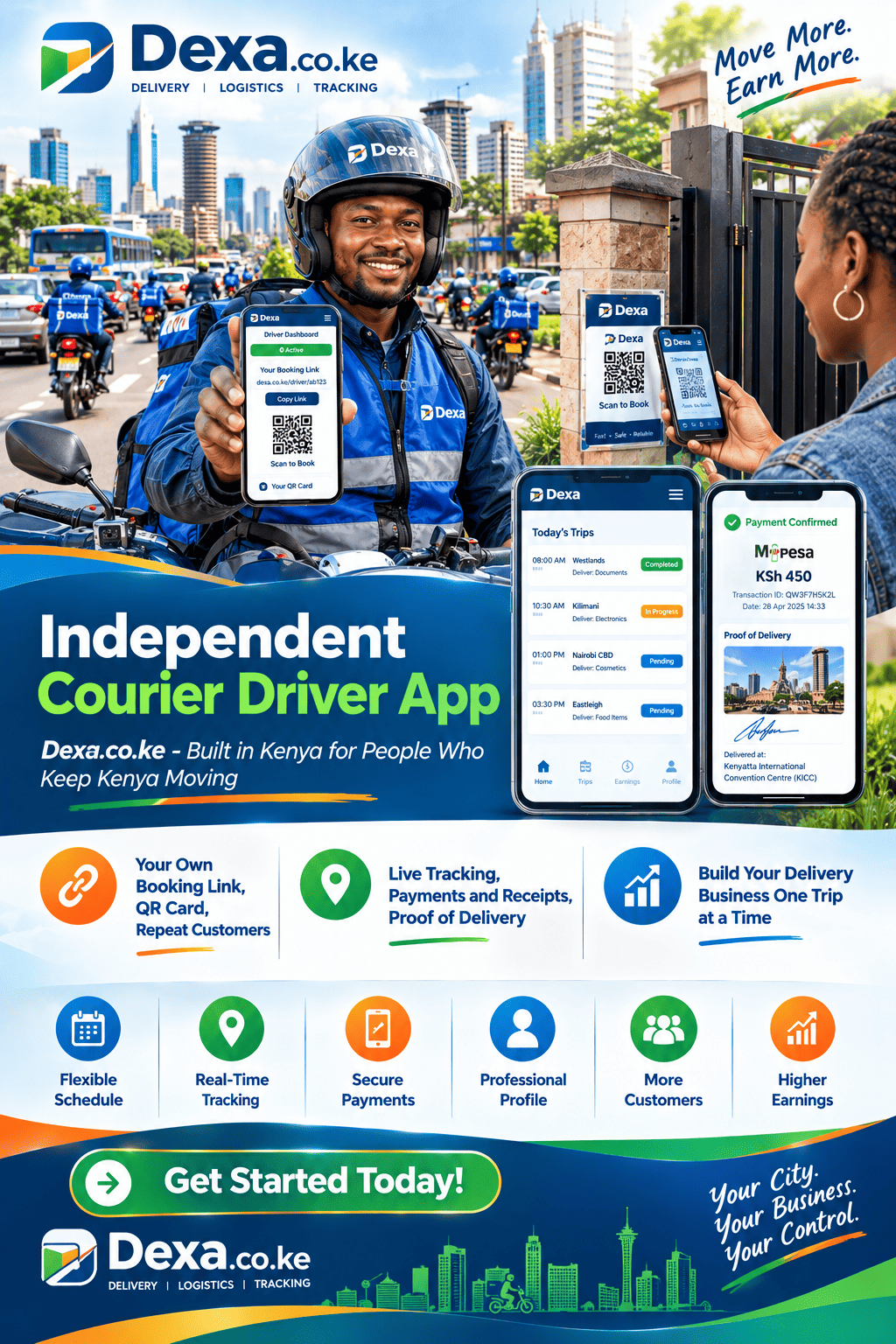
An independent courier driver app addresses a problem that most delivery platforms have no interest in solving: how a rider builds a business of their own rather than renting their time to an algorithm. Every platform-based delivery app keeps the customer inside the platform. The rider completes the trip, the passenger or sender disappears into the system, and the next time that customer needs something moved they open the same app and are matched with whoever happens to be nearby.
An independent courier driver app changes that arrangement by giving the rider a customer channel they actually own. The distinction matters more than it first appears. An independent courier driver app is not simply a tool for accepting jobs. It is the infrastructure that turns a rider from a unit of supply into a small business with a customer base, a reputation, and a record of everything delivered.
What Independence Actually Means for a Courier Driver
Most riders in Kenya work across several platforms. They open an app, wait for a request, accept it, complete the trip, and then wait again. The work arrives through someone else’s system, and the customer belongs to someone else. The rider’s income is determined by an algorithm they cannot see and pricing they did not set.
An independent courier driver app reverses this arrangement. Instead of waiting to be matched, the rider creates a profile, generates a personal booking link, and shares it with customers. A customer who books through that link is booking the rider, not the platform. The next time they need something moved, they use the same link. Over months, those links accumulate into a roster of repeat clients, and the rider’s income becomes predictable rather than dependent on daily luck.
The practical effect is that the rider stops competing for every job against every other rider in the area. The rider’s customers come to them directly because they had a good experience and the rider gave them a way to book again. An independent courier driver app therefore changes the nature of the work rather than merely making it more convenient.
The Booking Link and QR Card That Build a Client Base
The mechanic behind an independent courier driver app is simple. A rider named John Kamau sets up a profile with his name, vehicle, and service areas. The system generates a link at dexa.co.ke/d/john-kamau along with a QR card. John shares the link on WhatsApp status, includes it in a message after a delivery, or sticks the QR card on his motorcycle.
A customer who scans the card is taken to a booking page that already knows who John is. They supply the pickup and drop-off details, and the booking lands in John’s queue. There is no number to type, no contact to add manually, and no chance of the customer losing the details. The independent courier driver app turns a single completed delivery into a repeat relationship.
The QR card works because it borrows a behaviour Kenyans already perform daily. Scanning a code is familiar from mobile payments, menus, and promotions. Applying that habit to delivery booking removes the friction that otherwise prevents a satisfied customer from becoming a repeat customer. For a rider trying to build something that lasts, this is the single most valuable feature an independent courier driver app can provide.
Scheduling and Earnings in One Place
A rider working independently needs three things visible at all times: what is scheduled, where the current delivery is, and how much has been earned. Scattered across separate tools, these three pieces of information create daily confusion. Held together in an independent courier driver app, they allow the rider to work without stopping to reconstruct what is happening.
The scheduling function lets a rider plan pickups in advance rather than accepting them one at a time. A customer who books for later in the day appears on the schedule alongside everything else. The rider can plan fuel, route, and rest around what is coming rather than discovering the day one job at a time.
Earnings accumulate against each completed trip rather than being remembered at the end of the day. The rider can see what has been earned, what has been collected, and what remains outstanding. For riders working on thin margins, knowing whether a day has been profitable before it ends is a practical advantage that an independent courier driver app provides without requiring any extra effort.
Payments Without the Cash Risk
Cash remains common in courier work, and it creates risk that riders carry personally. A rider collecting cash across a full day is carrying money that can be lost, stolen, or disputed. Mobile money reduces that risk, but only if the rider has a way to request and confirm payment at the point of delivery.
An independent courier driver app handles both methods with the same discipline. When a customer pays through mobile money, the transaction attaches to the trip automatically. When a rider collects cash, the collection is logged against the same trip before the rider moves on. Receipts are generated without the rider having to write anything.
This documentation protects the rider as much as it protects the customer. A recorded collection cannot be disputed from either side. A rider who has evidence of what was collected and from whom does not have to rely on the customer’s memory or their own.
Proof of Delivery on the Road
Capturing proof of delivery is harder than it sounds when the rider is standing at a gate with a parcel in one hand and a phone in the other. Any proof system that requires more than a few seconds of attention will be skipped under pressure.
This is why the proof features in an independent courier driver app are designed to be quick. A photograph of the parcel at the delivery location. A signature if the customer is willing. A timestamp and location captured automatically. Together these elements produce a record that settles most disputes without requiring the rider to type anything.
In a market where addresses are often landmarks rather than street numbers, the photograph carries particular weight. A picture of the parcel at the blue gate beside the petrol station establishes location in a way that written confirmation cannot. The independent courier driver app treats the photograph as a routine step rather than an optional extra, because the moments when proof matters most are precisely the ones that go unrecorded when it is left to discretion.
Passing Work to Trusted Colleagues
No rider can take every job. There are days when the schedule is full, the motorcycle needs servicing, or a personal commitment takes priority. In those moments, most riders simply lose the customer, because they have no way to hand the work to someone they trust.
An independent courier driver app changes this by allowing a rider to offer a booking to a colleague rather than declining it. The customer stays with the rider who introduced them, the colleague gets paid for the work, and the relationship survives. The rider does not have to become a full-time dispatcher to make this work. The app handles the transfer without requiring manual coordination.
This feature turns a solo rider into a small network. A rider with two or three trusted colleagues can cover more ground, take on more work, and serve customers even when they are personally unavailable. The independent courier driver app supports this without asking the rider to manage a team.
Working Alongside the Apps Drivers Already Use
One of the practical decisions behind the independent courier driver app is that it does not ask riders to abandon the platforms they already work with. A rider using a ride-hailing app for passenger trips can continue doing so. The app works alongside by giving passengers and customers a way to request the rider directly next time.
The logic is straightforward. A rider who completes a good trip and hands over a QR card gives the customer an option they did not have before. The customer can book the rider directly rather than going through a marketplace that takes a commission. The independent courier driver app does not replace the rider’s existing work. It adds a channel that belongs to the rider and produces income that is not subject to someone else’s pricing.
For riders who also work with courier teams, the same app supports that arrangement. A rider can be part of a team’s dispatch while also maintaining their own customer channel. The two do not conflict, because the app treats each booking as a separate record with its own customer, payment, and proof.
The Conditions the App Is Built For
An independent courier driver app designed for Kenya has to account for conditions that apps built elsewhere can ignore. Traffic congestion in Nairobi ranks among the worst in Africa, and delivery times are unpredictable. Addresses are often landmarks rather than street numbers. Network coverage is uneven in some areas, which means the app must continue capturing records when connectivity drops and sync them automatically when it returns.
Pricing needs to work as part of the booking record rather than as a separate negotiation. The agreed fee is captured when the booking is confirmed, so the rider knows what to collect and the customer knows what to pay. The independent courier driver app handles this without requiring the rider to quote a figure at the door, which is where most cash disputes begin.
The app also needs to work on the phones riders actually use. Battery life matters over a long shift, and data consumption has to be modest for riders paying for their own airtime. Systems designed for the Kenyan market account for these constraints from the beginning rather than treating them as problems to solve later.
From Solo Rider to Small Business
The progression from solo rider to small business is one of the more important things an independent courier driver app makes possible. A rider starts with a booking link and a QR card. The link produces repeat customers. The schedule fills. The rider begins passing work to trusted colleagues. Over time, the rider is no longer simply completing trips but running a small operation with a customer base, a reputation, and a record of everything delivered.
That progression happens without the rider having to negotiate commission rates with a platform or compete for every job against every other rider. The independent courier driver app gives the rider the tools to build something that belongs to them rather than to an algorithm.
The same tools support riders who prefer to remain solo. Not every rider wants to manage other people, and the app does not require it. A rider can use the booking link, the scheduling, the payment records, and the proof of delivery features without ever adding a colleague. The independent courier driver app scales to the size of the operation rather than assuming a particular ambition.
What Riders Gain From a Proper System
The immediate gain is a quieter phone. When customers can see where their delivery is, they stop calling to ask. When bookings arrive through a link, the rider does not have to negotiate every job from scratch. When payments are recorded automatically, nobody has to reconcile from memory at the end of the day.
The second gain is protection. A rider with a recorded delivery, a payment log, and a proof photograph has evidence against false claims. A customer who says a parcel never arrived can be shown the record. A dispute about what was collected can be settled from the log. The independent courier driver app protects the rider as much as it protects the customer.
The third gain is a customer base that compounds. Every satisfied customer who saves the booking link is a potential repeat job. Over months, those links accumulate into a roster of regular clients and predictable income. The independent courier driver app turns daily work into an asset that grows rather than resets each morning.
Managing Money as an Independent Rider
Earning money and keeping it are different skills. Many riders earn reasonably well during the week and find nothing left by the end. The reason is usually that costs are absorbed as they arise rather than planned for.
A simple approach works better. Set aside a fixed amount each day for fuel. Set aside a smaller amount for maintenance. Track what is left rather than tracking what was earned. Over a month, the maintenance fund covers the chain, tyres, and servicing that would otherwise become an emergency. Riders who use an independent courier driver app to track earnings against costs develop a clearer picture of which days and which types of work are genuinely profitable.
That knowledge changes how the rider accepts work. A rider might discover that long-distance jobs appear lucrative until fuel and time are counted, while shorter repeat deliveries produce better returns. That insight, accumulated over weeks, is what separates a rider who earns well from one who works hard and wonders where the money went.
Where Independent Courier Work Is Heading
Several shifts are reshaping motorcycle and courier work in Kenya. Electric motorcycles are becoming more common, and their lower running costs change the economics of short-distance delivery. Charging costs a fraction of fuelling, and maintenance requirements are lighter. Riders using electric motorcycles keep more of what they earn, and the independent courier driver app supports both vehicle types without distinction.
Mobile money integration continues to deepen, and the connection between payment confirmation and delivery confirmation is becoming tighter. Government investment in intelligent traffic management is gradually improving movement across Nairobi, which will make arrival estimates generated by the app more reliable over time.
What will not change is the underlying requirement: a rider needs to be findable, to accept work without friction, to collect payment safely, and to have a record of what was delivered. That requirement sits at the centre of what an independent courier driver app should provide.
Choosing the Right App
Riders evaluating options should focus on a few practical questions. Can the app give them a customer channel of their own, or does it keep customers locked inside a platform? Does it handle both cash and mobile money without treating one as an exception? Does it work when the network drops? Can proof of delivery be captured in seconds rather than minutes? Can the rider pass work to a colleague without losing the customer?
An app that answers these well will not create new problems as the rider’s business grows. An app that answers only some will leave gaps, and gaps are where money disappears and disputes develop. The difference between the two is rarely visible in a demonstration, which is why testing with real deliveries across a fortnight is worth the effort before committing.
An independent courier driver app is not simply a way to accept jobs. It is the infrastructure that turns a rider from someone who completes trips into someone who runs a delivery business. It gives them a customer channel, a booking link, a QR card, a schedule, a payment record, and a proof of delivery that does not depend on memory.
For riders working across Nairobi, Mombasa, Kisumu, and beyond, the independent courier driver app from dexa.co.ke is built for the work they actually do. It supports the motorcycle, the cash and mobile money mix, the landmark addresses, and the reality of a rider trying to build something that lasts.
From the first booking to the final confirmed delivery, the record stays with the trip. Nothing has to be reconstructed from memory. Nothing gets lost between the request and the delivery. The rider builds a business, and the app makes sure nothing falls through the cracks along the way.