A freelance delivery rider in Kenya represents a different way of working than the platform-based model that has dominated the sector for years. On a platform, the rider accepts whatever job appears, completes it, and waits for the next one. The customer belongs to the system, the pricing is set by someone else, and the rider’s income depends on an algorithm they cannot see. A freelance delivery rider in Kenya works differently. They find their own customers, set their own terms, and build a client base that belongs to them rather than to a company.
The distinction is not simply about independence as a matter of principle. It is about economics. A freelance delivery rider in Kenya who has built a roster of regular clients earns more consistently than one who depends entirely on daily job matching. The repeat customer who calls twice a week is worth more over a month than a dozen one-off trips, because the relationship removes the uncertainty from the working day. A freelance delivery rider in Kenya who understands this treats every completed delivery as an opportunity to build a relationship rather than simply close a transaction.
What Freelance Work Actually Looks Like
Freelance delivery work in Kenya covers more ground than most people assume. The category includes parcel movement for online sellers, food delivery from restaurants, document couriering for offices, grocery runs, pharmacy deliveries, and ad hoc requests from individuals who need something moved across town. Each type has its own rhythm and its own customer expectations. A freelance delivery rider in Kenya who understands these patterns can plan the day to fill quiet hours rather than waiting at a stage.
The working day varies considerably depending on the type of work. Food delivery peaks around lunch and dinner, with a lull in between. Business parcels follow office hours with a late-afternoon rush. Individual requests arrive unpredictably throughout the day. A freelance delivery rider in Kenya who knows which hours are productive and which areas generate the most requests earns more than one who simply accepts whatever appears without thinking about the pattern.
What Freelance Riders Actually Earn
Earnings from freelance delivery work vary widely, and anyone quoting a single figure is oversimplifying. The range depends on hours worked, the type of deliveries accepted, fuel costs, and whether the rider owns the motorcycle or hires it. Gross takings on a normal day commonly fall between KSh 1,200 and KSh 2,500 for a rider working a full shift in a busy area. From that, fuel consumes between KSh 300 and KSh 600. A rider hiring a motorcycle pays a daily target of roughly KSh 300 to KSh 500 to the owner. SACCO levies and airtime add another KSh 50 to KSh 150. Take-home figures therefore range from KSh 400 on a slow day to KSh 1,200 on a good one.
The difference between the low and high ends of that range is rarely about luck. Riders who earn consistently well have a phone that rings with repeat customers. A WhatsApp list of regular clients who call directly is what separates a strong day from a weak one. The central insight for any freelance delivery rider in Kenya is that the customer relationship is worth more than any individual trip.
The Cost Structure Freelance Riders Must Understand
Fuel is the largest daily expense, and it moves with the pump price. A shilling increase at the pump comes directly off the rider’s day, which makes route efficiency and avoiding unnecessary mileage a financial matter rather than a matter of convenience. Maintenance is the second major cost, and it is not optional. Chains, sprockets, tyres, brake pads, and oil changes all need attention, and Kenyan roads wear these parts faster than riders expect. Budgeting for maintenance monthly is considerably cheaper than dealing with a breakdown that takes the motorcycle off the road for days.
Idle time is the hidden cost. Every hour parked at a stage waiting for walk-up customers is an hour that earns nothing while the day’s costs continue to accumulate. Riders who fill idle time with delivery work rather than waiting for passengers tend to earn more consistently. The economics of being a freelance delivery rider in Kenya favour riders who keep moving rather than those who wait.
Requirements for Freelance Riders
To work legally as a delivery rider in Kenya, several requirements must be met. A valid motorcycle licence is the starting point. County regulations require riders to register under recognised SACCOs or companies, obtain annual permits, and adhere to safety standards including helmets and reflective gear. Riders also need a certificate of good conduct for registration. Motorcycles must carry valid insurance, and PSV insurance is necessary for commercial work. Riders must be at least eighteen years old.
Complying with these requirements is not simply a legal formality. Formal registration provides riders with recognition and legal protection that informal operators lack. It also opens access to corporate clients who will not engage unregistered riders. Any serious approach to working as a freelance delivery rider in Kenya should begin with ensuring these requirements are met rather than treating them as an afterthought.
Finding Work as a Freelance Rider
There are several routes into freelance delivery work, and each suits a different type of rider.
Platform-based work offers the most immediate start. Riders sign up, complete verification, and begin accepting jobs through the app. The advantage is that work is available without the rider needing to find customers. The disadvantage is that the customer belongs to the platform, and the rider competes for every job against every other rider in the area.
Direct relationships with businesses offer a better long-term return. A rider who becomes the regular delivery partner for a small online seller or a restaurant builds a client relationship that produces repeat work. These arrangements often begin informally when a rider completes a delivery well and the business asks if they are available again. A freelance delivery rider in Kenya who thinks about the work as a relationship business rather than a transaction business builds more stable income over time.
Independent operation is the third route and the one with the highest ceiling. A rider who has their own booking link and QR card can accept customers directly, set their own prices, and keep the full delivery fee rather than a platform’s share. The challenge is that independent riders must find their own customers, which is where the right tools make a considerable difference. A freelance delivery rider in Kenya working independently needs a way to be found, a way to accept bookings, and a way to keep records that do not depend on memory.
Building a Client Base Instead of Chasing Trips
The most important shift for any freelance rider is moving from chasing individual trips to building a base of repeat customers. This is where the earnings difference between a weak day and a strong day actually comes from. A rider with ten regular customers who call once or twice a week has a predictable income stream that does not depend on an algorithm or the luck of the stage.
The mechanic is straightforward. A rider completes a delivery well. They hand over a QR card or share a booking link. The customer scans or saves it. The next time they need something moved, they book directly. Each satisfied customer becomes a small ongoing source of work. Over months, the roster grows, and the rider’s income becomes less volatile. The most effective approach for a freelance delivery rider in Kenya is not accepting every job that appears. It is turning satisfied customers into repeat clients.
How Dexa.co.ke Supports Freelance Riders
Dexa.co.ke was built for the Kenyan market rather than adapted from a foreign model, and its structure reflects how delivery work actually happens here. The platform splits into two products. Independent riders get tools designed for solo operation. Courier teams get tools designed for managing multiple riders and orders. Both treat the rider’s customer relationship as something worth preserving rather than something to be captured by the platform.
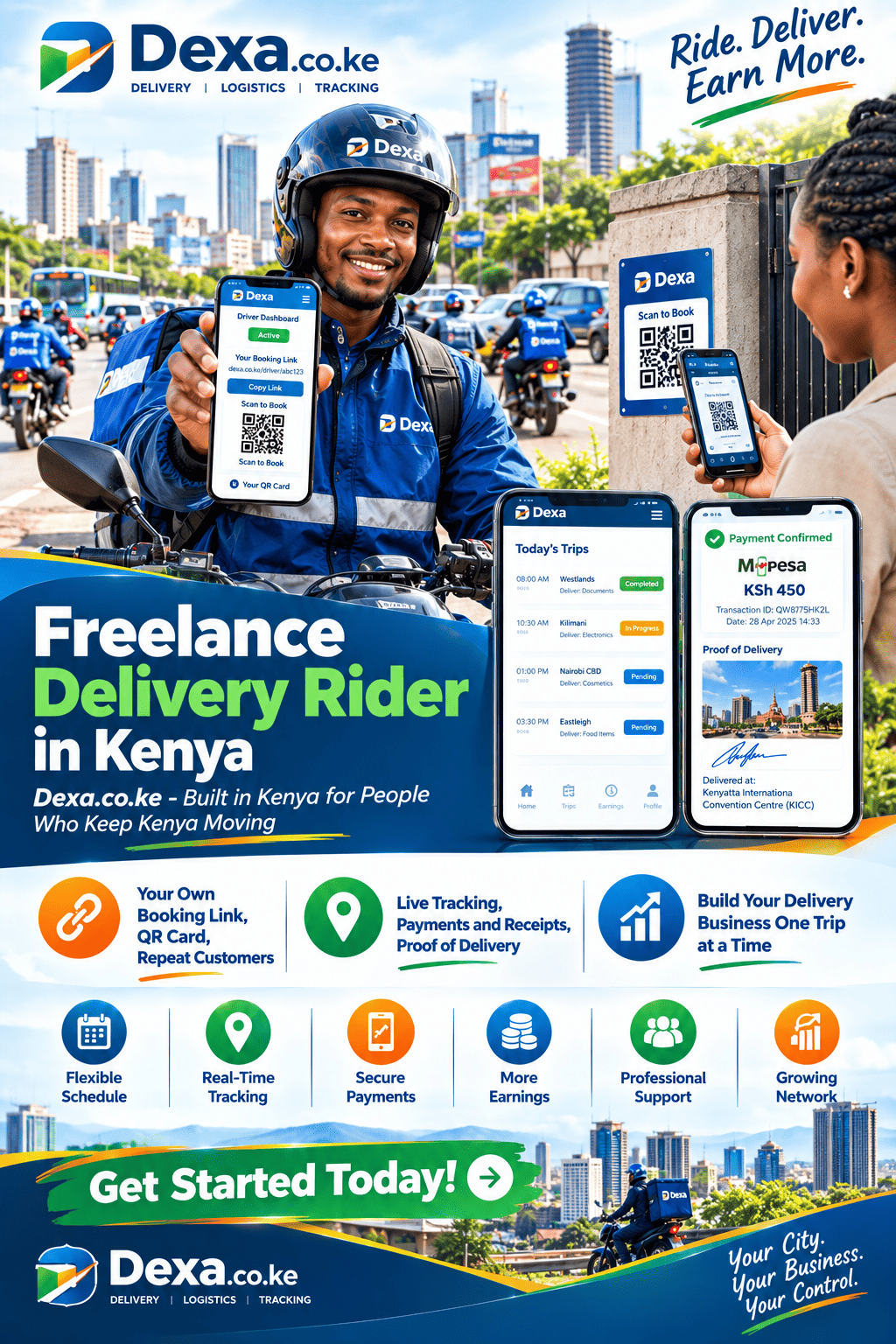
For a freelance delivery rider in Kenya working independently, the setup is simple. The rider creates a profile with their name, motorcycle details, and service areas. The system generates a personal booking link and a QR card. The rider shares the link on WhatsApp or hands over the card after a delivery. Customers can book directly, and the rider can accept, decline, or reschedule. The rider’s schedule, earnings, and completed deliveries all live in one place.
The Booking Link and QR Card
The booking link is the mechanism that turns a single delivery into a customer relationship. A rider named John Kamau gets a link at dexa.co.ke/d/john-kamau. He shares it on WhatsApp status, includes it in a message after a delivery, or sticks the QR card on his motorcycle. A customer who scans the card is taken to a booking page that already knows who the rider is. The customer supplies the pickup and drop-off details, and the booking lands in the rider’s queue. For anyone working as a freelance delivery rider in Kenya, this is the single most valuable habit: convert every good delivery into a saved contact.
Scheduling and Earnings Tracking
A rider using the platform can see their day in advance rather than discovering it one job at a time. Bookings appear on the schedule. The rider can plan fuel, route, and rest around what is coming. Earnings accumulate against each completed trip, so the rider knows what they have made without reconstructing the day from memory. This visibility matters for a freelance delivery rider in Kenya because riders working on thin margins need to know whether a day has been profitable before it ends, not after.
Payments and Proof of Delivery
The platform handles both cash and mobile money. When a customer pays through mobile money, the transaction attaches to the trip automatically. When a rider collects cash, the collection is logged against the same trip before the rider moves on. Receipts are generated without the rider having to write anything. Proof of delivery, including a photograph at the handover location, attaches to the trip record. For anyone serious about working as a freelance delivery rider in Kenya, this documentation protects the rider against false claims and gives them a record they can refer to if a question arises later.
Passing Work to Trusted Colleagues
No rider can take every job. A rider using the platform can pass a booking to a trusted colleague when they are unavailable rather than losing the customer. The colleague completes the delivery, the customer stays with the original rider’s link, and the relationship survives. This feature allows a rider to scale beyond what one motorcycle can handle without becoming a full-time dispatcher. It is one of the ways a freelance delivery rider in Kenya can grow into something larger than a solo operation.
Working Alongside Existing Platforms
The platform does not ask riders to abandon the delivery apps they already use. A rider working with a ride-hailing or food delivery app can continue doing so. The booking link and QR card add a channel that belongs to the rider, producing income that is not subject to platform commission. A rider can accept jobs through an app and also receive direct bookings through their own link. The two do not conflict.
This matters because most freelance riders need the volume that platforms provide, especially when starting out. The direct channel grows gradually as the rider accumulates satisfied customers. Over time, the direct work becomes a larger share of the rider’s income, and the rider becomes less dependent on any single source of jobs. Freelance delivery riders in Kenya who succeed usually combine platform work with a growing base of direct customers rather than relying entirely on one or the other.
The Conditions Freelance Riders Work In
A freelance delivery rider in Kenya works in conditions that apps built elsewhere can ignore. Traffic congestion in Nairobi ranks among the worst in Africa, and delivery times are unpredictable. Addresses are often landmarks rather than street numbers. Network coverage is uneven in some areas, which means the tools a rider uses must continue capturing records when connectivity drops and sync them automatically when it returns.
Pricing needs to work as part of the booking record rather than as a separate negotiation. The agreed fee is captured when the booking is confirmed, so the rider knows what to collect and the customer knows what to pay. The platform handles this without requiring the rider to quote a figure at the door, which is where most cash disputes begin.
The tools also need to work on the phones riders actually use. Battery life matters over a long shift, and data consumption has to be modest for riders paying for their own airtime. Systems designed for the Kenyan market account for these constraints from the beginning rather than treating them as problems to solve later.
From Solo Rider to Small Business
The progression from solo rider to small business is one of the more important things freelance work makes possible. A rider starts with a booking link and a QR card. The link produces repeat customers. The schedule fills. The rider begins passing work to trusted colleagues. Over time, the rider is no longer simply completing trips but running a small operation with a customer base, a reputation, and a record of everything delivered.
That progression happens without the rider having to negotiate commission rates with a platform or compete for every job against every other rider. The tools available to a freelance delivery rider in Kenya give the rider the ability to build something that belongs to them rather than to an algorithm.
The same tools support riders who prefer to remain solo. Not every rider wants to manage other people, and nothing requires it. A rider can use the booking link, the scheduling, the payment records, and the proof of delivery features without ever adding a colleague. The setup scales to the size of the operation rather than assuming a particular ambition.
What Freelance Riders Gain From a Proper System
The immediate gain is a quieter phone. When customers can see where their delivery is, they stop calling to ask. When bookings arrive through a link, the rider does not have to negotiate every job from scratch. When payments are recorded automatically, nobody has to reconcile from memory at the end of the day.
The second gain is protection. A rider with a recorded delivery, a payment log, and a proof photograph has evidence against false claims. A customer who says a parcel never arrived can be shown the record. A dispute about what was collected can be settled from the log. The system protects the rider as much as it protects the customer.
The third gain is a customer base that compounds. Every satisfied customer who saves the booking link is a potential repeat job. Over months, those links accumulate into a roster of regular clients and predictable income. The tools available to a freelance delivery rider in Kenya turn daily work into an asset that grows rather than resets each morning.
Managing Money as a Freelance Rider
Earning money and keeping it are different skills. Many riders earn reasonably well during the week and find nothing left by the end. The reason is usually that costs are absorbed as they arise rather than planned for.
A simple approach works better. Set aside a fixed amount each day for fuel. Set aside a smaller amount for maintenance. Track what is left rather than tracking what was earned. Over a month, the maintenance fund covers the chain, tyres, and servicing that would otherwise become an emergency. Riders who track earnings against costs develop a clearer picture of which days and which types of work are genuinely profitable.
That knowledge changes how the rider accepts work. A rider might discover that long-distance jobs appear lucrative until fuel and time are counted, while shorter repeat deliveries produce better returns. That insight, accumulated over weeks, is what separates a rider who earns well from one who works hard and wonders where the money went.
Where Freelance Delivery Work Is Heading
Several shifts are reshaping motorcycle and courier work in Kenya. Electric motorcycles are becoming more common, and their lower running costs change the economics of short-distance delivery. Charging costs a fraction of fuelling, and maintenance requirements are lighter. Riders using electric motorcycles keep more of what they earn, and the tools available support both vehicle types without distinction.
Mobile money integration continues to deepen, and the connection between payment confirmation and delivery confirmation is becoming tighter. Government investment in intelligent traffic management is gradually improving movement across Nairobi, which will make arrival estimates more reliable over time.
What will not change is the underlying requirement: a rider needs to be findable, to accept work without friction, to collect payment safely, and to have a record of what was delivered. That requirement sits at the centre of what a freelance delivery rider in Kenya needs from the tools they use.
Choosing the Right Tools
Riders evaluating options should focus on a few practical questions. Can the platform give them a customer channel of their own, or does it keep customers locked inside a system? Does it handle both cash and mobile money without treating one as an exception? Does it work when the network drops? Can proof of delivery be captured in seconds rather than minutes? Can the rider pass work to a colleague without losing the customer?
A platform that answers these well will not create new problems as the rider’s business grows. A platform that answers only some will leave gaps, and gaps are where money disappears and disputes develop. The difference between the two is rarely visible in a demonstration, which is why testing with real deliveries across a fortnight is worth the effort before committing.
A freelance delivery rider in Kenya is not simply someone who works without a formal employer. They are a small business operator who happens to work on two wheels. The riders who earn consistently are the ones who treat the work as a business, build a customer base, and use tools that keep their records together rather than scattered across memory and messages.
For riders working across Nairobi, Mombasa, Kisumu, and beyond, the tools from dexa.co.ke support the motorcycle, the cash and mobile money mix, the landmark addresses, and the reality of a rider trying to build something that lasts. From the first booking to the final confirmed delivery, the record stays with the trip. Nothing has to be reconstructed from memory. Nothing gets lost between the request and the delivery.
The rider builds a business, and the app makes sure nothing falls through the cracks along the way.