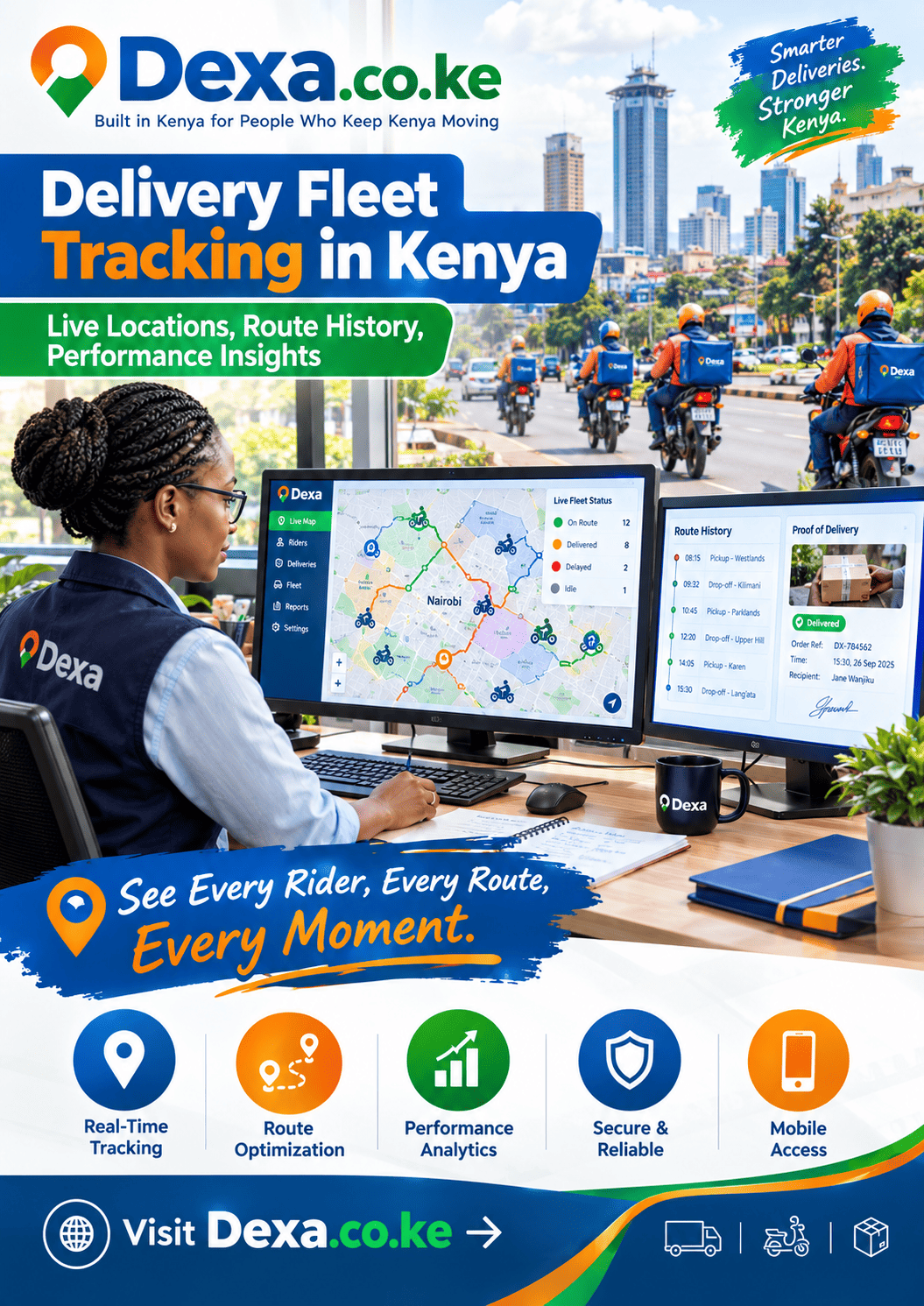
Delivery fleet tracking in Kenya addresses the most persistent problem in courier management: not knowing where riders actually are once they leave the pickup point. A parcel leaves the shop, a rider heads into traffic, and from that moment the business relies on phone calls, estimates, and hope. Delivery fleet tracking in Kenya replaces that uncertainty with continuous location data, so dispatchers can see every rider on a map rather than reconstructing their movements from memory.
The gap matters more in Nairobi than in most cities. Traffic congestion ranks among the worst in Africa, and a journey that should take twenty minutes can stretch past an hour without warning. When a business cannot see where its riders are, it cannot answer the one question every customer asks. A delivery fleet tracking in Kenya system closes that gap by turning each rider’s position into live information that dispatchers and customers can act on.
Why Fleet Tracking Became Essential
Courier businesses once managed riders the way dispatch offices managed taxis: by radio, telephone, and experience. That approach worked when volumes were small and routes were familiar. It breaks down as soon as a business grows beyond a handful of riders, because no dispatcher can hold ten simultaneous journeys in their head while also answering calls and assigning new work.
The first problem tracking solves is assignment. A dispatcher who can see every rider’s location assigns the nearest available person to a new pickup, which reduces travel time and increases the number of deliveries completed per shift. A delivery fleet tracking in Kenya system makes this possible without guesswork, and the efficiency gain compounds across hundreds of assignments each week.
The second problem is customer communication. When a customer calls to ask where their parcel is, the dispatcher should be able to answer in seconds by looking at the map. Without tracking, the same question triggers a call to the rider, who may be riding and unable to respond. The capability behind delivery fleet tracking in Kenya removes that chain of interruption entirely.
The third problem is accountability. Without location data, a rider’s performance is judged on impression rather than evidence. A rider who appears slow may simply have been given difficult routes. A rider who appears fast may be cutting corners. Continuous tracking provides the factual basis for fair assessment, which benefits both the business and the rider.
How Fleet Tracking Actually Works
The technology behind delivery fleet tracking in Kenya is more accessible than many business owners assume. Every smartphone contains a GPS receiver, and the rider’s device transmits position data to a central system at regular intervals. No specialised hardware is required for basic tracking, which is why the barrier to adoption has fallen so sharply.
The sophistication lies in what happens to that data. A raw position is of limited value on its own. Useful tracking requires a mapping layer that converts coordinates into recognisable locations, a routing layer that understands the road network, and a display layer that shows dispatchers what they need to see. A delivery fleet tracking in Kenya system that handles all three provides genuine operational value, while one that simply plots dots on a map provides considerably less.
Update frequency matters as well. A position that refreshes every few minutes suits longer journeys. A position that refreshes only when the rider opens an app is unreliable, because it depends on the rider remembering to do so. The strongest delivery fleet tracking in Kenya implementations update continuously in the background, so the record is complete whether or not anyone is paying attention.
What Businesses Can See With Proper Tracking
Live Rider Locations
The foundation of any tracking system is a live map showing where every rider currently is. Dispatchers can see at a glance who is available, who is on a delivery, and who is heading back. This visibility allows assignments to be made intelligently rather than by rotation. The live location feature within delivery fleet tracking in Kenya is the feature dispatchers use most, because it directly informs every decision they make during the day.
Route History
Live location answers the question of where a rider is now. Route history answers the question of where they have been. This retrospective view is valuable for resolving disputes, understanding why a delivery took longer than expected, and identifying patterns that suggest training needs. A delivery fleet tracking in Kenya system that stores route history turns each delivery into a reviewable record rather than a vanishing event.
Delivery Status in Real Time
Location data becomes considerably more useful when it is connected to delivery status. A rider heading toward a pickup is in a different state from one carrying a parcel to a customer. Systems that link position to status give dispatchers a complete operational picture rather than a set of disconnected dots. This connection is what makes delivery fleet tracking in Kenya genuinely operational rather than merely observational.
Performance Metrics
Over time, location data accumulates into performance information. Average speed, time per delivery, distance covered, and idle periods all become measurable. These metrics allow a business to understand which riders are efficient, which routes are slow, and where time is being lost. The analytical layer of delivery fleet tracking in Kenya turns daily operations into a source of continuous improvement.
Geofencing and Zone Alerts
More advanced systems allow businesses to define zones and receive alerts when riders enter or leave them. A rider arriving at a customer location triggers a notification. A rider straying outside an assigned area raises a flag. The geofencing capability within delivery fleet tracking in Kenya adds a layer of control that is particularly useful for businesses operating across multiple neighbourhoods.
How Dexa.co.ke Approaches Fleet Tracking
Dexa.co.ke was built for the Kenyan market rather than adapted from a foreign model, and its structure reflects how delivery actually works here. The platform splits into two products, each suited to a different stage of growth, and both treat fleet tracking as a core function rather than a feature added later.
For sellers and operators working with one or two trusted riders, the independent driver model fits naturally. Tracking in this arrangement matters because it lets a business see where a rider is without making a call, and it gives the customer confidence that the parcel is genuinely on its way. For operations that have outgrown informal arrangements and now coordinate several riders, the courier team model provides the coordination layer that delivery fleet tracking in Kenya requires at volume.
For Independent Drivers
A rider using this arrangement creates their own customer channel, sharing a personal booking link with businesses on WhatsApp and receiving direct bookings rather than competing for work in a crowded marketplace. From the business’s side, this simplifies matters considerably: one known contact, one consistent standard, one person accountable for each parcel.
The rider benefits too. Rather than chasing one-off trips, a driver builds a roster of regular business clients, plans pickups in advance, and tracks earnings in one place. When location data is recorded automatically, the rider is protected as well, because a disputed delivery can be verified from the route history rather than argued from memory. Reliable delivery fleet tracking in Kenya therefore serves the rider’s interests as much as the business’s.
For Courier Teams
Teams managing several riders and a steady flow of orders need structure that informal arrangements cannot provide. The platform keeps one operating record from request to receipt, so no order has to be reconstructed from scattered chats. Each parcel carries its customer details, assigned rider, agreed price, payment status, proof of delivery, and associated expense along with it.
For a business working with a courier team, this makes delivery fleet tracking in Kenya routine rather than exceptional. Dispatch is organised, riders know their assignments, and every delivery produces a location record alongside its proof. When a customer disputes a delivery, the route history is already in the system rather than in someone’s recollection.
The Customer Experience Dimension
Tracking is often discussed as an internal management tool, but its customer-facing benefits are equally significant. A customer who can see their rider approaching on a map does not need to call and ask. A customer who receives an automatic message when the rider is fifteen minutes away can be ready at the gate rather than waiting uncertainly indoors.
This matters particularly in the Kenyan context, where addresses are often landmarks and riders frequently need to call for directions. A customer who knows the rider is close is more likely to answer the phone promptly and provide clear guidance. The customer-facing features of delivery fleet tracking in Kenya therefore reduce failed deliveries as well as enquiries, because both rider and customer are better prepared for the handover.
The effect on first-attempt delivery rates is measurable. When customers know when to expect a rider, they are more likely to be present. When riders can see exactly where they are going, they arrive more reliably. The combination improves the single most important metric in delivery economics.
Tracking and Rider Trust
Some riders resist tracking, assuming it signals distrust. In practice, the opposite is usually true. A rider who knows their location is recorded has protection against false claims. If a customer says a delivery never arrived, the route history shows that the rider was at the location. If a dispute arises about timing, the record settles it.
The businesses that introduce tracking well explain it in these terms rather than presenting it as surveillance. Transparent tracking that protects both parties is accepted far more readily than tracking presented as monitoring for its own sake. The framing matters, and the strongest delivery fleet tracking in Kenya implementations treat the data as a shared record rather than a one-way tool.
Battery, Data, and Practical Constraints
Two practical concerns arise whenever tracking is discussed in the Kenyan market: battery life and data consumption. Continuous GPS use drains a phone faster than ordinary use, and riders working long shifts need their devices to last the day.
The strongest systems address this through efficient background tracking that adjusts update frequency based on context. A rider moving at speed needs frequent updates. A rider stationary at a delivery point needs fewer. Adaptive tracking of this kind reduces both battery drain and data consumption without sacrificing the accuracy that makes delivery fleet tracking in Kenya useful.
Data consumption is similarly manageable. Position updates are small, and the total volume over a working day is modest by the standards of modern mobile plans. Businesses considering adoption should verify that their chosen platform is designed for efficiency rather than simply transmitting as often as possible.
Offline Resilience
Networks fail. A tracking system that stops working when connectivity drops leaves both the business and the customer without information at exactly the moment it is needed. Robust delivery fleet tracking in Kenya continues recording position data during outages and syncs automatically when the connection returns.
This capability matters in areas where coverage is uneven. A rider passing through a dead zone should not disappear from the map permanently. The record should fill in once connectivity resumes, so the journey remains complete. Systems without offline resilience create gaps that undermine confidence in the data as a whole.
Tracking Alongside Proof of Delivery
Tracking and proof of delivery are complementary capabilities, and a platform that connects them produces something neither can offer alone. The location record shows where a rider went. The proof of delivery shows what happened when they arrived. Together they create a complete account of every delivery.
When a dispute arises, the combination is powerful. The route history establishes that the rider reached the correct area. The photographic proof and signature establish that the parcel was handed over. A customer who claims a delivery never happened faces a record that shows otherwise. The continuity between tracking and proof is what makes delivery fleet tracking in Kenya genuinely protective.
Performance Management Without Confrontation
One of the less obvious benefits of tracking is that it makes performance conversations easier rather than harder. Instead of telling a rider they seem slow, a manager can show them the data. Instead of guessing why a particular route takes longer, the business can review the history and see the bottleneck.
This factual basis reduces friction. Riders respond better to evidence than to impression, particularly when the evidence is presented as a shared tool for improvement rather than a judgement. Used well, delivery fleet tracking in Kenya becomes a coaching instrument rather than a disciplinary one, and the resulting improvements benefit everyone.
Choosing the Right Tracking System
Businesses evaluating options should focus on a few practical questions. Does the system update location continuously in the background, or only when the rider opens an app? Is the location data connected to delivery status and proof of delivery, or stored separately? How does the system handle network outages? What is the impact on battery life over a full shift?
A system that answers these well is one that will not create new problems as volume rises. A system that answers only the first is one that will produce incomplete data and frustrated dispatchers. The difference between the two is rarely visible in a demonstration, which is why testing with real riders across a fortnight is worth the effort before committing.
The Direction Tracking Technology Is Heading
Several shifts are reshaping how fleet tracking works in Kenya. Electric motorcycles are becoming more common, and their onboard telemetry allows richer data than simple GPS pings, including battery status and motor performance alongside location. Government investment in intelligent traffic management is gradually improving movement across Nairobi, which will make the arrival estimates generated from tracking data more accurate over time.
Mobile money integration continues to deepen, and the connection between location data and payment records is becoming tighter. In the near future, a single record will confirm where a rider went, when they arrived, and whether payment was collected, all without manual input at any stage.
What will not change is the underlying requirement: a delivery business needs to know where its riders are, and it needs that information to be accurate, continuous, and retrievable. That requirement sits at the centre of what delivery fleet tracking in Kenya should deliver.
Delivery fleet tracking in Kenya is not simply a map with moving dots on it. It is the operational foundation that connects rider location, delivery status, customer communication, and proof of handover into a single visible journey. When that journey is visible, most of the daily uncertainty in a delivery business disappears on its own.
Whether you are running a single motorcycle from a single room or coordinating a fleet across the city, the tools behind delivery fleet tracking in Kenya from dexa.co.ke give you the visibility that makes dispatch faster, customers calmer, and disputes rare. From the first assignment to the final confirmed delivery, every rider stays accounted for.
The businesses that grow are the ones that treat visibility as a foundation rather than a feature. Build the habit early, let it carry the weight as volume rises, and managing a fleet becomes considerably less stressful than it once was.