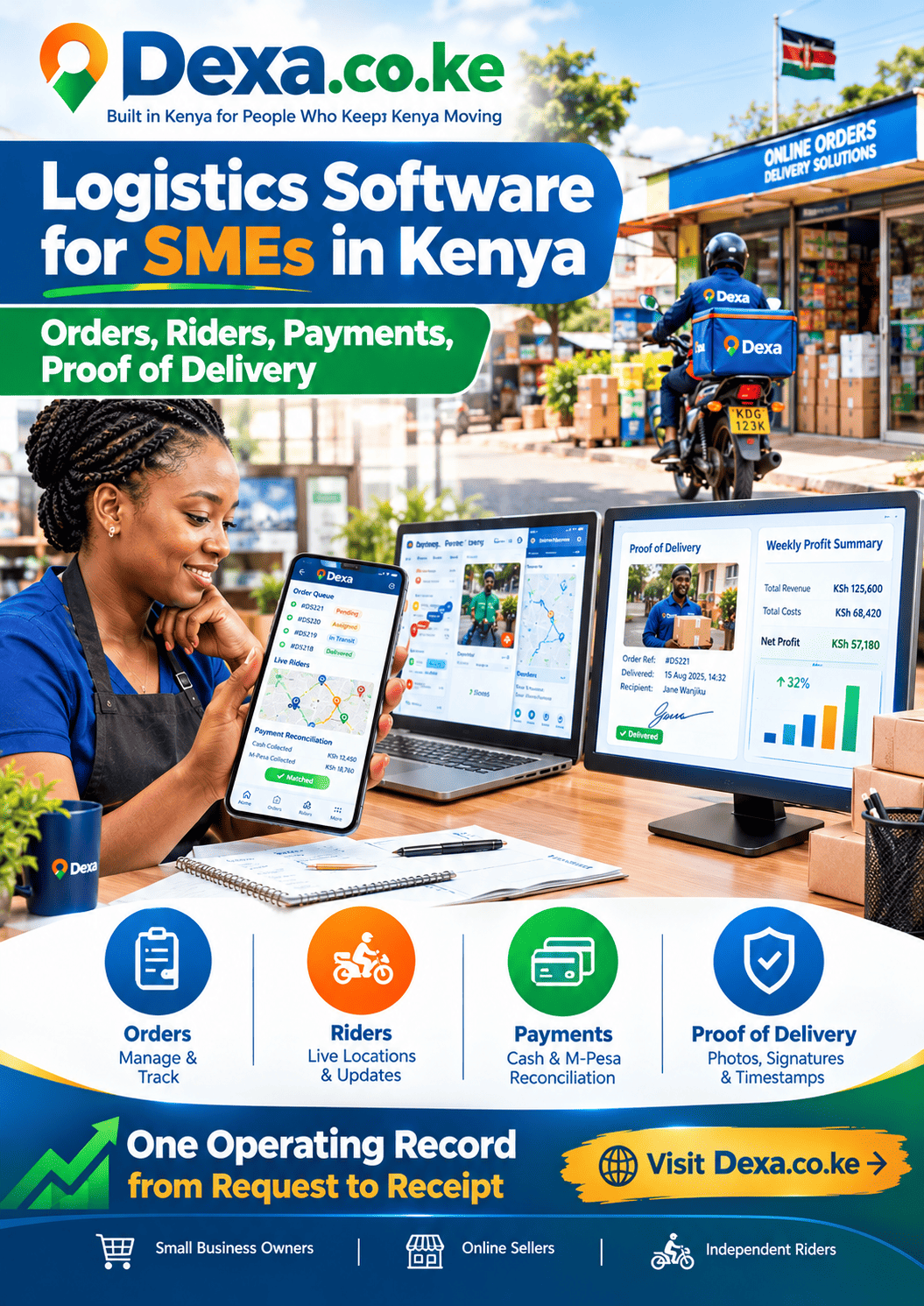
Logistics software for SMEs in Kenya becomes necessary at a specific point in every small business’s life: the moment the volume of deliveries exceeds what any person can track reliably from memory. Before that point, a notebook and a WhatsApp group work fine. Orders arrive, someone assigns a rider, the parcel is delivered, and cash is collected. The system is imperfect but functional.
After that point, the arrangement collapses. Orders arrive through several channels and details get lost between them. Riders call for instructions that were already given. Customers ask where their order is and nobody can answer without making another call. Cash collections do not match expectations and nobody can say which delivery is short. A logistics software for SMEs in Kenya replaces that fragile arrangement with a structure that does not forget, and the change is felt within the first week rather than the first quarter.
What the Software Actually Manages
The phrase covers more ground than most SME owners initially assume. A logistics software for SMEs in Kenya is not simply a tracking tool or a dispatch board. It is the operating record for the entire delivery cycle, from the moment a customer places an order to the moment payment is reconciled and the transaction is closed.
That record includes the customer’s details, the pickup and drop-off information, the agreed price, the rider assigned, the delivery status, the proof captured at handover, the payment collected, and any expense attached to that journey. Each of those elements normally lives somewhere different in an informal operation. A logistics software for SMEs in Kenya brings them together so that answering a question about any single delivery takes seconds rather than a search through several sources.
The practical benefit of that consolidation is difficult to overstate. When a customer calls to ask where their order is, the answer is on one screen. When a rider disputes a collection, the record settles it. When the owner wants to know whether last month was profitable, the figures are already assembled rather than reconstructed from a shoebox of receipts. A logistics software for SMEs in Kenya turns daily operations into information that can actually be used.
Why SMEs Need This More Than Large Operators
There is a common assumption that logistics software belongs to big companies with dedicated operations teams. In practice, the opposite is closer to the truth. A large logistics operator can absorb inefficiency because it has scale and reserves. An SME cannot. Every wasted trip, every unprofitable route, every rider who consumes more fuel than necessary comes directly out of a margin that is already thin.
The practical value of logistics software for SMEs in Kenya therefore sits in the decisions it enables rather than the reports it produces. A five-rider operation that discovers one of its regular clients has been unprofitable for months can act immediately. A business that never sees the numbers cannot act at all.
There is also the question of time. SME owners rarely have the luxury of delegating. They are simultaneously handling sales, customer service, procurement, and delivery coordination. Every hour spent reconciling payments or chasing riders is an hour not spent growing the business. A logistics software for SMEs in Kenya absorbs the coordination work that would otherwise consume the owner’s day.
Order Capture and Customer Records
The first function any system must handle is capturing orders consistently. In many Kenyan SMEs, orders arrive through several channels: WhatsApp messages, phone calls, Instagram DMs, and walk-in requests. Each channel produces information in a different format, and details get lost in the translation. A logistics software for SMEs in Kenya standardises this by capturing every request into the same structured record, regardless of how it arrived.
Standardisation matters more than it first appears. When every order contains the same fields in the same format, dispatch becomes faster because nobody has to interpret a message or ask a follow-up question. The address, the landmark, the customer’s phone number, and any special instructions are all in the places they are expected to be. A logistics software for SMEs in Kenya removes the ambiguity that otherwise consumes a business owner’s morning.
Customer records add another layer. When a customer orders repeatedly, the system already knows their details. The rider does not have to ask for the landmark again. The business can see how many orders that customer has placed and whether they pay reliably. Over time, a logistics software for SMEs in Kenya builds a customer history that supports better decisions about pricing, credit, and service levels.
Dispatch and Rider Assignment
Dispatch is where informal operations struggle most visibly. A new order arrives, and someone has to decide who should carry it. In a business with one or two riders, that decision is made by whoever is holding the phone. In a business that has grown to five or six riders, it becomes a bottleneck that delays every delivery.
A logistics software for SMEs in Kenya turns dispatch into a queue that assigns itself. A new order appears. A rider is selected based on location, availability, and current workload. The customer receives confirmation. The rider receives the job. None of this requires a phone call, and none of it depends on anyone remembering to pass the message along.
The assignment logic matters because it affects the whole day. A dispatcher who can see every rider’s position assigns the nearest available person to a new pickup, which reduces travel time and increases the number of deliveries completed per shift. Over a week, that efficiency gain compounds into a meaningful difference in capacity. A logistics software for SMEs in Kenya makes those decisions possible by replacing guesswork with visible information.
Live Tracking and Customer Communication
Once a rider leaves with an order, the business needs to know where they are and how the delivery is progressing. Without that visibility, every customer enquiry triggers a phone call, and every phone call interrupts a rider who should be focused on the road.
A logistics software for SMEs in Kenya provides live location visibility so that the business can see every rider on a map and answer customer questions without making a call. The same information can be shared with the customer directly, which reduces inbound enquiries dramatically. A customer who can see their rider approaching does not need to ask where the order is.
The customer-facing side of this matters as much as the internal side. Automated notifications sent at dispatch, when the rider is nearby, and on arrival keep the customer informed without anyone having to remember to send a message. In a market where addresses are often landmarks and riders frequently need to call for directions, a prepared customer is a customer who answers the phone and gives clear guidance. A logistics software for SMEs in Kenya makes that preparation automatic rather than dependent on the owner’s memory.
Payments and Reconciliation
Payment is the most sensitive part of any delivery, and it is where SMEs leak money most quietly. Mobile money leaves its own trace, but cash does not. When collections are recorded in a rider’s memory and reconciled at the end of the week, small discrepancies accumulate without anyone noticing until the total is significantly short.
A logistics software for SMEs in Kenya applies the same discipline to both payment methods. When a customer pays through mobile money, the transaction attaches to the order automatically. When a rider collects cash, the collection is logged against the same order before the rider moves on. The business sees both in the same place, and reconciliation covers the full picture rather than one convenient part of it.
Receipts are generated as a natural output. The customer receives confirmation, and the business keeps a copy. Nothing depends on a rider remembering to write something down or a customer keeping a paper slip. The documentation discipline built into a logistics software for SMEs in Kenya is what allows a small operation to behave like a larger one without hiring additional administrative staff.
Proof of Delivery and Documentation
Proof of delivery has moved from an occasional courtesy to a standard output of every completed job. A rider captures a photograph of the parcel at the delivery location. The customer signs on the rider’s device. The system records the timestamp and GPS coordinates automatically. Together these elements produce a record that settles most disputes before they develop.
In a market where formal addresses are rare, the photograph often carries more weight than the signature. A picture of the parcel at the blue gate beside the petrol station establishes location in a way that written confirmation cannot. A logistics software for SMEs in Kenya treats photographic capture as a routine step rather than an optional extra, because the moments when proof matters most are precisely the ones that go unrecorded when it is left to discretion.
Businesses that adopt this discipline consistently report a sharp reduction in disputed deliveries. Claims that an order never arrived are answered with evidence rather than argument, and the business avoids refunds it would once have absorbed to preserve goodwill. Over a year, the sums involved are considerable for any SME handling meaningful volume.
Expense Tracking and Profit Visibility
Revenue is visible. Costs are not. This asymmetry is what allows an SME to grow steadily while quietly losing money on every delivery. Fuel, rider commissions, maintenance, airtime, and failed delivery attempts all consume margin, and none of them appear as a line item unless someone records them.
A logistics software for SMEs in Kenya connects expenses to the orders that generated them, so the business can see profit at the level of the individual delivery. That granularity changes what decisions are possible. A business that discovers its long-distance deliveries lose money can adjust pricing or decline that work. A business that discovers one customer’s orders consistently run at a loss can renegotiate or walk away. None of those decisions are possible from a monthly total.
Failed deliveries deserve particular attention because they never appear as a transaction. The trip simply happens twice, and no invoice reflects the duplication. Each failed attempt roughly doubles the cost of that delivery. A logistics software for SMEs in Kenya records these explicitly, which is often the difference between a route that appears profitable and one that is quietly draining the business.
For Solo Operators and Independent Riders
Logistics software is not only for teams. Solo operators and independent riders benefit from the same structure applied to their own work. A rider who wants to build a client base rather than chase one-off trips needs a way to be found, a way to accept work, and a way to track earnings in one place.
The platform gives a rider a personal booking link and a QR card that customers can use to book directly. The link turns a single completed delivery into a repeat relationship, because the customer no longer has to search for a number the next time they need something moved. Over months, that accumulates into a roster of regular clients and predictable income.
The same system lets a rider pass work to trusted colleagues when their schedule is full. Rather than losing a customer because they cannot take the job, the rider hands it to someone they trust and keeps the relationship intact. Independent riders using logistics software for SMEs in Kenya therefore operate as small businesses rather than as isolated units of supply.
For Growing Delivery Teams
Teams face a different problem. They have riders, orders, payments, and customers, and the connections between them exist mostly in people’s heads and chat threads. A rider remembers which order is on the bike. A dispatcher remembers which customer paid. The owner has a rough idea of how much cash should be in the tin at the end of the day.
Logistics software for SMEs in Kenya replaces that arrangement with a record that does not forget. Orders, riders, pricing, payments, tracking, receipts, proof of delivery, and expenses all attach to the same order. Dispatch stops being a series of phone calls and becomes a queue that assigns itself. The business sees what is happening without asking anyone.
The effect on administrative burden is considerable. A team that once needed a dedicated person to manage records and reconciliation can handle the same volume with existing staff. Logistics software for SMEs in Kenya allows growth without proportional growth in back-office costs, which is what makes expansion viable for businesses operating on thin margins.
What Changes in the First Week
The most immediate change is a quieter phone. When customers can see where their order is, they stop calling to ask. When riders receive clear assignments, they stop calling for instructions. When payments are recorded automatically, nobody has to reconcile from memory at the end of the day.
The second change is faster problem resolution. A rider who has stopped moving for twenty minutes is visible on the map before the customer notices the delay. Dispatchers can intervene, reassign the delivery, or notify the customer proactively. Logistics software for SMEs in Kenya converts potentially damaging incidents into minor ones by surfacing them early.
The third change is confidence in the numbers. A business that knows what it delivered, what it collected, and what it spent can make decisions about pricing, routes, and hiring that a business relying on instinct cannot. Logistics software for SMEs in Kenya turns daily operations into information, and information is what allows a small operation to compete with larger ones.
Scaling Without Rebuilding
Growth makes coordination harder, not easier. A business running two riders can manage informally through familiarity. A business running ten cannot, because the volume of transactions exceeds what any person can hold in their head. This is why adoption of logistics software for SMEs in Kenya tends to happen at a specific point in a business’s development, usually just after a period of rapid growth has exposed the limits of informal tracking.
The businesses that adopt earlier avoid the period of confusion entirely. The ones that delay discover, months later, that they cannot explain why revenue doubled while the bank balance did not. Logistics software for SMEs in Kenya provides the foundation that allows a business to add riders, expand coverage, and take on larger clients without rebuilding its processes each time.
Choosing the Right Software
Businesses evaluating options should focus on a few practical questions. Does the system keep the order, the rider, the payment, and the proof in one place? Can it handle both cash and mobile money without treating one as an exception? Does it work when the network drops? Can it produce profit figures at the individual order level? Are reports simple enough to review daily and detailed enough to support decisions?
A system that answers these well will not create new problems as volume rises. A system that answers only some will leave gaps, and gaps are where money disappears. The difference between the two is rarely visible in a demonstration, which is why testing with real orders across a fortnight is worth the effort before committing.
It also helps to consider how the software connects to the rest of the operation. A tracking tool that stands alone provides partial value. A platform that links dispatch, tracking, payment, proof, and expenses provides considerably more, because every delivery becomes part of a complete history rather than an isolated event. The strongest logistics software for SMEs in Kenya is the one that treats the delivery journey as a single connected process rather than a set of separate tasks.
The Direction the Market Is Heading
Several shifts are reshaping how SMEs operate in Kenya. Mobile money integration continues to deepen, and the connection between payment confirmation and delivery confirmation is becoming tighter, so a single automatic action will soon verify both. Electric motorcycles are becoming more common, and their lower running costs change the economics of short-distance delivery.
Government investment in intelligent traffic management is gradually improving movement across Nairobi, which will make arrival estimates derived from tracking data more reliable over time. Regulatory expectations around record-keeping are tightening, favouring businesses that already maintain clean digital documentation.
What will not change is the underlying requirement: an SME needs to know where its orders are, who is carrying them, whether they arrived, and whether payment was collected. That requirement sits at the centre of what logistics software for SMEs in Kenya should deliver, today and in the years ahead.
Logistics software for SMEs in Kenya is not a luxury for large operators. It is the structure that allows a business of any size to keep track of what it is doing, prove what it has delivered, and understand whether the work is generating profit. The businesses that grow are the ones that adopt this structure early, before the volume of information exceeds what any person can hold reliably in their head.
Whether you are running a single motorcycle from a single room or coordinating a handful of riders across the city, logistics software for SMEs in Kenya from dexa.co.ke keeps the customer, the rider, the payment, and the proof attached to the same order. From the first request to the final confirmation, nothing has to be reconstructed from memory.
Delivery does not have to be the part of the business that keeps you awake. With the right system in place, it becomes the part that brings customers back.