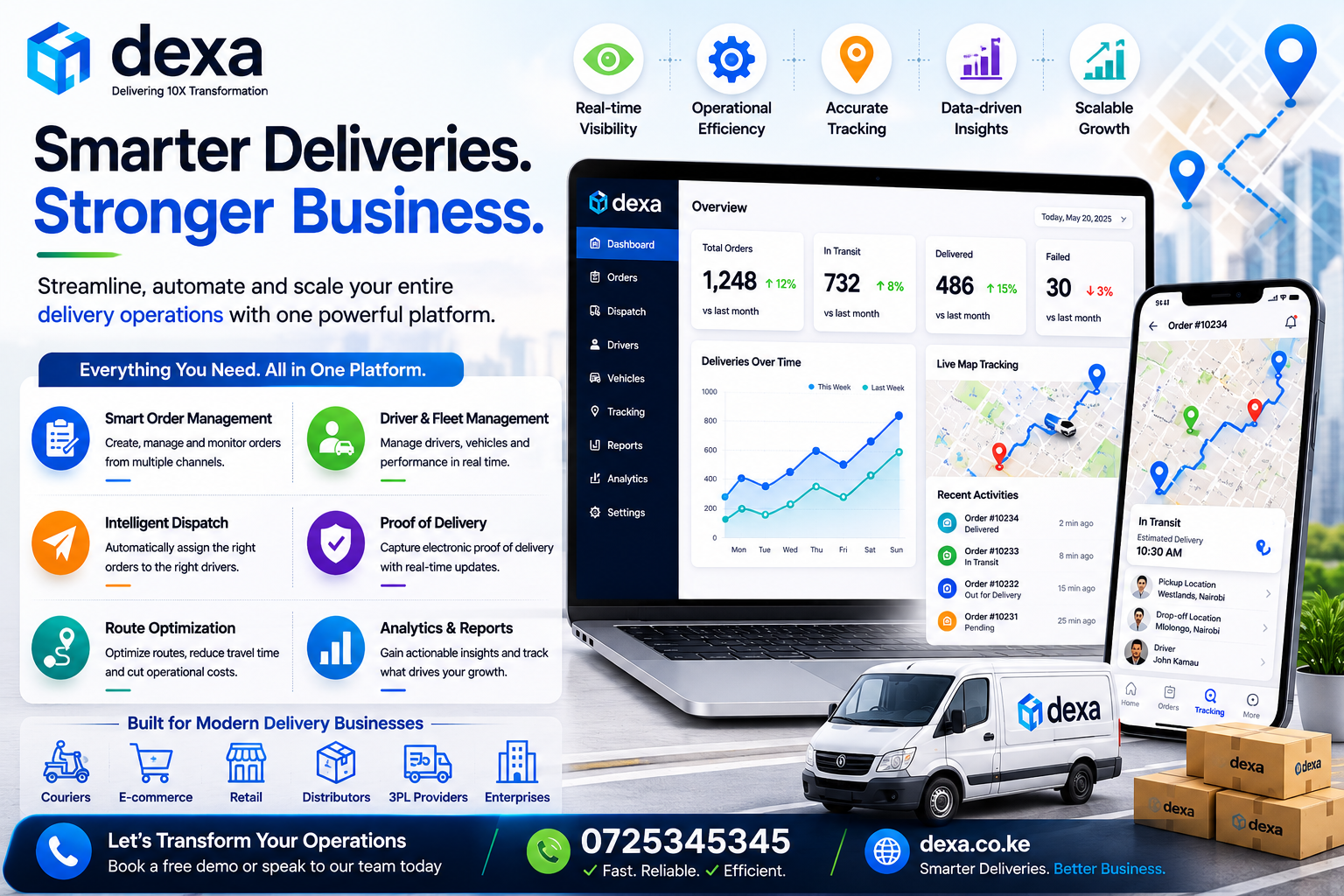
Dispatch Order Management: The Foundation of Efficient Delivery Operations
For delivery-driven businesses, success depends on more than simply receiving customer orders. Every order must be processed accurately, assigned to the right driver, dispatched at the right time, tracked throughout its journey, and completed efficiently. As businesses grow, managing these tasks manually becomes increasingly difficult, leading to delayed deliveries, dispatch errors, unhappy customers, and rising operational costs.
This is why Dispatch Order Management has become an essential component of modern logistics operations.
An effective dispatch order management system centralizes the entire delivery workflow, allowing businesses to coordinate orders, dispatch teams, drivers, customers, and operational data from a single platform. Rather than juggling spreadsheets, phone calls, messaging apps, and paper records, organizations can automate and streamline every stage of the dispatch process.
Dexa provides a comprehensive cloud-based platform that enables courier companies, delivery businesses, eCommerce retailers, distributors, and logistics providers to simplify dispatch operations while maintaining complete visibility over every order from creation to successful delivery.
What Is Dispatch Order Management?
Dispatch Order Management refers to the process of organizing, assigning, tracking, and completing delivery orders through a structured workflow. It ensures that every order follows a standardized process from the moment it is received until proof of delivery is recorded.
Instead of relying on disconnected systems, businesses manage all delivery activities through one centralized platform.
A typical dispatch order management workflow includes:
- Order creation
- Customer information capture
- Pickup scheduling
- Delivery scheduling
- Driver assignment
- Dispatch coordination
- Route planning
- Live delivery tracking
- Proof of delivery
- Payment recording
- Reporting and analytics
Each stage is connected, allowing businesses to monitor operations in real time while reducing administrative work.
Why Dispatch Order Management Is Important
As customer expectations continue to increase, businesses need greater operational control.
Without an organized dispatch process, companies often experience:
- Delayed deliveries
- Lost orders
- Duplicate assignments
- Poor communication
- Driver confusion
- Customer complaints
- Manual paperwork
- Limited operational visibility
- High operating costs
- Inefficient resource allocation
Implementing Dispatch Order Management enables businesses to standardize operations, reduce human error, and improve service quality across the entire delivery lifecycle.
How Dispatch Order Management Works
An effective dispatch system connects multiple operational functions into one seamless workflow.
Order Creation
Every delivery begins with an order.
Businesses capture important information including:
- Customer details
- Pickup address
- Delivery destination
- Package description
- Delivery priority
- Payment information
- Delivery instructions
- Preferred delivery time
This information immediately becomes available to dispatch teams.
Order Verification
Before dispatching an order, businesses verify important details to prevent delivery failures.
Verification may include:
- Customer contact confirmation
- Address validation
- Package availability
- Payment status
- Delivery requirements
- Service level confirmation
Accurate order verification reduces costly delivery errors.
Dispatch Planning
Dispatch managers organize deliveries based on operational priorities.
Factors considered include:
- Driver availability
- Vehicle capacity
- Delivery zones
- Traffic conditions
- Delivery urgency
- Existing workloads
Well-planned dispatch operations improve productivity while reducing unnecessary travel.
Driver Assignment
Once planning is complete, deliveries are assigned to available drivers.
Modern platforms help managers balance workloads fairly while ensuring deliveries are completed efficiently.
Assignments are visible immediately through driver applications or operational dashboards.
Real-Time Tracking
After dispatch, businesses monitor deliveries throughout the journey.
Managers can view:
- Driver location
- Delivery progress
- Estimated arrival times
- Delivery status
- Operational exceptions
- Route deviations
Real-time visibility enables faster responses to unexpected challenges.
Delivery Confirmation
Successful deliveries are confirmed using digital proof of delivery.
Businesses may capture:
- Customer signatures
- Delivery photographs
- GPS location
- Date and time stamps
- Recipient information
Digital records improve accountability while reducing disputes.
Key Features of Dispatch Order Management Software
Centralized Order Dashboard
A centralized dashboard provides complete visibility into all active, pending, completed, and cancelled orders.
Managers can monitor operational performance without switching between multiple systems.
Automated Dispatch Workflows
Automation removes repetitive manual tasks.
Businesses can automate:
- Order allocation
- Driver assignment
- Status updates
- Customer notifications
- Delivery confirmations
- Operational reporting
Automation improves consistency while reducing administrative workload.
Intelligent Driver Management
Driver management tools help organizations monitor:
- Availability
- Active deliveries
- Completed deliveries
- Daily workload
- Delivery performance
- Service quality
These insights help maximize workforce productivity.
Live Order Tracking
Customers increasingly expect delivery transparency.
Live tracking allows both businesses and customers to monitor delivery progress in real time.
Benefits include:
- Reduced customer inquiries
- Improved communication
- Faster issue resolution
- Increased customer confidence
Route Optimization
Efficient routes reduce operational expenses.
Route optimization helps businesses:
- Reduce fuel consumption
- Complete more deliveries
- Minimize travel time
- Improve delivery punctuality
- Increase vehicle utilization
Optimized routing contributes directly to improved profitability.
Delivery Notifications
Keeping customers informed improves the delivery experience.
Businesses can send notifications regarding:
- Order confirmation
- Dispatch updates
- Estimated arrival
- Delivery completion
- Delivery exceptions
Timely communication reduces uncertainty and improves customer satisfaction.
Benefits of Dispatch Order Management
Faster Order Processing
Centralized workflows reduce delays between order placement and dispatch.
Orders move through the system more efficiently, allowing businesses to process larger delivery volumes.
Improved Operational Visibility
Managers gain complete oversight of dispatch operations through real-time dashboards.
Visibility enables proactive decision-making rather than reactive problem-solving.
Reduced Human Error
Manual processes often result in:
- Incorrect assignments
- Duplicate orders
- Missing deliveries
- Data entry mistakes
Automation significantly reduces these operational risks.
Better Customer Satisfaction
Customers appreciate:
- Accurate delivery estimates
- Faster deliveries
- Transparent tracking
- Professional communication
- Reliable service
Satisfied customers are more likely to become loyal repeat clients.
Lower Operational Costs
Dispatch optimization helps reduce expenses associated with:
- Fuel consumption
- Administrative work
- Failed deliveries
- Delivery delays
- Driver downtime
- Route inefficiencies
Improved operational efficiency contributes directly to business profitability.
Increased Scalability
As businesses grow, manually managing dispatch operations becomes increasingly difficult.
A structured Dispatch Order Management platform allows organizations to handle growing delivery volumes without proportionally increasing administrative staff.
Common Challenges Solved by Dispatch Order Management
Many delivery businesses struggle with recurring operational issues.
Poor Order Visibility
Without centralized management, tracking hundreds of deliveries becomes nearly impossible.
A unified dashboard provides complete operational visibility.
Delayed Dispatch
Manual assignment processes often slow delivery operations.
Automated dispatch workflows significantly reduce dispatch times.
Driver Coordination Problems
Phone calls and messaging applications create communication delays.
Centralized platforms keep dispatchers and drivers synchronized throughout the delivery process.
Customer Communication Gaps
Customers become frustrated when they lack delivery updates.
Automated notifications provide continuous visibility throughout the delivery journey.
Reporting Difficulties
Manual reporting consumes valuable management time.
Automated reporting provides instant access to operational performance metrics.
Industries That Benefit from Dispatch Order Management
Dispatch Order Management supports organizations across numerous sectors.
Industries include:
- Courier companies
- Parcel delivery services
- eCommerce businesses
- Retail distribution
- Pharmaceutical logistics
- Food distribution
- Wholesale suppliers
- Manufacturing companies
- Third-party logistics providers
- Document delivery services
Any organization managing pickups and deliveries can benefit from structured dispatch management.
Integrating Dispatch Order Management with Business Systems
Operational efficiency improves when dispatch software integrates with existing business applications.
Common integrations include:
- Order Management Systems
- Warehouse Management Systems
- Customer Relationship Management (CRM)
- GPS Tracking
- Accounting Software
- Payment Platforms
- Inventory Management
- Electronic Proof of Delivery
- Customer Notification Systems
- Business Intelligence Tools
Integration reduces duplicate work while improving operational accuracy.
Best Practices for Effective Dispatch Order Management
Successful implementation involves more than adopting new software.
Businesses should also:
Standardize dispatch procedures
Create consistent workflows that every team follows.
Train operational teams
Ensure dispatchers, drivers, and administrators understand platform functionality.
Monitor operational KPIs
Track metrics such as delivery success rate, average dispatch time, route efficiency, and customer satisfaction.
Review reports regularly
Use operational analytics to identify opportunities for continuous improvement.
Automate repetitive tasks
Automation improves consistency while freeing staff to focus on higher-value activities.
Continuously optimize routes
Review route performance frequently to improve delivery efficiency.
Why Businesses Choose Dexa
Dexa is designed to simplify dispatch operations while providing businesses with complete visibility over every delivery.
Using Dexa, organizations can:
- Manage delivery orders from one centralized platform
- Coordinate dispatch teams efficiently
- Assign drivers quickly
- Track deliveries in real time
- Monitor operational performance
- Capture digital proof of delivery
- Generate detailed operational reports
- Improve customer communication
- Scale delivery operations confidently
Its cloud-based architecture supports growing courier businesses by bringing dispatch management, delivery tracking, operational analytics, and customer visibility together within one integrated system.
Future Trends in Dispatch Order Management
Technology continues transforming dispatch operations.
Future innovations include:
- Artificial Intelligence dispatch recommendations
- Predictive delivery scheduling
- Machine learning route optimization
- Automated workload balancing
- Smart delivery forecasting
- Enhanced fleet analytics
- Real-time operational intelligence
- Advanced customer communication tools
Businesses that embrace these technologies will be better positioned to meet growing customer expectations while maintaining operational efficiency.
Conclusion
Efficient delivery operations begin with organized dispatch processes. Dispatch Order Management enables businesses to streamline order processing, automate dispatch workflows, improve driver coordination, reduce operational costs, and enhance customer satisfaction through centralized management.
Whether you’re managing a growing courier service, an eCommerce fulfillment operation, or a large logistics network, implementing a structured dispatch order management platform can significantly improve productivity and service quality. With Dexa, businesses gain the tools needed to modernize dispatch operations, increase visibility, and support long-term growth in an increasingly competitive logistics industry.
Frequently Asked Questions (FAQs)
What is Dispatch Order Management?
Dispatch Order Management is the process of organizing, assigning, tracking, and completing delivery orders through a centralized system that improves operational efficiency.
How does Dispatch Order Management improve delivery operations?
It automates dispatch workflows, improves driver coordination, provides real-time tracking, reduces manual work, and increases visibility across the delivery lifecycle.
Which businesses benefit from Dispatch Order Management?
Courier companies, eCommerce retailers, distributors, manufacturers, wholesalers, pharmacies, and third-party logistics providers all benefit from structured dispatch management.
Can Dispatch Order Management reduce operational costs?
Yes. It minimizes dispatch delays, optimizes routes, reduces administrative work, lowers fuel consumption, and decreases failed deliveries, resulting in improved profitability.
Does Dispatch Order Management improve customer satisfaction?
Absolutely. Customers receive timely updates, accurate delivery estimates, real-time tracking, and faster deliveries, creating a more reliable delivery experience.
Can Dispatch Order Management integrate with other business systems?
Yes. Modern platforms integrate with warehouse management, inventory systems, CRM software, accounting platforms, GPS tracking, payment gateways, and proof-of-delivery solutions to create a connected logistics ecosystem.
Is Dispatch Order Management suitable for small businesses?
Yes. Cloud-based solutions like Dexa are scalable, making them suitable for startups, growing courier businesses, and large logistics enterprises alike.
Why should businesses choose Dexa for Dispatch Order Management?
Dexa provides a centralized cloud platform that simplifies dispatch workflows, enhances operational visibility, supports real-time delivery tracking, captures proof of delivery, generates insightful reports, and enables businesses to scale efficiently while maintaining excellent customer service.