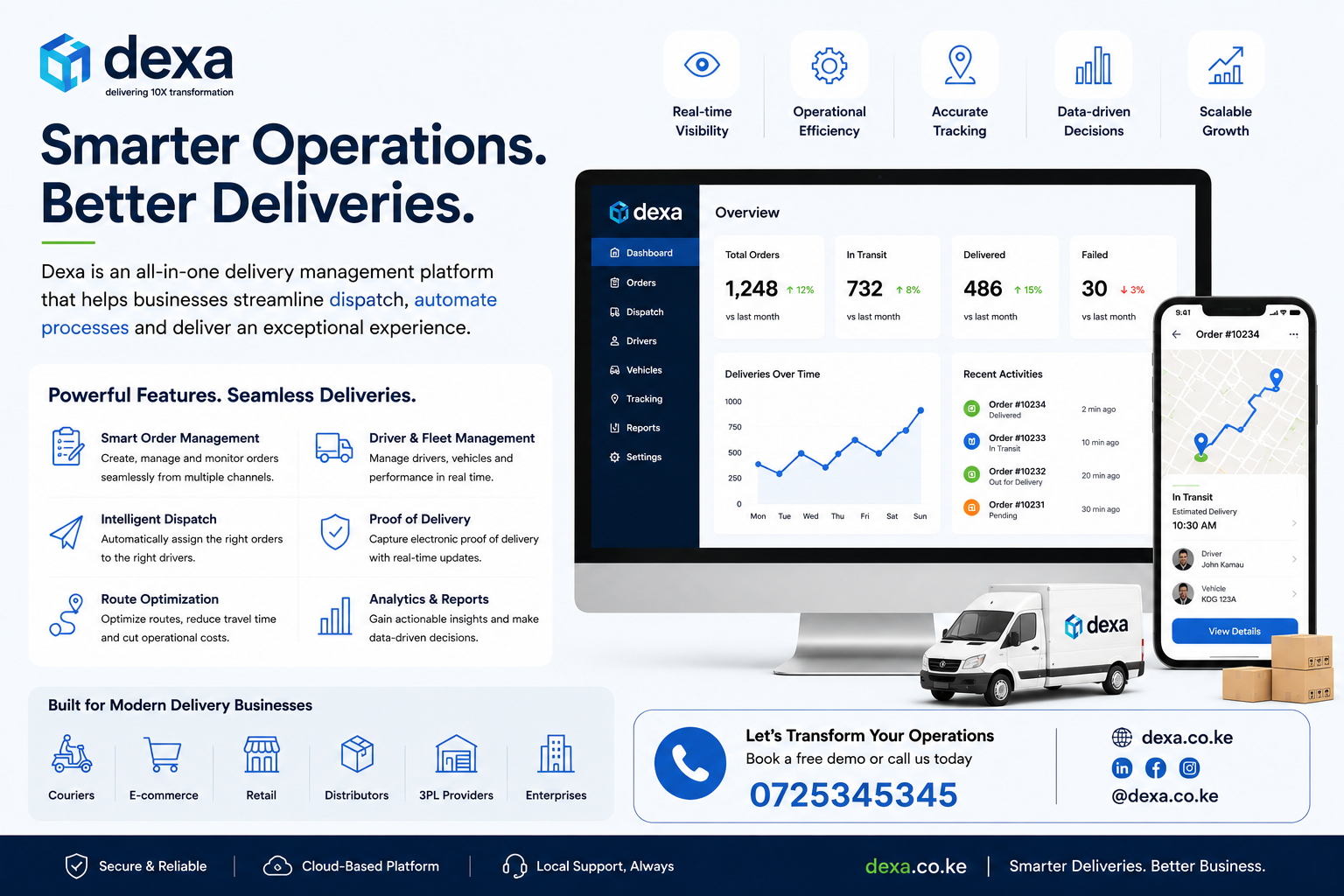
Delivery Management SaaS: Modernizing Logistics Through the Cloud
The logistics industry is undergoing rapid digital transformation. As customer expectations continue to rise, businesses are expected to deliver faster, provide real-time updates, maintain operational transparency, and scale without compromising service quality. Managing all these processes manually is no longer practical for growing courier businesses.
This is where Delivery Management SaaS has become a game-changing solution.
Unlike traditional on-premise delivery software that requires expensive infrastructure, complex installations, and ongoing maintenance, a Software-as-a-Service (SaaS) platform allows businesses to access powerful delivery management capabilities through the cloud. Teams can coordinate dispatch operations, monitor riders, manage payments, track deliveries, and generate reports from a single centralized platform without worrying about server maintenance or software upgrades.
Dexa is a cloud-based courier management SaaS platform designed to help modern courier businesses streamline operations from order intake to proof of delivery. It combines dispatch management, rider coordination, payment visibility, customer tracking, reporting, and multi-business capabilities into one structured workspace built for scalable logistics operations. (dexa.co.ke)
What Is Delivery Management SaaS?
Delivery Management SaaS is cloud-hosted software that enables businesses to manage every stage of the delivery lifecycle through an online platform. Instead of installing software on local servers, organizations simply access the system through a secure web browser or mobile application.
The platform centralizes every critical delivery function, including:
- Order creation
- Delivery scheduling
- Dispatch management
- Rider assignment
- GPS tracking
- Proof of delivery
- Customer communication
- Billing
- Payment management
- Operational reporting
- Business analytics
Since the software is hosted in the cloud, businesses can access their operations from virtually anywhere with an internet connection.
Why Businesses Are Moving to SaaS Delivery Platforms
Traditional logistics software often presents several challenges:
- High implementation costs
- Expensive hardware requirements
- Difficult software upgrades
- Limited remote accessibility
- Manual data synchronization
- Lengthy deployment periods
Cloud-based delivery platforms eliminate many of these obstacles.
With Delivery Management SaaS, businesses enjoy:
Lower upfront investment
There is no need to purchase expensive servers or maintain dedicated IT infrastructure.
Faster deployment
Teams can begin operating much sooner than with traditional software installations. Dexa, for example, is designed to help courier businesses go live quickly through a structured onboarding process. (dexa.co.ke)
Automatic updates
New features, security improvements, and performance enhancements are delivered without disrupting daily operations.
Anywhere access
Managers, dispatchers, finance teams, and riders can securely access the platform from different locations.
Greater scalability
As delivery volumes increase, businesses can expand without rebuilding their operational systems.
How Delivery Management SaaS Works
A cloud-based delivery platform connects every department involved in the delivery process.
Order Intake
Orders are received through administrators, clients, customer service teams, or integrated business systems.
Each order captures essential information such as:
- Customer details
- Pickup location
- Delivery address
- Delivery instructions
- Package information
- Payment method
- Delivery priority
The information becomes immediately available across the platform.
Dispatch Management
Dispatch teams assign deliveries using centralized workflows.
Modern SaaS platforms support:
- Manual dispatch
- Rule-based assignment
- Workload balancing
- Rider availability monitoring
- Priority deliveries
- Exception management
A structured dispatch process reduces errors while improving delivery efficiency.
Rider Coordination
Once deliveries are assigned, riders receive their work through mobile-friendly interfaces.
They can:
- Accept assignments
- Update delivery status
- Upload proof of delivery
- Record exceptions
- Communicate operational updates
This minimizes phone calls while improving visibility across delivery operations.
Customer Tracking
Customers increasingly expect visibility throughout the delivery journey.
Delivery Management SaaS enables businesses to provide:
- Public tracking portals
- Status notifications
- Estimated delivery windows
- Delivery confirmations
- Proof of delivery
Dexa includes branded public tracking experiences that improve transparency and customer confidence. (dexa.co.ke)
Billing and Payments
Financial processes remain connected to operational activities.
Businesses can manage:
- Customer invoices
- Cash-on-delivery records
- Digital payment logs
- Statements
- Financial exports
- Collection tracking
Keeping finance and operations within the same platform reduces reconciliation errors.
Core Features of Delivery Management SaaS
Centralized Dispatch Control
A centralized dispatch board gives operations teams a live overview of every delivery.
Managers can:
- View active orders
- Assign riders
- Monitor queue health
- Handle delivery exceptions
- Track completion progress
Centralized visibility improves coordination throughout the day.
Real-Time Delivery Tracking
Live tracking enables businesses to monitor every delivery from dispatch to completion.
Benefits include:
- Immediate operational visibility
- Faster issue resolution
- Improved customer communication
- Better resource management
- Reduced delivery uncertainty
Intelligent Rider Management
Delivery businesses rely heavily on rider productivity.
A SaaS platform helps monitor:
- Rider availability
- Current workload
- Delivery capacity
- Completed deliveries
- Active assignments
- Proof-of-delivery uploads
Managers can distribute work more effectively while avoiding rider overload.
Electronic Proof of Delivery
Proof of delivery provides accountability throughout the delivery process.
Businesses can capture:
- Customer signatures
- Delivery photographs
- Delivery timestamps
- GPS confirmation
- Recipient details
Electronic records simplify dispute resolution while improving operational transparency.
Reporting and Analytics
Business growth depends on measurable performance.
Delivery Management SaaS generates reports covering:
- Delivery success rates
- Driver productivity
- Route efficiency
- Operational costs
- Customer activity
- Revenue performance
- Fleet utilization
- Payment reconciliation
These reports support informed business decisions.
Benefits of Delivery Management SaaS
Improved Operational Efficiency
Automation removes repetitive manual work, allowing teams to process more deliveries with fewer administrative tasks.
Faster Delivery Coordination
Dispatchers spend less time managing assignments and more time optimizing operations.
Structured workflows improve overall delivery speed.
Better Customer Experience
Customers benefit from:
- Real-time updates
- Delivery transparency
- Faster response times
- Professional communication
- Reliable tracking
Satisfied customers are more likely to become repeat clients.
Lower Operating Costs
Cloud platforms help reduce costs associated with:
- Manual administration
- Dispatch inefficiencies
- Failed deliveries
- Duplicate data entry
- Poor route coordination
Improved operational efficiency directly contributes to higher profitability.
Scalable Business Growth
Whether managing 50 deliveries or 50,000 deliveries each month, SaaS platforms are built to scale with business growth without requiring complete system replacements.
Delivery Management SaaS for Different Industries
Cloud-based delivery platforms support numerous sectors, including:
- Courier companies
- eCommerce retailers
- Third-party logistics providers
- FMCG distributors
- Pharmaceutical suppliers
- Food delivery businesses
- Grocery delivery services
- Manufacturing companies
- Wholesale distributors
- Document and parcel delivery firms
Each industry benefits from centralized delivery coordination and improved operational visibility.
Integrating Delivery Management SaaS with Business Systems
The greatest value comes from connecting delivery management with other operational platforms.
Businesses can integrate with:
- Order management systems
- Inventory management
- Warehouse operations
- Customer relationship management (CRM)
- GPS tracking
- Accounting systems
- Payment gateways
- Customer notification tools
- Business intelligence platforms
Integration eliminates duplicate work while improving data accuracy across departments.
Security Advantages of SaaS Delivery Platforms
Security is a major consideration for logistics businesses.
Modern SaaS platforms typically include:
- Secure cloud hosting
- Encrypted communications
- Role-based user permissions
- Automated backups
- Disaster recovery capabilities
- Activity logging
- Controlled access management
These protections help safeguard operational and customer data while ensuring business continuity.
Why Cloud-Based Delivery Management Is the Future
The logistics industry continues to embrace cloud technology because it offers flexibility that traditional software cannot match.
Future-ready SaaS platforms support:
- Artificial Intelligence
- Predictive analytics
- Automated dispatch recommendations
- Route optimization
- Mobile workforce management
- Real-time operational intelligence
- Multi-branch coordination
- Multi-tenant business management
Businesses investing in cloud-based logistics today are better positioned for future growth and technological innovation.
Why Choose Dexa?
Dexa has been developed specifically for courier businesses seeking a structured, cloud-based operating environment.
Its platform brings together:
- Dispatch workflows
- Rider coordination
- Public tracking
- Billing and invoicing
- Payment visibility
- Operational reporting
- Multi-business management
- Role-based access control
Businesses can manage the complete courier lifecycle from a single workspace while maintaining operational clarity as delivery volumes grow. Dexa also supports multi-business environments, structured onboarding, and scalable plans suitable for businesses at different stages of growth. (dexa.co.ke)
Best Practices for Implementing Delivery Management SaaS
Successful implementation involves more than selecting software.
Businesses should:
- Define clear delivery workflows before deployment.
- Train dispatchers, riders, and administrators thoroughly.
- Standardize delivery status updates.
- Configure user roles and permissions carefully.
- Monitor key performance indicators from day one.
- Review reports regularly to identify improvement opportunities.
- Integrate the platform with existing business systems where possible.
- Continuously optimize processes as operations expand.
A well-planned implementation helps organizations maximize the long-term value of their investment.
The Future of Delivery Management SaaS
As logistics technology evolves, Delivery Management SaaS will continue incorporating advanced capabilities such as:
- AI-assisted dispatch planning
- Predictive delivery forecasting
- Machine learning for route optimization
- Automated exception handling
- Advanced customer experience analytics
- Sustainability reporting
- Smarter fleet utilization
- Enhanced business intelligence dashboards
Organizations that adopt cloud-based delivery platforms today will be better equipped to adapt to tomorrow’s logistics challenges.
Conclusion
Modern logistics requires more than tracking deliveries—it requires a connected, scalable, and intelligent operational platform. Delivery Management SaaS empowers courier companies and delivery-focused businesses to automate workflows, improve visibility, coordinate riders efficiently, manage payments, and deliver exceptional customer experiences from one centralized system.
With its cloud-based architecture, structured workflows, integrated payment visibility, reporting tools, and scalable design, Dexa helps businesses simplify complex delivery operations while preparing for sustainable growth in an increasingly competitive logistics landscape.
Frequently Asked Questions (FAQs)
What is Delivery Management SaaS?
Delivery Management SaaS is cloud-based software that enables businesses to manage delivery operations, dispatch, rider coordination, customer tracking, payments, and reporting through an online platform.
How is SaaS different from traditional delivery software?
SaaS is hosted in the cloud, eliminating the need for local server installations, manual upgrades, and extensive IT infrastructure while providing remote accessibility and easier scalability.
Which businesses benefit most from Delivery Management SaaS?
Courier companies, eCommerce retailers, logistics providers, wholesalers, manufacturers, pharmacies, food delivery businesses, and any organization managing regular deliveries can benefit.
Can Delivery Management SaaS support business growth?
Yes. Cloud-based platforms are designed to scale alongside increasing delivery volumes, users, and operational complexity without requiring complete software replacements.
Does Delivery Management SaaS improve customer satisfaction?
Yes. Features such as real-time tracking, automated notifications, proof of delivery, and faster dispatch coordination help provide a more transparent and reliable delivery experience.
Can Dexa manage multiple courier businesses?
Yes. Dexa includes multi-business capabilities that support separate businesses, role-based access, branded experiences, and centralized administration from a shared SaaS foundation. (dexa.co.ke)
Does Delivery Management SaaS integrate with payment systems?
Yes. Modern platforms such as Dexa support payment visibility, invoicing, collections, and records for both digital and manual payment workflows, helping finance and operations remain synchronized. (dexa.co.ke)
Why should businesses choose a cloud-based courier management platform?
Cloud-based platforms offer lower infrastructure costs, automatic updates, remote accessibility, faster deployment, improved collaboration, and the flexibility to grow as business needs evolve.