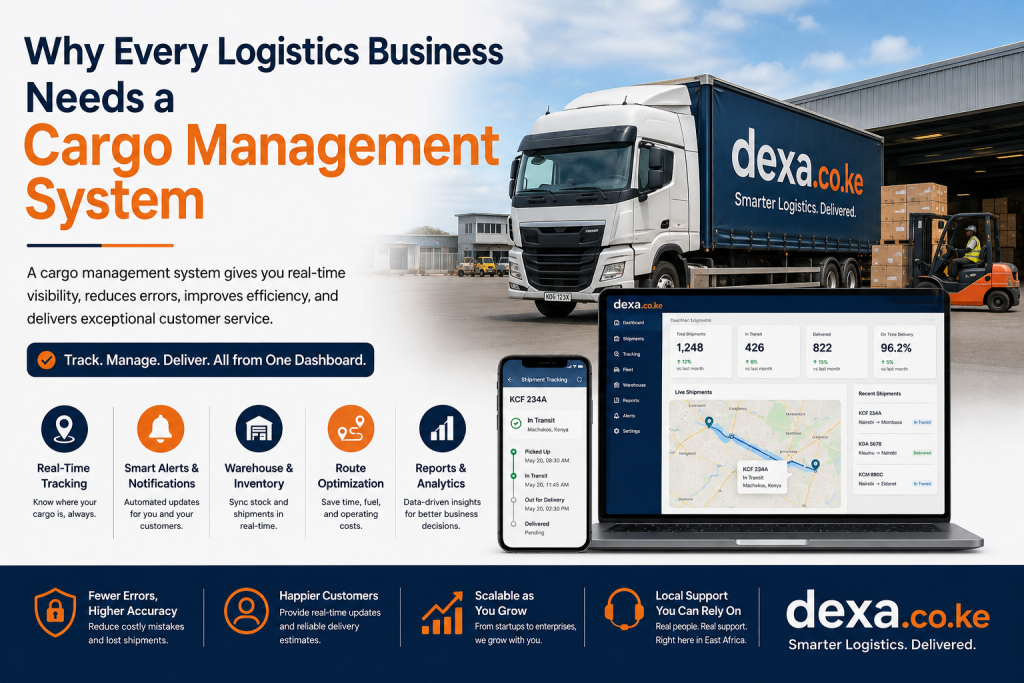
Introduction: Why Every Logistics Business Needs a Cargo Management System
Picture this: a delivery truck leaves the warehouse, but nobody is entirely sure what’s on it, where it’s headed first, or when it’s expected to arrive. A customer calls asking where their shipment is, and the response is a shrug and a promise to “check and call back.” This scenario plays out daily across logistics companies that haven’t yet adopted a proper cargo management system — and it’s costing them money, customers, and reputation.
A cargo management system changes everything. It replaces guesswork with visibility, replaces scattered spreadsheets with centralized data, and replaces stressed-out dispatchers with confident, informed teams. If you run a freight company, a warehouse, a courier service, or any business that moves goods from point A to point B, a cargo management system is no longer optional — it’s the backbone of a modern, competitive logistics operation.
This guide will walk you through everything you need to know about a cargo management system: what it actually means (in plain language, not jargon), why businesses across Kenya and beyond are adopting one, what features to look for, how much it costs, and how to choose the right cargo management system for your specific operation. By the end, you’ll understand exactly why dexa.co.ke has become the trusted name in cargo management system solutions.
What Is a Cargo Management System? A Simple Definition
Let’s cut through the industry jargon, because most definitions online are far more complicated than they need to be.
A cargo management system is software that helps businesses track and manage shipments from pickup to delivery.
That’s the whole idea. It’s a digital tool that gives you visibility over where your cargo is, what condition it’s in, and when it will arrive — all from one dashboard, instead of juggling phone calls, paper manifests, and guesswork.
Compare that to more elaborate definitions circulating online, such as describing a cargo management system as “a software platform used to plan, track, and streamline shipping, warehousing, and delivery operations.” That’s accurate, but unnecessarily wordy for something that, at its core, does one job really well: it helps you know where your cargo is and what’s happening to it, at every stage of its journey. A cargo management system should feel that simple — because when it’s built right, it is.
Why Businesses Are Adopting a Cargo Management System in 2026
The logistics industry has changed dramatically, and companies that haven’t kept up are falling behind. Here’s why a cargo management system has become essential rather than optional.
1. Real-Time Visibility Replaces Guesswork
With a cargo management system, you know exactly where every shipment is at any given moment. No more calling drivers to ask “where are you now?” No more telling customers “we’ll check and get back to you.” A good cargo management system gives you and your customers real-time answers.
2. Fewer Errors, Fewer Losses
Manual processes are prone to human error — misplaced paperwork, miscommunicated addresses, double-booked cargo space. A cargo management system automates data entry and reduces the room for costly mistakes that eat into your margins.
3. Better Customer Experience
Customers today expect the same tracking experience they get from major courier brands — a tracking number, a status update, an estimated delivery time. A cargo management system makes this level of service achievable even for smaller logistics operators, not just industry giants.
4. Improved Warehouse and Fleet Efficiency
A cargo management system doesn’t just track shipments in transit — it also helps optimize warehouse storage, fleet scheduling, and route planning, ensuring vehicles aren’t wasting fuel on inefficient routes and warehouse space isn’t sitting idle or overcrowded.
5. Data-Driven Decision Making
Every shipment processed through a cargo management system generates data — delivery times, common delays, popular routes, peak demand periods. Over time, this data becomes one of your most valuable business assets, helping you make smarter operational and investment decisions.
6. Regulatory Compliance and Documentation
Cross-border shipping, in particular, requires extensive documentation — customs forms, invoices, certificates of origin. A cargo management system centralizes this paperwork, reducing the risk of costly compliance errors and shipment delays at borders.
7. Scalability as Your Business Grows
What works for ten shipments a day will not work for five hundred. A cargo management system is built to scale, allowing your logistics operation to grow without needing to overhaul your entire process every time volume increases.
Core Features to Look For in a Cargo Management System
Not all cargo management system platforms are created equal. Here are the features that separate a genuinely useful cargo management system from a bare-bones tracking tool.
1. Real-Time GPS Tracking
The foundation of any good cargo management system is the ability to see, on a live map, exactly where each shipment or vehicle is located at any moment.
2. Automated Notifications and Alerts
A strong cargo management system should automatically notify both your team and your customers about pickup confirmations, transit updates, delays, and successful deliveries — without requiring manual follow-up calls.
3. Warehouse Inventory Integration
The best cargo management system solutions connect directly to warehouse inventory data, so you always know what’s in stock, what’s reserved for outgoing shipments, and what needs replenishing.
4. Route Optimization
Fuel and time are two of the biggest costs in logistics. A cargo management system with built-in route optimization can significantly cut both by calculating the most efficient delivery paths based on traffic, distance, and delivery windows.
5. Digital Documentation and E-Signatures
Paper-based proof of delivery is slow and easy to lose. A modern cargo management system allows digital signatures and photo confirmations right at the point of delivery, creating a reliable audit trail.
6. Multi-User Access with Role-Based Permissions
Different team members need different levels of access. A well-designed cargo management system allows administrators, dispatchers, drivers, and customer service teams to each see only what’s relevant to their role.
7. Reporting and Analytics Dashboards
A cargo management system should turn raw shipment data into readable reports — delivery time averages, driver performance, cost-per-shipment — helping managers spot trends and inefficiencies quickly.
8. Integration With Other Business Tools
Whether it’s accounting software, customer relationship management (CRM) tools, or e-commerce platforms, the most valuable cargo management system solutions integrate smoothly with the other software your business already relies on.
9. Mobile Accessibility
Drivers and field agents need mobile-friendly access. A cargo management system with a dedicated mobile app ensures your team can update statuses and access information from anywhere, not just from a desktop computer at the office.
10. Customs and Compliance Documentation Support
For businesses handling cross-border freight, a cargo management system that supports customs documentation, tariff calculations, and compliance checklists can save enormous amounts of time and prevent costly border delays.
Types of Businesses That Benefit From a Cargo Management System
You might assume a cargo management system is only for massive shipping conglomerates, but that’s far from true. Here’s a breakdown of who benefits most.
Freight and Trucking Companies
Fleet operators moving goods across regions or countries rely heavily on a cargo management system to coordinate multiple vehicles, drivers, and delivery schedules simultaneously.
Courier and Last-Mile Delivery Services
Companies delivering parcels directly to consumers need a cargo management system to manage high volumes of small shipments efficiently, often with tight delivery windows.
Warehousing and Distribution Centers
A cargo management system helps warehouses track inbound and outbound shipments, manage storage space, and coordinate with transport partners without manual reconciliation.
Import and Export Businesses
Businesses dealing with cross-border trade benefit enormously from a cargo management system that handles documentation, customs processes, and multi-leg shipment tracking across different transport modes.
E-Commerce Businesses
Online retailers shipping products to customers need a cargo management system to manage order fulfillment, delivery tracking, and returns processing at scale.
Agricultural and Perishable Goods Exporters
Time-sensitive shipments, such as flowers, fruits, or vegetables, require a cargo management system with real-time tracking to ensure goods reach their destination before spoiling.
Manufacturing Companies
Manufacturers moving raw materials in and finished products out benefit from a cargo management system that coordinates supply chain logistics on both ends of production.
Third-Party Logistics (3PL) Providers
Companies that manage logistics on behalf of other businesses depend on a robust cargo management system to juggle multiple clients’ shipments simultaneously without confusion or error.
How dexa.co.ke Delivers the Best Cargo Management System Experience
If you’re searching for a reliable, locally-relevant cargo management system, dexa.co.ke stands out as the go-to platform built specifically with East African logistics realities in mind — from unreliable road conditions to cross-border customs complexity.
Here’s what makes the dexa.co.ke cargo management system different:
- Built for local logistics realities: Unlike generic international platforms, the dexa.co.ke cargo management system understands Kenyan road networks, border processes, and delivery patterns.
- Transparent, scalable pricing: Whether you’re a small courier startup or an established freight company, dexa.co.ke offers a cargo management system that scales with your business rather than forcing you into an enterprise-only pricing tier.
- Dedicated onboarding support: Adopting a new cargo management system can feel intimidating, which is why the dexa.co.ke team provides hands-on onboarding to get your staff comfortable quickly.
- Continuous feature updates: Logistics needs evolve, and so does the dexa.co.ke cargo management system, with regular updates based on real customer feedback.
- Responsive local support: When something goes wrong, you need help fast. The dexa.co.ke support team is available to resolve issues without the frustration of dealing with distant, time-zone-mismatched call centers.
Choosing a cargo management system isn’t just about features on a spec sheet — it’s about choosing a partner who understands your operational context. That’s precisely why more logistics businesses are turning to the dexa.co.ke cargo management system instead of one-size-fits-all international alternatives.
How to Choose the Right Cargo Management System for Your Business
Selecting a cargo management system is a significant decision, and getting it right the first time saves you the pain of switching platforms later. Here’s a step-by-step approach.
Step 1: Define Your Operational Needs
Before evaluating any cargo management system, list out your specific pain points. Are you struggling with tracking visibility? Documentation? Route planning? Knowing your priorities narrows your search significantly.
Step 2: Consider Your Business Size and Growth Plans
A cargo management system that works for a five-vehicle courier service may not scale well for a fifty-vehicle freight company. Choose a platform that can grow alongside your business.
Step 3: Evaluate Ease of Use
The most feature-rich cargo management system is useless if your team finds it too complicated to use daily. Prioritize intuitive interfaces and manageable learning curves.
Step 4: Check Integration Capabilities
Make sure the cargo management system you choose can integrate with your existing accounting, CRM, or e-commerce tools to avoid duplicate data entry and disconnected workflows.
Step 5: Assess Mobile Functionality
Since much of the work happens in the field, confirm that the cargo management system offers a reliable, easy-to-use mobile app for drivers and field staff.
Step 6: Review Customer Support Quality
Ask about response times, support channels, and whether local support is available. A cargo management system is only as good as the support behind it when issues arise.
Step 7: Understand the Pricing Structure
Some cargo management system providers charge per shipment, others per vehicle, others a flat monthly rate. Understand exactly how pricing scales as your operation grows.
Step 8: Request a Demo or Trial Period
Never commit to a cargo management system without first testing it. A trial period reveals usability issues that a sales pitch won’t.
Step 9: Check Data Security Measures
Your shipment and customer data is valuable and sensitive. Confirm that the cargo management system you’re considering follows solid data protection practices.
Step 10: Read Reviews From Similar Businesses
Look for reviews from businesses similar in size and industry to yours. A cargo management system that works brilliantly for an e-commerce warehouse might not suit a cross-border freight operator, and vice versa.
Cost Guide: What to Expect When Investing in a Cargo Management System
Pricing for a cargo management system varies significantly depending on scale, features, and provider. Here’s a general breakdown to help set realistic budget expectations.
| Business Size | Typical Monthly Cost Range (KES) | What’s Usually Included |
|---|---|---|
| Small courier/startup (1–5 vehicles) | 3,000 – 15,000 | Basic tracking, notifications |
| Medium fleet (6–20 vehicles) | 15,000 – 50,000 | Tracking, route optimization, reporting |
| Large freight operation (20+ vehicles) | 50,000 – 200,000+ | Full suite: tracking, warehouse integration, analytics, multi-user access |
| Enterprise/3PL provider | Custom pricing | Fully customized cargo management system with dedicated support |
While cost matters, the real question to ask is not “how much does a cargo management system cost?” but rather “how much is my business losing without one?” Lost shipments, inefficient routes, and poor customer communication often cost far more than the monthly subscription for a proper cargo management system.
Common Mistakes Businesses Make When Choosing a Cargo Management System
Avoiding these mistakes will save you time, money, and operational headaches.
Mistake 1: Choosing Based on Price Alone
The cheapest cargo management system option isn’t always the best value. Missing features often mean you’ll need to purchase additional tools later, costing more overall.
Mistake 2: Ignoring Scalability
Some businesses choose a cargo management system that fits their current size perfectly but can’t handle growth, forcing a disruptive migration to a new system within a year or two.
Mistake 3: Underestimating the Onboarding Process
Switching to a new cargo management system requires staff training and adjustment time. Failing to plan for this transition period can temporarily disrupt operations.
Mistake 4: Overlooking Mobile Usability
If your drivers and field staff find the cargo management system’s mobile app clunky or unreliable, adoption will be poor, undermining the entire system’s value.
Mistake 5: Not Testing Customer Support Responsiveness
Some businesses only discover how poor a provider’s support is after something goes wrong. Test support responsiveness during the evaluation phase, not after committing.
Mistake 6: Failing to Involve Frontline Staff in the Decision
Dispatchers and drivers who will use the cargo management system daily should have input into the selection process. Decisions made purely by management, without frontline feedback, often lead to poor adoption rates.
Cargo Management System vs. Manual Tracking: A Direct Comparison
| Factor | Cargo Management System | Manual Tracking (Spreadsheets/Paper) |
|---|---|---|
| Real-Time Visibility | Yes, live GPS tracking | No, relies on phone calls and updates |
| Error Rate | Low, automated data entry | High, prone to human error |
| Customer Communication | Automated notifications | Manual, inconsistent |
| Scalability | Built to grow with your business | Becomes unmanageable at scale |
| Reporting | Instant, data-driven dashboards | Time-consuming manual compilation |
| Documentation | Centralized and digital | Scattered paperwork, easy to lose |
| Cost Efficiency (Long-Term) | Higher upfront, saves money long-term | Lower upfront, costlier in hidden losses |
This comparison makes the case for a cargo management system almost impossible to ignore, particularly for businesses handling any meaningful shipment volume.
Cargo Management System Use Cases by Industry
Retail and E-Commerce
Retailers rely on a cargo management system to synchronize online orders with warehouse dispatch and last-mile delivery, ensuring customers receive accurate delivery estimates and timely updates.
Agriculture and Export
Exporters of flowers, tea, coffee, and fresh produce depend on a cargo management system that provides real-time visibility, since delays can mean spoiled goods and lost revenue.
Construction and Heavy Materials
Construction firms moving equipment and materials between sites use a cargo management system to coordinate deliveries with project timelines, avoiding costly work stoppages due to missing materials.
Pharmaceuticals and Healthcare
Medical supply chains require precise tracking and documentation. A cargo management system ensures temperature-sensitive shipments and critical supplies are monitored closely from origin to destination.
Manufacturing and Industrial Supply
Manufacturers use a cargo management system to manage the flow of raw materials inbound and finished goods outbound, keeping production schedules on track.
Retail Distribution Networks
Businesses with multiple retail outlets use a cargo management system to manage stock replenishment across locations, ensuring no branch runs out of key inventory.
The Role of Automation in a Modern Cargo Management System
Automation is arguably the single biggest advancement in cargo management system technology over the past several years. Here’s how automation is transforming the space.
Automated Dispatching: Instead of manually assigning shipments to drivers, a modern cargo management system can automatically assign the most suitable vehicle and driver based on location, capacity, and availability.
Predictive Delay Alerts: Advanced systems can predict potential delays based on traffic patterns, weather data, or historical performance, allowing dispatchers to proactively adjust plans before a delay actually happens.
Automated Customer Notifications: Rather than customer service teams manually updating clients, a cargo management system sends automated status updates via SMS, email, or app notifications.
Smart Route Recalculation: If conditions change mid-route — heavy traffic, road closures — a well-designed cargo management system can automatically recalculate the optimal path in real time.
Automated Reporting: Instead of manually compiling performance data, a cargo management system generates reports automatically, freeing up management time for actual decision-making rather than data compilation.
As automation continues to advance, the gap between businesses using a modern cargo management system and those relying on manual processes will only widen, making early adoption a genuine competitive advantage.
Data Security and Compliance in a Cargo Management System
Handling shipment data means handling sensitive business and customer information, so security cannot be an afterthought. Here’s what to look for in a cargo management system regarding data protection.
Encrypted Data Transmission: Ensure that data moving between your cargo management system, drivers’ mobile devices, and your dashboard is encrypted to prevent interception.
Role-Based Access Control: Limiting who can view or edit sensitive shipment and customer data reduces the risk of internal data misuse.
Regular Backups: A reliable cargo management system should back up data regularly, protecting your business from data loss due to technical failures.
Compliance With Data Protection Laws: Depending on your operating region, your cargo management system should comply with relevant data protection regulations, particularly if you handle customer personal information.
Audit Trails: A good cargo management system logs who accessed or modified shipment records, which is valuable both for internal accountability and resolving customer disputes.
Integrating a Cargo Management System With Your Broader Supply Chain
A cargo management system doesn’t operate in isolation — its real value emerges when integrated with the rest of your supply chain technology stack.
Inventory Management Systems: Connecting your cargo management system with inventory software ensures accurate stock visibility across warehouses and distribution points.
Accounting Software: Integration allows automatic invoicing based on completed shipments, reducing manual billing errors and administrative workload.
Customer Relationship Management (CRM): Linking your cargo management system with CRM tools gives customer service teams full visibility into shipment status when handling customer inquiries.
E-Commerce Platforms: For online retailers, integrating a cargo management system directly with the sales platform ensures orders automatically trigger fulfillment and tracking without manual data entry.
Enterprise Resource Planning (ERP) Systems: Larger organizations often integrate their cargo management system with broader ERP systems, creating a single source of truth across finance, operations, and logistics.
This kind of integration transforms a cargo management system from a standalone tracking tool into the central nervous system of your entire logistics operation.
Real-World Scenarios: How Different Businesses Use a Cargo Management System
Scenario 1: The Growing Courier Startup A small courier company in Nairobi started with three motorbikes and a WhatsApp group to coordinate deliveries. As demand grew, coordination became chaotic, with missed deliveries and confused customers. Adopting a cargo management system allowed them to formalize dispatching, automate customer notifications, and scale to twenty riders without losing operational control.
Scenario 2: The Cross-Border Freight Company A freight company moving goods between Kenya and neighboring countries struggled with documentation delays at border crossings. By adopting a cargo management system with built-in customs documentation support, they reduced border clearance times significantly and avoided repeated compliance penalties.
Scenario 3: The Flower Exporter An exporter of fresh flowers needed absolute precision in shipment timing to avoid spoilage. A cargo management system with real-time tracking and predictive delay alerts allowed them to proactively reroute shipments during unexpected delays, protecting perishable inventory and maintaining client trust.
Scenario 4: The Multi-Branch Retailer A retail chain with locations across several towns struggled with uneven stock distribution — some branches overstocked, others constantly running out. A cargo management system integrated with their inventory software gave head office full visibility, allowing smarter redistribution decisions.
Each scenario reflects the same underlying truth: regardless of industry or company size, a properly implemented cargo management system solves real, costly operational problems.
The Future of Cargo Management System Technology
Looking ahead, several developments are shaping where cargo management system technology is headed.
Artificial Intelligence and Predictive Analytics: Future cargo management system platforms will increasingly use AI to predict delays, optimize routes, and even forecast demand before it happens.
Internet of Things (IoT) Sensor Integration: Sensors monitoring temperature, humidity, and shock exposure will feed directly into a cargo management system, providing granular condition monitoring for sensitive goods.
Blockchain for Documentation Verification: Some cargo management system providers are exploring blockchain technology to create tamper-proof records of shipment documentation, particularly valuable for cross-border trade.
Increased Mobile-First Design: As smartphone usage continues rising across Africa, cargo management system providers are prioritizing mobile-first experiences over desktop-heavy interfaces.
Sustainability Tracking: Environmental consciousness is pushing some cargo management system platforms to include carbon footprint tracking, helping businesses measure and reduce their logistics-related emissions.
Businesses that stay ahead of these trends by adopting a forward-looking cargo management system today will be better positioned for the operational demands of tomorrow.
Key Takeaways: Everything to Remember About a Cargo Management System
- Keep the definition simple. A cargo management system is software that helps businesses track and manage shipments from pickup to delivery — nothing more complicated than that.
- Visibility is the core value. The primary benefit of a cargo management system is replacing guesswork with real-time, accurate shipment information.
- Features matter more than buzzwords. Prioritize real-time tracking, automated notifications, route optimization, and mobile accessibility when evaluating a cargo management system.
- It’s for businesses of all sizes. From a three-motorbike courier startup to a large cross-border freight operator, a cargo management system delivers value at every scale.
- dexa.co.ke understands local logistics. For businesses operating in Kenya and the wider East African region, the dexa.co.ke cargo management system is built with local realities in mind, not adapted from a foreign context.
- Cost should be weighed against losses, not viewed in isolation. The real cost comparison isn’t the subscription fee — it’s the subscription fee versus what inefficiency and lost shipments are already costing you.
- Integration multiplies value. A cargo management system becomes significantly more powerful when connected to your accounting, CRM, and inventory systems.
- Automation is the future. Predictive alerts, automated dispatching, and smart route recalculation are quickly becoming standard features of a modern cargo management system.
- Security cannot be an afterthought. Choose a cargo management system with strong data protection practices, especially if you handle sensitive customer information.
- The right choice takes research. Don’t rush the decision — test, compare, and involve your frontline team before committing to a cargo management system.
Frequently Asked Questions About Cargo Management Systems
What exactly is a cargo management system?
A cargo management system is software that helps businesses track and manage shipments from pickup to delivery, giving real-time visibility over the entire shipping process.
Who needs a cargo management system?
Any business that moves goods — couriers, freight companies, warehouses, exporters, e-commerce retailers, and manufacturers — benefits from implementing a cargo management system.
How much does a cargo management system cost?
Costs vary widely based on business size and features, typically ranging from a few thousand shillings monthly for small operators to significantly higher custom pricing for large enterprises requiring a fully featured cargo management system.
Can a small business afford a cargo management system?
Yes. Many providers, including dexa.co.ke, offer scalable pricing specifically designed to make a cargo management system accessible to small and growing businesses, not just large corporations.
Does a cargo management system work for cross-border shipping?
Yes, particularly platforms that include customs documentation support, which is essential for smooth cross-border logistics operations.
How long does it take to implement a cargo management system?
Implementation timelines vary, but most businesses can be fully onboarded onto a cargo management system within a few weeks, including staff training.
Is a cargo management system difficult for staff to learn?
A well-designed cargo management system should be intuitive, with most staff comfortable using core features within a short training period, especially with proper onboarding support.
Can a cargo management system integrate with my existing software?
Most modern cargo management system platforms offer integration capabilities with accounting, CRM, inventory, and e-commerce systems, though it’s important to confirm compatibility before committing.
What’s the biggest benefit of switching to a cargo management system?
The biggest benefit is replacing uncertainty with real-time visibility — knowing exactly where every shipment is, at every stage, without relying on phone calls and guesswork.
Why should I choose dexa.co.ke for my cargo management system?
dexa.co.ke offers a cargo management system built specifically for East African logistics realities, with scalable pricing, hands-on onboarding, and responsive local support — advantages that generic international platforms often can’t match.
Final Thoughts: Take Control With the Right Cargo Management System
Logistics is unforgiving. A single missed delivery, a single miscommunicated shipment status, a single lost piece of paperwork — any of these can cost you a customer’s trust permanently. In an industry where reputation is everything, operating without a proper cargo management system is a risk that fewer and fewer businesses can afford to take.
A cargo management system isn’t just a tracking tool. It’s the difference between reactive, stressful logistics management and proactive, confident operations. It’s the difference between telling a customer “let me check and call you back” and telling them exactly when their shipment will arrive, because you already know.
Whether you’re a small courier just starting to scale, an established freight company managing dozens of vehicles, or an exporter racing against time to keep perishable goods fresh, the right cargo management system transforms how your business operates — and how your customers perceive you.
Visit dexa.co.ke today to explore a cargo management system built specifically for businesses like yours. Stop guessing where your cargo is. Start knowing — with a cargo management system that actually works for your operation, your team, and your customers.