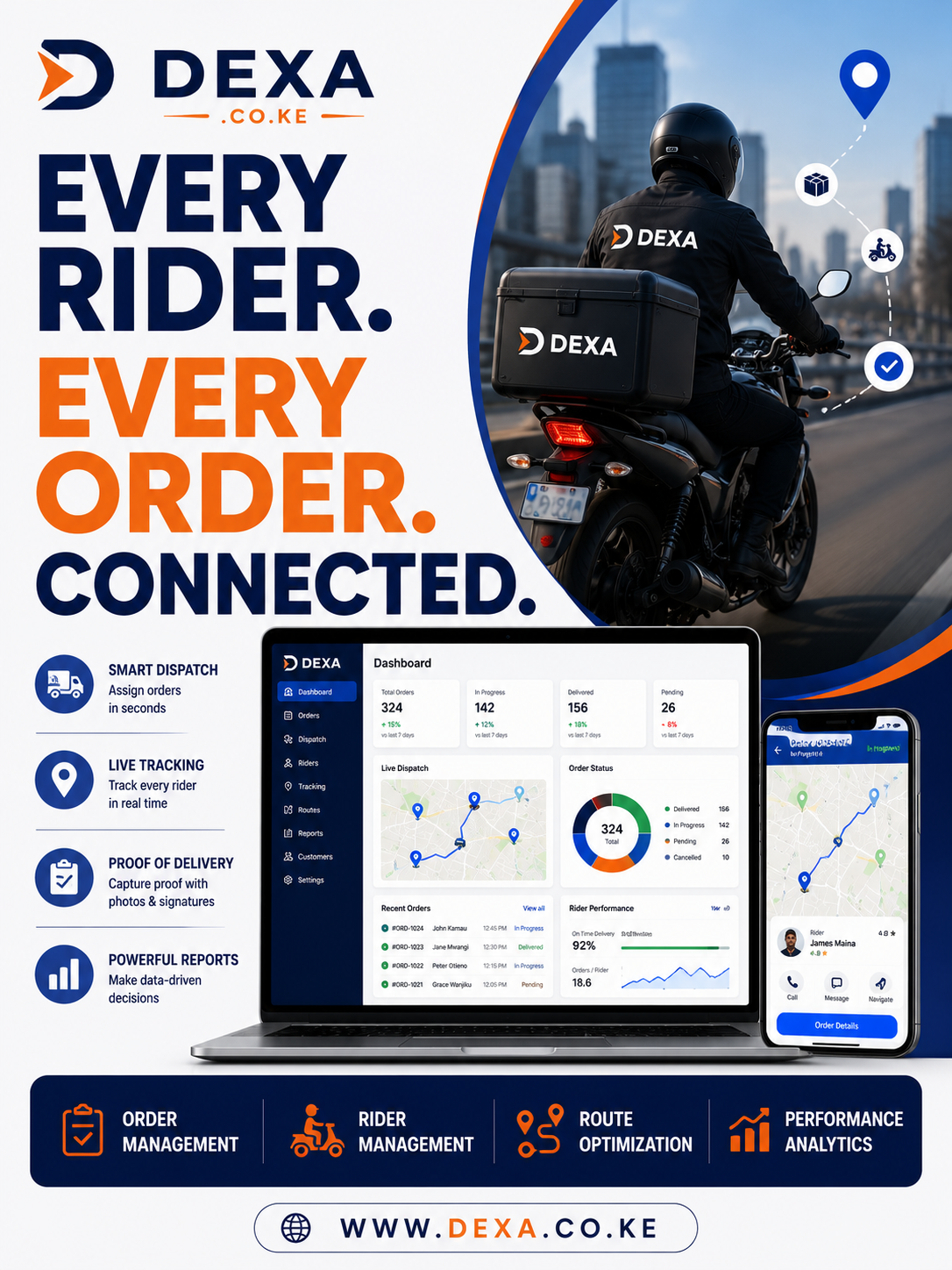
Delivery dispatch software Kenya is helping businesses across the country transform the way they manage deliveries, dispatch drivers, track fleets, and satisfy customers. As e-commerce, courier services, food delivery, wholesale distribution, pharmacies, supermarkets, and logistics companies continue to grow in Kenya, managing deliveries manually is becoming increasingly difficult. Businesses need faster, smarter, and more efficient ways to coordinate drivers, optimize routes, and ensure every package reaches its destination on time.
Modern dispatch software combines Artificial Intelligence (AI), GPS tracking, route optimization, mobile applications, automated notifications, and real-time reporting to simplify delivery operations. Whether you own a small courier business in Nairobi or manage a nationwide logistics company with hundreds of vehicles, investing in Delivery dispatch software Kenya can significantly improve productivity, reduce operational costs, and enhance customer satisfaction.
This guide explains everything Kenyan businesses need to know about delivery dispatch software, including how it works, its benefits, key features, industries that use it, and why AI-powered dispatching is becoming essential for companies that want to remain competitive.
Table of Contents
- What is Delivery Dispatch Software?
- Why Kenyan Businesses Need Delivery Dispatch Software
- Challenges of Manual Dispatch Operations
- How AI Improves Delivery Dispatch
- Key Features of Delivery Dispatch Software
- Benefits of AI-Powered Dispatch Software
- Real-Time Fleet Tracking
- Route Optimization
- Driver Management
- Order Management
- Delivery Notifications
- Proof of Delivery
What is Delivery Dispatch Software?
Delivery dispatch software Kenya refers to a digital platform that helps businesses plan, assign, monitor, and complete deliveries efficiently. Instead of relying on paper records, spreadsheets, phone calls, or WhatsApp messages to coordinate drivers, dispatch software automates the entire process.
A modern dispatch system manages:
- Delivery requests
- Driver assignments
- Route planning
- GPS tracking
- Customer notifications
- Delivery confirmations
- Fleet monitoring
- Performance reporting
Artificial Intelligence further enhances these capabilities by analyzing thousands of data points in real time to recommend the fastest routes, assign the most suitable driver, and predict delivery times accurately.
Businesses can monitor every delivery from a centralized dashboard, giving managers complete visibility over their operations.
Why Kenyan Businesses Need Delivery Dispatch Software
Kenya has experienced rapid growth in online shopping, courier services, and on-demand deliveries. Customers expect fast deliveries, accurate tracking, and excellent communication throughout the delivery process.
Manual dispatch methods often lead to:
- Late deliveries
- Lost orders
- High fuel costs
- Driver confusion
- Poor communication
- Customer complaints
- Increased operational expenses
Implementing Delivery dispatch software Kenya helps businesses overcome these challenges through automation and real-time visibility.
Companies can dispatch drivers within seconds, optimize delivery routes, and monitor every vehicle throughout the day.
Common Challenges with Manual Delivery Dispatch
Many businesses still rely on manual dispatch methods, especially growing companies that started with only a few drivers.
As operations expand, manual dispatch becomes increasingly difficult.
Some common challenges include:
Slow Job Assignment
Dispatchers spend valuable time calling drivers individually to assign deliveries.
This delays deliveries and reduces productivity.
Poor Route Planning
Drivers often choose their own routes without considering traffic, fuel efficiency, or delivery priorities.
This increases:
- Fuel consumption
- Delivery delays
- Vehicle wear
- Customer dissatisfaction
Limited Visibility
Managers have little visibility into driver locations or delivery progress.
Without GPS tracking, it becomes difficult to answer customer questions about delivery status.
Communication Problems
Drivers, dispatchers, and customers frequently exchange multiple phone calls to confirm deliveries.
This consumes valuable time and creates unnecessary confusion.
Human Errors
Manual scheduling often leads to:
- Duplicate deliveries
- Missed deliveries
- Incorrect addresses
- Wrong driver assignments
Automation greatly reduces these errors.
How AI is Transforming Delivery Dispatch in Kenya
Artificial Intelligence is changing dispatch management by making smarter decisions faster than humans can.
Instead of manually analyzing delivery schedules, AI evaluates multiple factors simultaneously, including:
- Driver location
- Vehicle availability
- Traffic conditions
- Customer priority
- Delivery deadlines
- Historical delivery performance
- Weather conditions
- Vehicle capacity
The software instantly recommends the best driver and route for each delivery.
As new orders arrive or road conditions change, AI continuously recalculates schedules to maintain efficiency.
This dynamic approach helps businesses complete more deliveries with fewer resources.
How Delivery Dispatch Software Works
Understanding the dispatch process helps businesses appreciate the value of automation.
A typical workflow includes:
Step 1: Customer Places an Order
Orders may originate from:
- E-commerce websites
- Mobile apps
- Customer service agents
- Retail stores
- ERP systems
- CRM software
The order automatically enters the dispatch system.
Step 2: AI Assigns the Delivery
The software analyzes:
- Driver proximity
- Vehicle availability
- Delivery urgency
- Vehicle capacity
- Route efficiency
Within seconds, the most suitable driver receives the assignment.
Step 3: Route Optimization
The software generates the most efficient route based on:
- Current traffic
- Distance
- Road conditions
- Multiple delivery stops
- Delivery windows
Drivers receive turn-by-turn navigation through the mobile application.
Step 4: Live Tracking
Managers monitor delivery progress in real time.
Customers can also track their deliveries without calling customer support.
Step 5: Proof of Delivery
Once delivery is completed, drivers capture:
- Customer signature
- Delivery photo
- GPS coordinates
- Timestamp
The system automatically updates delivery status.
Key Features of Delivery Dispatch Software
When evaluating Delivery dispatch software Kenya, businesses should prioritize solutions that include comprehensive features.
Intelligent Dispatch Automation
Rather than assigning deliveries manually, the software automatically selects the most suitable driver based on operational data.
Benefits include:
- Faster dispatching
- Improved efficiency
- Balanced workloads
- Reduced delays
GPS Fleet Tracking
Real-time GPS tracking enables businesses to monitor:
- Vehicle location
- Driver movement
- Route progress
- Idle time
- Speed
- Delivery completion
Managers gain complete visibility over fleet operations.
Route Optimization
AI-powered route optimization helps drivers avoid:
- Heavy traffic
- Road closures
- Congested areas
- Unnecessary detours
Optimized routes reduce travel time while lowering fuel costs.
Driver Management
Managers can easily monitor:
- Driver schedules
- Delivery performance
- Working hours
- Assigned deliveries
- Completed deliveries
Performance reports help identify top-performing drivers while supporting fair workload distribution.
Order Management
Delivery requests can be organized according to:
- Delivery priority
- Customer location
- Scheduled delivery time
- Vehicle capacity
Order management ensures efficient planning throughout the day.
Mobile Driver Application
Drivers receive all delivery information directly on their smartphones.
The application typically includes:
- Delivery assignments
- Navigation
- Customer contact details
- Delivery instructions
- Status updates
- Proof of delivery
This eliminates paperwork while improving communication.
Automated Customer Notifications
Customers appreciate being informed throughout the delivery journey.
The software automatically sends:
- Order confirmation
- Dispatch notification
- Estimated arrival time
- Driver tracking link
- Delay alerts
- Delivery confirmation
Automated communication reduces customer inquiries while improving satisfaction.
Digital Proof of Delivery
Paper delivery notes can easily be lost or damaged.
Modern systems capture digital proof using:
- Electronic signatures
- Delivery photographs
- QR code scanning
- Barcode verification
- GPS location
- Date and time stamps
This creates a permanent delivery record for future reference.
Benefits of Delivery Dispatch Software for Kenyan Businesses
Implementing Delivery dispatch software Kenya delivers measurable improvements across every stage of the delivery process.
Faster Deliveries
AI assigns drivers instantly while optimizing routes, reducing delays and helping businesses meet customer expectations.
Reduced Fuel Costs
Fuel is one of the largest operating expenses for delivery businesses.
Optimized routing reduces:
- Total distance traveled
- Time spent in traffic
- Unnecessary trips
- Vehicle idling
Lower fuel consumption translates into significant cost savings.
Improved Driver Productivity
Drivers spend less time waiting for instructions and more time completing deliveries.
Automated scheduling allows each driver to complete more jobs during a typical workday.
Better Customer Experience
Customers benefit from:
- Real-time tracking
- Accurate delivery estimates
- Automated notifications
- Faster deliveries
- Transparent communication
Satisfied customers are more likely to return and recommend your services.
Increased Operational Visibility
Managers gain access to a centralized dashboard displaying:
- Active deliveries
- Driver locations
- Delivery progress
- Fleet status
- Operational performance
Real-time insights enable quicker and better-informed decisions.
Lower Administrative Work
Automation reduces repetitive tasks such as:
- Manual scheduling
- Phone calls to drivers
- Updating spreadsheets
- Tracking delivery status
Dispatch teams can focus on resolving exceptions and improving customer service instead of routine coordination.
Enhanced Business Growth
As delivery volumes increase, manual processes become difficult to manage. Delivery dispatch software Kenya enables businesses to scale without proportionally increasing administrative staff or operational costs.
A dispatch platform provides the foundation needed to expand into new towns, counties, or nationwide delivery operations while maintaining high service standards.
As delivery businesses continue to expand across Kenya, efficiency has become one of the biggest competitive advantages. Customers now expect same-day deliveries, accurate tracking, instant notifications, and reliable service. Businesses that continue relying on manual dispatch methods often struggle to meet these expectations. This is where Delivery dispatch software Kenya becomes an essential business solution.
Modern dispatch software uses Artificial Intelligence (AI), automation, cloud technology, GPS tracking, and real-time analytics to help businesses deliver faster while reducing operational costs. Whether you operate in Nairobi, Mombasa, Kisumu, Nakuru, Eldoret, Thika, or any other town, intelligent dispatch software allows your team to manage more deliveries with fewer resources.
Advanced Features of Delivery Dispatch Software
The best Delivery dispatch software Kenya should include advanced capabilities that go beyond simple driver assignment. These features improve productivity, reduce delays, and provide complete visibility over delivery operations.
AI Route Optimization
One of the most valuable features of modern dispatch software is AI-powered route optimization.
Instead of simply choosing the shortest route, Artificial Intelligence evaluates multiple variables simultaneously.
These include:
- Live traffic conditions
- Road closures
- Weather conditions
- Driver location
- Vehicle capacity
- Delivery priority
- Customer availability
- Historical traffic patterns
For example, if heavy traffic develops along a major highway in Nairobi, the software automatically recommends an alternative route before the driver reaches the congestion.
This saves valuable time while reducing fuel consumption.
Benefits include:
- Faster deliveries
- Lower fuel costs
- Reduced vehicle wear
- Better customer satisfaction
Businesses handling dozens or hundreds of deliveries every day can achieve substantial savings through intelligent route optimization.
Intelligent Driver Assignment
Assigning the nearest driver is not always the best decision.
Delivery dispatch software Kenya analyzes numerous operational factors before selecting the ideal driver.
The system considers:
- Current location
- Vehicle size
- Driver workload
- Delivery urgency
- Driver skills
- Vehicle availability
- Remaining working hours
- Traffic conditions
This ensures deliveries are completed efficiently without overloading individual drivers.
Balanced workloads also improve employee satisfaction and reduce overtime expenses.
Dynamic Dispatching
Delivery operations change constantly throughout the day.
Examples include:
- New customer orders
- Customer cancellations
- Traffic delays
- Vehicle breakdowns
- Driver emergencies
- Weather disruptions
Instead of requiring dispatchers to manually adjust schedules, AI automatically recalculates assignments in real time.
Drivers immediately receive updated instructions through the mobile application.
Dynamic dispatching keeps operations running smoothly despite unexpected events.
Predictive Dispatch Planning
Artificial Intelligence does more than react—it predicts future demand.
By analyzing historical delivery data, Delivery dispatch software Kenya can forecast:
- Busy delivery periods
- Seasonal demand
- Popular delivery locations
- Driver availability
- Vehicle utilization
- Customer ordering behavior
Businesses can schedule additional drivers before demand increases rather than reacting after delays occur.
Predictive planning improves service quality while reducing operational stress.
Automated Scheduling
Manual scheduling becomes increasingly difficult as businesses grow.
AI automatically schedules:
- Driver shifts
- Delivery routes
- Pickup requests
- Vehicle assignments
- Maintenance windows
Schedules continuously adjust whenever operational conditions change.
This reduces administrative workload while improving fleet utilization.
Smart Load Balancing
Some drivers may receive too many deliveries while others remain underutilized.
AI continuously balances workloads by evaluating:
- Number of assigned deliveries
- Driving distance
- Estimated completion time
- Working hours
- Vehicle capacity
Fair workload distribution improves productivity while reducing employee fatigue.
Real-Time GPS Fleet Tracking
Fleet visibility is critical for efficient dispatch management.
Modern Delivery dispatch software Kenya provides real-time GPS tracking for every vehicle.
Managers can monitor:
- Vehicle location
- Driver movement
- Route progress
- Vehicle speed
- Idle time
- Delivery completion
- Route deviations
This information allows dispatchers to respond quickly whenever unexpected situations occur.
Live Delivery Monitoring
Instead of calling drivers for updates, dispatchers can monitor every delivery from a centralized dashboard.
Delivery statuses may include:
- Order received
- Driver assigned
- Driver en route
- Driver arrived
- Delivery completed
- Delivery delayed
- Delivery failed
Customers also benefit from accurate delivery updates throughout the journey.
Digital Proof of Delivery
Paper delivery notes are quickly becoming obsolete.
Modern Delivery dispatch software Kenya supports digital proof of delivery through:
- Electronic signatures
- Delivery photos
- GPS verification
- QR code scanning
- Barcode scanning
- Automatic timestamps
Every completed delivery is securely recorded, reducing disputes and improving accountability.
Automated Customer Communication
Keeping customers informed is essential for a positive delivery experience.
The software automatically sends notifications such as:
- Order confirmation
- Driver assignment
- Estimated arrival time
- Live tracking links
- Delay notifications
- Delivery confirmation
Automated communication reduces support calls while increasing customer confidence.
Analytics and Business Intelligence
Operational data becomes valuable only when it is easy to understand.
Delivery dispatch software Kenya provides comprehensive dashboards that display key performance indicators in real time.
Managers can monitor:
- On-time delivery rate
- Driver productivity
- Fleet utilization
- Fuel consumption
- Average delivery time
- Customer satisfaction
- Failed deliveries
- Revenue by route
- Delivery costs
These reports help businesses identify opportunities for continuous improvement.
Industries Using Delivery Dispatch Software in Kenya
Many industries across Kenya are adopting AI-powered dispatch systems.
Courier Companies
Courier businesses use dispatch software to:
- Assign deliveries automatically
- Optimize delivery routes
- Track parcels
- Notify customers
- Improve delivery performance
This allows courier companies to handle growing delivery volumes efficiently.
E-Commerce Businesses
Online retailers depend on reliable delivery services.
Dispatch software helps e-commerce businesses manage:
- Same-day deliveries
- Next-day deliveries
- Customer tracking
- Driver coordination
- Delivery confirmations
Faster deliveries improve customer satisfaction and encourage repeat purchases.
Food Delivery Services
Restaurants and food delivery companies require fast dispatching.
AI helps by:
- Assigning nearby riders
- Optimizing delivery routes
- Reducing delivery times
- Managing peak demand
Customers receive fresh meals while businesses increase delivery capacity.
Wholesale Distributors
Wholesalers delivering products to retailers across Kenya benefit from:
- Route optimization
- Fleet tracking
- Delivery scheduling
- Driver monitoring
Efficient dispatching reduces transportation costs while improving service reliability.
Pharmaceutical Companies
Medical deliveries often require strict delivery timelines.
Dispatch software supports:
- Medicine distribution
- Medical equipment delivery
- Laboratory sample transportation
- Hospital deliveries
Priority-based dispatching ensures urgent deliveries are completed first.
Water and Gas Delivery Companies
Businesses delivering water, LPG cylinders, and industrial gases rely on efficient dispatch coordination.
AI improves:
- Driver scheduling
- Delivery tracking
- Route optimization
- Customer notifications
This increases delivery efficiency while reducing missed deliveries.
Field Service Businesses
Companies providing installation, maintenance, and repair services also benefit from Delivery dispatch software Kenya.
Examples include:
- Electrical contractors
- Plumbers
- Internet service providers
- HVAC technicians
- Security system installers
Technicians receive optimized schedules that reduce travel time between customer locations.
Delivery Dispatch Software vs Manual Dispatch
Businesses still relying on manual dispatch often experience unnecessary operational challenges.
| Feature | Manual Dispatch | Delivery Dispatch Software |
|---|---|---|
| Driver Assignment | Manual | AI Automated |
| Route Planning | Manual | AI Optimized |
| GPS Tracking | Limited | Real-Time |
| Customer Notifications | Manual | Automatic |
| Delivery Reports | Manual | Instant |
| Proof of Delivery | Paper | Digital |
| Fleet Visibility | Low | Complete |
| Scalability | Limited | High |
| Analytics | Basic | Advanced |
The differences become even more significant as delivery volumes increase.
Integration with Existing Business Systems
The best Delivery dispatch software Kenya integrates seamlessly with other business applications.
Common integrations include:
- ERP systems
- CRM software
- Accounting systems
- Inventory management
- Warehouse Management Systems
- Payment gateways
- GPS tracking devices
- SMS gateways
- Email platforms
- Mobile applications
Integration reduces duplicate work while improving operational accuracy.
Mobile Driver Applications
Drivers need access to delivery information wherever they are.
A mobile application allows drivers to:
- Accept deliveries
- View optimized routes
- Navigate using GPS
- Contact customers
- Upload proof of delivery
- Update delivery status
- Report delivery issues
Mobile apps improve communication while reducing paperwork.
Cloud-Based Delivery Dispatch Software
Cloud deployment offers several advantages over traditional on-premise systems.
Benefits include:
- Access from anywhere
- Automatic updates
- Reduced infrastructure costs
- Secure cloud storage
- Easy scalability
- Multi-branch management
- Faster deployment
- Business continuity
Cloud solutions are ideal for growing businesses operating across multiple counties.
Security Features
Protecting operational and customer data is essential.
A reliable Delivery dispatch software Kenya should include:
- Data encryption
- Role-based permissions
- Multi-factor authentication
- Automatic backups
- Audit logs
- Secure cloud hosting
- Data recovery tools
These features help businesses maintain data security while meeting compliance requirements.
Choosing the Best Delivery Dispatch Software in Kenya
Before selecting a solution, evaluate the following factors:
Ease of Use
Choose software with an intuitive interface that requires minimal training.
Artificial Intelligence Capabilities
Look for:
- Automatic dispatching
- Route optimization
- Predictive analytics
- Intelligent scheduling
Scalability
Ensure the platform can support business growth without requiring replacement.
Integration
Verify compatibility with your existing software systems.
Reporting
Comprehensive dashboards help managers make informed decisions.
Customer Support
Reliable support minimizes downtime and ensures smooth implementation.
Mobile Access
Drivers and managers should be able to access the system from smartphones, tablets, or computers.