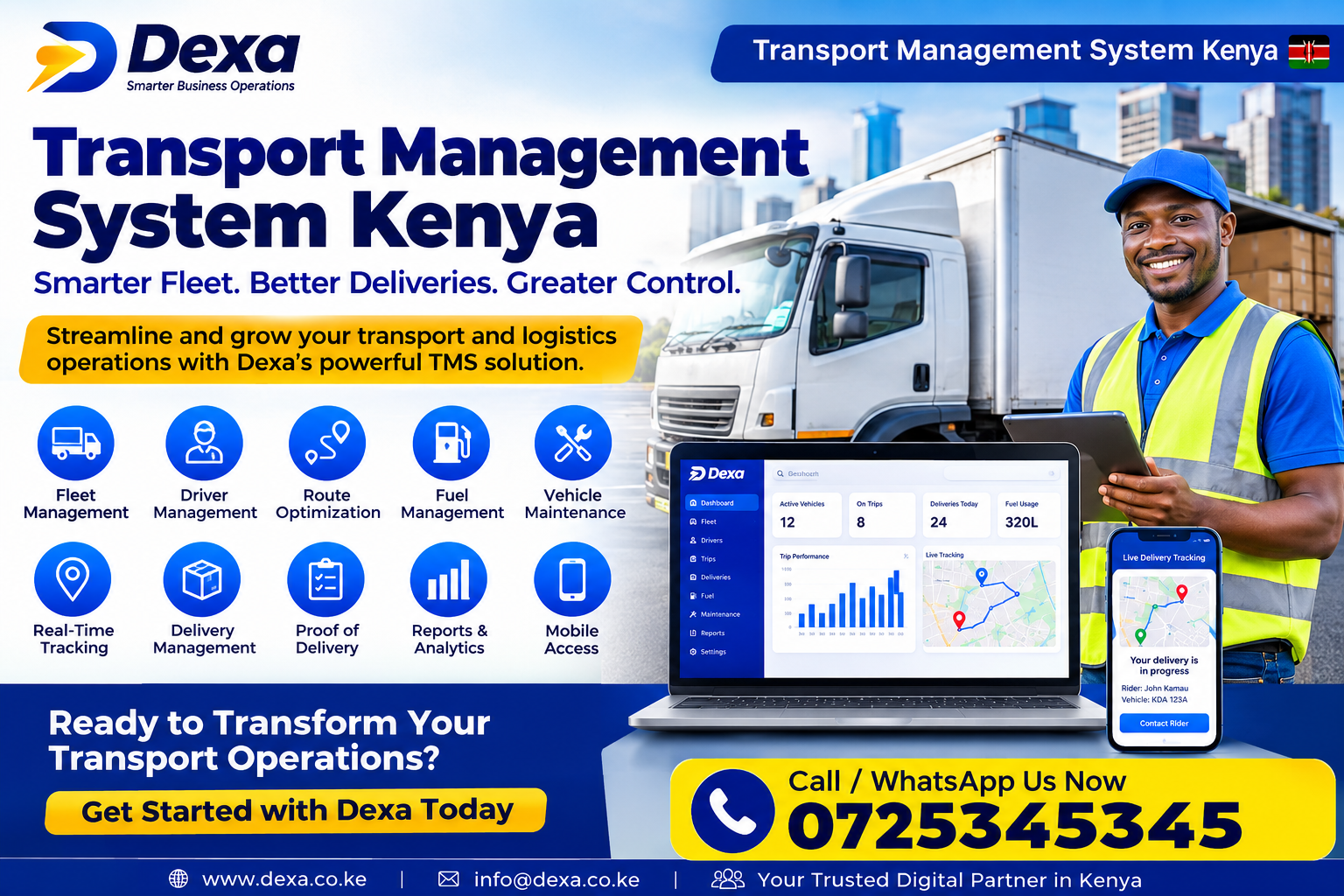
 Transport Management System Kenya is becoming an essential technology for businesses that depend on vehicles, drivers, deliveries, cargo, and logistics operations. As companies expand their delivery networks and serve customers across Nairobi, Mombasa, Kisumu, Nakuru, Eldoret, Thika, Kiambu, and other parts of Kenya, managing transportation manually can become increasingly difficult.
A Transport Management System Kenya gives businesses a centralized way to plan, organize, monitor, and improve transportation operations. Instead of depending on spreadsheets, paper records, phone calls, WhatsApp messages, and disconnected systems, businesses can manage important transportation activities through one digital platform.
A modern Transport Management System Kenya can help businesses manage vehicles, drivers, trips, routes, deliveries, customers, expenses, maintenance, payments, tracking, proof of delivery, and operational reports.
For businesses looking for a practical digital solution, Dexa provides technology designed for driver and courier operations in Kenya. Dexa’s platform brings orders, riders, customers, payments, proof of delivery, receipts, and expenses into a connected workflow.
What Is a Transport Management System Kenya?
A Transport Management System Kenya is software that helps organizations plan, execute, monitor, and analyze transportation activities.
The system acts as a central platform for managing the movement of goods, parcels, people, materials, and other items from one location to another.
Depending on the business and software configuration, a Transport Management System Kenya can include:
- Vehicle management
- Driver management
- Trip management
- Route planning
- Dispatch management
- Delivery tracking
- GPS visibility
- Fuel management
- Vehicle maintenance
- Customer management
- Proof of delivery
- Payment management
- Expense management
- Reports and analytics
- Delivery scheduling
- Performance monitoring
The main objective of a Transport Management System Kenya is to make transportation more organized, visible, measurable, and efficient.
For example, a distributor may receive an order from a customer in Nairobi. The operations team can record the order, assign a suitable vehicle and driver, schedule the trip, monitor the journey, confirm delivery, record proof of delivery, and analyze the transportation cost afterward.
Instead of managing each step separately, the Transport Management System Kenya connects the workflow.
Why Businesses Need a Transport Management System Kenya
Transportation can represent a significant operational expense for many businesses. Fuel, vehicle maintenance, driver costs, route inefficiencies, administrative work, delays, and failed deliveries can all affect profitability.
Without a structured system, managers may have difficulty answering basic operational questions:
- Which vehicles are available?
- Which vehicles are currently on the road?
- Which driver is assigned to each trip?
- Where are active deliveries?
- Which vehicles need servicing?
- How much fuel has been consumed?
- Which trips have been completed?
- Which deliveries are delayed?
- How much did each trip cost?
- Which drivers are performing efficiently?
A Transport Management System Kenya provides a centralized source of operational information.
This can help managers make faster decisions based on actual transportation records instead of relying entirely on phone calls or manually updated spreadsheets.
Transport Management System Kenya and Manual Transportation Challenges
Many businesses begin transportation management using simple tools.
A spreadsheet may contain vehicle information. A notebook may contain maintenance records. Drivers may receive instructions through phone calls or WhatsApp. Fuel receipts may be stored in envelopes, while customer delivery information may exist in different files.
This approach can work for a small operation.
However, transportation becomes more complicated as the business grows.
Poor Route Planning
Poor route planning can increase travel distances, fuel consumption, delivery times, and vehicle wear.
A Transport Management System Kenya can help businesses organize destinations and plan more efficient transportation workflows.
Businesses handling multiple delivery locations can also use route-planning technology to group deliveries according to location, priority, vehicle capacity, and driver availability.
Dexa also provides information about delivery route planning software in Kenya and how route planning can help businesses reduce unnecessary travel and improve vehicle utilization.
Difficulty Managing Drivers
Managing several drivers manually can quickly become complicated.
Managers need to know driver availability, assignments, completed trips, pending work, and delivery performance.
A Transport Management System Kenya can organize driver information and connect drivers directly to their assigned transportation activities.
High Fuel Costs
Fuel is an important cost for businesses operating commercial vehicles.
A Transport Management System Kenya can help managers connect fuel expenses with vehicles, trips, mileage, and transportation activities.
This makes it easier to identify unusual fuel expenses and investigate potential inefficiencies.
Vehicle Downtime
Unexpected breakdowns can disrupt deliveries and create additional costs.
A Transport Management System Kenya can support preventive maintenance by keeping records of servicing, repairs, inspections, mileage, and maintenance schedules.
Limited Visibility
When transportation information is spread across multiple systems, managers may not have a clear picture of what is happening.
A centralized Transport Management System Kenya gives management greater visibility into transportation operations.
Key Features of a Transport Management System Kenya
A successful Transport Management System Kenya should provide features that solve real operational problems.
Below are some of the most important capabilities businesses should consider.
Vehicle Management
Vehicle management is one of the core functions of a Transport Management System Kenya.
Businesses can maintain digital records for vehicles and monitor information such as:
- Registration details
- Vehicle type
- Vehicle capacity
- Mileage
- Service history
- Maintenance schedules
- Insurance information
- Vehicle availability
- Current assignments
- Operating costs
Instead of searching through physical documents, managers can access vehicle information from a centralized platform.
This makes it easier to determine which vehicle is available for a particular trip.
Driver Management
A Transport Management System Kenya can also simplify driver management.
Businesses can maintain driver profiles and associate drivers with trips, deliveries, vehicles, and performance records.
Important driver information may include:
- Driver name
- Contact information
- Assigned vehicle
- Current assignment
- Completed trips
- Delivery history
- Work schedule
- Performance information
Driver management becomes particularly important when a business operates a large fleet.
A centralized system can help dispatchers allocate work more efficiently and avoid unnecessary communication delays.
Route Optimization
Route optimization is an important feature of a Transport Management System Kenya.
Businesses may need to deliver products to multiple customers during the same day. Sending vehicles along inefficient routes can increase costs and reduce productivity.
Route optimization can help businesses consider:
- Delivery locations
- Vehicle capacity
- Delivery priority
- Driver availability
- Travel distance
- Traffic conditions
- Number of stops
- Delivery schedules
Better routes can potentially reduce unnecessary travel and help drivers complete more deliveries within their working hours.
Dispatch Management
Dispatchers coordinate vehicles, drivers, customers, and deliveries.
A Transport Management System Kenya can centralize dispatch activities so that the operations team can see which jobs are:
- New
- Pending
- Assigned
- In transit
- Delayed
- Completed
- Cancelled
Instead of calling every driver individually, dispatchers can use a structured digital workflow.
This reduces administrative work and improves coordination.
Delivery Tracking
Delivery visibility is increasingly important for businesses and customers.
A Transport Management System Kenya can provide information about delivery progress and help management monitor active transportation activities.
Tracking can help answer questions such as:
- Has the vehicle left?
- Is the delivery in progress?
- Has the driver reached the destination?
- Has the delivery been completed?
- Was the delivery delayed?
For businesses that depend on customer deliveries, this visibility can improve communication and customer service.
Digital Proof of Delivery
Paper-based proof of delivery can be difficult to organize, store, and retrieve.
A modern Transport Management System Kenya can support digital proof of delivery depending on the system configuration.
This may include:
- Customer signatures
- Delivery photographs
- Delivery timestamps
- Recipient information
- GPS/location information
- Delivery notes
Digital records can make it easier to confirm completed deliveries and resolve disputes.
Fuel Management
Fuel expenses can have a major impact on transportation profitability.
A Transport Management System Kenya can help businesses record fuel purchases and associate them with vehicles or trips.
Managers can then analyze:
- Fuel consumption
- Fuel expenses
- Vehicle mileage
- Cost per trip
- Cost per kilometer
- Unusual consumption patterns
The objective is not simply to record fuel purchases but to use transportation data to identify opportunities for better cost control.
Maintenance Management
Vehicle maintenance is essential for businesses that rely on transportation.
A Transport Management System Kenya can help managers organize maintenance records and schedules.
Businesses can track:
- Service dates
- Mileage
- Oil changes
- Tire replacements
- Repairs
- Inspection schedules
- Maintenance costs
- Upcoming service requirements
Preventive maintenance can help reduce the likelihood of unexpected vehicle downtime.
Expense Management
Transportation involves many expenses beyond fuel.
A Transport Management System Kenya can help businesses organize:
- Fuel expenses
- Maintenance costs
- Driver expenses
- Parking expenses
- Tolls
- Trip expenses
- Delivery expenses
- Other operational costs
When transportation expenses are connected to trips and vehicles, management can better understand the actual cost of operating the fleet.
Benefits of a Transport Management System Kenya
Implementing a Transport Management System Kenya can provide several operational benefits.
Reduced Transportation Costs
One of the main reasons businesses invest in transportation software is cost control.
A Transport Management System Kenya can help businesses identify inefficient routes, unnecessary trips, poor vehicle utilization, excessive fuel consumption, and other operational issues.
The system does not automatically eliminate every cost, but it provides the information and workflows needed to manage transportation more effectively.
Improved Vehicle Utilization
A business may have vehicles that are heavily used while others remain idle.
A Transport Management System Kenya provides managers with information about vehicle assignments and utilization.
This can help organizations determine whether their existing fleet is being used efficiently.
Better utilization may allow a company to handle more transportation work without immediately adding more vehicles.
Better Driver Accountability
Driver accountability becomes easier when transportation activities are digitally recorded.
A Transport Management System Kenya can connect drivers to trips, deliveries, vehicles, and delivery outcomes.
This creates a clearer operational record.
Managers can review completed trips and identify areas where additional training, process improvement, or operational support may be required.
Faster Dispatching
Manual dispatching can take significant time when a company has many drivers and deliveries.
A Transport Management System Kenya can make assignments more structured.
Dispatchers can view available drivers, vehicles, orders, and delivery requirements from a centralized platform.
This can reduce delays between receiving a transportation request and assigning it to the appropriate driver.
Improved Customer Experience
Customers increasingly expect reliable delivery information.
A Transport Management System Kenya can help businesses provide better delivery visibility and communication.
Customers may benefit from:
- Delivery status information
- Better estimated delivery coordination
- Faster responses to inquiries
- Delivery confirmation
- Proof of delivery
Improved visibility can help build customer confidence.
Better Management Decisions
Transportation produces valuable operational data.
A Transport Management System Kenya can turn daily transportation activities into useful reports.
Managers can analyze:
- Delivery performance
- Vehicle utilization
- Fuel expenses
- Driver performance
- Maintenance costs
- Trip costs
- Failed deliveries
- Completed deliveries
This supports data-driven management.
Transport Management System Kenya for Courier Businesses
Courier businesses manage many deliveries, customers, riders, parcels, payments, and delivery locations.
A Transport Management System Kenya can help courier companies organize these activities through a connected workflow.
A typical courier operation may involve:
Order → Dispatch → Rider Assignment → Route → Tracking → Delivery → Proof → Payment → Receipt
A centralized system makes it easier to keep these records connected.
Dexa’s courier platform is designed around this type of workflow, with features including customer orders, rider management, payments, parcel tracking, receipts, proof of delivery, and business expenses.
For a more specialized solution, businesses can also explore courier management software in Kenya to understand how digital courier operations can be structured.
Transport Management System Kenya for E-Commerce Businesses
E-commerce has created greater demand for reliable last-mile transportation.
An online store may receive dozens or hundreds of orders every day.
Each order can require:
- Customer verification
- Order preparation
- Delivery scheduling
- Driver assignment
- Route planning
- Dispatch
- Tracking
- Customer communication
- Proof of delivery
- Payment reconciliation
A Transport Management System Kenya can connect these activities.
This is especially valuable for businesses that deliver products directly to customers in Nairobi and other parts of Kenya.
Businesses can also combine transportation management with delivery management software in Kenya to create a more organized last-mile delivery workflow.
Transport Management System Kenya for Distributors and Wholesalers
Distributors and wholesalers often deliver products to shops, supermarkets, branches, agents, and other customers.
A Transport Management System Kenya can help them manage multiple delivery destinations while keeping transportation information centralized.
For example, a distributor may have several vehicles delivering goods across Nairobi and neighboring counties.
The operations team needs to coordinate:
- Customer orders
- Vehicle capacity
- Driver assignments
- Delivery schedules
- Routes
- Delivery confirmations
- Expenses
Using a Transport Management System Kenya makes it easier to coordinate these activities.
Transport Management System Kenya for Manufacturers
Manufacturers may operate transportation fleets for moving raw materials, finished products, equipment, or stock between facilities.
A Transport Management System Kenya can help manufacturers improve visibility across transportation activities.
The system can support:
- Factory-to-warehouse transportation
- Warehouse-to-customer deliveries
- Inter-branch transfers
- Supplier transportation
- Vehicle scheduling
- Driver management
- Maintenance
- Transportation reporting
This can help manufacturers create a more structured transportation process.
Transport Management System Kenya for Construction Companies
Construction companies frequently move materials, machinery, tools, and equipment between sites.
A Transport Management System Kenya can help construction businesses organize vehicle movements and transportation requirements.
Managers can track which vehicles are assigned to particular sites and monitor transportation activities.
This can be especially useful for companies operating multiple construction projects at the same time.
Transport Management System Kenya for Field Service Businesses
Some businesses operate vehicles for technicians, installers, maintenance teams, sales representatives, or service personnel.
A Transport Management System Kenya can help coordinate field teams and vehicle assignments.
For example, a company may need to send technicians to several customer locations each day.
Digital scheduling and route planning can help organize these assignments.
GPS Tracking and Transport Management System Kenya
GPS technology can improve fleet visibility.
A Transport Management System Kenya integrated with appropriate GPS functionality can help businesses understand vehicle movements.
Managers may be able to monitor:
- Current vehicle location
- Journey history
- Route progress
- Stops
- Delays
- Distance traveled
GPS fleet technology can be particularly useful for logistics companies, courier businesses, distributors, construction companies, and field-service organizations.
Businesses can also explore GPS fleet tracking software to learn more about vehicle visibility and fleet monitoring.
Mobile Access for Transport Management System Kenya
Transportation teams are rarely confined to an office.
Drivers and riders spend most of their working day on the road.
Therefore, a Transport Management System Kenya should support mobile workflows where appropriate.
Drivers may need to:
- View assignments
- Check delivery information
- Update delivery status
- Communicate with dispatch
- Capture proof of delivery
- Record delivery outcomes
Mobile access helps connect field teams with the central operations team.
Cloud-Based Transport Management System Kenya
Cloud technology allows transportation information to be accessed from connected devices without depending on one office computer.
A cloud-based Transport Management System Kenya can support access through computers, smartphones, and tablets, depending on the platform.
This can be valuable for companies with:
- Multiple branches
- Remote managers
- Field teams
- Distributed fleets
- Multiple warehouses
- Regional operations
Cloud systems can also make it easier for businesses to scale as their transportation requirements increase.
Data Security and Transport Management System Kenya
Transportation software often handles personal and operational information.
This may include driver details, customer information, phone numbers, delivery addresses, payment information, and location-related data.
Businesses should therefore take data protection seriously when selecting a Transport Management System Kenya.
Kenya’s Office of the Data Protection Commissioner has specifically highlighted the importance of responsible handling of personal data in the transport sector, including information processed through mobile applications, GPS tracking, fleet management systems, and digital payment platforms.
Businesses can also refer to the Data Protection Act, 2019 for the underlying Kenyan legal framework.
When evaluating a Transport Management System Kenya, businesses should consider:
- Access controls
- User permissions
- Data security
- Secure authentication
- Data retention
- Privacy policies
- Backup procedures
- Audit records
Transport Management System Kenya and Logistics Digitization
Kenya’s logistics environment increasingly relies on digital systems.
The National Logistics Platform established under Kenya’s National Electronic Single Window framework provides for online logistics information and functions including electronic cargo tracking and transport orders.
KRA has also described the Regional Electronic Cargo Tracking System as a web-based cargo monitoring solution integrated with customs systems across the East African Community.
These developments demonstrate the broader movement toward digital logistics and transportation management.
A Transport Management System Kenya can therefore form part of a company’s wider digital transformation strategy.
How to Choose the Best Transport Management System Kenya
Choosing software should begin with business requirements rather than the number of features advertised.
1. Understand Your Fleet
Determine:
- Number of vehicles
- Vehicle types
- Vehicle capacities
- Number of drivers
- Number of daily trips
- Number of delivery locations
This helps determine which features you actually need.
2. Consider Scalability
Your Transport Management System Kenya should be capable of supporting business growth.
A company that currently has five vehicles may eventually have 20, 50, or more.
The software should not become a limitation as operations expand.
3. Check Mobile Access
Drivers and field workers need convenient access to relevant information.
Mobile-friendly workflows are therefore important for transportation businesses.
4. Evaluate Reporting
A good Transport Management System Kenya should help management understand operational performance.
Look for useful reports covering:
- Trips
- Deliveries
- Fuel
- Maintenance
- Drivers
- Vehicles
- Expenses
- Customer activity
5. Review Integration Options
Businesses may already use accounting software, payment platforms, GPS systems, e-commerce platforms, or other business applications.
A Transport Management System Kenya that can integrate with existing technology may reduce duplicate data entry.
6. Evaluate Security
Ask how the provider handles:
- Customer information
- Driver information
- Access permissions
- Backups
- Data security
- System availability
7. Consider Pricing
The best solution is not necessarily the most expensive one.
Businesses should compare the cost of software against the operational problems it can solve.
Dexa currently publishes courier software plans ranging from a Starter plan at KES 2,500 per month to Growth and Enterprise plans, with different limits and capabilities.
Pricing should always be evaluated against the specific requirements of your transportation operation.
Transport Management System Kenya: Implementation Best Practices
Buying a system is only the beginning.
Successful implementation requires preparation.
Start With Clear Objectives
Define what you want to improve.
For example:
- Reduce delivery delays
- Improve vehicle utilization
- Control fuel expenses
- Improve driver accountability
- Reduce paperwork
- Improve customer visibility
Train Employees
Drivers, dispatchers, managers, and administrators should understand how the system works.
Digitize Existing Records
Move important vehicle, driver, customer, and operational records into the system where appropriate.
Establish Standard Processes
Create consistent procedures for:
- Order creation
- Dispatch
- Driver assignment
- Delivery confirmation
- Expense recording
- Maintenance
- Reporting
Measure Results
Track key performance indicators before and after implementation.
Useful KPIs may include:
- On-time delivery rate
- Cost per trip
- Fuel consumption
- Vehicle utilization
- Delivery completion rate
- Failed delivery rate
- Average delivery time
- Maintenance cost
Transport Management System Kenya and Business Growth
As a business grows, transportation becomes more complex.
A company may move from:
5 vehicles → 10 vehicles → 25 vehicles → 50+ vehicles
At each stage, manual coordination becomes more difficult.
A Transport Management System Kenya provides a foundation for structured growth.
Instead of continuously adding administrative staff to manage spreadsheets and phone calls, businesses can automate and centralize more transportation processes.
This can help operations teams focus on improving service rather than constantly searching for information.
Transport Management System Kenya for SMEs
Small and medium-sized enterprises may assume that transportation software is only for large companies.
That is not necessarily the case.
A Transport Management System Kenya can be valuable even for a growing business with a small fleet.
For an SME, the most important benefits may include:
- Better organization
- Faster dispatching
- Reduced paperwork
- Improved customer communication
- Better delivery records
- Easier expense management
- Improved visibility
Starting with a digital system can also create a foundation for future growth.
Why Choose Dexa for Transport Management System Kenya?
Dexa is a Kenya-focused technology platform built around driver and courier operations.
Its courier platform provides tools for managing customer orders, riders, pricing, M-Pesa and cash payments, parcel tracking, receipts, proof of delivery, and business expenses.
Dexa’s approach connects important operational information into one record.
For example:
Order → Rider → Payment → Proof → Receipt
This can reduce the need to rebuild delivery histories from phone calls, spreadsheets, and disconnected messages.
Businesses interested in transportation and delivery digitization can also explore Dexa’s resources on delivery management software in Kenya, delivery dispatch systems, and delivery scheduling software.
Transport Management System Kenya vs Manual Management
| Area | Manual Management | Transport Management System Kenya |
|---|---|---|
| Vehicle records | Paper/spreadsheets | Centralized digital records |
| Driver assignment | Calls/messages | Structured assignments |
| Route planning | Manual | Digital planning |
| Delivery tracking | Phone calls | Digital status/tracking |
| Proof of delivery | Paper | Digital records |
| Fuel records | Receipts/spreadsheets | Centralized expense records |
| Maintenance | Notebooks | Scheduled digital records |
| Reporting | Manual | Automated reports |
| Customer updates | Manual calls | Digital communication |
| Management visibility | Limited | Centralized |
The key advantage is not simply replacing paper with software. The objective is to create a connected transportation workflow.
Future of Transport Management System Kenya
The future of transportation management will increasingly involve automation, mobile technology, data analytics, GPS, digital payments, route optimization, and integrated business systems.
Businesses are likely to demand greater visibility into every stage of transportation.
A modern Transport Management System Kenya can evolve from a simple fleet record system into a comprehensive operational platform.
Future transportation systems may increasingly connect:
- Orders
- Customers
- Vehicles
- Drivers
- Routes
- GPS
- Payments
- Maintenance
- Delivery proof
- Financial records
- Analytics
The result is a more connected transportation ecosystem.
Frequently Asked Questions About Transport Management System Kenya
What is a Transport Management System Kenya?
A Transport Management System Kenya is software that helps businesses plan, manage, monitor, and analyze transportation activities such as vehicles, drivers, routes, trips, deliveries, fuel, maintenance, expenses, and customer information.
What businesses need a Transport Management System Kenya?
Courier companies, logistics companies, distributors, manufacturers, retailers, e-commerce businesses, construction companies, wholesalers, field-service companies, and other organizations operating vehicles can benefit from a Transport Management System Kenya.
Can a Transport Management System Kenya reduce transportation costs?
Yes. A Transport Management System Kenya can provide visibility into routes, fuel, vehicle utilization, maintenance, driver activities, and trip expenses. This information can help businesses identify inefficiencies and improve cost control.
Can small businesses use a Transport Management System Kenya?
Yes. Small businesses can use a scalable Transport Management System Kenya to organize transportation operations and establish processes that can support future growth.
Does a Transport Management System Kenya manage drivers?
Yes. Depending on the platform, a Transport Management System Kenya can manage driver profiles, assignments, trips, deliveries, schedules, and performance records.
Can a Transport Management System Kenya track vehicles?
A Transport Management System Kenya can support vehicle tracking when integrated with appropriate GPS technology.
Can a Transport Management System Kenya manage deliveries?
Yes. A Transport Management System Kenya can help businesses create delivery orders, assign drivers, plan routes, track delivery progress, and capture proof of delivery.
Does a Transport Management System Kenya support M-Pesa?
Some platforms can integrate payment workflows involving M-Pesa. Dexa’s courier platform specifically lists M-Pesa and cash payments among its capabilities.
How much does transport management software cost in Kenya?
Pricing depends on fleet size, users, features, integrations, tracking requirements, and business complexity. Businesses should compare pricing with the operational value and features provided by the software.
Why should I choose Dexa?
Dexa is designed for driver and courier operations in Kenya and provides tools for orders, riders, tracking, payments, proof of delivery, receipts, and expenses.
Transportation is a critical part of business operations. As delivery volumes, vehicle fleets, customer expectations, and operational complexity increase, manual transportation management becomes harder to maintain.
A Transport Management System Kenya gives businesses a more organized way to manage vehicles, drivers, trips, routes, deliveries, fuel, maintenance, expenses, customers, payments, and operational reporting.
The right system can help businesses improve visibility, strengthen accountability, reduce administrative work, improve vehicle utilization, support better route planning, and deliver a stronger customer experience.
For Kenyan businesses looking to modernize transportation and delivery operations, Dexa provides a locally focused digital platform for managing driver and courier workflows.
Ready to modernize your transportation operations? Visit Dexa to explore the platform, or review the Dexa pricing plans to find an option suitable for your operation.
Dexa — helping businesses in Kenya manage transportation and delivery operations with greater control, visibility, and efficiency.
SEO Publishing Checklist
- Focus Keyword: Transport Management System Kenya
- SEO Title: Transport Management System Kenya: Powerful Solutions for Smarter Logistics
- Meta Description: Discover how a Transport Management System Kenya helps businesses manage fleets, drivers, routes, deliveries, fuel, maintenance, tracking, and logistics more efficiently with Dexa.
- URL:
https://dexa.co.ke/transport-management-system-kenya/ - Primary Keyword Placement: Title, meta description, URL, introduction, H2/H3 headings, body content, FAQ, and conclusion.
- Suggested Keyword Usage: Use the exact focus keyword naturally throughout the article. The requested minimum of 40 appearances is met without forcing the keyword into every sentence.
- Internal Links: Dexa website, delivery management, courier management, route planning, dispatch, scheduling, GPS fleet tracking, and pricing pages.
- External DoFollow Resources: Office of the Data Protection Commissioner, Kenya Data Protection Act, Kenya Law National Electronic Single Window Regulations, and KRA cargo-tracking resources.
- Recommended Image Alt Text:
Transport Management System Kenya for fleet and logistics operations - Recommended Featured Image Title:
Transport Management System Kenya - Recommended Image Caption:
Modern Transport Management System Kenya for smarter fleet, delivery, and logistics operations.