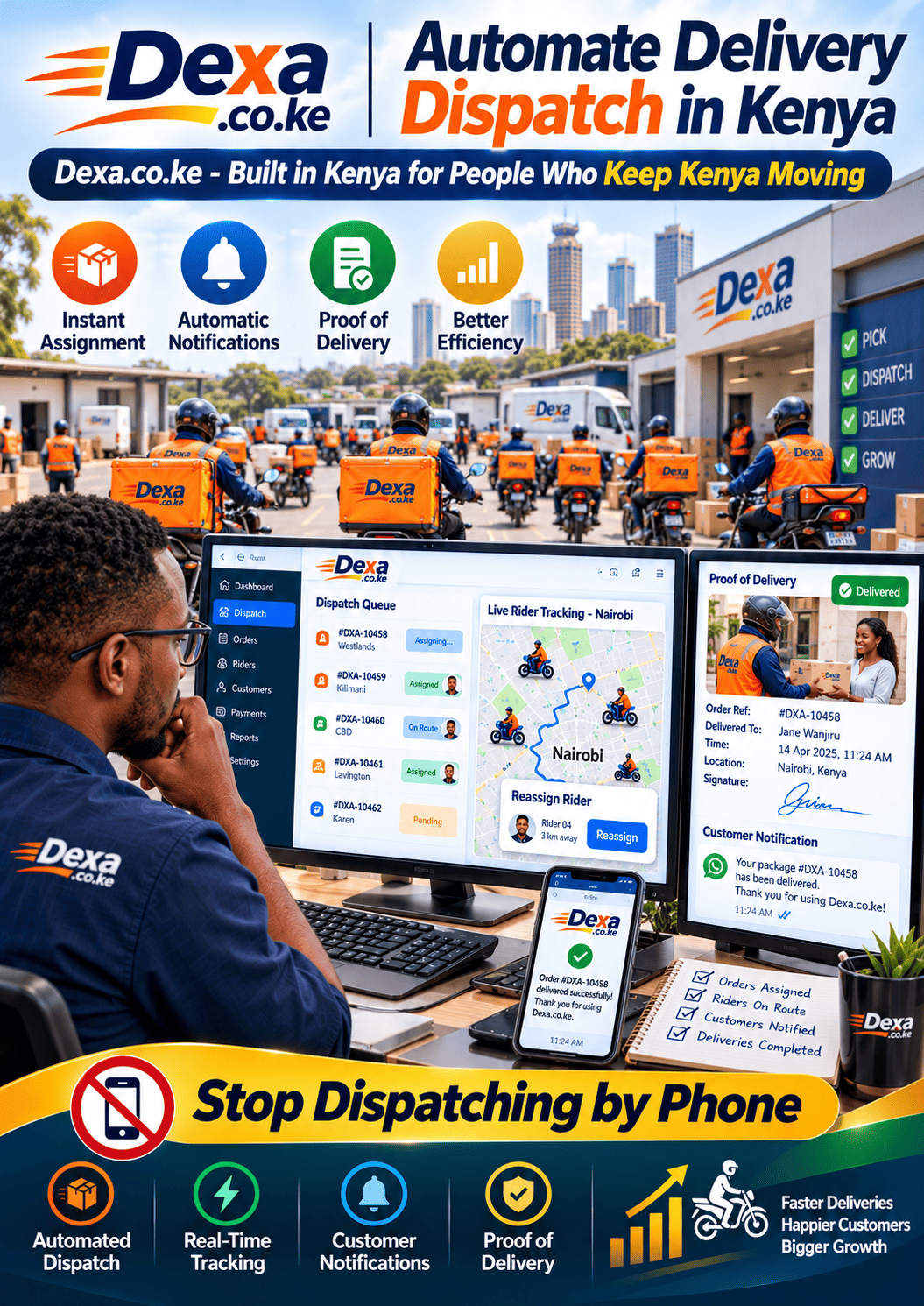
To automate delivery dispatch in Kenya is to solve the single problem that consumes more hours in a courier business than any other: deciding who carries what, and then confirming that the decision actually happened. In most Kenyan courier operations, dispatch works by phone. An order arrives, someone calls a rider, the rider confirms, and the process repeats for every parcel. It functions at three riders and five orders. It collapses at eight riders and forty orders, and the collapse is rarely dramatic. The dispatcher simply never stops talking, and the day disappears.
The consequences of manual dispatch are easy to underestimate until volume rises. Riders spend more time waiting for instructions than riding. Customers wait longer than promised. Deliveries are assigned to whoever answers first rather than whoever is closest. To automate delivery dispatch in Kenya properly means replacing those conversations with a queue that assigns itself, so dispatch stops being a full-time occupation and becomes something that happens in the background while the business gets on with delivering.
Why Manual Dispatch Fails at Scale
Manual dispatch is not a bad method. It is simply a method that does not scale. Understanding exactly where it breaks helps clarify what automation needs to fix.
The first failure is assignment quality. A dispatcher working by phone assigns the next job to whoever they manage to reach, not to the rider best positioned to complete it quickly. A rider who is twenty minutes away may receive a pickup that a rider five minutes away could have taken. Across forty deliveries a day, those small inefficiencies compound into hours of wasted travel and fuel.
The second failure is the confirmation loop. A dispatcher who calls a rider has no proof that the message was understood. The rider may have misheard the address, forgotten the floor number, or written down the wrong phone number. Each misunderstanding surfaces later as a failed delivery or a delayed one.
The third failure is reassignment. When a rider breaks down or a customer becomes unreachable, the dispatcher must repeat the entire process: call another rider, explain the situation, confirm the new arrangement. In a busy operation, this happens several times a day, and each instance consumes time the dispatcher does not have.
What Automation Actually Changes
When businesses automate delivery dispatch in Kenya, they are not simply replacing phone calls with an app. They are changing the underlying logic of how work is assigned and tracked.
The first change is that the order exists as a structured record before dispatch begins. The customer details, the landmark, the agreed price, and any special instructions are all captured in the same format regardless of which channel the order arrived through. A automate delivery dispatch in Kenya system cannot function without this foundation, because automation requires structured data.
The second change is that assignment becomes rule-based rather than conversational. The system selects a rider based on location, availability, and current workload. The rider receives the job on their phone. The customer receives confirmation. No calls are made, and no messages are exchanged. The third change is that reassignment becomes a single action rather than a sequence of conversations. A job can be moved from one rider to another without rebuilding the order record.
These three changes together constitute what it means to automate delivery dispatch in Kenya in practice. The technology is not doing anything a good dispatcher could not do. It is doing it faster, at volume, without fatigue.
The Conditions Automation Must Handle
Any realistic approach to automating dispatch in Kenya has to account for the operating environment. Nairobi ranks among the most congested cities in Africa, and a peak-hour journey can stretch past an hour for a distance that should take fifteen minutes. An assignment algorithm that uses straight-line distance will produce bad decisions. It must account for actual travel time, or at least for the geography of the city.
Addressing adds a second constraint. Large parts of Kenyan cities have no formal street numbering, so delivery instructions arrive as landmarks—behind the blue gate, opposite the petrol station, call when you reach. Nationally, a substantial share of parcels are delayed or never delivered at all, and the inability to locate a destination precisely is a leading cause. A system designed to automate delivery dispatch in Kenya must capture landmark details in structured fields rather than in free-form messages.
Payment habits complete the picture. Cash on delivery remains common, particularly among first-time buyers who want to see a product before paying. Mobile money is near-universal. Automation that dispatches parcels but does not record payments is solving half the problem, because a delivery that is dispatched but not reconciled remains incomplete.
What an Automated Dispatch System Manages
The phrase covers more ground than most owners initially assume. A proper system does not merely assign riders. It manages the entire delivery journey from the moment an order arrives to the moment payment is confirmed.
That record includes the customer’s details, the pickup and drop-off information, the agreed price, the rider assigned, the delivery status, the proof captured at handover, the payment collected, and any expense attached to that journey. In an informal operation, each of these elements lives somewhere different. A system built to automate delivery dispatch in Kenya brings them together so that answering a question about any single order takes seconds rather than a search through several sources.
The practical benefit becomes clear on the first busy day. When a customer asks where their parcel is, the answer is on the screen. When a rider disputes a collection, the record settles it. When the owner wants to know whether the month was profitable, the figures are assembled rather than reconstructed from memory.
Order Capture as the First Step
Automation cannot begin without structured orders. Kenyan businesses receive requests through several channels: WhatsApp messages, phone calls, Instagram DMs, marketplace listings, and their own websites. Each channel produces information in a different format, and details get lost in the translation between them.
A system designed to automate delivery dispatch in Kenya standardises this by capturing every request into the same structured record, regardless of where it originated. The address, the landmark, the customer’s phone number, and any special instructions all end up in the same fields. This removes the ambiguity that otherwise consumes a dispatcher’s morning and reduces the back-and-forth that slows every dispatch.
Customer records add another layer. When a customer orders repeatedly, the system already holds their details, so the rider does not have to ask for the landmark again. The business can see how many orders that customer has placed and whether they pay reliably. Over time, a system built to automate delivery dispatch in Kenya builds a customer history that supports better decisions about pricing, credit, and service levels.
Assignment Logic That Produces Good Decisions
The core of any dispatch automation is the assignment logic. This is where the system either earns its place or fails.
A naive approach assigns the next job to whichever rider is geographically closest. This produces reasonable results in simple conditions and poor results in complex ones. A rider who is two minutes away but already carrying three parcels may not be the right choice. A rider who is seven minutes away but idle may be better positioned to complete the delivery quickly.
A robust approach to automate delivery dispatch in Kenya considers several factors at once: location, current workload, vehicle capacity, and the urgency of the delivery. The system balances these factors so that work is distributed reasonably rather than piling onto whoever happens to be nearest at any given moment.
This balance matters for rider morale as much as for operational efficiency. Riders who feel that work is assigned fairly are more likely to stay. Riders who feel that the same people get all the good jobs will leave, and replacing them costs money in recruitment and training. Automated dispatch makes the logic visible, which reduces resentment.
Reassignment Without Rebuilding the Record
Not every delivery goes according to plan. A rider breaks down. A customer cannot be reached. A parcel turns out to be larger than expected. Each of these situations requires a dispatch decision to be revisited, and how quickly that happens determines whether the customer notices.
A system built to automate delivery dispatch in Kenya makes reassignment a single action. The job moves from one rider to another without rebuilding the order record. The customer receives an updated notification. The original rider is released for other work. The dispatcher does not have to make three phone calls to accomplish what a single click handles.
This responsiveness is where automation proves its value most clearly. In an informal operation, a breakdown means a delivery is delayed until the rider can be reached, the situation explained, and a replacement arranged. An automated system handles the same situation in seconds, and the customer experiences a minor delay rather than a missed delivery.
Customer Communication Handled Automatically
Customers expect to know what is happening with their parcel. A business that cannot answer that question without making a phone call spends its day answering the same question repeatedly, and the customers who do not call simply form a negative impression in silence.
Automated notifications solve this. Messages are sent at dispatch, when the rider is nearby, and on arrival, triggered by the delivery record rather than by someone remembering. In a market where addresses are often landmarks and riders frequently need to call for directions, a prepared customer is a customer who answers the phone and gives clear guidance.
The communication features built into systems that automate delivery dispatch in Kenya make that preparation automatic. Each message reduces the likelihood of an inbound enquiry, and the cumulative effect is a dispatcher who can focus on exceptions rather than routine questions.
Payments Recorded at the Point of Collection
Payment is the most sensitive part of any delivery, and it is where businesses leak money most quietly. Mobile money leaves its own trace, but cash does not. When collections are recorded in a rider’s memory and reconciled at the end of the week, small discrepancies accumulate without anyone noticing until the total is significantly short.
A system designed to automate delivery dispatch in Kenya applies the same discipline to both payment methods. When a customer pays through mobile money, the transaction attaches to the order automatically. When a rider collects cash, the collection is logged against the same order before the rider moves on. The business sees both in the same place, and reconciliation covers the full picture.
Receipts are generated as a natural output. The customer receives confirmation, and the business keeps a copy. Nothing depends on a rider remembering to write something down or a customer keeping a paper slip.
Proof of Delivery Integrated Into Dispatch
Proof of delivery has moved from an occasional courtesy to a standard output of every completed job. A rider captures a photograph of the parcel at the delivery location. The customer signs on the rider’s device. The system records the timestamp and GPS coordinates automatically. Together these elements produce a record that settles most disputes before they develop.
In a market where formal addresses are rare, the photograph often carries more weight than the signature. A picture of the parcel at the blue gate beside the petrol station establishes location in a way that written confirmation cannot. Businesses that automate delivery dispatch in Kenya with proof integrated into the flow find that disputes decline sharply, because the evidence exists for every delivery rather than only for the ones someone remembered to document.
How Dexa.co.ke Approaches Dispatch Automation
Dexa.co.ke was built for the Kenyan market rather than adapted from a foreign model, and its structure reflects how dispatch actually works here. The platform splits into two products, each suited to a different stage of growth, and both treat dispatch as a connected process rather than a standalone task.
For sellers working with one or two trusted riders, the independent driver model fits naturally. This arrangement matters when choosing how to automate delivery dispatch in Kenya because it lets a business build a relationship with a specific rider who learns the pickup routine, the packaging habits, and the regular customers. Familiarity reduces errors even before automation arrives.
For operations that have outgrown informal arrangements and now coordinate several riders, the courier team model provides the structure. Dispatch, rider assignment, pricing, payments, and delivery proofs live in one place. This matters when working with systems that automate delivery dispatch in Kenya at volume, because the coordination layer is where growing businesses most often come unstuck.
For Independent Drivers
A rider using this arrangement creates their own customer channel, sharing a personal booking link with businesses on WhatsApp and receiving direct bookings rather than competing for work in a crowded marketplace. From the business’s side, this simplifies matters considerably: one known contact, one consistent standard, one person accountable for each parcel.
The rider benefits too. Rather than chasing one-off trips, a driver builds a roster of regular business clients, plans pickups in advance, and tracks earnings in one place. When dispatch is automated, the rider receives jobs on their phone without interruption, which means less time on the phone and more time moving.
For Courier Teams
Teams managing several riders and a steady flow of orders need structure that informal arrangements cannot provide. The platform keeps one operating record from request to receipt, so no order has to be reconstructed from scattered chats. Each parcel carries its customer details, assigned rider, agreed price, payment status, proof of delivery, and associated expense along with it.
For a business working with a courier team, this makes the decision to automate delivery dispatch in Kenya considerably easier, because the platform already holds the data the automation requires. Dispatch is organised, riders know their assignments, and the business receives a clean record for every order.
What Changes in the First Week
The most immediate change is a quieter phone. When customers can see where their parcel is, they stop calling to ask. When riders receive clear assignments, they stop calling for instructions. When payments are recorded automatically, nobody has to reconcile from memory at the end of the day.
The second change is faster problem resolution. A rider who has stopped moving for twenty minutes is visible on the map before the customer notices the delay. Dispatchers can intervene, reassign the delivery, or notify the customer proactively. Automation converts potentially damaging incidents into minor ones by surfacing them early.
The third change is confidence in the numbers. A business that knows what it delivered, what it collected, and what it spent can make decisions about pricing, routes, and hiring that a business relying on instinct cannot.
Scaling Without Adding Dispatchers
Growth in a delivery business traditionally means adding coordinators. Every few riders requires another person to manage the phone calls, and those coordinators become a fixed cost that grows with the operation. Automation breaks that link by removing the coordination work that would otherwise require additional staff.
A business running five riders can manage with the same system that a business running twenty uses. The queue assigns itself. The tracking updates automatically. The customer notifications send without prompting. The business adds riders without adding dispatchers, which means revenue growth translates more directly into profit.
This is why the decision to automate delivery dispatch in Kenya tends to happen at a specific point in a business’s development, usually just after a period of rapid growth has exposed the limits of manual coordination. The businesses that adopt earlier avoid the period of chaos entirely.
Common Mistakes When Automating
Several mistakes appear repeatedly when businesses attempt to automate dispatch without examining the details.
The first is automating a broken process. If order capture is inconsistent and addresses are incomplete, automation will simply produce bad assignments faster. The process must be fixed before it is automated.
The second is choosing on price alone. A cheaper system that produces unreliable assignments is not cheaper, because every failed delivery roughly doubles the cost of that delivery. A moderately priced system that completes most deliveries on the first attempt is worth more.
The third is neglecting rider adoption. A system that riders do not understand or trust will not be used consistently, and inconsistent use produces incomplete data. Explaining why automation protects the rider as much as the business is what makes adoption stick.
The fourth is expecting automation to eliminate judgment. Automation handles routine assignment well. Exceptions still require human attention, and a dispatcher who understands the system remains valuable.
The Direction Dispatch Automation Is Heading
Several shifts are reshaping how dispatch automation works in Kenya. Mobile money integration continues to deepen, and the connection between payment confirmation and delivery confirmation is becoming tighter, so a single automatic action will soon verify both.
Electric motorcycles are becoming more common, and their onboard telemetry allows richer assignment decisions, including battery status and remaining range alongside location. Government investment in intelligent traffic management is gradually improving movement across Nairobi, which will make arrival estimates generated by automated dispatch more reliable over time.
What will not change is the underlying requirement: a delivery business needs to assign work intelligently, know where every parcel is, confirm that it arrived, and record that payment was collected. That requirement sits at the centre of what it means to automate delivery dispatch in Kenya.
To automate delivery dispatch in Kenya is not simply to replace phone calls with software. It is to build a process where orders exist as structured records, assignments follow visible logic, reassignment takes seconds, customers receive automatic updates, and every delivery produces proof and a payment record.
Whether you are running a single motorcycle from a single room or coordinating a fleet across the city, the tools behind automating delivery dispatch in Kenya from dexa.co.ke give you the coordination that makes growth survivable. From the first order to the final confirmation, nothing depends on anyone remembering to pass the message along.
The businesses that grow are the ones that treat dispatch as a system rather than a conversation. Build the structure early, let it carry the weight as volume rises, and the dispatcher’s phone stops ringing for the right reasons.