Automated delivery invoicing addresses one of the most tedious and error-prone tasks in any courier business: turning a month of completed deliveries into accurate, client-ready invoices. In an informal operation, this means gathering paper slips, matching them against orders, typing details into a spreadsheet, checking the totals, and hoping nothing was missed. It is slow, it is repetitive, and it is almost always wrong somewhere. Automated delivery invoicing replaces that process with documents generated directly from the delivery records themselves, so the invoice is accurate by construction rather than by careful transcription.
The value of automated delivery invoicing becomes clear the first time a client queries an invoice. A business working from paper records must search through slips and reconstruct what happened. A business using automated delivery invoicing opens the order record and sees the delivery, its proof, its payment status, and its price in one place. The answer takes seconds rather than an afternoon, and the client receives a response that suggests the business knows what it is doing.
Why Manual Invoicing Fails at Scale
Manual invoicing works reasonably well when a business is issuing a handful of invoices a month. It becomes untenable as soon as volume rises, and the failure is not gradual. It arrives suddenly, usually at the end of the first month when the number of deliveries has doubled and someone realises the invoice compilation will take three days rather than three hours.
The first failure is transcription error. Every figure typed from a paper slip into a spreadsheet is an opportunity for a mistake. A missing zero, a transposed digit, a delivery attributed to the wrong client. These errors are rarely caught before the invoice goes out, and when they are caught afterwards, they damage credibility.
The second failure is omission. Deliveries recorded on slips that were lost, damaged, or never returned cannot be invoiced. The business absorbs the cost silently, and because nobody knows the delivery happened, nobody knows the revenue was lost. A automated delivery invoicing process draws from the same order records that dispatch and tracking use, so a delivery that was completed is a delivery that appears on the invoice.
The third failure is delay. Manual invoicing takes time, and that time pushes the invoice date later each month. Clients pay later as a result, which affects cash flow. When invoicing is automated, the invoice can be issued on the first working day of the following month, and payment arrives sooner.
What Automated Invoicing Actually Does
The phrase covers more ground than most owners initially assume. Automated delivery invoicing is not simply a template that produces a PDF. It is the mechanism that connects delivery records to financial documents without human intervention.
The process begins with the order record. Every delivery captured through dispatch carries its customer details, agreed price, assigned rider, delivery status, proof of delivery, and payment status. When the invoicing cycle arrives, the system aggregates these records by client and by period, calculates totals, applies any agreed rates or discounts, and produces an invoice that reflects exactly what was delivered.
This is what makes automated delivery invoicing fundamentally different from a spreadsheet template. The template requires a person to enter data. The automated system requires nobody, because the data already exists in the delivery records. The invoice is a view of information that was captured as the work happened, not a reconstruction created afterwards.
The Components That Must Be Connected
Automated invoicing only works when several elements of the operation are connected. If these elements live in separate systems, the automation breaks down at the point where they need to meet.
The first component is order capture. Every delivery must exist as a structured record with a client reference, a price, and a date. If orders arrive through WhatsApp and are never formalised, the invoice has nothing to draw from. Proper automated delivery invoicing begins with disciplined order capture.
The second component is delivery confirmation. An invoice should reflect deliveries that actually happened, not deliveries that were scheduled. The proof of delivery, whether a signature, a photograph, or a timestamp, is what confirms the delivery occurred. When that proof is attached to the order record, the invoicing process can filter for completed deliveries only.
The third component is pricing. The agreed rate for each delivery must be recorded at the point of booking rather than calculated later. A automated delivery invoicing system that draws on recorded prices produces invoices that match what the client expected, which reduces disputes considerably.
The fourth component is payment status. An invoice should distinguish between deliveries that have already been paid and those that remain outstanding. This is particularly important for cash on delivery and mobile money transactions, where payment may be collected at the doorstep rather than invoiced later. When payment records are connected to order records, automated delivery invoicing can produce a complete financial picture rather than a partial one.
How Dexa.co.ke Handles Invoicing
Dexa.co.ke was built for the Kenyan market rather than adapted from a foreign model, and its structure reflects how money and documentation actually move here. The platform splits into two products, each suited to a different stage of business growth, and both treat invoicing as a natural output of the delivery record rather than a separate administrative task.
For sellers and operators working with one or two trusted riders, the independent driver model fits naturally. Invoicing in this arrangement matters because a solo operator has no finance team to compile documents at month end. For operations that have outgrown informal arrangements and now coordinate several riders, the courier team model provides the aggregation structure that automated delivery invoicing requires at volume.
For Independent Drivers
A rider using this arrangement creates their own customer channel, sharing a personal booking link with businesses on WhatsApp and receiving direct bookings rather than competing for work in a crowded marketplace. From the business’s side, this simplifies matters considerably: one known contact, one consistent standard, one person accountable for each delivery.
The rider benefits too. Rather than chasing one-off trips, a driver builds a roster of regular business clients, plans pickups in advance, and tracks earnings in one place. When every completed trip produces a record, the rider can produce a summary of work done for any client without reconstructing the month from memory. Clean automated delivery invoicing practice protects the rider as much as the business, because a documented delivery cannot be disputed later.
For Courier Teams
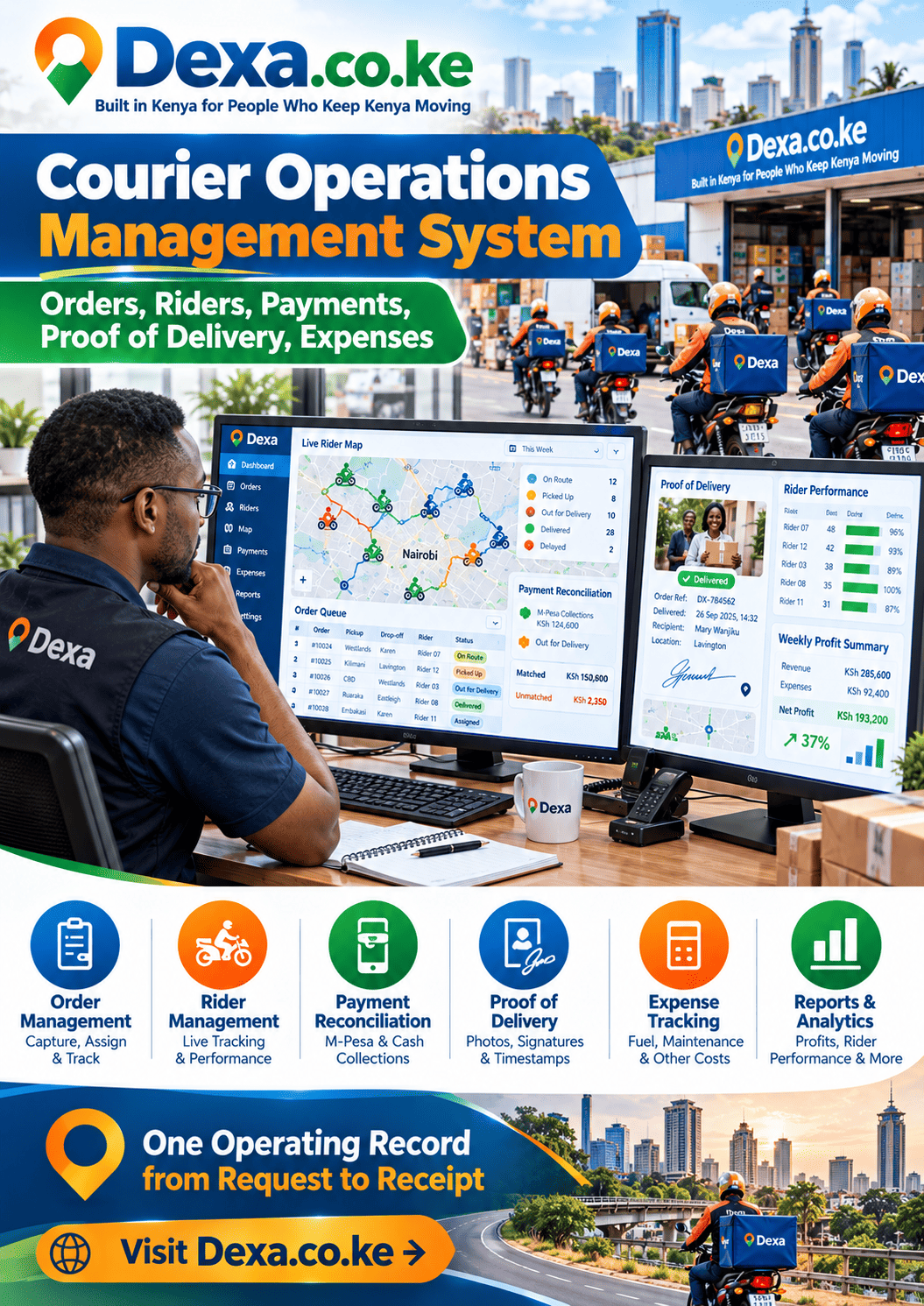
Teams managing several riders and a steady flow of orders need structure that informal arrangements cannot provide. The platform keeps one operating record from request to receipt, so no order has to be reconstructed from scattered chats. Each parcel carries its customer details, assigned rider, agreed price, payment status, proof of delivery, and associated expense along with it.
For a business working with a courier team, this makes automated delivery invoicing routine rather than burdensome. Dispatch is organised, riders know their assignments, deliveries are confirmed with proof, and invoices are generated from the same records. When a client queries a charge, the answer is already in the system rather than in someone’s memory.
Client-Level Aggregation
Most courier businesses serve several clients, and each client wants an invoice that covers their own deliveries rather than the whole operation. Automated invoicing handles this by aggregating records at the client level.
The system filters completed deliveries by client and by period, then produces a document that lists each delivery with its date, reference, and price. Some clients prefer a summary invoice with a single total. Others want line-by-line detail so they can reconcile against their own records. A automated delivery invoicing system that supports both formats serves more clients without additional administrative effort.
Client-level aggregation also reveals things that monthly totals conceal. A client whose deliveries cluster in expensive areas may be consuming more resource than their invoice suggests. A client with a high rate of failed attempts may be generating costs that never appear on the invoice. When invoicing is connected to cost tracking, the business can see the true margin on each client relationship rather than just the revenue.
Handling Different Pricing Structures
Courier businesses rarely charge the same rate for every delivery. A short urban trip, a long cross-city journey, and a multi-stop route have different cost profiles, and clients may have negotiated rates that reflect their specific requirements.
Effective automated delivery invoicing supports these variations rather than forcing every delivery into a single price. Zone-based rates, distance-based charges, volume discounts, and fixed monthly retainers can all be accommodated when the pricing rule is recorded at the point of booking. The invoice then reflects what was agreed rather than what someone remembered to apply.
This flexibility matters most for businesses serving corporate clients, where a single contract may cover hundreds of deliveries across varied routes and distances. A automated delivery invoicing process that handles these variations produces invoices that match the contract terms, which reduces disputes and speeds up payment.
Compliance and Record-Keeping
Kenyan businesses operate under record-keeping obligations that manual systems struggle to satisfy. The Kenya Revenue Authority expects businesses to maintain accurate records of transactions, and the burden of proof falls on the business when questions arise.
Automated invoicing produces records that are timestamped, searchable, and stored in a form that can be exported when required. When KRA requests documentation of a specific transaction from eighteen months ago, a business using automated delivery invoicing retrieves the record in seconds. A business relying on paper faces an unpleasant search through boxes and filing cabinets.
There is a practical dimension to this that goes beyond audit preparation. Businesses that maintain clean digital records find that VAT reporting and other compliance obligations become simpler as well. The invoices already exist in the right form, so producing the required summaries becomes a matter of generating a report rather than compiling data from scratch.
Cash Flow and Payment Timing
Invoicing timing has a direct effect on cash flow. A business that issues invoices on the first of the month receives payment sooner than one that issues them on the fifteenth after two weeks of compilation. The difference compounds across a year.
Automated delivery invoicing makes early invoicing practical because the compilation effort disappears. The business selects a period, generates the invoices, and sends them, all within an hour. Clients receive their invoices promptly, and payment arrives sooner as a result.
The same system supports payment tracking. An invoice that remains unpaid after its due date can be identified immediately rather than discovered during a monthly review. The business can follow up before the delay becomes habitual, which improves collection rates without requiring confrontation.
Handling Refunds and Credit Notes
Disputes happen. A delivery is charged incorrectly, a parcel arrives damaged, a client disputes a line item. Handling adjustments manually is slow and leaves no clear record of what changed and why.
A proper invoicing system handles reversals with the same discipline as the original invoice. The credit note is recorded against the specific delivery and the specific invoice, the client receives confirmation, and the business has a complete record for its accounts. This symmetry between invoice and credit note is what makes the financial documentation trustworthy from both directions.
Common Mistakes in Delivery Invoicing
Several mistakes appear repeatedly when businesses handle invoicing without proper systems.
The first is invoicing from memory. A business that compiles invoices by recalling what was delivered will always miss something. The invoice must be generated from records, not recollection.
The second is invoicing only when the client asks. A business that waits for a prompt before issuing an invoice is a business that waits for payment. Regular, prompt invoicing is what keeps cash moving.
The third is failing to connect invoices to delivery records. An invoice that cannot be traced back to the deliveries it covers is difficult to defend when challenged. The connection between the two is what makes the invoice credible.
The fourth is treating invoicing as a finance task rather than an operational one. When invoicing is disconnected from dispatch and delivery records, it becomes a reconstruction exercise. When it is connected, it becomes a view of information that already exists.
The Direction Invoicing Is Heading
Several shifts are reshaping how delivery businesses handle invoicing in Kenya. Mobile money integration continues to deepen, and the connection between payment records and invoice records is becoming tighter, so a single automatic action will soon confirm that a delivery happened, that payment was received, and that the invoice reflects both.
Government integration with mobile money platforms for transaction-level traceability is also developing, which points toward a future where digital records serve compliance needs as well as operational ones. Businesses that have already moved to automated invoicing will find that transition considerably easier than those still compiling documents manually.
Electric motorcycles are becoming more common, and their cost profile differs substantially from petrol machines. Businesses tracking costs carefully will find that automated invoicing, connected to expense records, gives them a clearer view of margin per delivery than was previously possible.
What will not change is the underlying requirement: every delivery needs a document that both parties can rely on and that the business can produce on demand. That requirement sits at the centre of what automated delivery invoicing should deliver.
Choosing the Right Invoicing System
Businesses evaluating options should focus on a few practical questions. Does the system generate invoices directly from delivery records, or does it require manual data entry? Can it aggregate by client and by period? Does it support different pricing structures, including zones, distances, and negotiated rates? Are invoices connected to proof of delivery and payment status? Can records be exported for accounting and tax purposes?
A system that answers these well will not create new problems as volume rises. A system that answers only some will leave gaps, and gaps are where money disappears. The difference between the two is rarely visible in a demonstration, which is why testing with real orders across a fortnight is worth the effort before committing.
It also helps to consider how invoicing connects to the rest of the operation. An invoicing tool that stands alone provides partial value. A platform that links invoicing to dispatch, tracking, payment, proof of delivery, and expenses provides considerably more, because every invoice becomes part of a complete delivery history rather than an isolated document.
Automated delivery invoicing is not simply a matter of replacing a spreadsheet with a template. It is about creating a financial documentation system that draws directly from the delivery records, so that invoices are accurate, timely, and defensible without requiring hours of manual compilation.
Whether you are dispatching five orders a week from a single room or fifty a day from a small warehouse, automated delivery invoicing from dexa.co.ke connects every delivery to its invoice, its payment, and its proof. From the first order request to the final credit note, every transaction stays documented.
The businesses that grow are the ones that treat invoicing as a natural output of good delivery records rather than a separate administrative burden. Build the habit early, let it carry the weight as volume rises, and getting paid stops being the part of the month everyone dreads.