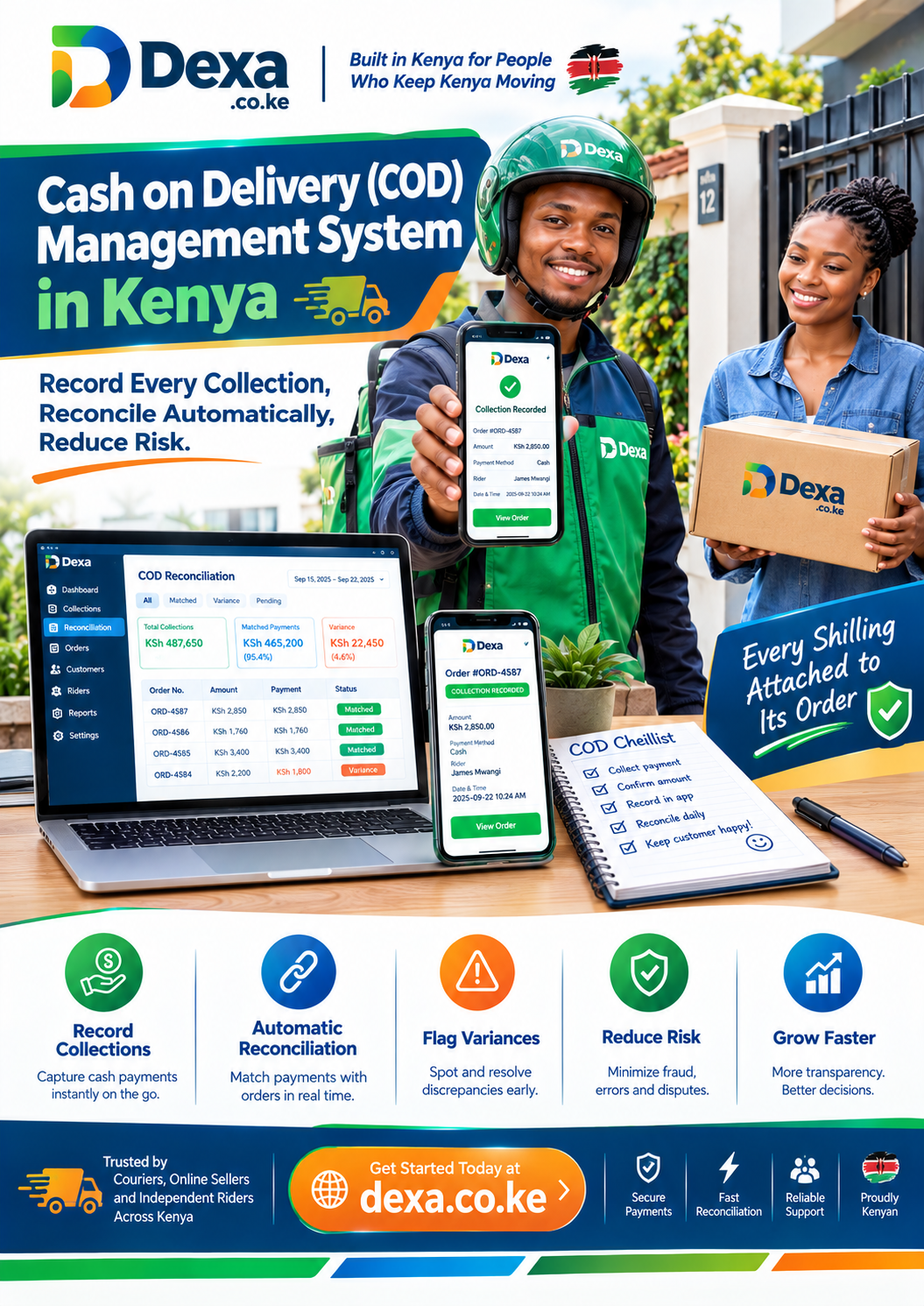
Cash on delivery (COD) management system in Kenya addresses the single most sensitive moment in any delivery: the exchange of money at the doorstep. Kenyan online buyers have embraced paying on arrival, particularly first-time customers who want to see a product before parting with money. Sellers, for their part, welcome the arrangement because it converts hesitant browsers into completed orders. The result is that a substantial share of deliveries in Nairobi, Mombasa, and Kisumu still end with a rider collecting physical cash. A proper cash on delivery (COD) management system in Kenya takes that moment and turns it from a risk into a recorded, auditable event.
The problem has never been cash itself. It is what happens around cash when there is no system holding it accountable. Riders carry money across a full day of deliveries. Businesses reconcile collections at the end of the week, often from memory or a notebook. Small discrepancies appear, explained away as mistakes, and over months they add up to a figure that would have funded a new rider. A cash on delivery (COD) management system in Kenya closes that gap by attaching every shilling collected to the specific order it belongs to.
Sellers who have operated without such a system rarely realise how much they are losing. The losses are rarely dramatic. A shortfall of two hundred shillings here, an unrecorded delivery there, a customer who claims they already paid and cannot be contradicted. Individually trivial, collectively significant. This is why cash on delivery (COD) management system in Kenya tools have moved from optional to essential for businesses handling any meaningful volume of cash orders.
Why Cash Creates Structural Problems
Understanding why COD needs managing begins with recognising that cash is the only part of a delivery that leaves no automatic trace. A parcel has a tracking number. A rider has an assignment. A customer has an order record. The money, until it is recorded somewhere, exists only in the rider’s pocket and the customer’s memory.
The first structural problem is custody. From the moment a rider collects cash until it reaches the business, the money is unsecured. Riders are not banks. They stop for fuel, take breaks, and travel through areas where a large sum of cash invites attention. Losses happen, and when they do, the business absorbs them because there is no way to establish what actually occurred. Reliable cash on delivery (COD) management system in Kenya practice reduces the amount of cash in circulation at any time by encouraging digital payment alternatives and by settling rider remittances more frequently.
The second problem is reconciliation. When a rider returns at the end of the day with cash and a rough count of deliveries, matching money to orders becomes an exercise in trust. If a customer later disputes what they paid, or if an order cannot be accounted for, resolving it requires reconstructing the day from fragments. Businesses using cash on delivery (COD) management system in Kenya platforms log each collection as it happens, so reconciliation becomes verification rather than investigation.
The third problem is the customer experience. Cash offers no automatic receipt and no independent record. Customers who pay in cash and later need proof of payment have nothing to refer to. When disputes reach the business, they arrive with no evidence on either side. Structured cash on delivery (COD) management system in Kenya handling gives both parties a record they can check, which resolves most disagreements before they escalate.
What a COD Management System Actually Does
A common misunderstanding is that these systems simply record cash. In practice, they manage the entire cycle from order placement through to settled funds, with the cash collection sitting in the middle of a longer chain.
The cycle begins when an order is flagged for cash payment. The customer details, delivery address or landmark, agreed price, and any special instructions attach to the order from that point. When the rider is dispatched, the expected collection amount travels with the assignment. This matters because it establishes in advance exactly what should be collected, removing the ambiguity that allows a rider to quote a different figure at the door.
At the point of delivery, the collection is recorded against the order. Whether the customer pays in cash or through mobile money, the transaction is logged with a timestamp and the rider’s identity. The order status updates automatically, the customer receives confirmation, and the business sees the payment appear in its dashboard. Proper cash on delivery (COD) management system in Kenya discipline means this happens in real time rather than at end of day.
The cycle closes when funds are remitted and reconciled. Riders hand over collected amounts, the business verifies them against recorded collections, and any variance is identified immediately rather than discovered weeks later. Well-designed cash on delivery (COD) management system in Kenya processes make this final step fast enough that it becomes routine rather than a monthly ordeal.
Core Features That Make COD Manageable
Collection Records Attached to Orders
Every collection should live with the order it belongs to. Not in a separate ledger, not in a rider’s notebook, but in the same record as the customer details and delivery proof. This single design decision is what separates functioning cash on delivery (COD) management system in Kenya operations from those held together by spreadsheets.
When payment records sit alongside order records, answering a question takes seconds. Did this customer pay? How much? On what date? Who collected it? The answers are in one place rather than distributed across several.
Rider Accountability Without Distrust
A well-built cash on delivery (COD) management system in Kenya makes it possible to hold riders accountable without treating them as suspects. The system records what was collected, from whom, and when. A rider who follows process has nothing to worry about. A rider who does not stands out immediately, because the variance shows up against a specific order rather than disappearing into an end-of-week total.
This cuts both ways. Riders benefit from clear records too, because disputed collections can be verified rather than argued. In practice, most businesses find that clear cash on delivery (COD) management system in Kenya processes improve rider relations rather than damaging them, because ambiguity is removed from both directions.
Automatic Reconciliation
Reconciliation is the task that consumes the most time in cash-heavy operations and produces the most frustration. The system should do it automatically. Each collection is matched to its order, the total collected is calculated, and any gap between expected and actual is flagged.
With the right cash on delivery (COD) management system in Kenya tools, what once took an hour each evening takes minutes. For a growing business, that recovered time is often more valuable than any fee saved elsewhere.
Expense Visibility Alongside Collections
Delivery costs accumulate quietly: fuel, rider commissions, maintenance, airtime. A platform that tracks collections without tracking costs gives an incomplete picture. Businesses need both to understand true margins, because a delivery that collected correctly but cost more than expected is still a loss.
Complete cash on delivery (COD) management system in Kenya accounting keeps revenue and cost side by side, which turns pricing from guesswork into a calculation.
Digital Payment Alternatives Built In
The most effective way to reduce cash risk is to reduce cash volume. A system that offers mobile money at the point of delivery gives customers a familiar alternative that removes physical cash from the equation entirely.
Strong cash on delivery (COD) management system in Kenya platforms support both methods without forcing the customer into an unfamiliar process. Customers pay the way they prefer, and the business records both methods with equal discipline.
How Dexa.co.ke Approaches COD Management
Dexa.co.ke was built for the Kenyan market rather than adapted from a foreign model, and its structure reflects how money actually moves here. The platform splits into two products, each suited to a different stage of business growth, and both treat cash handling as a core function rather than an afterthought.
For sellers working with one or two trusted riders, the independent driver model fits naturally. Cash handling in this arrangement matters because it lets a rider record collection without keeping a private tally, and it lets the business see collections in real time rather than at the end of the week. For operations that have outgrown informal arrangements and now coordinate several riders, the courier team model provides the reconciliation structure that a cash on delivery (COD) management system in Kenya requires at volume.
For Independent Drivers
A rider using this arrangement creates their own customer channel, sharing a personal booking link with businesses on WhatsApp and receiving direct bookings rather than competing for work in a crowded marketplace. From the seller’s side, this simplifies matters considerably: one known contact, one consistent standard, one person accountable for each collection.
The rider benefits as well. Rather than chasing one-off trips, a driver builds a roster of regular business clients, plans pickups in advance, and tracks earnings in one place. When cash collections are recorded rather than remembered, the rider’s own financial picture becomes clearer too, which reduces the friction that often surrounds remittance.
For Courier Teams
Teams managing several riders and a steady flow of orders need structure that informal arrangements cannot provide. The platform keeps one operating record from request to receipt, so no order has to be reconstructed from scattered chats. Each parcel carries its customer details, assigned rider, agreed price, payment status, and associated expense along with it.
For a business working with a courier team, this makes cash handling predictable rather than anxious. Dispatch is organised, riders know their assignments, collections are logged as they occur, and the business receives a clean record for every order. When a customer disputes a payment, the answer is already in the system rather than in someone’s memory.
Managing Cash Flow Through Better COD Discipline
Cash flow determines how quickly a growing business can restock, advertise, and expand. Cash sitting in a rider’s pocket until the end of the week is cash unavailable for operations, and the compounding effect over a month is material.
Frequent remittance cycles, supported by accurate records, keep funds moving. When collections are logged as they happen, remittance can be verified in minutes, which makes it practical to settle daily or every second day rather than weekly. This is one of the practical advantages of a well-run cash on delivery process: the money does not sit idle, and the business is not financing its own deliveries out of working capital.
Faster settlement also reduces the working capital required to operate at a given volume. A business that receives payment immediately after delivery can reinvest the same day. Over a quarter, the difference between weekly and daily remittance is not marginal.
Reducing Fraud and Disputes
Fraud in cash deliveries takes two forms, and both are addressed by the same discipline.
The first is internal. Without records, a rider can under-report collections or claim a customer refused to pay. Because the business has no independent evidence, the claim usually stands. Once every collection is logged against a specific order at the point of delivery, under-reporting becomes visible immediately. The variance appears against a named order, and the question shifts from accusation to verification.
The second is external. Customers occasionally claim they paid when they did not, or dispute the amount. Without a record, the business usually concedes to preserve the relationship. With a timestamped collection record and a rider confirmation, the business can establish what occurred without confrontation.
In both cases, the protection comes from the same principle: attach the money to the order at the moment of exchange. That principle sits at the heart of what a cash on delivery management system is for.
Cash Alongside Mobile Money
A realistic approach acknowledges that cash has not disappeared from Kenyan online retail, and it will not disappear soon. Network coverage remains uneven in some areas, some customers prefer physical payment for small orders, and some simply do not use mobile money regularly.
The right approach is not to eliminate cash but to manage it with the same discipline as digital payments. When a rider collects cash, the collection is recorded immediately against the order. When a customer pays through mobile money, the transaction is logged the same way. The business sees both in the same dashboard, and reconciliation covers both without separate processes.
This unified view is what prevents the quiet losses that accumulate when cash and digital payments live in separate records. It also gives the business accurate data for decisions about which payment methods to encourage, since the true cost of handling each becomes visible.
Handling Refunds and Reversals Under COD
Disputes happen. A product arrives damaged, an order is duplicated, a customer changes their mind. Handling refunds through cash is messy and leaves no trace, which is one reason COD disputes escalate more often than they should.
A proper system handles reversals with the same discipline as collections. The refund is logged against the original order, the customer receives confirmation, and the business has a complete record for its accounts. This symmetry between collection and refund is what makes the payment side of a delivery operation trustworthy from both directions.
Scaling COD Operations
As order volumes rise, cash handling becomes more complex rather than merely more frequent. More riders mean more collections, more remittance points, and more opportunities for variance. What worked at ten orders a day becomes unmanageable at sixty.
The transition is easier when the underlying records already exist. Order details, rider assignments, collection logs, and delivery proofs should live in one place from the beginning, so adding riders later does not mean rebuilding the process. The tools that support cash handling at higher volumes are the same ones that make small volumes simpler to manage.
Warning Signs Your COD Process Needs Attention
Some warning signs build gradually and are easy to miss. If you cannot answer a customer’s question about their payment without making a call, your records are not where they should be. If reconciliation takes more than a few minutes at the end of each day, something is being tracked manually that should be automatic.
Other signs include collections that never quite match expectations, disputes that cannot be resolved either way, riders who prefer not to use the system, and a general sense that money is moving through the business without being fully visible. None of these are unusual for a business that has grown faster than its processes. They are simply what happens when cash is handled without proper structure.
Cash on delivery (COD) management system in Kenya is not about distrusting customers or riders. It is about removing ambiguity from the moment money changes hands, so that everyone involved has a record they can rely on. When collections are attached to orders, reconciled automatically, and visible in real time, the disputes that once consumed hours simply stop arising.
Whether you are dispatching five orders a week from a single room or fifty a day from a small warehouse, the tools behind cash on delivery (COD) management system in Kenya from dexa.co.ke give you the visibility and records that make cash handling predictable. From the first order request to the final remittance, every shilling stays attached to the delivery it belongs to.
The businesses that grow are the ones that treat cash with the same rigour as digital payments. Get the money right, and the rest of the operation becomes considerably easier to manage.
- Cash on delivery (COD) management system in Kenya
- Cash on delivery (COD) management system in Kenya
- Cash on delivery (COD) management system in Kenya
- Cash on delivery (COD) management system in Kenya
- Cash on delivery (COD) management system in Kenya
- Cash on delivery (COD) management system in Kenya
- Cash on delivery (COD) management system in Kenya
- Cash on delivery (COD) management system in Kenya
- Cash on delivery (COD) management system in Kenya