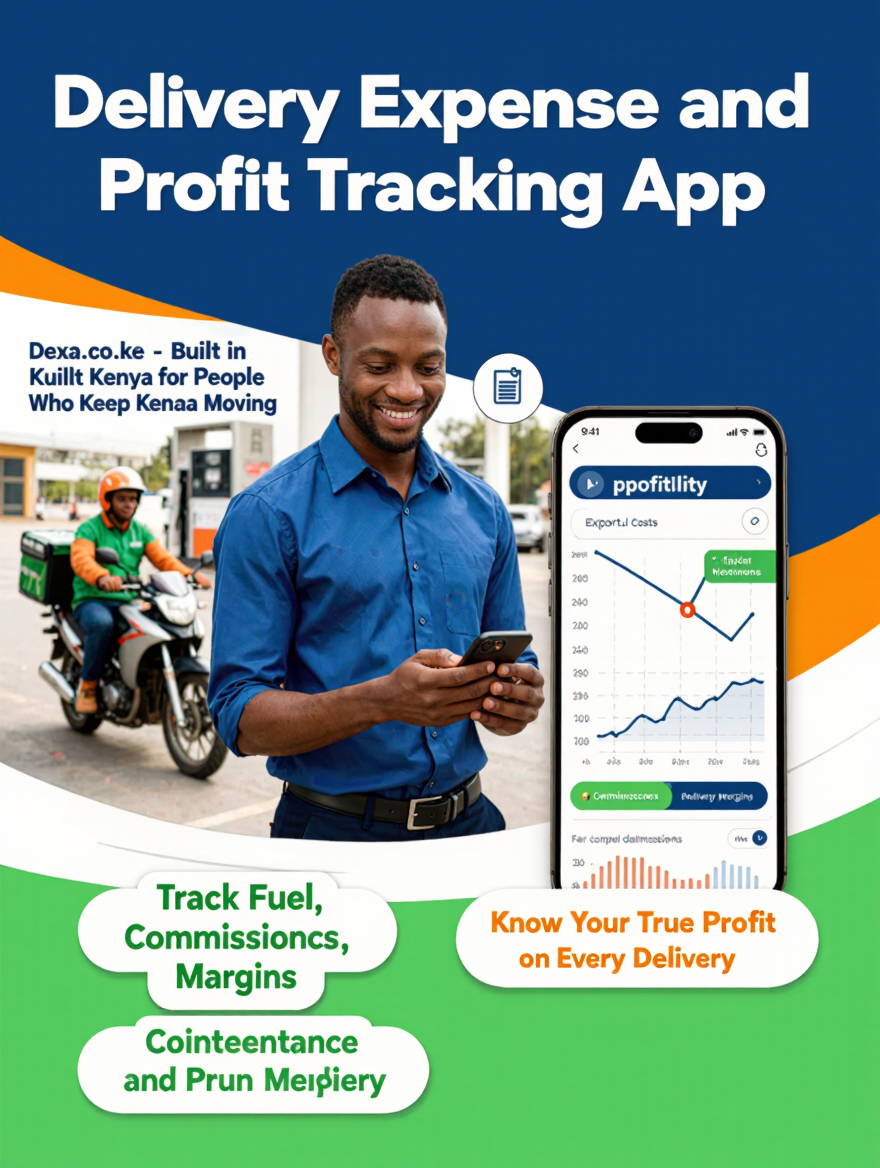
A delivery expense and profit tracking app answers a question most Kenyan courier businesses cannot answer accurately: are you actually making money? Revenue is visible. It arrives in the M-Pesa balance or the cash tin. Costs are far less visible, scattered across fuel receipts, rider payments, maintenance, airtime, and the slow erosion of unpaid deliveries. When those costs are never gathered in one place, a business can grow revenue steadily while quietly losing money on every parcel.
Most operators in Nairobi, Mombasa, and Kisumu run on instinct. They know roughly what they charge, roughly what fuel costs, and roughly what they pay riders. The word doing the heavy lifting in that sentence is “roughly.” A delivery expense and profit tracking app replaces estimation with arithmetic, and the difference often reveals that certain routes, certain clients, or certain order types have been unprofitable for months without anyone noticing.
Why Delivery Costs Hide So Well
Delivery is unusual among businesses in how thoroughly its costs disperse. A retail shop knows its rent, its stock, and its staff costs. A courier operation deals with a stream of small, irregular expenses that individually seem trivial and collectively determine whether the business survives.
Fuel is the most obvious. A rider fills up twice a day, pays in cash, and the receipt goes into a pocket. Across ten riders and thirty days, that is six hundred transactions, and unless each one is captured, the business has no reliable figure for its largest variable cost. A delivery expense and profit tracking app captures these at source rather than reconstructing them from memory at month end.
Maintenance is the second hidden cost. Motorcycles need servicing, tyres, chains, and occasional repairs. These arrive unpredictably, and because they are irregular, they tend to be treated as one-off events rather than the ongoing cost they represent. Over a year, maintenance on a working delivery motorcycle is a substantial figure. Tracking it alongside revenue changes how the business views vehicle replacement and rider allocation.
Rider commissions form the third category, and they interact awkwardly with revenue. If commissions are calculated per delivery but expenses are not, a rider can appear productive while the deliveries they complete are unprofitable. A delivery expense and profit tracking app that connects commission to the same order record as fuel and time makes this visible immediately.
Then there is the quietest cost of all: failed deliveries. When a rider cannot locate a customer or the recipient is unavailable, the trip repeats. Fuel is burned twice, the rider is paid twice, and no additional revenue is collected. Industry data suggests a substantial share of parcels nationally are delayed or never delivered at all, and each failed attempt roughly doubles the cost of that delivery. Without a delivery expense and profit tracking app, these losses never appear as a line item. They simply reduce the bank balance without explanation.
What Profit Tracking Actually Requires
Profit is revenue minus cost, which sounds simple until you try to calculate it for a single delivery. To know whether one parcel made money, you need the fee charged, the fuel consumed, the rider’s commission, the share of maintenance attributable to that trip, and any failed-attempt cost attached to the order.
Few businesses can produce that figure. They know their monthly revenue and their monthly bank balance, and they infer profit from the gap. The inference is unreliable because it hides which parts of the operation are generating margin and which are consuming it. A delivery expense and profit tracking app produces profit at the level of the individual order, which is the only level at which decisions can actually be made.
This granularity changes behaviour. A business that discovers its long-distance deliveries lose money can adjust pricing or decline that work. A business that discovers one client’s orders consistently run at a loss can renegotiate or walk away. A business that finds its short urban routes are highly profitable can chase more of them. None of these decisions are possible from a monthly total.
The Expense Categories Worth Tracking
Not every cost deserves equal attention, but several are consistently significant enough to warrant careful tracking.
Fuel sits at the top for any motorcycle-based operation. It scales with distance, fluctuates with pump prices, and varies considerably between riders depending on riding style and route selection. Tracking fuel per delivery reveals which riders and which routes are efficient.
Rider commissions and wages form the second major category. These should attach to specific deliveries rather than being recorded as a monthly total, because only then can the business see the true cost of each completed job.
Maintenance and repairs are the third. These should be captured when they occur and attributed to the vehicle, which allows the business to identify machines approaching replacement and to understand the real cost per kilometre of operating its fleet.
Airtime and data deserve a mention because they are small but constant. A rider running navigation and receiving assignments all day consumes data, and the cost belongs in the delivery calculation.
Finally, failed deliveries and refunds must be recorded as costs rather than absorbed silently. A delivery expense and profit tracking app that ignores these is presenting an incomplete picture, and incomplete pictures produce poor decisions.
How Dexa.co.ke Handles Expense and Profit Tracking
Dexa.co.ke was built for the Kenyan market rather than adapted from a foreign model, and its structure reflects how money actually moves through a delivery business. The platform splits into two products, each suited to a different stage of growth, and both treat expense tracking as a core function rather than a reporting feature added later.
For sellers and operators working with one or two trusted riders, the independent driver model fits naturally. Expense tracking matters in this arrangement because a solo operator has no finance team to catch what is missed. For operations that have outgrown informal arrangements and now coordinate several riders, the courier team model provides the structure that a delivery expense and profit tracking app requires at volume, where manual tracking of dozens of daily costs becomes impossible.
For Independent Drivers
A rider using this arrangement creates their own customer channel, sharing a personal booking link with businesses on WhatsApp and receiving direct bookings rather than competing for work in a crowded marketplace. From the operator’s side, this simplifies matters considerably: one known contact, one consistent standard, one person accountable for each parcel.
The rider benefits too. Rather than chasing one-off trips, a driver builds a roster of regular business clients, plans pickups in advance, and tracks earnings in one place. When fuel and other costs are recorded alongside those earnings, the rider develops an accurate sense of which work is genuinely worth taking and which only looks attractive before expenses are counted.
For Courier Teams
Teams managing several riders and a steady flow of orders need structure that informal arrangements cannot provide. The platform keeps one operating record from request to receipt, so no order has to be reconstructed from scattered chats. Each parcel carries its customer details, assigned rider, agreed price, payment status, proof of delivery, and associated expense along with it.
For a business working with a courier team, this makes delivery expense and profit tracking app reporting routine rather than a monthly ordeal. Dispatch is organised, riders know their assignments, and the financial picture builds itself from records created as work happens. When the owner asks whether last month was profitable, the answer is already available rather than assembled from a shoebox of receipts.
Features That Make the Numbers Useful
Expense Capture at Source
Costs should be recorded when they occur rather than remembered later. Fuel purchased at a filling station, a repair paid at a garage, airtime topped up before a shift: each of these should enter the system close to the moment it happens. Delivery expense and profit tracking app processes that rely on end-of-day recollection inevitably lose detail, and lost detail becomes invisible cost.
Per-Order Profit Calculation
The single most useful output of any expense and profit tracking app is profit per delivery. Revenue from the order, minus fuel, commission, and an apportioned share of other costs, produces a figure that tells the business whether that work was worth doing. Repeated across hundreds of orders, patterns emerge that are invisible in monthly totals.
Route and Zone Profitability
Aggregating per-order profit by route or delivery zone reveals which parts of the city generate margin and which consume it. A business may discover that a particular corridor is highly profitable while an apparently busy area loses money on every trip. Delivery expense and profit tracking app reporting at this level supports decisions about pricing, coverage, and rider allocation that would otherwise be guesswork.
Rider Performance Economics
Tracking costs per rider reveals more than productivity. Two riders completing the same number of deliveries may produce very different margins depending on fuel consumption, route selection, and the number of failed attempts they generate. This is a more useful management signal than delivery count alone.
Payment Reconciliation Alongside Costs
Revenue tracking and cost tracking belong together. When collections are logged against orders and expenses are logged against the same orders, the business sees a complete financial picture for every delivery rather than two disconnected sets of numbers. Delivery expense and profit tracking app tools that separate these functions force manual reconciliation, which is where discrepancies hide.
Exportable Reports
Numbers are only useful if they can be used. Reports should be exportable for accounting purposes, for tax preparation, and for the business owner’s own review. Businesses that need to demonstrate their financial position to a lender or an investor will find that clean, exportable records make the conversation considerably easier.
The Decisions Profit Tracking Enables
Accurate expense and profit data changes what a delivery business can do. Without it, the only available strategy is to increase volume and hope margins hold. With it, the business can make targeted decisions.
Pricing becomes evidence-based. A business that knows its true cost per delivery can set rates that produce a target margin rather than guessing at what the market will bear. It can also identify clients or order types that should be priced higher or declined.
Coverage decisions become rational. If outer zones consistently lose money, the business can adjust pricing there, set minimum order values, or route those deliveries differently. Without cost data, expansion into new areas is a gamble rather than a calculation.
Fleet decisions improve. Knowing the real cost per kilometre of each motorcycle informs decisions about maintenance, replacement, and whether a vehicle has become a net drain on the business.
Rider management becomes fairer and more effective. Performance discussions can reference actual fuel efficiency, failed delivery rates, and profit contribution rather than vague impressions. This tends to be better received than criticism based on intuition.
Where Delivery Businesses Commonly Get This Wrong
Several patterns appear repeatedly when businesses attempt to track costs without proper tools.
The first is tracking revenue only. This produces a business that knows how much money came in but not whether any of it was profit. Revenue growth can mask deteriorating margins for months, and by the time the problem is noticed, corrective action is expensive.
The second is treating expenses as a monthly lump. A single figure for fuel, a single figure for maintenance, and a single figure for rider payments tells the business nothing about which deliveries or routes generated those costs. The information needed for decisions has already been averaged away.
The third is ignoring failed deliveries. These are the most commonly omitted cost because they never appear as a transaction. The trip simply happened twice, and no invoice reflects the duplication. Delivery expense and profit tracking app discipline requires recording these explicitly, because they are often the difference between a profitable route and an unprofitable one.
The fourth is separating driver pay from the order record. When commissions are calculated from delivery counts rather than attached to specific orders, the business cannot see the true cost of each job. The connection between revenue and its associated labour cost is lost.
Scaling Without Losing Sight of the Numbers
Growth makes cost visibility harder, not easier. A business running five riders can track expenses informally through familiarity. A business running twenty cannot, because the volume of transactions exceeds what any person can hold in their head.
This is why delivery expense and profit tracking app adoption tends to happen at a specific point in a business’s development, usually just after a period of rapid growth has exposed the limits of informal tracking. The businesses that adopt earlier avoid the period of confusion entirely. The ones that delay discover, months later, that they cannot explain why revenue doubled while the bank balance did not.
The system also supports expansion. A business that knows its cost structure can price confidently in a new area, evaluate whether a new client is worth taking on, and identify when a fleet addition will pay for itself. Growth becomes a series of calculated steps rather than a series of hopeful ones.
The Direction Cost Tracking Is Heading
Several shifts are reshaping how delivery businesses understand their finances in Kenya. Mobile money integration continues to deepen, and the connection between payment records and delivery records is becoming tighter, which means revenue side data is increasingly automatic.
Electric motorcycles are becoming more common, and their cost profile differs substantially from petrol machines. Charging costs a fraction of fuelling, and maintenance requirements are lighter. Businesses tracking expenses carefully will find that the switch changes their margins in ways that are visible in the data well before they are visible in the bank balance.
Government investment in intelligent traffic management is gradually improving movement across Nairobi, which will reduce fuel wasted in congestion and improve delivery times. For businesses tracking costs, these improvements will show up as improved margins on existing routes.
What will not change is the underlying requirement: a delivery business needs to know what it earns, what it spends, and whether the difference constitutes a living. That requirement sits at the centre of what a delivery expense and profit tracking app should deliver.
A delivery expense and profit tracking app is not an accounting nicety. It is the instrument that tells a courier business whether its work is building something or quietly consuming it. Revenue without cost visibility is a comforting number that can conceal serious problems for months.
Whether you are running a single motorcycle from a single room or coordinating a fleet across the city, the tools behind a delivery expense and profit tracking app from dexa.co.ke connect every delivery to its revenue, its costs, and its contribution to the bottom line. From the first order request to the final reconciliation, the numbers stay together.
The businesses that survive and grow are the ones that treat financial visibility as a foundation rather than a year-end exercise. Build the habit early, let it carry the weight as volume rises, and the question of whether you are making money stops being a guess.
- delivery expense and profit tracking app
- delivery expense and profit tracking app
- delivery expense and profit tracking app
- delivery expense and profit tracking app
- delivery expense and profit tracking app
- delivery expense and profit tracking app
- delivery expense and profit tracking app
- delivery expense and profit tracking app
- delivery expense and profit tracking app