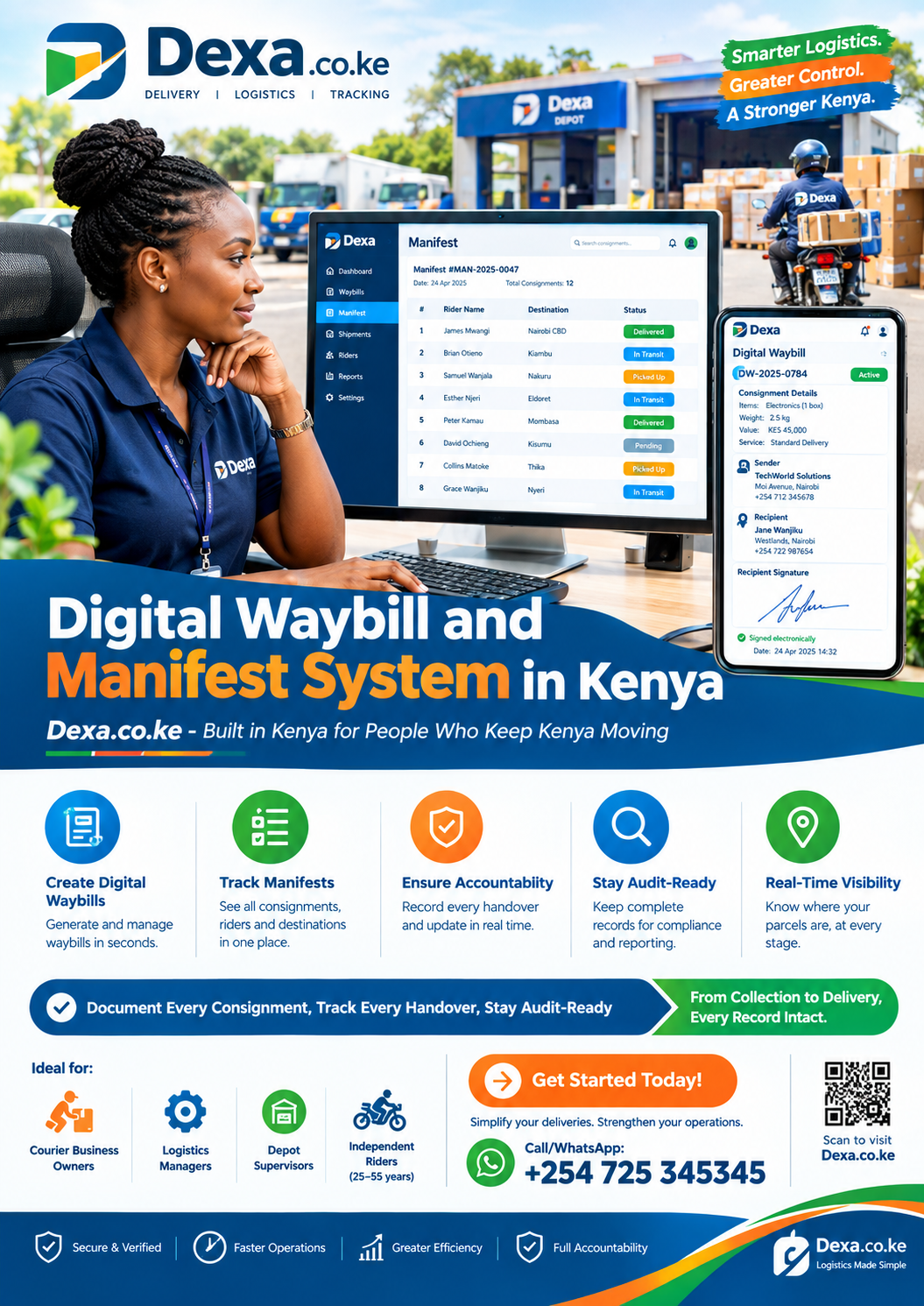
Digital waybill and manifest system in Kenya addresses one of the last strongholds of paper in the country’s logistics sector. Every parcel that moves between a business and a customer technically requires documentation: a record of what is being carried, from whom, to whom, and under whose custody. In practice, much of that documentation still lives on carbon-copy forms, handwritten trip sheets, and manifests typed into spreadsheets hours after the vehicles have left. The digital waybill and manifest system in Kenya replaces that fragile arrangement with records created at the point of dispatch and updated as the journey progresses.
The consequences of paper documentation are easy to underestimate until something goes wrong. A parcel is disputed. A vehicle is stopped at a weighbridge. A client asks for proof that a consignment was dispatched on a particular date. An auditor requests the movement records for a specific month. Each of these situations requires documentation that a paper-based operation may or may not be able to produce. A digital waybill and manifest system in Kenya produces it as a matter of course rather than as an emergency exercise.
What a Waybill and Manifest Actually Do
The two documents serve different but connected purposes, and understanding the distinction helps clarify what a digital system needs to deliver.
A waybill is the document that accompanies a consignment. It identifies what is being carried, who sent it, who is receiving it, and the terms under which it moves. In delivery terms, the waybill is the authority for a rider to carry goods on behalf of a business, and it is the record that establishes what was collected and what should be delivered. A digital waybill and manifest system in Kenya generates this document from the order record itself, so the details are accurate by construction rather than dependent on someone completing a form correctly under time pressure.
A manifest is the summary document that lists everything being carried on a particular trip, vehicle, or route. Where a waybill covers one consignment, a manifest covers the collection. It is what a driver presents at a checkpoint, what a depot uses to verify arrivals, and what a business uses to reconcile what left against what was delivered. A digital waybill and manifest system in Kenya builds the manifest automatically from the individual waybills assigned to that trip, so the summary is always consistent with the detail beneath it.
Why Digital Beats Paper in Practice
The case for digital documentation is not simply that it looks more modern. It rests on specific operational advantages that paper cannot match.
The first is accuracy. A paper waybill is completed by hand, often in a hurry, sometimes in poor light. Details are miswritten, illegible, or omitted. A digital waybill and manifest system in Kenya draws its data from the order record, which was captured at the point of booking. The waybill and the manifest therefore reflect what was actually ordered rather than what someone remembered to write down.
The second is retrieval. Paper documents live in folders, drawers, and vehicle glove compartments. Finding a specific waybill from four months ago is a physical search that may or may not succeed. A digital waybill and manifest system in Kenya stores every document in a searchable archive, retrievable in seconds by order reference, date, rider, or customer.
The third is completeness. Paper documents get lost, damaged by rain, or simply left behind. When a waybill is missing, the consignment it covered becomes difficult to account for. Digital records cannot be lost in the same way, because they exist independently of any physical copy. This permanence is one of the quieter advantages of a digital waybill and manifest system in Kenya, and it becomes more valuable as volume rises.
The fourth is speed. Compiling a manifest manually from a stack of waybills takes time at exactly the moment when vehicles should be departing. A digital waybill and manifest system in Kenya produces the manifest instantly from the assigned orders, so dispatch is not delayed by documentation.
How Dexa.co.ke Handles Documentation
Dexa.co.ke was built for the Kenyan market rather than adapted from a foreign model, and its structure reflects how goods actually move here. The platform splits into two products, each suited to a different stage of growth, and both treat documentation as a standard output rather than an administrative afterthought.
For sellers and operators working with one or two trusted riders, the independent driver model fits naturally. Documentation in this arrangement matters because a small operation has no back office to reconstruct records later. For operations that have outgrown informal arrangements and now coordinate several riders or vehicles, the courier team model provides the structure that a digital waybill and manifest system in Kenya requires at volume, where no single person can personally verify every consignment.
For Independent Drivers
A rider using this arrangement creates their own customer channel, sharing a personal booking link with businesses on WhatsApp and receiving direct bookings rather than competing for work in a crowded marketplace. From the business’s side, this simplifies matters considerably: one known contact, one consistent standard, one person accountable for each consignment.
The rider benefits too. Rather than chasing one-off trips, a driver builds a roster of regular business clients, plans pickups in advance, and tracks earnings in one place. When each job generates its own waybill automatically, the rider carries documentation without having to complete forms, and the record of what was collected and delivered builds itself. Reliable digital waybill and manifest system in Kenya practice therefore reduces administrative work for the rider rather than adding to it.
For Courier Teams
Teams managing several riders and a steady flow of consignments need structure that informal arrangements cannot provide. The platform keeps one operating record from request to receipt, so no consignment has to be reconstructed from scattered chats. Each parcel carries its customer details, assigned rider, agreed price, payment status, proof of delivery, and associated expense along with it.
For a business working with a courier team, this makes digital waybill and manifest system in Kenya routine rather than burdensome. Dispatch is organised, riders know their assignments, and the manifest for each trip is generated automatically from the waybills assigned to it. When a client asks for proof that a consignment was dispatched, the documentation is already in the system.
What the Documents Should Contain
A well-designed waybill carries several elements, and omitting any of them weakens its usefulness.
The consignment details come first: what is being carried, how many items, and any relevant description. For businesses handling varied goods, this record matters when a customer later disputes what was delivered. A digital waybill and manifest system in Kenya captures these details from the order rather than relying on summary descriptions.
The parties come next: the sender, the recipient, and the rider or vehicle carrying the consignment. Each of these establishes accountability at a specific point in the journey. Without them, a consignment has no identifiable custodian. The accountability structure within a digital waybill and manifest system in Kenya is what allows a business to answer the question of who was responsible for a parcel at any given moment.
The terms come third: the agreed delivery fee, the payment method, and any special instructions. These details matter particularly for cash on delivery consignments, where the amount to be collected must be established before the rider departs. Recording the expected amount in the waybill removes the doorstep negotiation that otherwise slows every cash delivery.
Finally, the signatures close the record. The sender’s acknowledgement at collection and the recipient’s confirmation at delivery complete the chain of custody. Both should be captured electronically as part of the same document, so the waybill is not merely a description of intent but evidence of what occurred. Complete digital waybill and manifest system in Kenya documentation includes both ends of the journey.
Manifests and Multi-Stop Routes
Manifests become particularly valuable when a rider or vehicle is carrying multiple consignments on a single trip. This is common for businesses serving several customers in one area, and it is where paper documentation struggles most.
A manifest lists every consignment on the trip, along with the sequence in which they should be delivered. The rider can see at a glance what is on board and what remains to be delivered. The business can see the same information, which means a customer enquiry can be answered without calling the rider. Strong digital waybill and manifest system in Kenya implementations update the manifest in real time as deliveries are completed, so the record reflects the current state of the trip rather than its state at departure.
This real-time updating matters for reconciliation. When a rider returns, the manifest should show exactly what was delivered, what was collected, and what remains. Any discrepancy is visible immediately rather than discovered during an end-of-week review. The manifest function within digital waybill and manifest system in Kenya platforms therefore serves both operational and financial purposes.
Compliance and Audit Readiness
Kenyan businesses operate under record-keeping obligations that paper systems struggle to satisfy. Regulators and tax authorities expect businesses to maintain accurate records of transactions, and the burden of proof falls on the business when questions arise.
Digital documentation provides protection that paper cannot match. Records are timestamped, searchable, and stored in a form that can be exported when required. When an auditor requests the movement records for a specific period, a business using a digital waybill and manifest system in Kenya retrieves them in seconds. A business relying on paper faces an unpleasant search through boxes and filing cabinets.
There is also a compliance dimension specific to transport. Vehicles carrying goods may be stopped at checkpoints, and drivers are expected to produce documentation for what they are carrying. A printed or on-screen waybill generated from a digital system satisfies this requirement cleanly, whereas a missing or illegible paper document can delay a journey considerably. Reliable digital waybill and manifest system in Kenya practice ensures documentation is always available regardless of where the vehicle is stopped.
Chain of Custody and Dispute Resolution
Every consignment passes through several hands, and each handover is a point where accountability can blur. Digital documentation preserves the chain by recording each transfer.
At collection, the sender acknowledges that the goods have left their possession. The rider takes custody. At any intermediate point, such as a depot or consolidation centre, custody transfers and the record notes it. At delivery, the recipient acknowledges receipt. The chain is unbroken from start to finish, and each link is documented.
When a dispute arises, the chain of custody settles it. A customer who claims a consignment never arrived can be shown the delivery record with signature and photograph. A sender who claims goods were never collected can be shown the collection record. A business querying a missing item can trace exactly where custody changed and who held the consignment at that point. The evidentiary value of a digital waybill and manifest system in Kenya is one of its most significant benefits, because it converts disputes from arguments into verifications.
Connecting Documentation to Payment
Documentation and payment are closely linked in delivery operations, and systems that connect them produce something neither can offer alone. The waybill establishes what should be collected. The payment record confirms what was collected. When both attach to the same order, reconciliation becomes straightforward.
This connection matters particularly for cash on delivery, where the amount to be collected is established at booking and confirmed at delivery. A digital waybill and manifest system in Kenya that records both the expected amount and the actual collection gives the business a complete financial picture for every consignment. Any variance is visible immediately rather than surfacing weeks later during a monthly review.
The same principle applies to invoicing. For businesses serving corporate clients, the waybills generated across a month can be compiled into a single invoice automatically. Rather than manually gathering paper records and typing them into a spreadsheet, the business selects a date range and a client, and the invoice is produced from the underlying documentation. This function within digital waybill and manifest system in Kenya platforms converts a multi-day task into a few minutes of work.
Reducing Loss and Misdelivery
Consignments go missing for several reasons, and most of them trace back to gaps in documentation. A parcel is loaded without being recorded. A handover occurs without acknowledgement. A delivery is made to the wrong recipient because the waybill was misread.
Digital documentation addresses each of these. Every consignment is recorded at collection, so nothing can be loaded without appearing on the manifest. Every handover requires acknowledgement, so custody transfers are visible. Every delivery captures the recipient’s confirmation, so misdelivery is detectable.
The cumulative effect is a significant reduction in loss. A business handling hundreds of consignments a month and losing even a small percentage to misdelivery is writing off a meaningful sum. Proper digital waybill and manifest system in Kenya discipline reduces that percentage sharply, and the savings frequently cover the cost of the system within months.
Scaling Documentation Without Adding Staff
One of the practical reasons businesses adopt digital documentation is that it allows volume to grow without proportional growth in administrative overhead. A business handling fifty consignments a week and one handling five hundred can both rely on the same automated processes.
This matters because administrative hiring is expensive and slow. A business that needs to add a records clerk every time volume doubles will find its margins compressed even as revenue grows. Automation breaks that link, allowing the operation to scale without scaling the back office at the same rate.
Common Mistakes in Digital Documentation
Several mistakes appear repeatedly when businesses move from paper to digital.
The first is generating documents only when requested. The value of digital documentation comes from its completeness. If waybills are produced only for certain clients or certain consignments, the record has gaps, and gaps are where problems hide. Consistent digital waybill and manifest system in Kenya practice means every consignment is documented, every time.
The second is storing documents separately from the orders they relate to. A waybill that cannot be linked to its order is only marginally more useful than a paper slip. The strongest approach keeps everything connected, so a single search retrieves the order, its waybill, its manifest, its proof of delivery, and its payment record together.
The third is neglecting the archive. Documentation is only valuable if it can be retrieved months or years later. Businesses should verify that their chosen platform retains records in an accessible form and allows export when needed.
The Direction Documentation Is Heading
Several shifts are reshaping how documentation works in Kenyan logistics. Mobile money integration continues to deepen, and the connection between payment records and movement records is becoming tighter, so a single automatic action will soon confirm both that a consignment moved and that payment was received.
Electric motorcycles and vehicles are becoming more common, and their onboard telemetry allows richer journey data than simple location pings. Government investment in intelligent traffic management is gradually improving movement across Nairobi, which will make arrival estimates derived from documentation more accurate over time.
Regulatory expectations around record-keeping are tightening, which favours businesses that already maintain clean digital documentation. Operations relying on paper will find compliance increasingly difficult as requirements become more specific.
What will not change is the underlying requirement: every consignment needs a documented record of what moved, when, by whom, and to whom. That requirement sits at the centre of what a digital waybill and manifest system in Kenya should deliver.
A digital waybill and manifest system in Kenya is not simply a paper replacement. It is the mechanism that gives a delivery business complete visibility over what it is carrying, who is carrying it, and what happened to it along the way. When every consignment is documented from collection to delivery, disputes stop being arguments and become verifications.
Whether you are running a single motorcycle from a single room or coordinating a fleet across the city, the tools behind a digital waybill and manifest system in Kenya from dexa.co.ke give you the records that protect your business, your riders, and your clients. From the first order request to the final confirmed delivery, every consignment stays documented.
The businesses that grow are the ones that treat documentation as a foundation rather than a formality. Build the habit early, let it carry the weight as volume rises, and record-keeping becomes one of the easiest parts of the operation to manage.