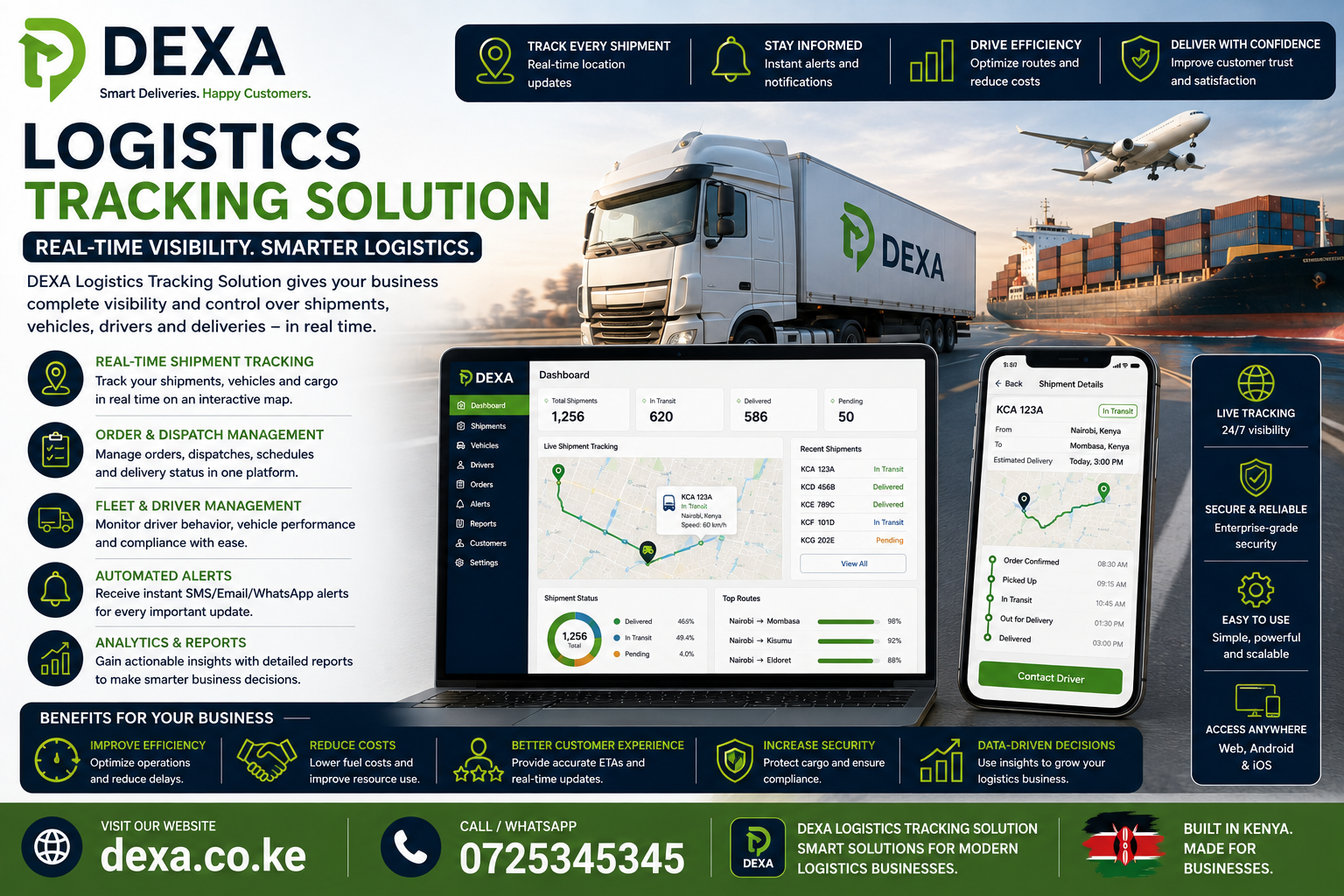
Logistics Tracking Solution
A logistics tracking solution helps businesses monitor the movement of goods, deliveries, riders, vehicles, and orders from one point to another. As businesses handle increasingly complex delivery operations, having visibility over logistics activities can improve coordination, accountability, and customer service.
From e-commerce companies and retailers to restaurants, farms, distributors, pharmacies, and courier businesses, organizations need reliable ways to know where their deliveries are and what stage each order has reached.
Instead of depending entirely on phone calls, paper records, and spreadsheets, businesses can use digital logistics technology to organize their operations.
Dexa provides digital solutions that can help businesses manage delivery and logistics activities more efficiently.
Logistics Tracking Solution – What Is It?
A logistics tracking solution is a digital system designed to provide visibility into the movement and status of goods or deliveries.
Depending on the platform, businesses can monitor:
- Orders
- Riders
- Drivers
- Delivery assignments
- Delivery locations
- Order status
- Completed deliveries
- Pending deliveries
- Failed deliveries
- Delivery history
The objective is to create a centralized view of logistics operations.
When managers have access to organized delivery information, they can make faster decisions and respond to customer enquiries more effectively.
Logistics Tracking Solution – Why Businesses Need Tracking
A logistics tracking solution becomes increasingly important as the number of deliveries grows.
A company handling only a few deliveries each day may manage them through calls and messages. However, this approach becomes difficult when dozens or hundreds of orders need to be coordinated.
Tracking technology can help businesses answer important operational questions:
- Where is the delivery?
- Who is handling the order?
- Has the package been collected?
- Is the order still pending?
- Has the customer received it?
- Which deliveries have failed?
- Which assignments require attention?
Having this information available digitally can reduce confusion and improve workflow.
Logistics Tracking Solution – Managing Delivery Riders
A logistics tracking solution can make rider management more organized.
Businesses that use motorcycles for last-mile delivery may have several riders operating simultaneously. Assigning orders manually can make it difficult to maintain accurate records.
A digital platform can help managers organize rider information such as:
- Rider names
- Contact information
- Assigned orders
- Delivery status
- Completed assignments
- Pending assignments
- Delivery history
Businesses involved in professional driver management can also explore Dereva for related driver and transport services.
Logistics Tracking Solution – Real-Time Delivery Visibility
Real-time visibility is an important feature for modern logistics operations.
A logistics tracking solution can provide businesses with better awareness of delivery progress.
For example, a dispatch manager may need to know whether a rider has:
- Received an assignment.
- Collected the package.
- Started the journey.
- Reached the customer’s area.
- Completed the delivery.
Tracking this information can make it easier to identify delays and take action.
Businesses should select systems based on their specific operational requirements and the tracking capabilities offered by the provider.
Logistics Tracking Solution – Improving Customer Communication
Customers want information about their orders.
When customers do not know what is happening, they may repeatedly call the business or contact customer support.
A logistics tracking solution can help businesses provide clearer delivery updates.
Possible delivery statuses include:
Order Received
The business has received the order.
Processing
The order is being prepared.
Assigned
A rider or driver has been assigned.
Picked Up
The delivery has been collected.
In Transit
The order is on its way.
Delivered
The customer has received the order.
Clear status information can create a more transparent delivery experience.
Logistics Tracking Solution – Reducing Delivery Delays
Delivery delays can affect customer satisfaction and business reputation.
A logistics tracking solution allows managers to identify pending deliveries and investigate delays.
Possible causes include:
- Traffic
- Incorrect addresses
- Customer unavailability
- Vehicle problems
- Rider availability
- Weather
- Dispatch errors
- Communication problems
Once the business identifies the cause, it can improve its delivery processes.
For example, repeated address-related problems could indicate that the ordering process needs better location information.
Logistics Tracking Solution – Supporting E-Commerce Businesses
E-commerce businesses depend heavily on reliable delivery operations.
A customer may purchase an item online without ever visiting the physical store. Delivery therefore becomes an important part of the overall customer experience.
A logistics tracking solution can help online businesses organize the process from order preparation to final delivery.
The workflow can include:
Online Order → Order Processing → Dispatch → Rider Assignment → Pickup → Transit → Delivery Confirmation
A structured workflow helps different teams understand what needs to happen at each stage.
Logistics Tracking Solution – Supporting Retail Businesses
Retailers increasingly offer delivery services to customers.
A shop may receive orders through its website, social media pages, messaging platforms, or other channels.
Without proper logistics organization, the business can struggle to coordinate multiple orders.
A logistics tracking solution helps create a more systematic process for managing those deliveries.
Retail businesses can use tracking technology for products such as:
- Electronics
- Clothing
- Groceries
- Household products
- Hardware
- Office supplies
- Beauty products
The system can help businesses maintain records and monitor delivery progress.
Logistics Tracking Solution – Supporting Restaurant Deliveries
Restaurants often operate within strict delivery timeframes.
Customers ordering meals expect their food to arrive while it is still fresh.
A logistics tracking solution can help restaurants coordinate orders and delivery personnel.
Managers can monitor:
- Orders waiting for preparation
- Ready orders
- Assigned riders
- Deliveries in progress
- Completed deliveries
Better coordination between the kitchen, dispatch team, rider, and customer can contribute to smoother operations.
Logistics Tracking Solution – Supporting Farm Produce Distribution
Agricultural businesses can also benefit from organized logistics.
Farmers, aggregators, distributors, and produce businesses may need to move products from farms to collection centres, markets, warehouses, retailers, or customers.
A logistics tracking solution can help businesses coordinate transportation and delivery activities.
For agricultural management and farm-related technology, Fama provides complementary digital solutions.
Combining farm management with organized logistics can help businesses improve visibility from production through distribution.
Logistics Tracking Solution – Delivery Reports and Analytics
Tracking data can become valuable business information.
A logistics tracking solution can help businesses review delivery performance over time.
Useful information may include:
- Number of deliveries
- Completed orders
- Failed deliveries
- Pending orders
- Rider activity
- Delivery times
- Customer locations
- Delivery frequency
Managers can use these insights to identify areas requiring improvement.
For example, if a particular area consistently experiences delays, the business can investigate whether route planning or rider allocation should be changed.
Logistics Tracking Solution – Improving Operational Accountability
Accountability is important when multiple people participate in a delivery process.
A logistics tracking solution can create records showing which rider or driver was assigned to an order and what happened during the delivery process.
This can help businesses investigate:
- Missing packages
- Delayed orders
- Failed deliveries
- Customer complaints
- Incorrect assignments
Clear records can also make internal communication easier.
Instead of relying on memory or scattered messages, managers can refer to delivery information stored within the system.
Logistics Tracking Solution – Managing Last-Mile Deliveries
The last mile is often one of the most challenging parts of logistics.
It involves moving goods from a business, warehouse, or distribution point to the final customer.
A logistics tracking solution can help businesses improve visibility during this stage.
Last-mile operations may involve:
- Multiple customers
- Different addresses
- Traffic
- Changing delivery schedules
- Customer communication
- Rider availability
Digital management can make it easier to coordinate these moving parts.
Logistics Tracking Solution – Benefits for Small Businesses
Small businesses sometimes assume that logistics technology is only necessary for large companies.
However, even a business making 10 or 20 deliveries per day can experience operational challenges.
A logistics tracking solution can help small businesses establish organized delivery processes from the beginning.
Potential users include:
- Online shops
- Restaurants
- Bakeries
- Grocery stores
- Florists
- Pharmacies
- Boutiques
- Electronics stores
- Small distributors
As order volumes increase, an organized system can make expansion easier.
Logistics Tracking Solution – Benefits for Large Businesses
Large businesses often manage many orders, drivers, riders, customers, and delivery locations.
A logistics tracking solution can provide a centralized way of monitoring these operations.
Larger organizations may benefit from:
- Multi-rider management
- Delivery monitoring
- Order management
- Performance reporting
- Customer updates
- Delivery history
- Operational visibility
The specific features required will depend on the size and complexity of the logistics operation.
Logistics Tracking Solution – Choosing the Right Platform
When evaluating a logistics tracking solution, businesses should consider their actual requirements.
Important factors include:
Logistics Tracking Solution – Ease of Use
The platform should be easy for managers, dispatchers, and delivery personnel to understand.
Logistics Tracking Solution – Scalability
The system should be capable of supporting the business as delivery volumes increase.
Logistics Tracking Solution – Tracking Features
Businesses should understand what information can be tracked and how frequently it is updated.
Logistics Tracking Solution – Reporting
Reports can help management measure operational performance.
Logistics Tracking Solution – Customer Experience
The platform should support a delivery workflow that keeps customers informed where applicable.
Logistics Tracking Solution – Integrating Payments and Delivery
Delivery businesses often handle payments alongside logistics.
For businesses collecting digital payments, integrating operational workflows with payment technology can simplify administration.
Pawa provides payment and connectivity-related technology that may be useful within a broader digital business environment.
A well-organized logistics operation should make it easy to determine which orders have been paid for, dispatched, delivered, or require follow-up.
Logistics Tracking Solution – Technology for Growing Logistics Businesses
As a company grows, manual processes can become a bottleneck.
A business that initially manages deliveries through spreadsheets may eventually need a centralized digital system.
A logistics tracking solution can help businesses transition toward more structured operations.
Growth may involve:
- More customers
- More delivery personnel
- More delivery zones
- More orders
- More vehicles
- More administrative requirements
Technology can help businesses maintain control as these variables increase.
For businesses looking at broader digital technology services, ZamaCore and Prim are additional resources to explore.
Logistics Tracking Solution – Connecting Different Business Operations
Logistics does not operate independently.
It is connected to sales, inventory, customer service, accounting, and operations.
A logistics tracking solution can therefore become part of a larger digital business workflow.
For example:
Customer Order → Inventory Confirmation → Payment → Dispatch → Rider Assignment → Tracking → Delivery → Reporting
This workflow can reduce gaps between departments and make it easier to determine what has happened to an order.
Businesses managing properties, tenants, or rental operations can also explore RentalDesk as a complementary business technology resource.
Logistics Tracking Solution – Data Security and Privacy
Logistics platforms may handle sensitive business and customer information.
This can include:
- Names
- Phone numbers
- Addresses
- Order information
- Delivery records
- Rider information
- Location information
Businesses should therefore implement appropriate security controls.
Access should be limited to authorized personnel, and companies should handle personal information according to applicable data-protection requirements.
Businesses should also establish internal procedures covering passwords, user permissions, customer information, and data retention.
For website and online business support, Kenya Website Experts provides another digital service resource.
Logistics Tracking Solution – Improving Delivery Performance
One of the biggest advantages of tracking technology is the ability to identify patterns.
A logistics tracking solution can help businesses determine where operational improvements may be possible.
For example, managers can examine:
- Frequently delayed routes
- High-failure delivery areas
- Rider workloads
- Peak delivery periods
- Customer ordering patterns
- Frequently used delivery zones
This information can support better planning.
Over time, businesses can use historical delivery data to improve staffing, dispatching, customer communication, and resource allocation.
Logistics Tracking Solution – Building a More Efficient Delivery Business
A successful logistics operation requires coordination.
Customers need accurate information. Riders need clear assignments. Dispatchers need visibility. Managers need reports. Business owners need to understand whether the operation is profitable and efficient.
A logistics tracking solution can bring these requirements into a more organized workflow.
Other Kenyan technology businesses can complement logistics operations. Wito, Zivo, and ZES are examples of digital platforms and businesses that can form part of a broader technology ecosystem.
Logistics Tracking Solution – Why Digital Tracking Is the Future
Customers are becoming more accustomed to digital services.
They expect businesses to process orders quickly, communicate clearly, and provide convenient delivery experiences.
A logistics tracking solution gives businesses the infrastructure to organize these expectations more effectively.
Digital logistics management is particularly useful as businesses move from local, manually managed deliveries toward larger and more structured operations.
The goal is not simply to track a vehicle or rider on a map. The goal is to create a complete operational picture.
Logistics Tracking Solution – Managing Delivery Zones Efficiently
Businesses operating across different towns, estates, and commercial centres need a clear way to organize delivery zones. Dividing an operating area into manageable zones can help dispatch teams assign orders more efficiently and understand where delivery demand is concentrated.
A logistics platform can help businesses maintain delivery information according to different locations. This is useful for companies serving multiple neighbourhoods within Nairobi or operating across several counties.
For example, an online retailer could organize deliveries into Nairobi CBD, Westlands, Kilimani, Embakasi, Kasarani, Karen, and other service areas. This can make it easier to allocate riders according to demand and availability.
Logistics Tracking Solution – Managing High-Volume Delivery Days
Some businesses experience significant differences in delivery volumes from one day to another. Weekends, public holidays, promotional campaigns, salary periods, and special events can create sudden increases in orders.
During busy periods, manual coordination can become difficult. A digital delivery management platform can help teams maintain an organized list of pending orders and assigned riders.
Managers can prioritize urgent deliveries, identify unassigned orders, and monitor completed assignments. This allows the business to respond more effectively when demand increases unexpectedly.
Logistics Tracking Solution – Supporting Fleet and Rider Productivity
Delivery businesses need to understand how their available workforce is being utilized. When some riders have too many assignments while others remain idle, operational efficiency can suffer.
Tracking delivery assignments can provide useful information about workload distribution. Managers can review completed tasks and identify whether certain riders or service areas require additional support.
This information can also contribute to better scheduling. Instead of relying entirely on assumptions, businesses can use historical delivery records to understand when additional riders may be required.
For businesses that also require professional driver-related services, Dereva provides a complementary platform for driver-focused needs.
Logistics Tracking Solution – Managing Failed Deliveries
A failed delivery does not always mean that an order has been lost. The customer may have been unavailable, the address may have been incomplete, or the rider may have encountered an unexpected problem.
Recording failed delivery attempts allows businesses to determine what should happen next. The order can be rescheduled, the customer can be contacted, or the delivery instructions can be updated.
Maintaining this information digitally is more reliable than depending on individual riders to remember previous attempts.
Logistics Tracking Solution – Improving Inventory-to-Delivery Coordination
Delivery operations are closely connected to inventory management. A customer should not receive a dispatch confirmation for an item that is unavailable.
Businesses can improve coordination by ensuring that products are confirmed before riders are assigned. Once an item is ready, dispatch teams can proceed with the delivery workflow.
This approach can reduce unnecessary rider trips and prevent situations where a customer expects an order that has not actually been prepared.
Agricultural businesses can also benefit from connecting production and distribution activities. Fama offers technology focused on farm and agricultural management.
Logistics Tracking Solution – Managing Business-to-Business Deliveries
Not every delivery goes to an individual consumer. Many companies deliver documents, stock, equipment, supplies, and products to other businesses.
Business-to-business deliveries may require specific delivery windows and accurate recipient information.
A structured system can help record:
- Company receiving the delivery
- Delivery address
- Contact person
- Assigned rider
- Order details
- Delivery status
- Completion information
This can make recurring business deliveries easier to coordinate.
Logistics Tracking Solution – Using Delivery Data to Control Costs
Delivery costs can increase when riders make unnecessary trips, deliveries fail repeatedly, or routes are poorly coordinated.
Historical delivery data can help management identify areas where costs may be reduced.
For instance, businesses can examine whether several orders going to the same area could be grouped into an efficient dispatch schedule.
Reducing unnecessary movement can potentially lower fuel consumption, rider costs, and delivery time.
Logistics Tracking Solution – Building Customer Trust
Reliable delivery communication can contribute significantly to customer trust.
Customers are more likely to feel confident when they receive clear information about their orders. Even simple updates can make a difference between a customer wondering what happened and a customer understanding the current delivery status.
Businesses should therefore consider tracking as part of customer service rather than treating it only as an internal management tool.
Logistics Tracking Solution – Connecting Logistics With Digital Business Systems
Modern businesses increasingly rely on several digital systems at the same time. Logistics may operate alongside websites, payment platforms, customer-management systems, accounting tools, and inventory applications.
Pawa can support businesses with connectivity and payment-related technology, while ZamaCore provides another digital technology resource.
The objective should be to create workflows where information can move efficiently between different parts of the organization.
Logistics Tracking Solution – Preparing for Expansion
A company should consider future growth when selecting logistics technology. Even if the current operation only has a handful of riders, the system should not become difficult to use as the customer base expands.
Growth may introduce additional delivery zones, staff, vehicles, customers, and orders.
Choosing an organized platform early can help establish consistent processes before the operation becomes complicated.
Businesses can also explore Wito, Zivo, and ZES as complementary digital resources depending on their wider technology requirements.
Logistics Tracking Solution – The Importance of Reliable Logistics Technology
Effective delivery management depends on accurate information, clear responsibilities, and timely communication. Technology can provide the structure required to bring these elements together.
A well-organized platform allows businesses to spend less time searching through messages and spreadsheets and more time focusing on customers and operations.
For Kenyan businesses looking to modernize delivery management, Dexa provides a practical starting point for exploring digital logistics and delivery workflows.
Whether the business handles ten deliveries per day or operates a larger network, establishing clear processes around order assignment, rider management, tracking, customer communication, and reporting can create a stronger foundation for sustainable growth.
Logistics Tracking Solution
A logistics tracking solution can help Kenyan businesses improve visibility, organize deliveries, monitor riders, manage orders, communicate with customers, and analyze logistics performance.
Whether you operate an online store, restaurant, retail shop, agricultural business, pharmacy, distribution company, or courier service, reliable delivery management can become an important competitive advantage.
Manual systems may work when delivery volumes are very low, but they become increasingly difficult to manage as the business grows.
Digital tracking allows businesses to establish structured workflows around order processing, dispatch, rider assignment, delivery monitoring, and reporting.
Businesses should evaluate their delivery volume, geographical coverage, workforce, customer expectations, and growth plans before choosing a platform.
For companies seeking a Kenyan solution for organizing delivery and logistics operations, Dexa provides a platform worth exploring.
Logistics Tracking Solution – Start Improving Your Delivery Operations
Before adopting new technology, map your existing delivery process.
Determine how orders are received, how riders are assigned, how deliveries are monitored, how customers receive updates, and how completed orders are recorded.
Then identify the areas where automation and tracking could save time or reduce errors.
A well-planned digital logistics system can help businesses move from scattered communication and manual records toward a more organized, measurable, and scalable delivery operation.