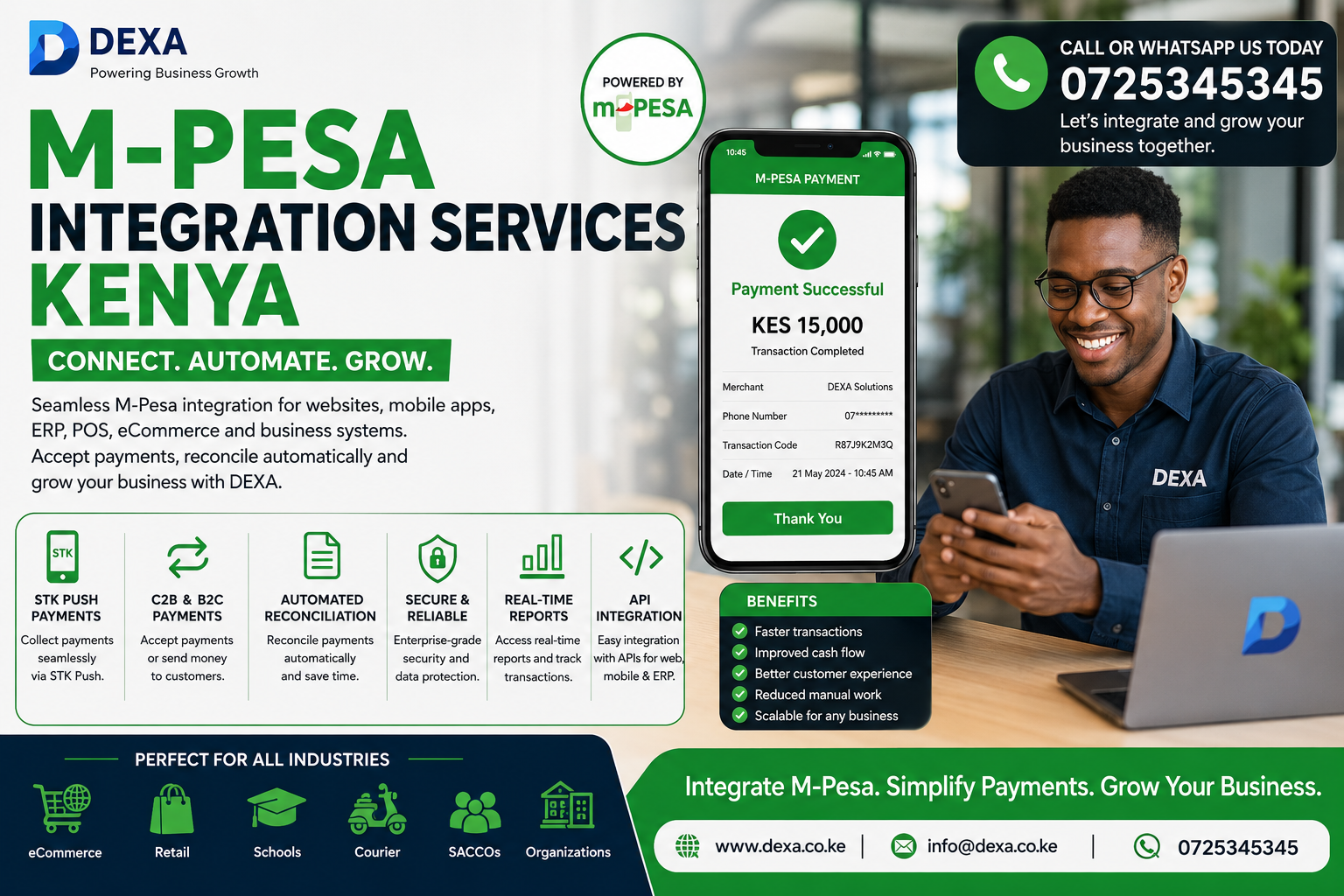
 M-Pesa integration services Kenya refer to technology services that connect a business application, website, mobile application, ERP, POS system, courier platform, or other software to M-Pesa payment services.
Instead of requiring customers or employees to manually confirm payments, an integrated system can automatically communicate payment information between M-Pesa and the business application.
Safaricom’s Daraja platform provides access to M-Pesa APIs that can act as a bridge between M-Pesa services and web or mobile applications. Safaricom describes Daraja as a platform for connecting applications to M-Pesa APIs and provides documentation, testing resources, and developer tools.
For Kenyan businesses, M-Pesa integration services Kenya can therefore provide an important connection between mobile payments and business operations.
For example, when a customer pays for an order, the payment information can be processed by the business system and associated with the correct customer, invoice, order, subscription, delivery, or account.
This reduces dependence on manual payment confirmation.
Why Businesses Need M-Pesa Integration Services Kenya
M-Pesa is widely used by Kenyan consumers and businesses, making mobile payment capability an important consideration for many digital products and business systems.
However, accepting M-Pesa payments is only part of the challenge.
Businesses also need to know:
- Who made the payment?
- How much was paid?
- Which order does the payment belong to?
- Was the transaction successful?
- When was the payment made?
- Has the transaction been reconciled?
- Should the customer’s order now be processed?
- Should a receipt be generated?
- Should an account balance be updated?
M-Pesa integration services Kenya can help automate these processes.
Instead of asking employees to check payment messages and manually update spreadsheets, the business application can receive transaction information through an integration workflow.
Safaricom’s own materials describe M-Pesa API integration as a way to automate payment and reconciliation processes between M-Pesa and internal business systems.
This can be particularly valuable for businesses handling a large number of transactions.
How M-Pesa API Integration Works
M-Pesa integration services Kenya normally involve connecting a business application to the appropriate M-Pesa APIs through a supported integration process.
The exact implementation depends on the business requirements and the M-Pesa services being used.
A simplified process can look like this:
Customer → Business Application → M-Pesa Payment Request → Customer Authorization → M-Pesa → Callback/Transaction Response → Business System → Payment Confirmation
For example, an online customer may select M-Pesa as the payment method.
The website creates a payment request.
The customer authorizes the transaction through the appropriate M-Pesa process.
Once the transaction is processed, the business system receives the relevant transaction response and can update the order.
This is one of the main reasons businesses invest in M-Pesa integration services Kenya.
The payment process becomes connected to the rest of the business workflow.
M-Pesa STK Push Integration
One of the most recognizable M-Pesa payment experiences is STK Push.
With an STK Push workflow, a customer can initiate or authorize a payment through their mobile phone without manually typing all payment instructions into another system.
For businesses, this can make payment collection more convenient.
M-Pesa integration services Kenya can be used to connect STK Push functionality to websites, mobile applications, ordering systems, and other software platforms where appropriate.
A typical workflow may be:
- Customer enters their phone number.
- Customer selects M-Pesa as the payment method.
- Business application sends the payment request.
- Customer receives the payment prompt.
- Customer authorizes the transaction.
- M-Pesa processes the payment.
- Business application receives the transaction response.
- Order or account status is updated.
The exact API implementation should follow Safaricom’s current documentation and requirements.
Safaricom’s Daraja developer portal provides official documentation and testing resources for developers working with its APIs.
Customer-to-Business Payment Integration
Customer-to-Business, or C2B, payments allow customers to pay businesses.
For example, a customer may pay for:
- Products
- Services
- Delivery
- Membership
- School fees
- Subscriptions
- Invoices
- Utility services
- Online purchases
M-Pesa integration services Kenya can connect these payments to the business’s internal system.
Safaricom lists C2B APIs among the M-Pesa API services available through its developer ecosystem.
This can make it easier for a business to associate payments with customer records.
For example, an accounting system could identify an incoming payment and match it against an invoice reference.
A school system could associate a payment with a student account.
An e-commerce system could associate a payment with an online order.
A courier platform could associate a payment with a delivery order.
The value comes from connecting the payment to the correct business process.
Business-to-Customer Payment Integration
Businesses sometimes need to send money to customers, employees, suppliers, agents, or other recipients.
B2C payment workflows can support business disbursement requirements where applicable.
M-Pesa integration services Kenya can help connect B2C payment processes to internal systems.
Safaricom’s official M-Pesa materials identify B2C APIs as one of the available API categories and describe use cases such as business disbursements.
For example, an organization may have an internal system that manages approved payments.
Rather than manually entering every transaction, the organization may integrate the payment workflow with its internal application, subject to Safaricom’s requirements and approval processes.
Automated Payment Reconciliation
Payment reconciliation is one of the biggest reasons businesses consider M-Pesa integration services Kenya.
Manual reconciliation can be time-consuming.
Imagine a company receiving hundreds of payments every day.
Employees may need to:
- Download transaction reports.
- Check payment references.
- Search customer records.
- Match payments to invoices.
- Update balances.
- Mark orders as paid.
- Prepare financial reports.
An integrated system can automate many of these steps.
Safaricom states that M-Pesa API integration can automate payment and reconciliation processes and reduce reliance on manual processes.
For businesses, automated reconciliation can improve operational efficiency and reduce the possibility of human data-entry mistakes.
M-Pesa Integration for E-Commerce
E-commerce businesses need convenient payment options.
When a customer places an order online, the business needs to confirm payment before fulfilling the order where payment is required upfront.
M-Pesa integration services Kenya can connect the online checkout process to M-Pesa.
A typical e-commerce workflow may look like:
Product selection → Checkout → M-Pesa payment → Payment confirmation → Order processing → Dispatch → Delivery
This can reduce the need for customers to send screenshots of payment confirmations.
It can also reduce manual work for the e-commerce team.
For an online retailer, connecting payments to order management can create a more efficient customer journey.
DEXA can be particularly relevant where payments need to connect with courier orders, billing, and delivery operations. DEXA’s platform currently lists M-Pesa payments alongside order tracking, customer management, riders, receipts, proof of delivery, and business expenses.
M-Pesa Integration for Courier Businesses
Courier companies handle payments in several different ways.
Customers may pay delivery charges, businesses may pay courier accounts, and courier companies may collect cash or mobile payments from recipients.
M-Pesa integration services Kenya can help connect payment activity to courier operations.
For example, a courier system can associate a payment with:
- Customer
- Delivery order
- Parcel
- Rider
- Delivery fee
- COD amount
- Receipt
- Account balance
This can provide a clearer financial record.
For courier businesses, payment integration becomes even more useful when combined with order tracking and proof of delivery.
DEXA’s courier platform is designed to keep customer, rider, payment, proof, and expense information connected to the same delivery record.
Businesses looking for courier technology can also review DEXA’s courier management platform and courier pricing plans.
M-Pesa Integration for Retail Businesses
Retailers can also benefit from M-Pesa integration services Kenya.
A retail business may process many transactions every day.
An integrated POS or business management system can help connect payments to sales records.
This can improve:
- Sales reporting
- Payment tracking
- Reconciliation
- Customer records
- Inventory updates
- Receipt generation
Safaricom’s official materials describe M-Pesa integrations for businesses such as wholesalers, pharmacies, supermarkets, and other retail businesses, including automated payment processing and reconciliation.
For a growing retailer, connecting payment information with sales and inventory systems can reduce duplicate data entry.
M-Pesa Integration for Schools and Organizations
Schools, colleges, associations, and other organizations may receive large numbers of payments.
Payments may include:
- Tuition
- Registration
- Accommodation
- Events
- Membership
- Contributions
- Services
- Other approved charges
M-Pesa integration services Kenya can help connect payment records with student, member, or customer accounts.
For example, a school management system could allow administrators to identify which account has paid and which account has an outstanding balance.
This can make financial administration more organized.
The exact payment architecture depends on the organization’s requirements and the M-Pesa services it is approved to use.
M-Pesa Integration for SACCOs and Financial Businesses
Financial organizations often need reliable transaction processing and reconciliation.
A SACCO may need to record member deposits, payments, loan-related transactions, or other approved financial activities.
M-Pesa integration services Kenya can connect payment information with internal member or financial systems.
Safaricom’s official M-Pesa materials describe API use cases for financial institutions and other organizations, including automated updates to internal systems.
Because financial systems can be sensitive, businesses should carefully consider authentication, authorization, audit trails, data handling, and compliance requirements when implementing payment integrations.
M-Pesa Integration for Websites and Mobile Apps
Modern businesses often accept payments through websites and mobile applications.
An app may allow customers to:
- Purchase products
- Book services
- Pay invoices
- Subscribe
- Renew memberships
- Pay delivery fees
- Purchase tickets
- Make other approved payments
M-Pesa integration services Kenya can connect the payment interface to the underlying application.
Safaricom describes Daraja as a bridge between M-Pesa APIs and web or mobile applications.
This makes API integration useful for developers building digital products for the Kenyan market.
Benefits of M-Pesa Integration Services Kenya
There are several potential advantages to implementing M-Pesa integration services Kenya.
Faster Payment Processing
Automated workflows can reduce manual payment confirmation.
Better Reconciliation
Payments can be associated with internal records.
Reduced Data Entry
Staff do not have to manually copy every transaction into another system.
Better Customer Experience
Customers can receive a smoother payment experience.
Improved Reporting
Payment information can become part of business reports.
Better Operational Visibility
Managers can see payment information alongside orders, customers, or accounts.
Reduced Administrative Work
Automation can reduce repetitive tasks.
Easier Scaling
A connected system can help businesses handle increasing transaction volumes.
M-Pesa Integration Services Kenya for Business Automation
The biggest value of M-Pesa integration services Kenya is not simply accepting payments.
The greater opportunity is automation.
Consider a courier company.
A customer places a delivery order.
The system calculates the delivery charge.
The customer pays through M-Pesa.
The payment is confirmed.
The order changes to a paid status.
The dispatch team sees the order.
A rider is assigned.
The parcel is delivered.
The system records proof of delivery.
A receipt is generated.
The payment remains connected to the order.
This is a complete automated workflow.
Without integration, employees may need to perform several of these steps manually.
Choosing the Right M-Pesa Integration Partner
Choosing an integration provider is an important decision.
Businesses should consider technical expertise, support, security, documentation, integration experience, scalability, and understanding of the business process.
When evaluating M-Pesa integration services Kenya, ask the following questions:
Does the provider understand your industry?
A courier company has different requirements from an e-commerce store or SACCO.
Can the provider integrate with your existing software?
Integration should fit into your current technology environment.
Does the solution support your required payment workflows?
Confirm whether the required API capabilities are available for your use case.
Is testing supported?
Payment integrations should be tested before production deployment.
Is there ongoing support?
Payment systems are business-critical, so technical support matters.
Can the solution scale?
Your integration should not become a bottleneck as transaction volume grows.
Security and Data Protection
Payment integration requires careful security planning.
Businesses should protect:
- Customer information
- Phone numbers
- Transaction references
- Payment information
- API credentials
- Application credentials
- User accounts
- Business records
Access should be restricted according to user roles and operational requirements.
API credentials should not be exposed in client-side applications or public repositories.
Production credentials should be managed securely.
Businesses should also understand their obligations regarding personal data and payment-related information.
Safaricom provides official developer documentation and API resources for businesses and developers working with its M-Pesa ecosystem.
M-Pesa API Testing and Deployment
Testing is an important part of M-Pesa integration services Kenya.
Developers should normally build and test the integration before moving it to a live environment.
Safaricom’s Daraja platform provides a sandbox environment for testing applications and simulating API interactions.
A structured implementation process may include:
- Understanding the business requirements.
- Selecting the appropriate M-Pesa API.
- Creating the development environment.
- Configuring application credentials.
- Building the integration.
- Testing successful transactions.
- Testing failed transactions.
- Testing callback handling.
- Testing transaction status queries.
- Reviewing security.
- Preparing production configuration.
- Monitoring the live integration.
Testing different scenarios is important because payment systems need to handle both successful and unsuccessful transactions.
Common M-Pesa Integration Challenges
Although M-Pesa integration services Kenya can improve automation, implementation still requires careful planning.
Incorrect Payment References
If references are not structured properly, payments may be difficult to match to orders.
Duplicate Processing
Applications should be designed to handle repeated callbacks or transaction messages safely.
Failed Transactions
Systems should have clear processes for unsuccessful payments.
Network Interruptions
Applications should be able to handle temporary communication problems.
Incorrect Credentials
API configuration errors can prevent communication with the payment platform.
Poor Error Handling
A good integration should record errors and provide useful information for troubleshooting.
Weak Security
Exposed credentials or poorly configured access controls can create serious risks.
Poor User Experience
Even technically successful integrations can create frustration if payment instructions are confusing.
A professional implementation should consider both the technical and customer-facing sides of the payment journey.
Why Choose DEXA for M-Pesa Integration Services Kenya?
DEXA is a Kenyan software platform focused on business and courier operations.
The DEXA courier platform connects customer orders, riders, payments, receipts, proof of delivery, and business expenses into one operational record.
This makes DEXA particularly useful for courier businesses that want payment functionality connected directly to delivery operations.
DEXA’s published pricing also lists M-Pesa payments as part of its courier software offering. The current pricing page lists a Starter plan at KES 2,500 per month, a Growth plan at KES 7,500 per month, and an Enterprise plan at KES 20,000 per month; API access is listed on Growth and Enterprise plans.
Businesses can review the current DEXA courier software and DEXA pricing before choosing an implementation approach.
For businesses that need a broader technology solution, DEXA’s platform can also connect payment workflows with order management, customer tracking, receipts, proof of delivery, and expenses.
M-Pesa Integration Services Kenya for Growing Businesses
Small businesses often start with manual payment processes.
A customer sends money.
The business receives a message.
An employee confirms the payment.
The employee updates a spreadsheet.
A receipt is created.
The order is processed.
This can work at low transaction volumes.
As the business grows, however, the same process can become inefficient.
M-Pesa integration services Kenya allow businesses to move toward automated workflows.
The objective is not simply to replace one payment screen with another.
The objective is to create a connected business process.
How M-Pesa Integration Can Improve Customer Experience
Customers want payment processes that are simple and reliable.
A complicated payment process can cause abandoned orders.
An integrated payment experience can help customers move from checkout to confirmation with fewer unnecessary steps.
For example:
Select service → Enter details → Choose M-Pesa → Authorize payment → Receive confirmation → Continue
The exact customer journey depends on the application and payment method being implemented.
Businesses should also provide clear instructions when transactions fail or require customer action.
M-Pesa Integration and Automated Receipts
Receipts provide customers with confirmation that a payment has been recorded.
When payment information is connected to the business system, receipts can be generated as part of the transaction workflow where the system supports it.
This can be particularly useful for:
- Courier businesses
- Online stores
- Subscription businesses
- Service providers
- Retailers
- Schools
- Membership organizations
M-Pesa integration services Kenya can therefore contribute to a more organized payment and record-keeping process.
M-Pesa Integration and Business Reporting
Business owners need accurate information to make decisions.
Payment reports can help answer questions such as:
- How much was collected today?
- Which customers have paid?
- Which invoices remain outstanding?
- Which services generate the most payments?
- What is the transaction volume?
- Which payment references correspond to which orders?
- Are there failed or pending transactions?
When payment data is connected to business systems, reporting becomes more useful.
This is another important reason companies invest in M-Pesa integration services Kenya.
Frequently Asked Questions About M-Pesa Integration Services Kenya
What are M-Pesa integration services Kenya?
M-Pesa integration services Kenya involve connecting a business application, website, mobile app, POS, ERP, courier system, or other software to M-Pesa payment APIs and services.
What is the Daraja API?
Daraja is Safaricom’s developer platform for accessing M-Pesa and Safaricom APIs. Safaricom describes Daraja as a bridge between its APIs and web or mobile applications.
Can M-Pesa be integrated into a website?
Yes. M-Pesa APIs can be used to connect payment functionality to websites and web applications, subject to the applicable Safaricom requirements and API capabilities.
Can M-Pesa be integrated into a mobile application?
Yes. Safaricom’s Daraja platform is designed to provide API access that can connect M-Pesa services with mobile and web applications.
Can M-Pesa payments be automatically reconciled?
Yes. M-Pesa API integration can automate payment and reconciliation workflows. Safaricom specifically identifies automated reconciliation as a benefit of integration.
What is STK Push?
STK Push is a payment interaction that can prompt a customer to authorize an M-Pesa transaction from their mobile phone. Businesses should follow the current Safaricom Daraja documentation when implementing it.
Can M-Pesa integration support courier businesses?
Yes. M-Pesa payment functionality can be connected to courier workflows such as orders, delivery fees, COD records, receipts, and payment tracking. DEXA currently lists M-Pesa payments among its courier platform capabilities.
Does DEXA offer M-Pesa integration?
DEXA’s courier platform lists M-Pesa payments as a supported capability. Its published pricing also includes M-Pesa payments in the Starter, Growth, and Enterprise courier plans.
How much do M-Pesa integration services Kenya cost?
The cost depends on the application, required API functionality, development work, testing, hosting, support, and other requirements. A simple integration may have different requirements from a large ERP or multi-branch business system.
Is M-Pesa integration secure?
Security depends on the implementation, infrastructure, credentials management, application design, access controls, and compliance practices. Businesses should use official API documentation and follow appropriate security practices.
Can businesses integrate M-Pesa with ERP systems?
Yes. M-Pesa APIs can be connected to internal business applications and systems. Safaricom’s official materials describe integration with internal systems for payment processing and reconciliation.
How to Get Started With M-Pesa Integration Services Kenya
The first step is to identify what you want the payment integration to accomplish.
For example, your business may want to:
- Accept customer payments.
- Automate payment confirmation.
- Connect payments to invoices.
- Connect payments to orders.
- Automate reconciliation.
- Generate receipts.
- Receive transaction status information.
- Send approved payments.
- Connect M-Pesa to a website.
- Connect M-Pesa to a mobile application.
- Connect M-Pesa to an ERP or business management system.
Once the requirements are clear, the appropriate API and implementation approach can be determined.
Businesses should then review Safaricom’s official developer resources and work with an appropriately qualified integration provider.
The official Safaricom Daraja Developer Portal provides API documentation, developer resources, and testing capabilities.
Safaricom also provides information on M-Pesa business channels and API integration requirements.
The Future of M-Pesa Integration in Kenya
As Kenyan businesses continue to digitize their operations, payment integration is becoming increasingly important.
Businesses no longer want payment information to exist separately from the systems that manage customers, orders, inventory, accounting, subscriptions, and deliveries.
They want connected workflows.
M-Pesa integration services Kenya can help create that connection.
A successful integration can turn a payment from a standalone transaction into part of a complete business process.
For example:
Customer → Order → Payment → Confirmation → Fulfilment → Receipt → Reporting
This approach can help businesses reduce repetitive work and improve operational visibility.
Conclusion
M-Pesa integration services Kenya can help businesses connect mobile payments with the software systems they already use to run their operations.
From e-commerce websites and mobile applications to courier platforms, retail systems, ERP software, schools, SACCOs, and service businesses, payment integration can reduce manual processes and improve payment visibility.
The key is to implement the integration correctly.
Businesses should choose the right API, understand their requirements, test thoroughly, protect credentials, handle transaction responses correctly, and ensure the payment workflow fits the customer experience.
For courier and delivery businesses, DEXA provides a platform where M-Pesa payments can work alongside customer orders, rider management, tracking, receipts, proof of delivery, and expenses.
If you are looking for M-Pesa integration services Kenya, DEXA can help you explore a more connected approach to business payments and operational management.
Visit DEXA to learn more about its business and courier technology solutions, or review the DEXA pricing plans to find an option suitable for your operation.
For official API documentation and integration requirements, visit the Safaricom Daraja Developer Portal.