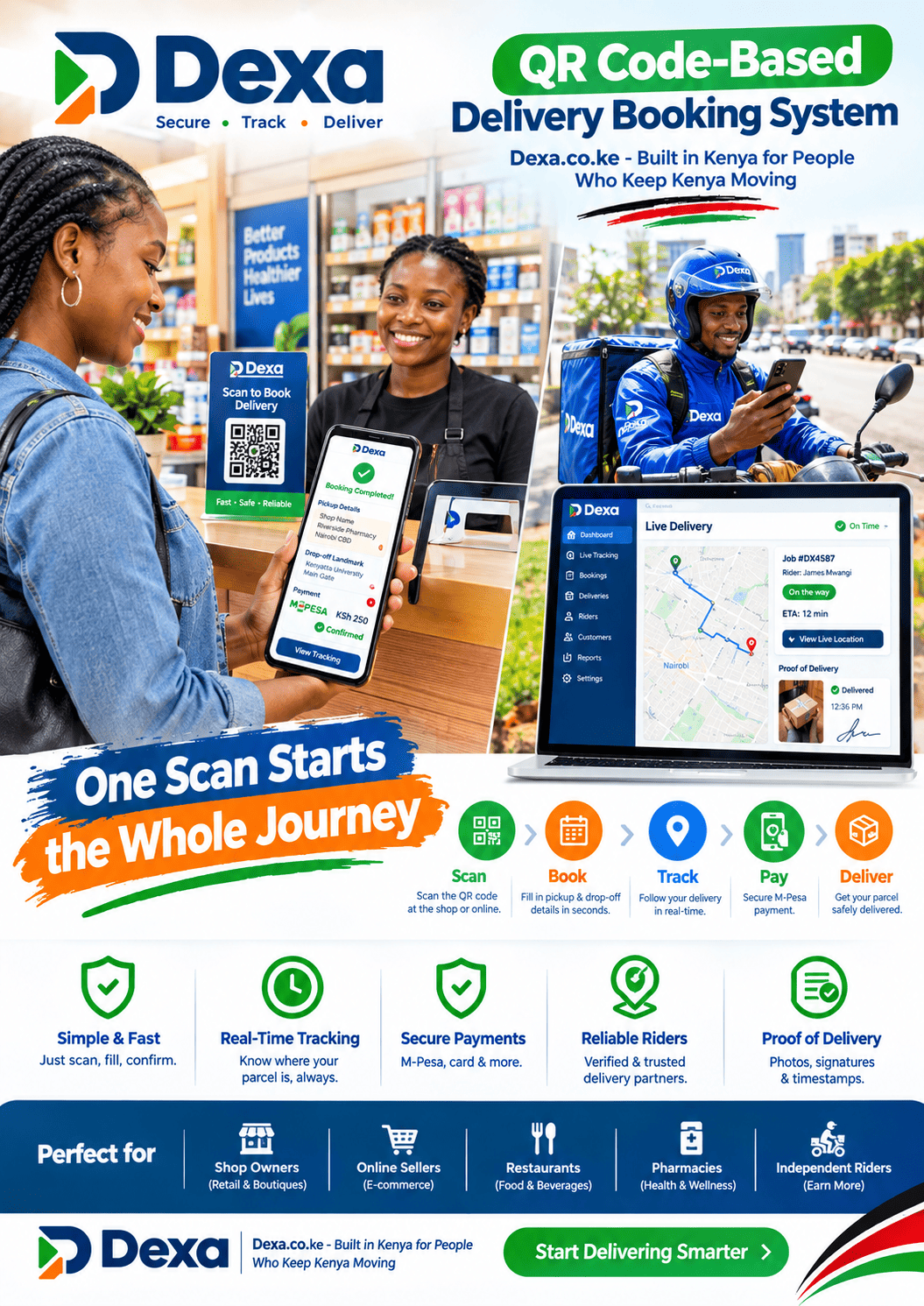
A QR code-based delivery booking system changes the moment a customer decides they want something delivered. Instead of searching for a phone number, typing out an address, or composing a WhatsApp message that may or may not be seen, the customer points a camera at a code and books in seconds. That reduction in friction is not a minor convenience. It is the difference between a customer completing a request and a customer abandoning it because the process felt like effort.
For businesses across Nairobi, Mombasa, and Kisumu, a QR code-based delivery booking system removes the barriers that quietly suppress order volume. Every extra step between wanting a delivery and requesting one loses a proportion of customers. A phone call requires the customer to find a number, wait for an answer, and explain what they need. A message requires them to type details that the business then has to interpret. A code requires nothing more than a glance and a tap.
The appeal of a QR code-based delivery booking system lies in how little it asks of the person using it. No app to download, no account to create, no form to learn. The customer scans, confirms a few details, and the request lands in the dispatch queue. Businesses that adopt a QR code-based delivery booking system typically find that the number of completed bookings rises not because more people want delivery, but because fewer give up along the way.
How the System Actually Works
The mechanics are simpler than most business owners assume. A unique code is generated for a business, a rider, or a specific location. That code encodes a link to a booking page that already knows who it belongs to. When a customer scans, the page opens with the relevant details pre-filled, and the customer supplies only what is missing.
The first thing a QR code-based delivery booking system captures is the pickup point. Because the code is tied to a specific business or rider, the system already knows where the parcel is coming from. The customer does not have to describe it, spell it, or explain which branch they mean. This single detail removes a category of error that plagues informal booking arrangements.
The customer then enters the drop-off details, which in the Kenyan context usually means a landmark, a phone number, and any instructions that help the rider find the gate. A QR code-based delivery booking system stores these against the order rather than leaving them in a message thread that will be buried by tomorrow. When the rider needs the information, it is attached to the job rather than scattered across conversations.
Once submitted, the request arrives in the dispatch dashboard where it can be assigned, tracked, and completed. From that point, a QR code-based delivery booking system behaves like any well-built delivery platform: the rider is assigned, the customer receives updates, the parcel is tracked, and the delivery is confirmed with proof. The difference is that the process began with a scan rather than a conversation.
Why QR Codes Suit the Kenyan Market
Kenya’s mobile-first population makes scanning a natural action rather than a novelty. Cameras are standard on every smartphone sold in the country, and the habit of scanning codes for payments, menus, and promotions is already well established. A QR code-based delivery booking system borrows a behaviour that customers already perform daily and applies it to a task that was previously awkward.
The addressing challenge reinforces the case. Large parts of Kenyan cities have no formal street numbering, which means delivery instructions arrive as landmarks rather than coordinates. A QR code-based delivery booking system captures those landmark details in a structured field rather than a free-form message, so the rider receives consistent information regardless of how the customer phrases it. The structured capture built into a QR code-based delivery booking system reduces the back-and-forth that otherwise consumes a rider’s time before they even start moving.
Payment habits complete the picture. Cash on delivery remains common, and mobile money is near-universal. A QR code-based delivery booking system can accommodate both, recording the expected amount at the point of booking and logging the collection when it happens. Customers who book through a QR code-based delivery booking system know what they will pay before the rider arrives, which removes the doorstep negotiation that slows every cash delivery.
What Businesses Gain
The most immediate gain for a business is a permanent booking channel that does not depend on anyone being available to answer a message. A QR code-based delivery booking system works at any hour, captures every request consistently, and never forgets to reply. Printed on packaging, receipts, shop windows, or business cards, a QR code-based delivery booking system turns every physical touchpoint into an opportunity for the customer to book again.
The second gain is consistency. When bookings arrive through a QR code-based delivery booking system, every request contains the same fields in the same format. Dispatch becomes faster because nobody has to interpret a message or ask a follow-up question. The standardisation that a QR code-based delivery booking system enforces removes a category of error that grows more expensive as volume rises.
The third gain is repeat business. A customer who has scanned once knows exactly how the process works and can repeat it without instruction. That familiarity makes a QR code-based delivery booking system particularly effective for businesses with regular customers, since the second order takes less effort than the first. Over time, a QR code-based delivery booking system builds a base of customers who book directly rather than searching for a delivery option each time.
What Drivers Gain
Independent riders benefit from the same principle applied to their own work. A rider can carry a personal QR card that customers scan to book them directly, giving the rider a customer channel that does not depend on competing for jobs in a crowded marketplace. A QR code-based delivery booking system attached to an individual rider transforms that rider from a gig worker into a small business with a recognisable identity.
The practical effect is a roster of repeat clients. Instead of chasing one-off trips, a rider using a QR code-based delivery booking system builds relationships with businesses that book them regularly. Those relationships produce predictable income, and predictable income is what allows a rider to plan, invest, and grow. A QR code-based delivery booking system gives a rider the tools to be found, and being findable is the first requirement of building a client base.
What Customers Gain
From the customer’s side, the value is simplicity. Scanning a code is faster than any alternative, and the resulting booking is confirmed immediately rather than left in uncertainty. A QR code-based delivery booking system also gives the customer a record of the request, which matters when a question arises later about what was booked and when.
Customers also benefit from not having to repeat themselves. Because a QR code-based delivery booking system stores details against the order, the customer does not have to explain the same pickup point or the same landmark every time. Repeat orders become quicker, and the overall experience feels considered rather than improvised.
Connecting Booking to Payment
A booking is only half a transaction. The other half is payment, and a well-built system connects the two from the start. When a customer books through a QR code-based delivery booking system, the expected amount can be shown before confirmation, so both parties know what is due. This transparency removes the ambiguity that leads to disputes at the doorstep.
The connection continues at delivery. When payment is collected, it is logged against the specific order created through the booking. A QR code-based delivery booking system that handles both booking and payment produces a complete record from request to receipt, with no gap where a transaction could go unrecorded. For businesses handling a high proportion of cash orders, this integration is often the feature that justifies the switch on its own.
Connecting Booking to Proof of Delivery
Booking and proof are two ends of the same journey, and a system that handles both produces something neither can offer alone. The request created through a QR code-based delivery booking system becomes the record against which the delivery is confirmed. The signature, photograph, timestamp, and location captured at handover attach to the order that began with a scan.
This continuity matters when disputes arise. A customer who claims a delivery never happened can be shown the original booking, the rider assigned, the route taken, and the proof captured at handover. A QR code-based delivery booking system that maintains this chain from start to finish settles questions in seconds rather than days.
Where the System Fits Best
Certain businesses gain more from a QR code-based delivery booking system than others. Retail shops with regular customers benefit because repeat bookings become effortless. Restaurants and food outlets benefit because the code can be printed on packaging and table cards, capturing orders at the moment a customer is thinking about delivery.
Pharmacies and clinics benefit because the booking captures details consistently, which matters when accuracy is important. Corporate offices benefit because staff can book document deliveries without leaving their desks. Online sellers benefit because the code can be included in every package, encouraging the customer to book their next delivery directly rather than through a marketplace that takes a commission.
Choosing the Right System
Businesses evaluating options should focus on a few practical questions. Does the booking capture structured details rather than free-form text? Is the request connected to a payment record and a proof of delivery? What happens if the customer scans but does not complete the booking? Can the code be tied to a specific rider as well as a business?
A system that answers these well is one that will not create new problems as volume rises. A system that answers only the first is one that will produce bookings without the records needed to complete them properly. The difference between the two is rarely visible in a demonstration, which is why testing with real orders across a fortnight is worth the effort before committing.
The Direction Booking Technology Is Heading
Several shifts are reshaping how customers request deliveries in Kenya. Mobile money integration continues to deepen, and the connection between booking, payment, and confirmation is becoming tighter, so a single scan will soon trigger the entire chain without a gap. Electric motorcycles are becoming more common, and their lower running costs make short-notice bookings more viable for riders working on thin margins. Government investment in intelligent traffic management is gradually improving movement across Nairobi, which makes the arrival estimates generated by a booking system more reliable over time.
What will not change is the underlying requirement: customers want to request a delivery with as little effort as possible, and businesses want that request to arrive in a form they can act on. That requirement sits at the centre of what a QR code-based delivery booking system should deliver.
A QR code-based delivery booking system is not simply a clever way to accept orders. It is a mechanism for turning every physical touchpoint into a booking opportunity, while ensuring that every request arrives with the structure needed to fulfil it properly. The scan is the beginning of a process that continues through dispatch, tracking, payment, and proof.
Whether you are running a single shop with a handful of regular customers or coordinating a fleet across the city, the tools behind a QR code-based delivery booking system from dexa.co.ke connect the customer’s first tap to the final confirmed delivery. From the scan to the signature, everything stays in one place.
The businesses that grow are the ones that make ordering effortless and delivery reliable. Build the habit early, let it carry the weight as volume rises, and the code on your counter becomes one of the most valuable assets your business owns.