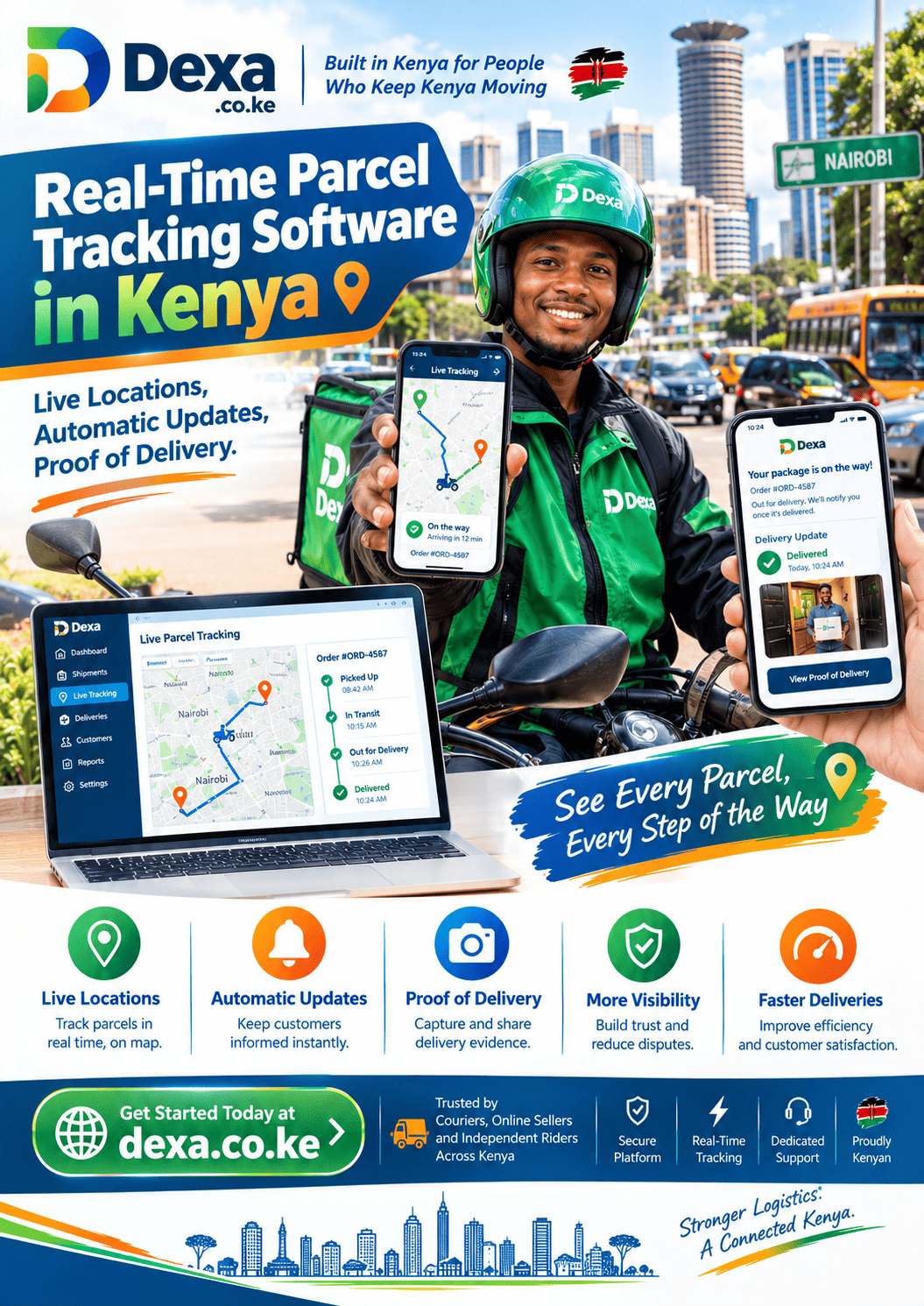
Real-time parcel tracking software in Kenya has moved from a nice-to-have feature to the foundation of every credible delivery operation. Customers who once accepted vague assurances that a parcel was “on the way” now expect to see exactly where it is, who is carrying it, and when it will arrive. Sellers who cannot provide that visibility spend their days answering questions they should not have to answer. Real-time parcel tracking software in Kenya closes that gap by turning every delivery into a visible, verifiable journey rather than a hopeful promise.
The shift is not simply about customer convenience. It is about operational control. A business that knows where every parcel is at every moment can respond to problems before they become complaints. A business that does not, discovers issues only when a customer calls to ask why their order has not arrived. Understanding real-time parcel tracking software in Kenya means recognising that visibility is the difference between managing delivery and reacting to it.
Why Tracking Matters More in the Kenyan Context
Any serious discussion of real-time parcel tracking software in Kenya has to begin with the conditions on the ground. Nairobi ranks among the most congested cities in Africa, and a peak-hour journey can stretch past an hour for a distance that would take fifteen minutes in clear conditions. Delivery schedules built on optimistic assumptions collapse, repeatedly, and customers hear the excuses.
Addressing compounds the problem. Large parts of the city have no formal street numbering, so delivery instructions arrive as landmarks rather than coordinates. Nationally, a substantial share of parcels are delayed or never delivered at all, and the inability to locate a destination precisely is a leading cause. The routing and location intelligence built into real-time parcel tracking software in Kenya directly addresses this, because a rider who can see the destination on a map and confirm it with the customer arrives more reliably than one navigating by memory.
Payment habits complete the picture. Cash on delivery remains widely used, particularly among first-time buyers. A parcel that is tracked but not paid for is a delivery half-completed. The best real-time parcel tracking software in Kenya connects location data with payment records, so the business sees not just where a parcel is but whether it has been paid for.
What Real-Time Tracking Actually Means
The phrase is used loosely, so it helps to be precise. Real-time tracking is not a status that updates once in the morning and again at night. It is a continuous stream of position data that lets anyone with permission see where a parcel is at this moment, not where it was six hours ago.
Genuine real-time tracking rests on three capabilities. The first is continuous location reporting from the rider’s device, typically through GPS, that updates frequently enough to be useful. The second is a mapping layer that converts coordinates into a recognisable location, ideally accounting for the landmark-based descriptions Kenyan customers actually use. The third is a notification system that pushes updates to customers and dispatchers automatically, so nobody has to check manually.
A platform that offers only the first is a map with a dot on it. A platform that offers all three is one that removes an entire category of daily friction. This distinction matters when evaluating real-time parcel tracking software in Kenya, because vendors often describe simple location sharing as real-time tracking when it falls well short.
The Features That Define Useful Tracking Software
Live Location Updates
The core of any tracking system is live location. Dispatchers and customers should see a rider’s position on a map, refreshed frequently enough that the information remains useful. When evaluating real-time parcel tracking software in Kenya, test how often the data refreshes. A position that updates every few minutes is workable for longer journeys. One that updates once an hour is not.
Delivery Status at Every Stage
Location alone does not tell the whole story. A parcel can be picked up, in transit, out for delivery, or delivered, and each stage carries different expectations. Useful real-time parcel tracking software in Kenya updates status automatically as events occur, so the customer sees progress rather than a static pin.
Automated Customer Notifications
Customers should not have to open an app or call the business to find out where their order is. Notifications should arrive without being requested: when the parcel is dispatched, when the rider is nearby, and when delivery is complete. Systems that handle this automatically save hours each week and reduce the volume of inbound enquiries dramatically. This is one of the most valued features of real-time parcel tracking software in Kenya from a customer’s perspective.
Proof of Delivery Integration
Tracking should end with a documented handover. Digital signatures, photographs, and timestamps captured at the point of delivery create a record that protects the business, the rider, and the customer. When tracking and proof are separate systems, the record becomes fragmented. When they are integrated, real-time parcel tracking software in Kenya produces a complete journey from dispatch to confirmed receipt.
Route Awareness
Knowing where a rider is has limited value if the route itself is inefficient. The stronger platforms combine live location with routing intelligence, accounting for traffic conditions and delivery sequence. This layer of real-time parcel tracking software in Kenya reduces journey times and fuel consumption, which matters on thin margins.
Offline Resilience
Networks fail. A tracking system that stops working when connectivity drops leaves both the business and the customer without information at the moment they need it most. Robust real-time parcel tracking software in Kenya continues recording during outages and syncs automatically when connectivity returns, so no part of the journey goes unrecorded.
How Dexa.co.ke Approaches Parcel Tracking
Dexa.co.ke was built for the Kenyan market rather than adapted from a foreign model, and its structure reflects how delivery actually works here. The platform splits into two products, each suited to a different stage of business growth, and both treat tracking as a core function rather than an optional feature.
For sellers working with one or two trusted riders, the independent driver model fits naturally. Tracking in this arrangement matters because it lets a business see where a rider is without making a call, and it gives the customer confidence that the parcel is genuinely on its way. For operations that have outgrown informal arrangements and now coordinate several riders, the courier team model provides the coordination layer that real-time parcel tracking software in Kenya requires at volume.
For Independent Drivers
A rider using this arrangement creates their own customer channel, sharing a personal booking link with businesses on WhatsApp and receiving direct bookings rather than competing for work in a crowded marketplace. From the seller’s side, this simplifies real-time parcel tracking software in Kenya considerably: one known contact, one consistent standard, one person accountable for each parcel.
The rider benefits as well. Rather than chasing one-off trips, a driver builds a roster of regular business clients, plans pickups in advance, and tracks earnings in one place. That stability encourages reliability, and reliability is exactly what a growing seller needs from a delivery partner.
For Courier Teams
Teams managing several riders and a steady flow of orders need structure that informal arrangements cannot provide. The platform keeps one operating record from request to receipt, so no order has to be reconstructed from scattered chats. Each parcel carries its customer details, assigned rider, agreed price, payment status, proof of delivery, and associated expense along with it.
For a business working with a courier team, this makes real-time parcel tracking software in Kenya genuinely useful rather than merely reassuring. Dispatch is organised, riders know their assignments, customers receive automatic updates, and the business has a clean record for every order. When a customer disputes a delivery, the answer is already in the system rather than in someone’s memory.
Benefits for Delivery Businesses
Reduced Inbound Enquiries
The most immediate benefit of real-time parcel tracking software in Kenya is a quieter phone. When customers can see where their parcel is, they stop calling to ask. For a small team, the hours recovered each week amount to a meaningful increase in capacity, often without any additional hiring.
Faster Problem Resolution
Problems still occur, but they surface earlier. A rider who has stopped moving for twenty minutes is visible on the map before the customer notices the delay. Dispatchers can intervene, reassign the delivery, or notify the customer proactively. This early visibility is one of the practical advantages of real-time parcel tracking software in Kenya, and it turns potentially damaging incidents into minor ones.
Better Rider Management
Tracking also provides a factual basis for managing riders. Performance becomes visible rather than assumed. A rider who consistently completes deliveries faster may need support understanding what they are doing differently. Tracking data informs these conversations without requiring confrontation, because the record speaks for itself.
Accurate Financial Records
When tracking data connects to payment records, the business gains a complete picture of every delivery. Collections are matched to orders, expenses are tracked alongside revenue, and pricing decisions become calculations rather than guesses. Any serious approach to real-time parcel tracking software in Kenya includes this financial layer, because delivery that cannot be costed cannot be priced correctly.
Benefits for Customers
Customers experience tracking primarily as reassurance. An order that can be seen is an order that feels real. Uncertainty is the most common source of anxiety in online shopping, and visibility removes it almost entirely.
The second customer benefit is accurate expectation setting. A delivery window derived from live tracking data is far more reliable than a generic estimate. Customers can plan their day around a realistic arrival time rather than waiting indefinitely.
The third benefit is dispute protection. When a customer receives an automatic confirmation with a photograph and timestamp, both parties have evidence of what occurred. Disagreements that would otherwise consume time and goodwill are resolved instantly.
How Tracking Connects to the Broader Operation
Real-time parcel tracking software in Kenya does not operate in isolation. It sits at the centre of a larger system that includes order capture, dispatch, payment handling, and proof of delivery.
When these elements are connected, the effect compounds. An order is placed and immediately visible to dispatch. A rider is assigned and their location becomes trackable. The customer receives updates without being asked. Payment is logged against the order. Proof of delivery completes the record. Each step reinforces the others, and the business gains a complete picture of its operations rather than fragments scattered across different tools.
When these elements are disconnected, the value of each is diminished. Tracking without payment records leaves financial questions unanswered. Proof of delivery without order history makes disputes harder to resolve. The strongest results come from systems that treat the delivery journey as a single connected process.
Choosing the Right Tracking Software
Businesses evaluating options should focus on a few practical questions. How frequently does location data refresh? Are customer notifications automatic? Is proof of delivery captured within the same system, or separately? What happens when the network drops? Can the software handle cash collections alongside digital payments?
A platform that answers these well is one that will not create new problems as volume rises. A platform that answers only the first is one that will become a source of daily friction. The difference between the two is rarely visible in a demo, which is why testing with real orders across a fortnight is worth the effort before committing.
The Direction Tracking Technology Is Heading
Several shifts are reshaping how parcel tracking works in Kenya. Electric motorcycles are becoming more common, and their onboard telemetry allows for richer tracking data than simple GPS pings. Government investment in intelligent traffic management is gradually improving movement across Nairobi, which will make live tracking data more predictable and more valuable over time.
Mobile money integration continues to deepen, and the connection between tracking and payment is becoming tighter. The direction is toward systems where every delivery produces a complete record automatically, with no manual input required at any stage.
What will not change is the underlying requirement: businesses and customers both need to know where a parcel is, and they need to be able to prove it arrived. That requirement sits at the centre of what real-time parcel tracking software in Kenya should deliver, today and in future.
Real-time parcel tracking software in Kenya is not simply a map with a moving dot on it. It is the operational backbone that connects orders, riders, payments, and proof into a single visible journey. When that journey is visible, most of the daily friction in a delivery business disappears on its own.
Whether you are dispatching five orders a week from a single room or fifty a day from a small warehouse, the tools behind real-time parcel tracking software in Kenya from dexa.co.ke give you the visibility and records that make delivery predictable. From the first order request to the final confirmation, every parcel stays accounted for.
The businesses that grow are the ones that treat visibility as a foundation rather than a feature. Build the system early, let it carry the weight as volume rises, and delivery becomes the part of the business that brings customers back.