Blog

  • Delivery Tracking Software Kenya: The Complete Guide for Businesses in 2026

    Delivery Tracking Software Kenya

    Delivery Tracking Software Kenya: The Complete Guide for Businesses in 2026

    In today’s highly competitive business environment, customers expect their orders to arrive quickly and on time. Whether you run an e-commerce store, pharmacy, supermarket, logistics company, or distribution business, managing deliveries efficiently has become essential for success. This is why investing in Delivery Tracking Software Kenya businesses can trust is no longer optional—it’s a necessity.

    Kenyan businesses are increasingly adopting digital technologies to improve operations, reduce costs, and enhance customer experiences. One area experiencing significant transformation is delivery management. Traditional methods of tracking deliveries through phone calls, spreadsheets, and manual records often lead to delays, lost orders, and dissatisfied customers.

    Modern delivery tracking systems provide businesses with real-time visibility, route optimization, automated notifications, and comprehensive reporting capabilities. These features enable companies to streamline delivery operations and meet the growing expectations of today’s consumers.

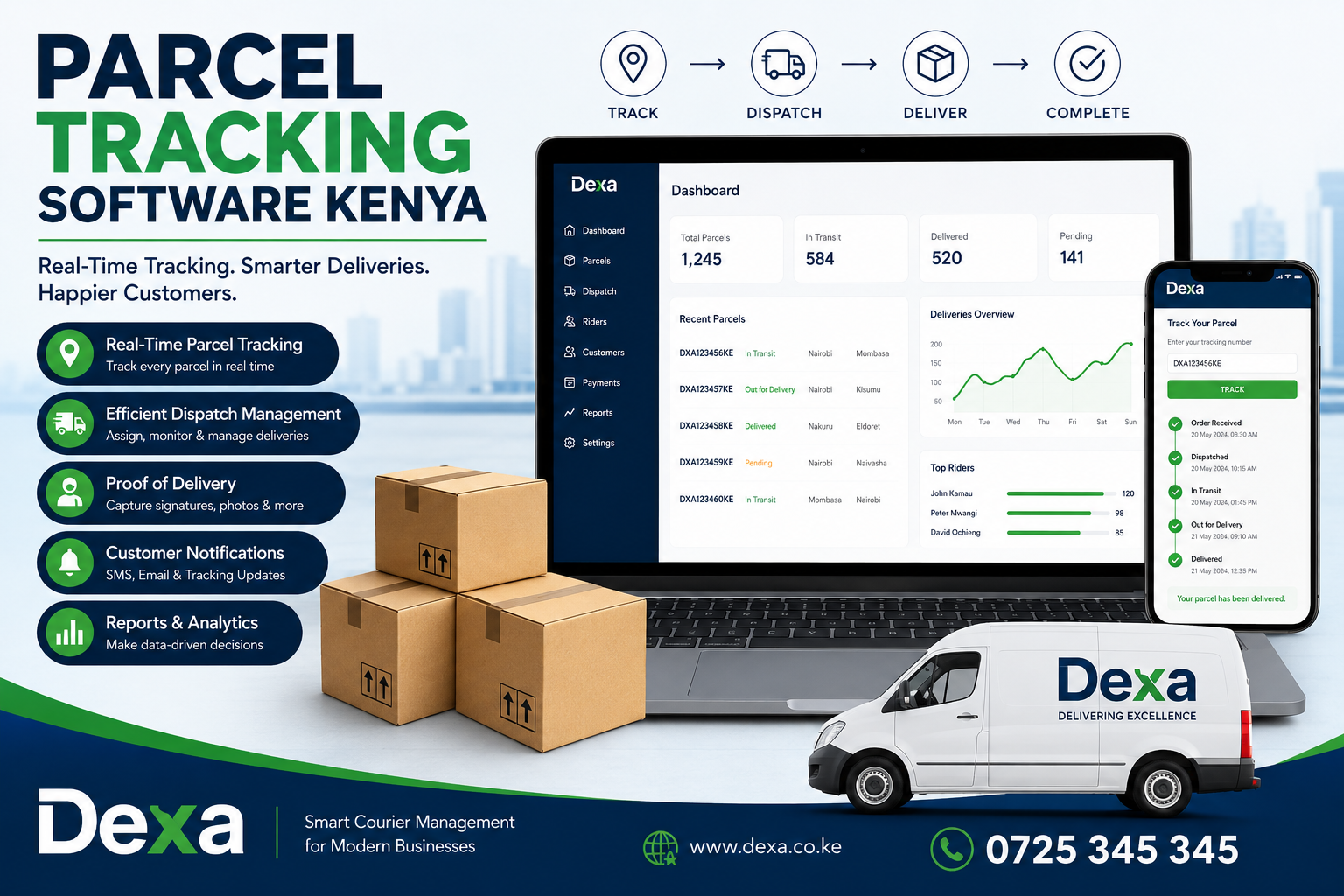
    At Dexa, we provide advanced Delivery Tracking Software Kenya businesses can use to automate delivery operations, monitor drivers in real time, and deliver exceptional customer experiences.

    What Is Delivery Tracking Software Kenya?

    Delivery tracking software is a digital solution designed to help businesses manage, monitor, and optimize their delivery processes. The software provides complete visibility into every stage of the delivery journey, from order creation to successful delivery completion.

    A robust delivery tracking solution enables businesses to:

    • Track deliveries in real time
    • Monitor driver locations and activities
    • Optimize delivery routes
    • Send automated customer notifications
    • Manage delivery assignments efficiently
    • Generate detailed delivery reports
    • Reduce operational costs
    • Improve customer satisfaction

    With the increasing demand for same-day and next-day deliveries, Delivery Tracking Software Kenya companies use has become a vital tool for maintaining competitiveness.

    Why Kenyan Businesses Need Delivery Tracking Software Kenya

    The logistics landscape in Kenya has changed significantly over the past few years. E-commerce growth, urbanization, and increased smartphone penetration have transformed customer expectations.

    Customers now expect:

    • Real-time order tracking
    • Fast delivery times
    • Delivery notifications
    • Accurate estimated arrival times
    • Seamless delivery experiences

    Businesses that fail to meet these expectations risk losing customers to competitors.

    Implementing Delivery Tracking Software Kenya enterprises can depend on offers several advantages.

    Improved Delivery Visibility

    Real-time tracking allows businesses to know exactly where their drivers and deliveries are at any given moment. Managers can monitor delivery progress and address issues before they escalate.

    Increased Operational Efficiency

    Manual delivery processes consume significant time and resources. Delivery tracking software automates tasks such as dispatching, route planning, and delivery updates.

    Better Customer Experience

    Customers appreciate transparency. Real-time tracking and automated notifications help reduce anxiety and build trust in your brand.

    Reduced Delivery Costs

    Optimized routes reduce fuel consumption, minimize unnecessary mileage, and improve resource utilization.

    Enhanced Decision Making

    Data-driven insights enable businesses to identify inefficiencies and continuously improve delivery operations.

    Key Features of Delivery Tracking Software

    Choosing the right Delivery Tracking Software Kenya businesses need requires understanding the features that contribute to operational efficiency.

    Real-Time GPS Tracking

    GPS tracking provides live visibility of delivery vehicles and drivers. Businesses can monitor routes and quickly respond to unexpected delays.

    Automated Dispatch Management

    Automated dispatching simplifies order assignments by automatically allocating deliveries to available drivers.

    Route Optimization

    Smart route planning ensures drivers take the most efficient routes, reducing fuel costs and delivery times.

    Customer Notifications

    Automated SMS and email notifications keep customers informed about their delivery status.

    Proof of Delivery

    Digital proof of delivery features allow drivers to capture signatures, photos, and delivery confirmations electronically.

    Driver Performance Monitoring

    Managers can monitor driver productivity, delivery completion rates, and adherence to schedules.

    Analytics and Reporting

    Comprehensive reporting provides valuable insights into delivery performance and operational trends.

    Industries That Benefit from Delivery Tracking Software Kenya

    The need for efficient delivery operations spans across numerous industries.

    E-Commerce Businesses

    Online retailers require accurate delivery tracking to meet customer expectations and maintain competitive advantage.

    Supermarkets and Grocery Stores

    Grocery deliveries require speed and precision. Real-time tracking helps ensure timely deliveries.

    Pharmaceutical Companies

    Medication deliveries often involve strict timelines. Delivery tracking software helps ensure critical products reach customers on time.

    Manufacturing Companies

    Manufacturers depend on reliable distribution networks to deliver products to distributors and retailers.

    Courier and Logistics Companies

    Courier businesses need complete visibility into delivery operations to maintain service quality and efficiency.

    Food Delivery Services

    Restaurants and food delivery companies benefit from optimized routes and real-time order tracking.

    This widespread adoption highlights why Delivery Tracking Software Kenya businesses implement is becoming increasingly important.

    Challenges of Manual Delivery Management

    Many businesses still rely on spreadsheets, phone calls, and paper-based systems to manage deliveries. While these methods may work for smaller operations, they become inefficient as businesses grow.

    Common challenges include:

    Limited Visibility

    Businesses struggle to know the exact location of drivers and deliveries.

    Delayed Deliveries

    Poor route planning often leads to traffic delays and missed delivery windows.

    Communication Gaps

    Manual communication processes can create misunderstandings and customer frustration.

    Increased Operational Costs

    Inefficient routes and poor resource allocation increase fuel and labor expenses.

    Lack of Performance Data

    Without proper reporting tools, businesses cannot accurately measure delivery performance.

    These challenges make investing in Delivery Tracking Software Kenya companies can rely on a strategic business decision.

    How Delivery Tracking Software Kenya Improves Customer Satisfaction

    Customer experience is one of the most significant drivers of business success.

    Modern consumers want convenience, transparency, and reliability. Delivery tracking software contributes to customer satisfaction by providing:

    Delivery Transparency

    Customers can monitor their deliveries in real time and know exactly when to expect their orders.

    Reduced Anxiety

    Automated updates eliminate uncertainty and reduce customer inquiries.

    Accurate Delivery Estimates

    Estimated delivery times improve planning and convenience for customers.

    Faster Deliveries

    Optimized routes help businesses deliver orders more efficiently.

    Better Communication

    Automated notifications keep customers informed throughout the delivery journey.

    Businesses using Delivery Tracking Software Kenya solutions often experience improved customer retention and higher satisfaction ratings.

    Why Real-Time Tracking Matters

    Real-time delivery tracking has become one of the most valuable features of modern delivery management systems.

    Benefits include:

    • Immediate visibility of delivery status
    • Quick response to unexpected delays
    • Improved driver accountability
    • Better customer communication
    • Enhanced operational control
    • Increased delivery success rates

    As customer expectations continue to evolve, real-time tracking capabilities are becoming essential for business competitiveness.

    Choosing the Best Delivery Tracking Software Kenya

    Selecting the right solution requires careful evaluation of business requirements.

    Consider the following factors:

    Ease of Use

    The software should be simple and intuitive for managers and drivers.

    Scalability

    Choose a solution that can support business growth and increasing delivery volumes.

    Integration Capabilities

    The system should integrate with your existing business processes and software applications.

    Mobile Accessibility

    Drivers need mobile applications that provide delivery instructions and real-time updates.

    Reporting Features

    Comprehensive analytics help businesses monitor performance and identify improvement opportunities.

    Customer Support

    Reliable support ensures smooth implementation and ongoing success.

    The best Delivery Tracking Software Kenya providers offer flexible, scalable solutions that adapt to changing business needs.

    How Dexa Delivery Tracking Software Kenya Helps Kenyan Businesses

    At Dexa, we understand the challenges businesses face when managing deliveries. Our platform is designed to help organizations streamline operations and deliver exceptional customer experiences.

    Our delivery tracking software provides:

    Real-Time Delivery Monitoring

    Track deliveries and driver locations in real time from a centralized dashboard.

    Automated Dispatch Management

    Assign deliveries efficiently and reduce manual administrative tasks.

    Smart Route Optimization

    Minimize delivery times and reduce fuel expenses through optimized routing.

    Customer Notifications

    Keep customers informed with automated delivery updates.

    Digital Proof of Delivery

    Capture signatures and delivery confirmations electronically.

    Performance Analytics

    Generate detailed reports to monitor operational performance and identify opportunities for improvement.

    Our Delivery Tracking Software Kenya solution empowers businesses to improve efficiency, reduce costs, and enhance customer satisfaction.

    The Future of Delivery Tracking Software Kenya

    Kenya’s logistics and e-commerce industries continue to grow rapidly. Businesses that invest in technology today will be better positioned to compete in the future.

    Emerging trends include:

    • Artificial intelligence for route optimization
    • Predictive delivery analytics
    • Advanced automation capabilities
    • Enhanced customer communication tools
    • Integration with e-commerce platforms
    • Data-driven operational insights

    As digital transformation accelerates, Delivery Tracking Software Kenya businesses implement will continue playing a critical role in operational success.

    Conclusion

    Efficient delivery management has become a major competitive advantage for modern businesses. Customers expect transparency, speed, and reliability, making delivery tracking technology essential for organizations that want to remain competitive.

    Investing in Delivery Tracking Software Kenya businesses trust enables companies to streamline operations, reduce costs, improve customer satisfaction, and make data-driven decisions.

    Dexa provides an advanced, scalable delivery tracking solution specifically designed to help Kenyan businesses manage deliveries more efficiently. Whether you operate an e-commerce store, logistics company, supermarket, pharmacy, or distribution business, our platform gives you the tools needed to optimize your delivery operations and achieve sustainable growth.

    Ready to transform your delivery operations? Visit https://dexa.co.ke and discover how Dexa’s Delivery Tracking Software Kenya solution can help your business deliver faster, smarter, and more efficiently.
  • Delivery Operations Platform Kenya: Complete Software for Managing Logistics, Dispatch, Tracking, and Deliveries

    Delivery Operations Platform Kenya

    Delivery Operations Platform Kenya: Complete Software for Managing Logistics, Dispatch, Tracking, and Deliveries

    The logistics industry in Kenya is evolving rapidly as businesses strive to meet growing customer expectations for faster deliveries, accurate tracking, and seamless service experiences. Whether you operate a courier company, e-commerce delivery service, wholesale distribution network, or enterprise logistics operation, managing deliveries efficiently is essential for business success.

    Traditional delivery management methods often rely on spreadsheets, phone calls, manual dispatching, and fragmented communication channels. While these methods may work for small-scale operations, they quickly become inefficient as delivery volumes increase.

    This is why many businesses are adopting a Delivery Operations Platform Kenya solution to streamline dispatch management, automate workflows, improve visibility, and enhance customer satisfaction.

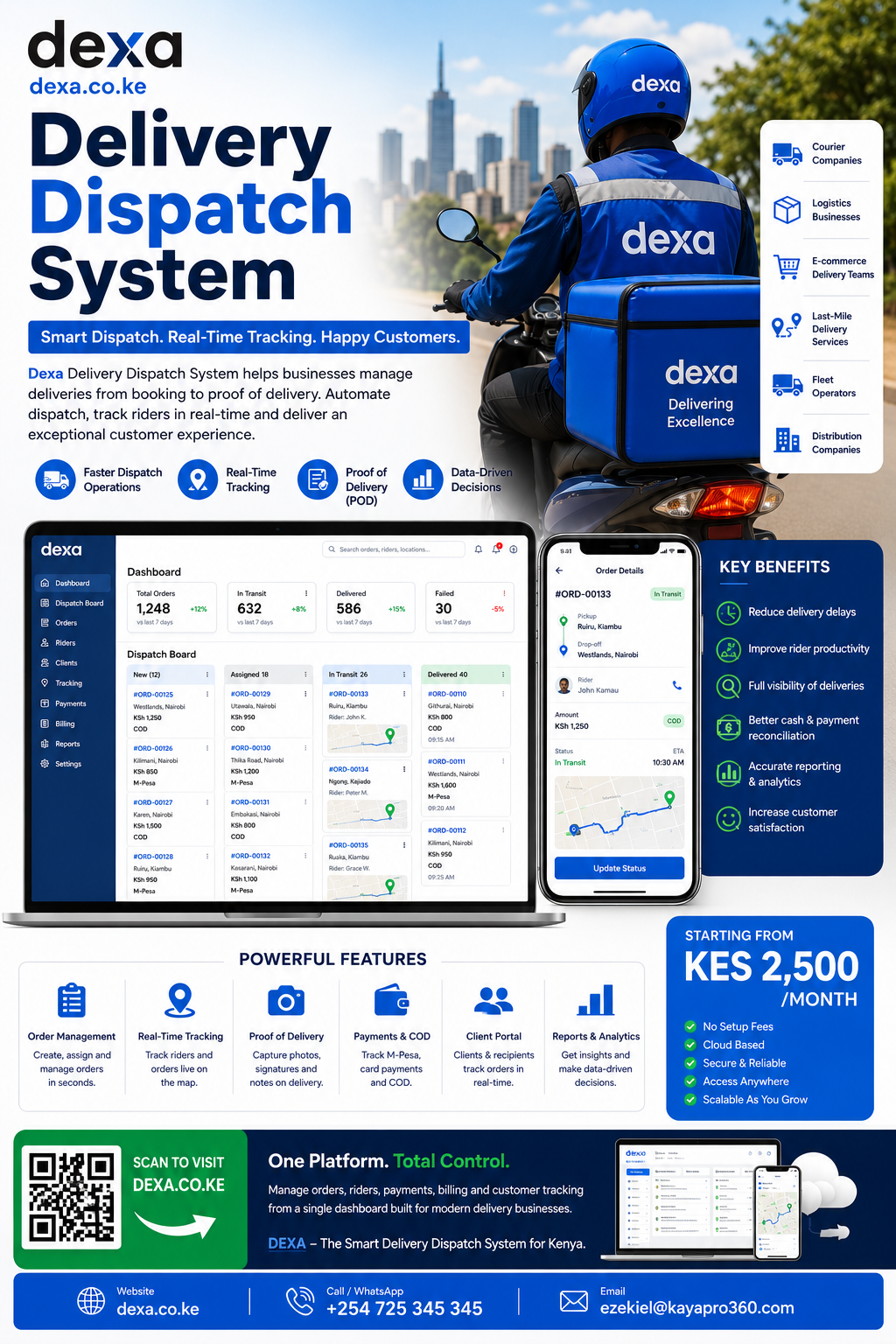
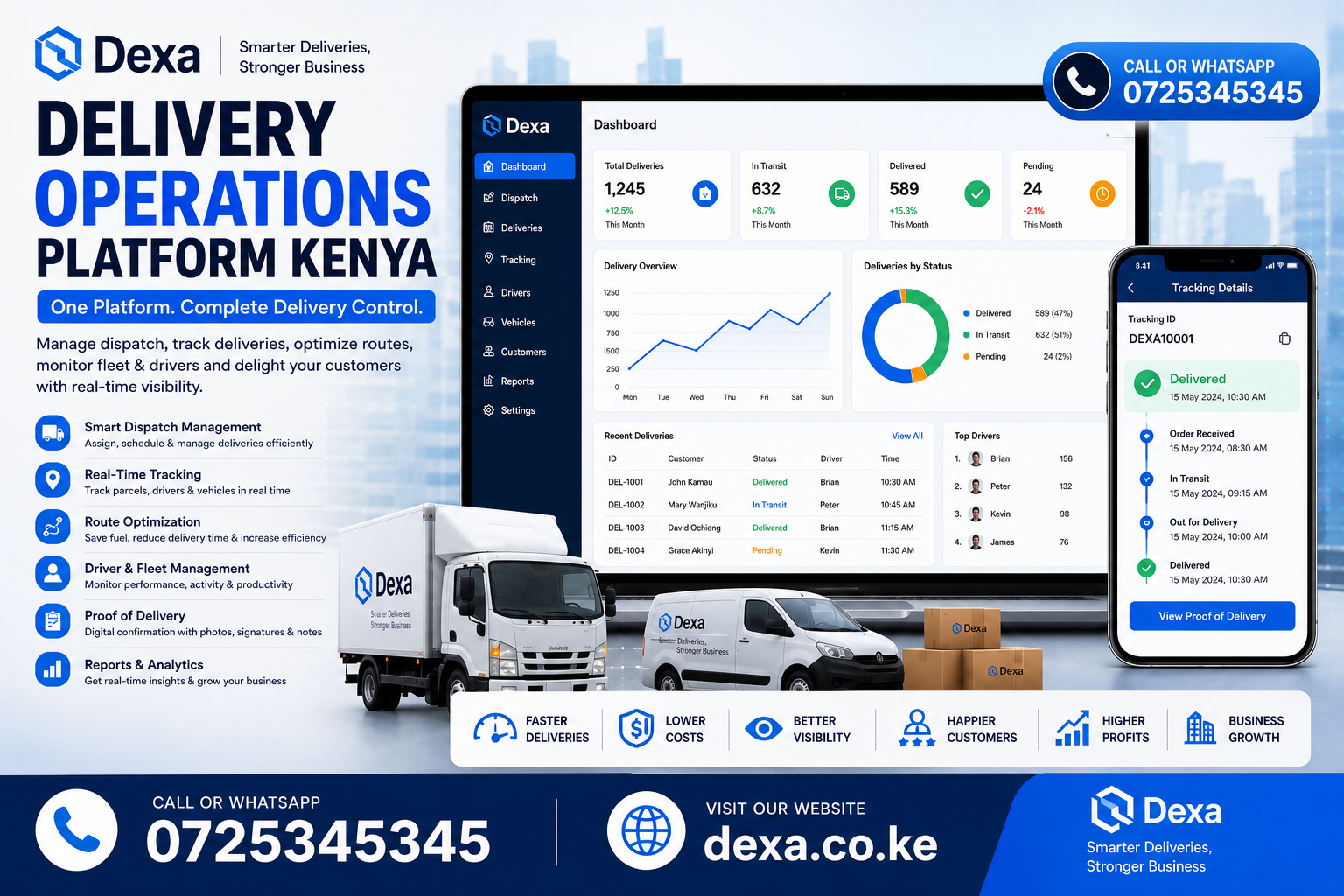
    At Dexa.co.ke, businesses can leverage a powerful Delivery Operations Platform Kenya designed to simplify logistics operations while supporting growth. From order creation and dispatch management to real-time tracking and reporting, Dexa provides the tools modern businesses need to operate efficiently.

    Call or WhatsApp 0725345345 today to schedule a free demo of Dexa Delivery Operations Platform Kenya.

    What Is a Delivery Operations Platform?

    A Delivery Operations Platform Kenya solution is a centralized system that helps businesses manage the complete delivery lifecycle from a single dashboard.

    Instead of using multiple disconnected tools, businesses can coordinate:

    • Delivery requests
    • Dispatch operations
    • Driver assignments
    • Vehicle management
    • Customer notifications
    • Route planning
    • Proof of delivery
    • Reporting and analytics

    A modern Delivery Operations Platform Kenya helps organizations automate repetitive tasks, improve operational visibility, and reduce delivery delays.

    Why Businesses Need a Delivery Operations Platform Kenya

    As customer expectations continue to rise, delivery businesses face increasing pressure to operate faster and more efficiently.

    Common challenges include:

    Delivery Delays

    Manual dispatch processes often create bottlenecks that slow down deliveries.

    Poor Operational Visibility

    Managers struggle to monitor active deliveries and driver performance in real time.

    Communication Gaps

    Customers frequently demand updates regarding parcel locations and estimated delivery times.

    High Operational Costs

    Inefficient routing and manual workflows increase fuel expenses and administrative overhead.

    A robust Delivery Operations Platform Kenya addresses these challenges through automation and centralized management.

    Key Features of a Delivery Operations Platform Kenya

    Smart Dispatch Management

    Effective dispatching is critical for successful delivery operations.

    A Delivery Operations Platform Kenya enables dispatchers to:

    • Assign deliveries quickly
    • Monitor delivery progress
    • Track active jobs
    • Manage exceptions efficiently
    • Improve operational control

    Automated dispatching reduces delays while improving service reliability.

    Real-Time Delivery Tracking

    Modern customers expect visibility throughout the delivery process.

    With a Delivery Operations Platform Kenya, businesses can provide:

    • Live tracking updates
    • Delivery notifications
    • Status monitoring
    • Delivery confirmations
    • Customer transparency

    Real-time tracking improves customer confidence and reduces support inquiries.

    Fleet Management Integration

    Vehicle management is an essential component of efficient delivery operations.

    A comprehensive Delivery Operations Platform Kenya helps businesses:

    • Track fleet activity
    • Monitor vehicle utilization
    • Improve resource allocation
    • Reduce operational inefficiencies

    Better fleet visibility leads to improved performance and reduced operating costs.

    Route Optimization

    Route planning directly impacts delivery efficiency.

    A Delivery Operations Platform Kenya can help organizations:

    • Minimize travel distances
    • Reduce fuel consumption
    • Improve delivery times
    • Increase daily delivery capacity

    Optimized routes contribute significantly to profitability.

    Driver Management

    Managing delivery personnel effectively improves service quality.

    Businesses can use a Delivery Operations Platform Kenya to:

    • Assign workloads fairly
    • Monitor driver performance
    • Track completed deliveries
    • Improve accountability

    This ensures smoother operations and better customer experiences.

    Benefits of Using a Delivery Operations Platform Kenya

    Improved Operational Efficiency

    Automation reduces repetitive manual tasks and streamlines workflows.

    Enhanced Customer Satisfaction

    Customers appreciate accurate tracking information and timely deliveries.

    Reduced Operating Costs

    Businesses often lower expenses related to:

    • Fuel consumption
    • Administrative work
    • Delivery errors
    • Resource wastage

    Better Decision Making

    A Delivery Operations Platform Kenya provides access to real-time operational data that supports informed business decisions.

    Increased Scalability

    As delivery volumes grow, businesses can scale operations without significantly increasing administrative workload.

    How a Delivery Operations Platform Kenya Improves Customer Experience

    Customer experience has become a major competitive advantage in the logistics industry.

    A modern Delivery Operations Platform Kenya helps businesses deliver superior customer experiences through:

    Delivery Transparency

    Customers can track orders throughout the delivery process.

    Faster Deliveries

    Optimized routes and automated dispatching reduce delivery times.

    Accurate Notifications

    Automated updates keep customers informed at every stage.

    Reliable Service

    Improved operational control leads to more consistent delivery performance.

    Satisfied customers are more likely to become repeat clients and recommend your services to others.

    Industries That Benefit from a Delivery Operations Platform Kenya

    A Delivery Operations Platform Kenya can benefit various industries including:

    Courier Companies

    Manage parcel deliveries, dispatching, and tracking from one platform.

    E-Commerce Businesses

    Coordinate customer deliveries and improve order fulfillment.

    Distribution Companies

    Streamline product deliveries across multiple regions.

    Retail Businesses

    Enhance last-mile delivery operations and customer communication.

    Enterprise Logistics Providers

    Manage large-scale delivery networks efficiently.

    Reporting and Analytics

    Data-driven decision-making is essential for growth.

    A Delivery Operations Platform provides detailed insights into:

    • Delivery volumes
    • Driver productivity
    • Vehicle utilization
    • Revenue performance
    • Operational efficiency
    • Customer satisfaction trends

    These reports help businesses identify opportunities for improvement and optimize performance.

    Why Choose Dexa Delivery Operations Platform Kenya?

    Dexa offers a modern, scalable, and easy-to-use Delivery Operations Platform designed to meet the needs of growing logistics businesses.

    Key advantages include:

    • Centralized delivery management
    • Real-time tracking
    • Smart dispatching
    • Fleet visibility
    • Driver management
    • Reporting and analytics
    • Scalable infrastructure
    • Improved customer experiences

    Whether you manage a startup delivery company or a large logistics enterprise, Dexa provides the technology needed to streamline operations and support growth.

    Call or WhatsApp 0725345345 today and discover how Dexa Delivery Operations Platform Kenya can transform your logistics operations.

    Future of Delivery Operations in Kenya

    Technology continues to reshape the logistics landscape.

    Businesses that invest in a modern Delivery Operations Platform gain advantages through:

    • Faster service delivery
    • Better operational visibility
    • Improved efficiency
    • Reduced costs
    • Enhanced customer satisfaction

    As competition increases, organizations that embrace automation and digital transformation will be better positioned for long-term success.

    Conclusion

    Managing deliveries manually is no longer sustainable for growing businesses. Companies require advanced tools that provide visibility, automation, and operational control.

    A Delivery Operations Platform Kenya helps businesses streamline dispatching, improve tracking, optimize routes, manage fleets, and deliver exceptional customer experiences.

    With Dexa.co.ke, organizations gain access to a powerful Delivery Operations Platform  that supports efficient operations and sustainable growth.

    Ready to modernize your delivery operations?

    Call or WhatsApp 0725345345 today for a free demo and learn how Dexa Delivery Operations Platform Kenya can help your business grow.

    Frequently Asked Questions

    What is a Delivery Operations Platform?

    A Delivery Operations Platform is a centralized system that manages dispatching, delivery tracking, fleet operations, customer communication, and reporting.

    Who can benefit from a Delivery Operations Platform?

    Courier companies, logistics providers, e-commerce businesses, distributors, retailers, and enterprise delivery operations can all benefit.

    Does Dexa support real-time delivery tracking?

    Yes. Dexa provides real-time visibility into delivery operations to improve customer service and operational control.

    How does a Delivery Operations Platform improve efficiency?

    It automates workflows, optimizes routes, improves dispatching, and provides centralized operational visibility.

    How can I get started with Dexa Delivery Operations Platform Kenya?

    Call or WhatsApp 0725345345 to schedule a free demonstration and consultation.

  • Fleet Dispatch Software Kenya: Smart Vehicle and Delivery Management for Modern Logistics Companies

    Fleet Dispatch Software Kenya

    Fleet Dispatch Software Kenya: Smart Vehicle and Delivery Management for Modern Logistics Companies

    The logistics and transportation industry in Kenya is becoming increasingly competitive. Customers expect faster deliveries, real-time updates, efficient service, and reliable communication throughout the delivery process. Businesses that rely on manual dispatch processes often struggle with delays, poor fleet visibility, inefficient route planning, and rising operational costs.

    This is where Fleet Dispatch Software Kenya becomes an essential business tool. Modern fleet dispatch software helps organizations automate vehicle assignments, track drivers in real time, optimize delivery routes, monitor fleet performance, and improve customer satisfaction.

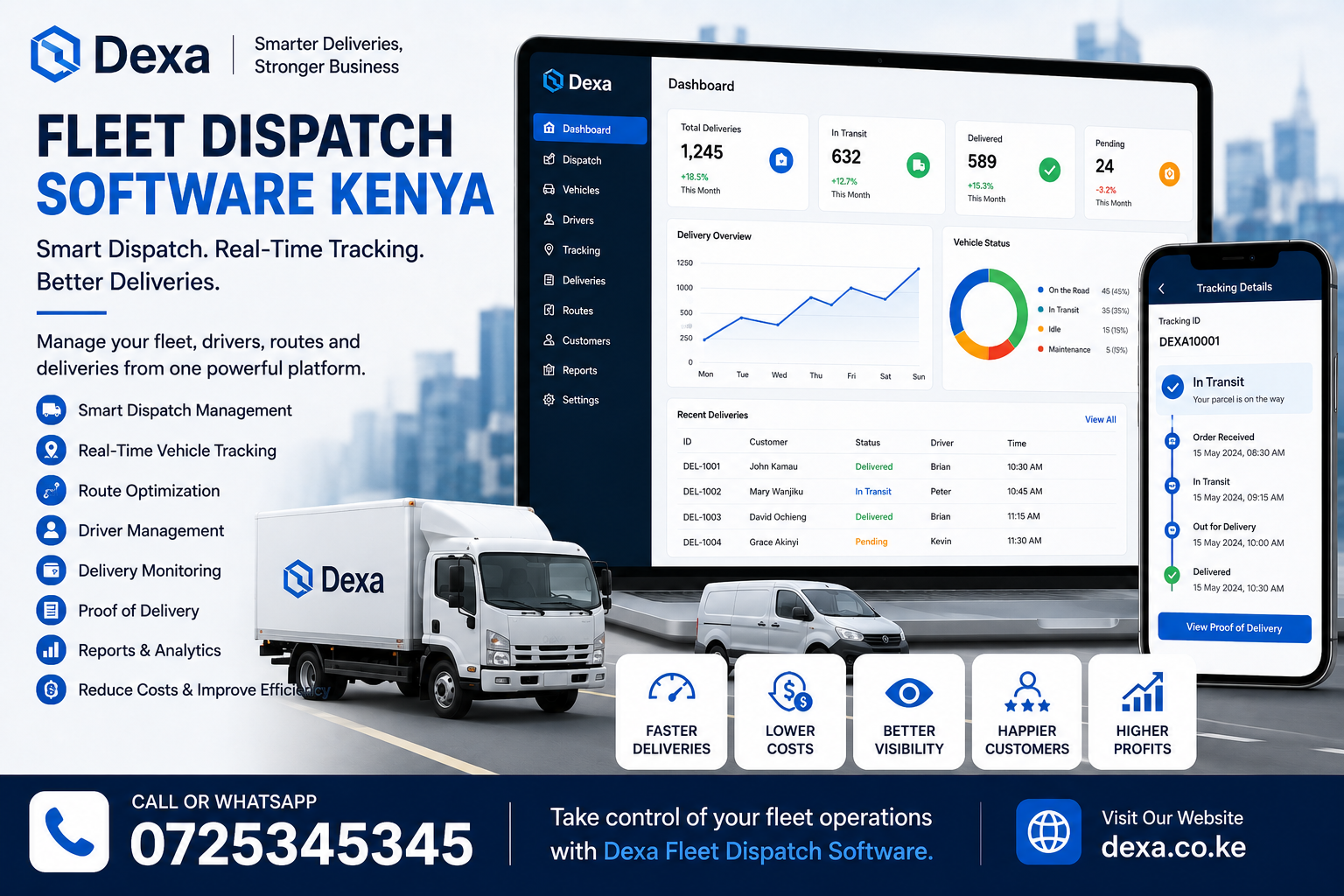
    At Dexa.co.ke, businesses can access a comprehensive fleet dispatch solution designed to streamline operations and improve overall efficiency. Whether you manage a courier company, distribution network, transport fleet, or logistics business, the right dispatch software can significantly enhance productivity and profitability.

    Call or WhatsApp 0725345345 today to learn how Dexa can transform your fleet operations.

    What Is Fleet Dispatch Software Kenya?

    Fleet Dispatch Software Kenya is a digital platform that helps businesses coordinate vehicles, drivers, deliveries, and dispatch operations from a centralized dashboard.

    Instead of relying on spreadsheets, phone calls, or manual paperwork, dispatchers can automate critical processes including:

    • Vehicle assignment
    • Driver scheduling
    • Route planning
    • Delivery tracking
    • Fleet monitoring
    • Performance reporting
    • Customer communication

    This automation reduces operational complexity and helps businesses manage growing delivery volumes more efficiently.

    Why Businesses Need Fleet Dispatch Software Kenya

    Many organizations experience operational challenges due to outdated dispatch methods. As fleets grow, manual processes become increasingly difficult to manage.

    Common challenges include:

    Poor Vehicle Visibility

    Without proper tracking systems, managers often struggle to know where vehicles are located or whether deliveries are progressing as planned.

    Inefficient Route Planning

    Poor route management can increase fuel consumption, delay deliveries, and reduce overall fleet productivity.

    Driver Coordination Problems

    Managing multiple drivers through phone calls and messaging applications can lead to communication gaps and scheduling conflicts.

    Limited Reporting

    Businesses need accurate operational data to make informed decisions and identify opportunities for improvement.

    Fleet Dispatch Software Kenya addresses these challenges by providing centralized visibility and automation.

    Key Features of Fleet Dispatch Software Kenya

    Smart Dispatch Management

    Dispatchers can assign vehicles quickly and efficiently based on delivery requirements, vehicle availability, and operational priorities.

    Benefits include:

    • Faster assignment processes
    • Reduced dispatch delays
    • Improved resource utilization
    • Better operational control

    Real-Time Vehicle Tracking

    Real-time tracking allows managers to monitor fleet activity throughout the day.

    Advantages include:

    • Improved visibility
    • Faster issue resolution
    • Enhanced customer communication
    • Better route management

    Customers also benefit from improved transparency regarding delivery status.

    Route Optimization

    Route optimization helps businesses identify the most efficient delivery paths.

    This can result in:

    • Reduced fuel costs
    • Faster deliveries
    • Increased vehicle productivity
    • Lower operating expenses

    For growing logistics businesses, route optimization can significantly improve profitability.

    Driver Management

    Fleet Dispatch Software Kenya enables businesses to manage driver performance more effectively.

    Features may include:

    • Driver assignment
    • Performance monitoring
    • Delivery tracking
    • Attendance monitoring
    • Workload balancing

    This helps improve accountability and operational efficiency.

    Delivery Monitoring

    Managers can track deliveries from dispatch to completion.

    Benefits include:

    • Better customer service
    • Faster response times
    • Reduced delivery disputes
    • Improved delivery success rates

    Benefits of Fleet Dispatch Software Kenya

    Improved Operational Efficiency

    Automation eliminates repetitive manual tasks and reduces administrative workload.

    Enhanced Customer Satisfaction

    Customers appreciate timely deliveries and accurate tracking information.

    Better Resource Utilization

    Businesses can maximize vehicle usage while minimizing unnecessary operational expenses.

    Increased Profitability

    Improved efficiency often leads to:

    • Lower fuel costs
    • Reduced overtime
    • Better fleet utilization
    • Higher delivery volumes

    Scalable Operations

    As businesses grow, fleet dispatch software helps maintain efficiency without significantly increasing administrative requirements.

    Industries That Benefit from Fleet Dispatch Software Kenya 

    Fleet Dispatch Software Kenya is suitable for a wide range of industries including:

    Courier Services

    Courier companies can manage parcel deliveries, driver assignments, and customer communication more effectively.

    Logistics Companies

    Logistics providers can streamline transportation operations and improve visibility across their delivery network.

    Distribution Businesses

    Distributors can coordinate deliveries, optimize routes, and monitor fleet performance.

    Retail Businesses

    Retailers offering delivery services can improve order fulfillment and customer satisfaction.

    Field Service Organizations

    Businesses that deploy technicians or service teams can manage schedules and assignments more efficiently.

    How Dexa Supports Fleet Management

    Dexa provides a modern platform designed to simplify fleet operations while supporting business growth.

    The system helps businesses:

    • Manage dispatch operations
    • Track vehicle activity
    • Monitor driver performance
    • Improve communication
    • Generate operational reports
    • Optimize resource utilization

    By centralizing fleet management activities, businesses gain better visibility and control over daily operations.

    Why Choose Dexa Fleet Dispatch Software Kenya?

    Dexa offers businesses a reliable and scalable fleet management solution designed to meet the needs of modern logistics operations.

    Key advantages include:

    • User-friendly interface
    • Centralized dispatch management
    • Real-time visibility
    • Reporting and analytics
    • Scalable infrastructure
    • Improved operational efficiency

    Businesses can reduce manual work while improving service delivery and customer satisfaction.

    Future of Fleet Dispatch Management in Kenya

    Technology continues to reshape transportation and logistics operations across Kenya.

    Organizations that adopt modern fleet dispatch solutions gain a competitive advantage through:

    • Faster service delivery
    • Better fleet visibility
    • Improved customer experiences
    • Reduced operational costs
    • Greater scalability

    As customer expectations continue to rise, businesses that invest in advanced dispatch management systems will be better positioned for long-term success.

    Conclusion

    Managing fleet operations manually is becoming increasingly difficult in today’s fast-moving business environment. Organizations require greater visibility, efficiency, and control to remain competitive.

    Fleet Dispatch Software Kenya provides the tools needed to automate dispatch operations, improve route planning, enhance driver management, and optimize fleet performance.

    With a comprehensive solution from Dexa.co.ke, businesses can streamline operations, improve customer satisfaction, and achieve sustainable growth.

    Call or WhatsApp 0725345345 today to schedule a free demo and discover how Dexa Fleet Dispatch Software Kenya can transform your logistics operations.

    Frequently Asked Questions

    What is Fleet Dispatch Software?

    Fleet Dispatch Software is a platform that helps businesses manage vehicles, drivers, deliveries, routes, and dispatch operations from a centralized system.

    Who can use Fleet Dispatch Software Kenya?

    Courier companies, logistics providers, distributors, retailers, transport companies, and field service organizations can benefit from fleet dispatch software.

    Does Fleet Dispatch Software Kenya improve delivery efficiency?

    Yes. It helps optimize routes, improve vehicle utilization, and streamline dispatch operations.

    Can Fleet Dispatch Software reduce operational costs?

    Yes. Businesses often reduce fuel expenses, administrative workload, and delivery delays through automation and route optimization.

    How can I learn more about Dexa Fleet Dispatch Software Kenya?

    Contact Dexa today by calling or WhatsApping 0725345345 for a free demonstration and consultation.

  • Courier Enterprise Software Kenya: The Complete Solution for Modern Logistics and Delivery Operations

    Courier Enterprise Software Kenya

    Courier Enterprise Software Kenya: The Complete Solution for Modern Logistics and Delivery Operations

    The courier and logistics industry in Kenya is evolving rapidly. Businesses now expect faster deliveries, real-time tracking, transparent communication, and efficient operations. Traditional methods such as spreadsheets, phone calls, WhatsApp groups, and manual paperwork are no longer sufficient for growing courier companies.

    To remain competitive, courier businesses need a centralized platform that automates operations, improves visibility, and enhances customer satisfaction. This is where Courier Enterprise Software Kenya becomes essential.

    At Dexa.co.ke, businesses gain access to a modern courier management platform designed to simplify dispatch, rider coordination, parcel tracking, billing, payments, reporting, and customer communication from one centralized system. Dexa is built specifically for courier companies seeking operational efficiency and scalable growth.

    What Is Courier Enterprise Software Kenya?

    Courier Enterprise Software Kenya is an integrated platform that manages every stage of the delivery lifecycle.

    From order booking to proof of delivery, the software provides a complete operational framework that allows courier businesses to operate efficiently while maintaining visibility across all processes.

    Instead of using multiple disconnected tools, courier companies can manage everything through a single dashboard including:

    • Parcel booking
    • Dispatch operations
    • Rider management
    • Customer communication
    • Route monitoring
    • Billing and invoicing
    • Payment reconciliation
    • Reporting and analytics
    • Proof of delivery management

    Modern enterprise courier software helps businesses eliminate manual errors, increase productivity, and deliver superior customer experiences.

    Why Courier Companies Need Enterprise Software

    Growing Delivery Volumes

    E-commerce growth and increasing demand for same-day deliveries have significantly increased shipment volumes across Kenya.

    Manual processes become difficult to manage as order volumes increase. Courier enterprise software Kenya provides automation that enables businesses to scale without increasing administrative workload.

    Customer Expectations Have Changed

    Customers now expect:

    • Real-time parcel tracking
    • Instant delivery updates
    • Fast issue resolution
    • Digital proof of delivery
    • Transparent communication

    Courier businesses that cannot meet these expectations risk losing customers to more technologically advanced competitors.

    Operational Visibility Matters

    Managers need access to accurate data regarding:

    • Active deliveries
    • Rider performance
    • Delivery success rates
    • Revenue collection
    • Outstanding invoices
    • Customer satisfaction

    Courier enterprise software Kenya provides this visibility through centralized dashboards and automated reporting.

    Key Features of Courier Enterprise Software Kenya

    Smart Dispatch Management

    Dispatch operations are the foundation of every courier business.

    Dexa provides a structured dispatch workflow that enables businesses to:

    • Create orders quickly
    • Assign deliveries efficiently
    • Monitor delivery progress
    • Track status changes
    • Manage exceptions
    • Verify completed deliveries

    This creates a predictable workflow that reduces confusion and improves operational efficiency.

    Real-Time Parcel Tracking

    Customers want to know exactly where their deliveries are.

    With enterprise tracking capabilities, businesses can provide:

    • Live shipment updates
    • Delivery status notifications
    • Tracking portals
    • Estimated delivery progress
    • Delivery confirmations

    This improves customer trust and reduces support inquiries.

    Rider Management System

    Managing riders effectively is critical for successful delivery operations.

    Dexa enables businesses to:

    • Monitor rider availability
    • Manage rider capacity
    • Assign workloads intelligently
    • Track active jobs
    • Capture proof of delivery
    • Evaluate performance metrics

    This ensures optimal resource utilization and improved delivery efficiency.

    Proof of Delivery Management

    Proof of Delivery (POD) provides accountability and transparency.

    Enterprise software enables:

    • Signature capture
    • Image uploads
    • Delivery verification
    • Timestamp recording
    • Customer confirmation

    Digital proof of delivery helps resolve disputes quickly while improving customer confidence.

    Customer Experience Benefits

    Professional Tracking Experience

    Customers appreciate visibility throughout the delivery journey.

    A professional tracking portal helps businesses:

    • Build credibility
    • Increase customer trust
    • Improve communication
    • Reduce support requests

    According to Dexa, public tracking and branded customer experiences help businesses appear more trustworthy from the first interaction.

    Faster Customer Support

    When customer service teams have access to delivery data, they can resolve issues more quickly.

    Benefits include:

    • Reduced response times
    • Better issue resolution
    • Improved customer satisfaction
    • Increased customer retention

    Financial Management Features

    Integrated Billing and Invoicing

    Courier businesses often struggle with disconnected finance and operations processes.

    Courier enterprise software Kenya solves this challenge through:

    • Automated invoicing
    • Client billing
    • Statement generation
    • Financial reporting
    • Transaction tracking

    Payment Management

    Dexa supports both M-Pesa and manual payment workflows, allowing businesses to maintain complete payment visibility.

    Benefits include:

    • Faster payment reconciliation
    • Reduced financial errors
    • Improved cash flow management
    • Better revenue visibility

    Collection Tracking

    Businesses can easily monitor:

    • Paid deliveries
    • Outstanding balances
    • Collection history
    • Customer payment records

    This improves financial accountability across the organization.

    Operational Reporting and Analytics

    Business Intelligence

    Courier Enterprise software Kenya transforms operational data into actionable insights.

    Managers can monitor:

    • Delivery volumes
    • Rider productivity
    • Revenue trends
    • Delivery success rates
    • Customer activity
    • Operational bottlenecks

    Data-Driven Decisions

    Analytics enable businesses to:

    • Identify inefficiencies
    • Optimize workflows
    • Improve resource allocation
    • Increase profitability

    Organizations that leverage operational data often outperform competitors that rely on manual reporting.

    Multi-Branch and Enterprise Scalability

    As courier businesses grow, managing multiple branches becomes increasingly complex.

    Enterprise software supports:

    Multi-Location Operations

    Businesses can manage:

    • Multiple offices
    • Different regions
    • Branch-level reporting
    • Centralized oversight

    Role-Based Access Control

    Different users can access different functions based on their responsibilities.

    Roles may include:

    • Administrators
    • Dispatchers
    • Riders
    • Finance staff
    • Customer service teams
    • Clients

    This improves security while maintaining operational efficiency.

    Business Expansion Support

    Dexa supports multiple courier businesses from a single SaaS foundation, making it suitable for growing enterprises and logistics groups.

    How Courier Enterprise Software Kenya Improves Profitability

    Reduced Administrative Costs

    Automation minimizes manual work by:

    • Eliminating duplicate data entry
    • Reducing paperwork
    • Streamlining workflows

    Increased Delivery Efficiency

    Better dispatch management results in:

    • Faster deliveries
    • Improved resource utilization
    • Higher rider productivity

    Enhanced Customer Retention

    Satisfied customers are more likely to continue using courier services.

    Professional tracking, reliable communication, and faster deliveries contribute directly to customer loyalty.

    Better Financial Control

    Integrated billing and payment tracking help businesses:

    • Improve cash flow
    • Reduce revenue leakage
    • Increase profitability

    Why Choose Dexa for Courier Enterprise Software Kenya?

    Dexa was designed specifically to address the operational challenges faced by courier businesses.

    The platform combines:

    • Dispatch management
    • Rider workflows
    • Customer tracking
    • Billing systems
    • Payment management
    • Reporting tools
    • Multi-business capabilities

    All within a clean, structured, and scalable environment.

    Businesses can launch quickly, streamline operations, and grow without rebuilding their systems as demand increases.

    Whether you operate a startup courier company, a regional logistics provider, or a large enterprise delivery network, Dexa provides the technology foundation required for long-term growth and operational excellence.

    Conclusion

    The logistics industry is becoming increasingly competitive, and businesses that rely on manual processes risk falling behind.

    Implementing Courier Enterprise Software Kenya enables courier companies to improve operational efficiency, enhance customer satisfaction, automate financial processes, and scale confidently.

    With comprehensive features for dispatch, tracking, rider management, billing, payments, and reporting, Dexa.co.ke provides a complete enterprise solution for modern courier businesses.

    Organizations seeking to improve delivery performance, reduce operational complexity, and increase profitability should consider adopting a robust courier enterprise platform that supports both current operations and future growth.

    FAQs

    What is Courier Enterprise Software Kenya?

    Courier Enterprise Software is a centralized platform that helps courier companies manage dispatch, tracking, rider coordination, billing, payments, reporting, and customer communication.

    How does courier enterprise software Kenya improve delivery operations?

    It automates workflows, improves visibility, reduces manual work, and enables real-time tracking throughout the delivery lifecycle.

    Can courier enterprise software Kenya support multiple branches?

    Yes. Modern enterprise platforms support multi-branch operations, centralized oversight, and branch-specific reporting.

    Does Dexa support parcel tracking?

    Yes. Dexa includes customer-facing tracking capabilities that allow clients and recipients to monitor delivery progress in real time.

    Is Dexa suitable for growing courier businesses?

    Yes. Dexa is designed to support businesses of different sizes, from startups to large courier enterprises, with scalable features and multi-business capabilities.

  • Powerful Parcel Delivery Management Platform in Kenya | Smart Logistics by Dexa

    Parcel Delivery Management Platform Parcel Delivery Management Platform in Kenya 

    Introduction: The Future of Courier and Logistics Management

    The logistics industry in Kenya is evolving rapidly, driven by the rise of e-commerce, digital marketplaces, SME delivery services, and same-day courier expectations. In this fast-paced environment, businesses can no longer rely on manual tracking, spreadsheets, or disconnected communication systems.

    A Parcel Delivery Management Platform is now the backbone of modern courier operations. It centralizes every aspect of logistics—from order creation to final delivery confirmation—into a single digital system.

    The platform offered by Dexa transforms traditional courier operations into a fully automated, transparent, and scalable system that improves efficiency, reduces errors, and enhances customer satisfaction.

    What is a Parcel Delivery Management Platform?

    A Parcel Delivery Management Platform is a software solution designed to manage the entire lifecycle of parcel delivery operations. It integrates multiple logistics functions into one system, ensuring smooth coordination between dispatch teams, riders, customers, and finance departments.

    Instead of relying on manual processes, courier companies use the system to:

    • Register and manage parcel orders
    • Assign deliveries to riders
    • Track parcels in real time
    • Generate invoices and payment records
    • Provide proof of delivery (POD)
    • Communicate updates to customers automatically

    With a system like the one provided by Dexa, logistics companies gain complete control and visibility over their entire delivery network.

    Why Parcel Delivery Systems Are Essential in Kenya

    Kenya’s logistics sector is experiencing rapid growth due to:

    • Expansion of e-commerce platforms
    • Increased demand for last-mile delivery
    • Growth of SMEs and online sellers
    • Rising customer expectations for fast delivery

    However, many courier businesses still struggle with operational inefficiencies such as:

    • Lost or delayed parcels
    • Manual dispatch coordination
    • Lack of real-time tracking
    • Poor communication between riders and customers
    • Revenue leakage due to untracked payments

    A Parcel Delivery Management Platform in Kenya solves these challenges by digitizing operations and introducing automation at every stage.

    Core Features of Dexa Parcel Delivery Management Platform

    The system built by Dexa is designed to meet the needs of modern logistics businesses. It combines operational efficiency with advanced tracking and reporting capabilities.

    1. Smart Order Management System

    Every parcel begins its journey with structured order entry. The system captures sender details, receiver information, parcel type, and delivery instructions.

    This ensures that no order is lost or incorrectly recorded.

    2. Advanced Dispatch Automation

    Dispatching is one of the most critical parts of logistics. Dexa’s system automatically assigns deliveries to available riders based on:

    • Location
    • Workload
    • Availability
    • Delivery priority

    This reduces delays and ensures faster fulfillment.

    3. Real-Time Parcel Tracking

    Customers today expect full visibility of their deliveries. The platform provides live tracking updates from pickup to final delivery.

    This includes:

    • Pickup confirmation
    • In-transit status updates
    • Delivery location tracking
    • Final delivery confirmation

    4. Digital Proof of Delivery (POD)

    To eliminate disputes, the system captures:

    • Digital signatures
    • Delivery photos
    • Timestamped confirmation
    • GPS location verification

    This ensures accountability for every delivery made.

    5. Integrated Payment and Billing System

    Financial tracking is fully automated. The system links each parcel to:

    • Invoice generation
    • Payment tracking
    • Rider commissions
    • Revenue reports

    This eliminates financial confusion and improves transparency.

    6. Customer Notification System

    Customers receive automated updates via SMS or dashboard notifications at every stage of delivery. This improves trust and reduces support inquiries.

    How Dexa Improves Courier Efficiency

    A Parcel Delivery Management Platform like Dexa significantly improves operational efficiency by reducing manual tasks and introducing automation.

    Faster Delivery Processing

    Orders are processed instantly, reducing delays in dispatch and assignment.

    Reduced Human Errors

    Automation minimizes mistakes such as wrong addresses, missed deliveries, or duplicate entries.

    Improved Rider Management

    Managers can monitor rider activity, performance, and workload in real time.

    Better Resource Allocation

    The system ensures optimal use of available riders and delivery resources.

    Increased Transparency

    Every stakeholder—from customer to manager—has access to real-time delivery information.

    Step-by-Step Parcel Workflow in Dexa System

    The delivery process follows a structured workflow:

    1. Order Creation

    A parcel is registered in the system with complete sender and receiver details.

    2. Dispatch Assignment

    The system assigns the parcel to a rider based on availability and location.

    3. Parcel Pickup

    The rider collects the parcel and updates its status in the system.

    4. Real-Time Transit Tracking

    The parcel is tracked throughout its journey to the destination.

    5. Delivery Completion

    The recipient receives the parcel, and proof of delivery is captured digitally.

    6. Payment Reconciliation

    All financial records are automatically updated and stored.

    Benefits of Using a Parcel Delivery Management Platform

    Businesses using Dexa experience significant improvements across operations.

    Operational Benefits

    • Faster dispatching
    • Reduced manual workload
    • Improved delivery accuracy
    • Centralized control system

    Financial Benefits

    • Accurate billing
    • Reduced revenue loss
    • Automated commission tracking
    • Better financial reporting

    Customer Experience Benefits

    • Real-time tracking
    • Faster delivery updates
    • Transparent communication
    • Improved trust and satisfaction

    Who Needs This System?

    The Parcel Delivery Management Platform in Kenya is ideal for:

    • Courier companies
    • E-commerce delivery services
    • SME logistics providers
    • Retail delivery networks
    • Corporate logistics departments

    Whether a business is small or large, the platform scales to match operational needs.

    Challenges Solved by Dexa Platform

    Courier businesses often face challenges such as:

    • Inefficient manual dispatching
    • Lack of transparency in deliveries
    • Poor customer communication
    • Difficulty tracking payments
    • Unorganized rider management

    The system developed by Dexa solves these challenges by introducing automation, real-time tracking, and centralized management.

    Why Automation is the Future of Logistics

    Automation is no longer optional in logistics—it is essential. Businesses that adopt platforms like Dexa gain:

    • Competitive advantage
    • Faster service delivery
    • Reduced operational costs
    • Improved scalability

    In Kenya’s growing digital economy, automated logistics systems are becoming the standard.

    Scalability and Growth with Dexa

    One of the strongest advantages of a Parcel Delivery Management Platform is scalability.

    As your business grows:

    • You can manage more riders
    • Handle more parcels daily
    • Expand to new locations
    • Improve delivery speed without increasing manual workload

    The system grows with your business.

    Security and Data Protection

    The platform ensures secure handling of:

    • Customer data
    • Payment information
    • Delivery records
    • Operational reports

    This reduces fraud risks and ensures compliance with business standards.

    Conclusion

    A Parcel Delivery Management Platform in Kenya is no longer a luxury—it is a necessity for any serious courier or logistics business.

    With the system provided by Dexa, businesses can automate operations, improve efficiency, enhance customer experience, and scale confidently in a competitive market.

    From dispatch to delivery, every process becomes structured, transparent, and fully optimized for performance.

    FAQs

    1. What is a Parcel Delivery Management Platform?

    It is a software system that manages courier operations including dispatch, tracking, and payments.

    2. How does Dexa improve courier operations?

    Dexa automates delivery workflows, improves tracking accuracy, and enhances customer communication.

    3. Is Dexa suitable for small businesses?

    Yes, it is scalable and works for both small and large logistics companies.

    4. Does it support real-time tracking?

    Yes, customers and managers can track parcels live from pickup to delivery.

    5. Can it manage multiple riders and branches?

    Yes, the system supports multi-rider and multi-branch logistics operations.

  • Parcel Tracking Software Kenya – Smart Real-Time Parcel Management for Courier Businesses

    Parcel Tracking Software Kenya

    Parcel Tracking Software Kenya – Transforming Courier Operations with Real-Time Visibility

    The courier and logistics industry in Kenya continues to grow rapidly as businesses and consumers increasingly rely on efficient parcel delivery services. Whether you operate a courier company, e-commerce business, delivery service, or transport firm, keeping track of parcels throughout the delivery journey is essential.

    This is where Parcel Tracking Software Kenya becomes invaluable. Modern parcel tracking systems provide real-time visibility, automated updates, proof of delivery, rider management, and customer tracking portals that significantly improve operational efficiency and customer satisfaction.

    At Dexa.co.ke, businesses gain access to a comprehensive courier management platform that combines dispatch management, rider coordination, public tracking, billing, payments, and reporting in one centralized solution.

    What Is Parcel Tracking Software Kenya?

    Parcel tracking software is a digital platform that allows courier companies and logistics providers to monitor parcels from booking to final delivery.

    Instead of relying on spreadsheets, phone calls, and manual updates, businesses can manage every parcel through a centralized dashboard that provides real-time tracking and complete delivery visibility.

    Modern parcel tracking software typically includes:

    • Parcel registration
    • Tracking number generation
    • Real-time status updates
    • Dispatch management
    • Rider assignment
    • Customer notifications
    • Proof of delivery
    • Billing and payment management
    • Reporting and analytics

    These tools help businesses streamline operations while giving customers confidence that their parcels are moving through the delivery process efficiently.

    Why Kenyan Courier Businesses Need Parcel Tracking Software Kenya

    Growing Customer Expectations

    Today’s customers expect instant information. They want to know:

    • Where their parcel is
    • When it will arrive
    • Whether delivery has been completed
    • Who handled the parcel

    Without proper tracking systems, customer support teams spend significant time answering status inquiries.

    Reduced Parcel Losses

    Manual tracking processes increase the likelihood of:

    • Lost parcels
    • Misrouted deliveries
    • Delivery disputes
    • Missing documentation

    A centralized parcel tracking platform creates accountability throughout the delivery chain.

    Improved Operational Efficiency

    Parcel tracking software automates routine tasks and allows dispatchers to focus on operational management rather than manual record keeping.

    Enhanced Customer Experience

    Customers appreciate transparency. Real-time parcel tracking builds trust and creates a professional experience that encourages repeat business.

    Key Features of Modern Parcel Tracking Software Kenya

    Real-Time Parcel Tracking

    One of the most important features is live parcel visibility.

    Every parcel receives a unique tracking number that allows both operators and customers to monitor delivery progress.

    Statuses may include:

    • Order received
    • Awaiting dispatch
    • Assigned to rider
    • In transit
    • Out for delivery
    • Delivered

    Real-time updates eliminate uncertainty and improve customer confidence.

    Dispatch Management

    Efficient dispatching is essential for courier operations.

    Parcel tracking software allows dispatchers to:

    • Create delivery orders
    • Assign riders
    • Monitor active deliveries
    • Manage delivery queues
    • Handle exceptions

    Dexa provides structured dispatch workflows that help courier companies move orders from booking to delivery efficiently.

    Rider Coordination

    Managing delivery personnel becomes easier with integrated rider management tools.

    Businesses can:

    • Track rider workloads
    • Monitor availability
    • Manage delivery assignments
    • Capture delivery evidence
    • Optimize daily operations

    This reduces communication delays and improves delivery performance.

    Proof of Delivery (POD)

    Proof of delivery protects both the courier company and customers.

    Features may include:

    • Digital signatures
    • Photo capture
    • Delivery timestamps
    • Recipient confirmation

    This creates an audit trail for every completed delivery.

    Customer Tracking Portal

    A customer-facing tracking portal allows recipients and senders to independently monitor deliveries.

    Benefits include:

    • Reduced support calls
    • Better customer experience
    • Increased transparency
    • Professional brand image

    Dexa includes public tracking capabilities that enable customers to follow parcel progress without contacting support teams.

    Automated Notifications

    Customers receive updates through:

    • SMS
    • Email
    • Tracking portals
    • System alerts

    Notifications keep customers informed at every stage of delivery.

    How Parcel Tracking Software Kenya Improves Courier Business Performance

    Faster Deliveries

    Dispatchers can quickly identify:

    • Delayed parcels
    • Unassigned deliveries
    • Rider bottlenecks
    • Route issues

    This enables proactive intervention before problems escalate.

    Better Customer Retention

    Customers are more likely to return when they can easily track deliveries and receive consistent updates.

    Improved Team Accountability

    Every action is recorded, creating accountability among:

    • Dispatchers
    • Riders
    • Customer service teams
    • Administrators

    Enhanced Reporting

    Managers gain access to performance metrics such as:

    • Delivery success rates
    • Parcel volumes
    • Rider productivity
    • Revenue tracking
    • Operational trends

    These insights support better decision-making.

    Industries That Benefit from Parcel Tracking Software Kenya

    Courier Companies

    Courier businesses can manage thousands of deliveries more efficiently using automated tracking and dispatch tools.

    E-Commerce Businesses

    Online stores use parcel tracking systems to provide customers with shipment visibility and delivery updates.

    Retail Chains

    Retailers offering home delivery services can monitor order fulfillment and delivery performance.

    Distribution Companies

    Businesses moving products between branches benefit from centralized tracking and inventory visibility.

    Document Delivery Services

    Legal firms, government agencies, and corporate organizations can securely track important documents and packages.

    Why Choose Dexa for Parcel Tracking Software Kenya?

    Dexa is designed specifically for modern courier operations seeking operational clarity and scalability.

    Key benefits include:

    Unified Courier Management

    Manage:

    • Orders
    • Riders
    • Dispatch
    • Payments
    • Billing
    • Tracking

    from one platform.

    Real-Time Tracking

    Provide customers with instant parcel visibility and delivery updates through branded tracking pages.

    Payment Visibility

    Maintain complete records of M-Pesa and manual payment transactions linked directly to delivery operations.

    Multi-Business Support

    Operate multiple courier brands while maintaining separate data and customer experiences.

    Scalable Growth

    Whether you’re a startup courier company or a growing logistics operation, Dexa scales with your business requirements.

    Future Trends in Parcel Tracking Software Kenya

    The future of logistics technology continues to evolve with:

    AI-Powered Route Optimization

    Artificial intelligence will improve delivery planning and reduce operational costs.

    Predictive Delivery Estimates

    Systems will provide increasingly accurate delivery windows based on traffic, weather, and rider performance.

    Enhanced Customer Communication

    Automated communication tools will continue improving customer engagement and satisfaction.

    Mobile-First Operations

    Courier teams will increasingly rely on mobile applications for delivery execution and tracking.

    Advanced Analytics

    Data-driven insights will help businesses optimize operations and improve profitability.

    Conclusion

    The logistics industry is becoming increasingly competitive, making efficiency, transparency, and customer satisfaction critical success factors. Implementing Parcel Tracking Software Kenya enables businesses to streamline operations, reduce delivery issues, improve visibility, and deliver a superior customer experience.

    Dexa provides a complete courier management platform that combines parcel tracking, dispatch management, rider coordination, customer tracking, billing, payments, and reporting into one powerful solution. For courier businesses looking to modernize operations and scale efficiently, Dexa offers the technology needed to stay ahead in Kenya’s growing logistics market.

    Frequently Asked Questions

    What is Parcel Tracking Software Kenya?

    Parcel tracking software is a system that allows businesses to monitor parcel movement from booking through final delivery using real-time updates and tracking tools.

    Who can use parcel tracking software?

    Courier companies, logistics providers, e-commerce stores, retailers, distribution companies, and delivery services can all benefit from parcel tracking software.

    Does Dexa provide customer tracking portals?

    Yes. Dexa offers public tracking capabilities that allow customers to monitor parcel status independently.

    Can parcel tracking software Kenya reduce delivery errors?

    Yes. Automated tracking, rider management, and proof of delivery features significantly reduce manual errors and delivery disputes.

    Is parcel tracking software suitable for growing courier companies?

    Absolutely. Modern parcel tracking platforms like Dexa are designed to scale alongside business growth and increasing delivery volumes.

  • Cash on Delivery Management Courier Africa: Powerful Real Profit Numbers, Startup Costs & Break-Even Calculator (2026)

    Why Cash on Delivery Management Courier Africa Is Becoming a Critical Logistics Infrastructure

    The growth of eCommerce across Africa has transformed how businesses sell and deliver products, but one challenge continues to affect online merchants: customer trust. While digital payment adoption has increased significantly in countries such as Kenya, Nigeria, Uganda, Tanzania, Ghana, and South Africa, millions of consumers still prefer paying for products only after physically receiving them.

    This preference has made cash on delivery management courier Africa an essential part of the continent’s logistics ecosystem. Unlike traditional delivery services that simply transport packages from one location to another, modern COD management involves order verification, customer communication, route optimization, payment collection, cash reconciliation, return handling, fraud prevention, merchant reporting, and settlement management. Businesses that fail to manage these processes effectively often experience delayed payments, lost revenue, high return rates, and customer complaints.

    Cash on Delivery Management Courier Africa
    Cash on Delivery Management Courier Africa

     As online shopping continues to expand, merchants are increasingly looking for courier partners that provide complete visibility into every stage of the delivery journey. A well-designed cash on delivery management courier Africa system enables businesses to track parcels in real time, confirm customer availability before dispatch, monitor delivery success rates, and automatically reconcile payments once collections are made.

    This level of operational transparency reduces disputes and improves cash flow management. For small and medium-sized enterprises, the benefits are even more significant because many lack dedicated logistics teams and rely heavily on external delivery partners. By leveraging modern software platforms, courier companies can automate delivery scheduling, generate proof-of-delivery records, track driver performance, and provide merchants with instant reports.

    The increasing use of mobile money services such as M-PESA, Airtel Money, and other digital wallets has also improved COD operations because collected payments can be transferred electronically instead of relying entirely on physical cash handling.

    Nevertheless, successful cash on delivery management courier Africa operations require more than technology alone. Businesses must invest in customer verification processes, staff training, route planning, fraud detection mechanisms, and performance monitoring systems. A single failed delivery can create multiple costs, including transportation expenses, customer service time, product return handling, and inventory management overhead.

    When these losses accumulate, profitability declines rapidly. This is why leading logistics operators focus on data-driven decision-making and process automation to improve delivery success rates. Another major trend driving demand for cash on delivery management courier Africa services is the rapid growth of social commerce. Thousands of entrepreneurs now sell products through Facebook, Instagram, TikTok, WhatsApp, and online marketplaces, generating a constant stream of COD orders that require reliable fulfillment.

    These sellers often need affordable delivery networks capable of handling collections, remittances, and customer communication without requiring large upfront investments. As a result, courier companies that offer integrated COD management solutions are positioned to capture a growing share of Africa’s expanding digital economy.

    Looking ahead, businesses that combine efficient logistics operations with modern management software, strong customer support, accurate reporting, and secure payment reconciliation will be best placed to scale. The future of eCommerce growth across the continent will depend heavily on how effectively cash on delivery management courier Africa providers help merchants build trust, reduce risk, accelerate cash flow, and deliver a consistently positive customer experience.

    Cash on Delivery Management Courier Africa
    Cash on Delivery Management Courier Africa

    What Is Cash on Delivery Management Courier Africa?

    Cash on delivery management courier Africa refers to the systems, processes, software, couriers, pickup points, payment reconciliation tools, and logistics operations used to manage orders where customers pay when receiving products.

    Across Kenya, Nigeria, Tanzania, Uganda, Ghana, Zambia, and South Africa, COD remains one of the most trusted payment methods because many consumers still prefer seeing goods before paying.


    The rise of cash on delivery management courier Africa solutions has created opportunities for:

    • Courier companies
    • Pickup stations
    • E-commerce sellers
    • Delivery startups
    • Logistics aggregators
    • Collection agents
    • Franchise operators

    Companies such as Codirect Courier, DLIVAD and Tracit are helping businesses manage COD deliveries more efficiently across African markets. (dlivad)


    Why COD Remains Dominant in Africa

    Despite the growth of mobile money and card payments, COD remains popular because:

    • Buyers trust physical verification.
    • Return rates are easier to negotiate.
    • Many first-time online shoppers prefer cash.
    • Some regions have low card penetration.
    • Fraud concerns still exist.

    Many logistics providers promote COD growth using phrases like:

    • “Increase sales dramatically.”
    • “Grow your business faster.”
    • “Earn more from every parcel.”
    • “Scale without limits.”

    The problem is that these statements rarely include actual financial calculations. Several leading COD websites discuss growth, profitability, and expansion without showing exact revenue formulas or break-even timelines. (ssascod.com)

    Instead of vague promises, let’s look at real numbers.


    The Role of Automation in Cash on Delivery Management Courier Africa

    One of the biggest differences between profitable and struggling logistics businesses is the level of automation used in daily operations. As parcel volumes increase, manually managing orders, customer confirmations, delivery assignments, payment tracking, and reporting becomes increasingly difficult.

    This is where cash on delivery management courier Africa solutions provide significant value. Automated systems can instantly notify customers when orders are dispatched, send reminders before delivery, capture digital proof of delivery, and update merchants in real time. Instead of relying on spreadsheets, paper receipts, and manual reconciliation processes, courier companies can centralize all delivery information within a single platform. This reduces human error and improves accountability across the organization.

    cash on delivery management courier Africa
    cash on delivery management courier Africa

    Automation also helps businesses improve cash flow management. In many COD operations, delays in reconciling collections can create financial challenges for merchants who depend on fast access to their revenue. Modern cash on delivery management courier Africa software can automatically record collections, calculate commissions, generate settlement reports, and trigger payments to merchants.

    This transparency strengthens trust between couriers and sellers while reducing disputes over missing or delayed funds. In addition, automated dashboards allow managers to monitor delivery performance, identify failed delivery trends, and measure profitability by region, product category, or delivery agent.

    Another advantage is scalability. A courier company handling 50 deliveries per day may be able to manage operations manually, but the same approach becomes unsustainable at 500 or 5,000 deliveries daily. Automation allows businesses to grow without increasing administrative costs at the same rate as order volume.

    Features such as route optimization, customer self-service portals, inventory synchronization, and automated communication significantly improve efficiency. As competition in African logistics continues to increase, companies that invest in automated cash on delivery management courier Africa systems will be better positioned to deliver faster service, reduce operating costs, improve customer satisfaction, and maintain profitability while expanding into new markets and regions.

    Startup Costs Breakdown

    Below is a realistic startup budget for a small cash on delivery management courier Africa operation in Kenya.

    Item Cost (KES)
    Business registration 15,000
    Website & domain 10,000
    Delivery management software 25,000
    Initial marketing 40,000
    Smartphone devices (2) 30,000
    Receipt printer 12,000
    Working capital 100,000
    Rider equipment 25,000
    Training & setup 18,000
    Miscellaneous 25,000
    Total Startup Cost 300,000 KES

    A professionally managed cash on delivery management courier Africa business can realistically start between KES 250,000 and KES 500,000 depending on fleet size.


    Revenue Models With Real KES Calculations

    Most COD operators earn from:

    1. Delivery fees
    2. Collection commissions
    3. Return handling fees
    4. Storage fees
    5. Merchant subscriptions
    6. Fulfillment services

    Assumptions:

    • Average delivery fee = KES 250
    • Collection commission = KES 30
    • Average orders per day varies by scenario
    • 26 working days monthly

    Monthly revenue formula:

    Orders × Revenue Per Order × Working Days

    Average revenue per order:

    250 + 30 = KES 280


    Scenario 1: 10-Unit Apartment

    A residential pickup point serving a 10-unit apartment block.

    Assumptions

    • 5 parcels daily
    • Revenue per parcel = KES 280

    Monthly Revenue:

    5 × 280 × 26

    = KES 36,400

    Monthly expenses:

    Expense Cost
    Internet 2,000
    Transport 5,000
    Phone 1,500
    Miscellaneous 2,500
    Total 11,000

    Net monthly profit:

    36,400 − 11,000

    = KES 25,400

    This is a modest entry-level cash on delivery management courier Africa operation.


    Scenario 2: Roadside Kiosk

    A busy kiosk handling neighborhood parcel collections.

    Assumptions

    • 20 parcels daily
    • Revenue per parcel = KES 280

    Monthly revenue:

    20 × 280 × 26

    = KES 145,600

    Monthly expenses:

    Expense Cost
    Rent contribution 10,000
    Staff support 15,000
    Internet 3,000
    Utilities 2,000
    Miscellaneous 5,000
    Total 35,000

    Net profit:

    145,600 − 35,000

    = KES 110,600

    Many pickup-point networks in Africa operate on a model similar to this. (dlivad)


    Scenario 3: School Collection Point

    Schools increasingly receive deliveries for students and staff.

    Assumptions

    • 30 parcels daily
    • Revenue per parcel = KES 280

    Monthly revenue:

    30 × 280 × 26

    = KES 218,400

    Monthly expenses:

    Expense Cost
    Staff allowance 20,000
    Software 5,000
    Connectivity 3,000
    Administration 7,000
    Total 35,000

    Net profit:

    218,400 − 35,000

    = KES 183,400

    This model shows why cash on delivery management courier Africa continues attracting entrepreneurs.


    Scenario 4: Event Space Collection Hub

    Large conferences, exhibitions, expos, and festivals generate parcel demand.

    Assumptions

    • 50 parcels daily
    • Revenue per parcel = KES 280

    Monthly revenue:

    50 × 280 × 26

    = KES 364,000

    Monthly expenses:

    Expense Cost
    Staff 40,000
    Rent allocation 15,000
    Software 10,000
    Connectivity 5,000
    Security 5,000
    Total 75,000

    Net profit:

    364,000 − 75,000

    = KES 289,000


    Monthly Operating Costs

    Every cash on delivery management courier Africa business faces recurring expenses.

    Cost Category Monthly KES
    Software subscriptions 5,000–30,000
    Rider management 20,000–100,000
    Fuel 15,000–80,000
    Internet 2,000–10,000
    Customer support 15,000–50,000
    Maintenance 5,000–25,000
    Payment reconciliation 3,000–15,000
    Marketing 10,000–100,000

    Maintenance often gets ignored.

    Typical maintenance includes:

    • Smartphone replacement
    • Printer servicing
    • POS repairs
    • Software updates
    • Motorbike servicing
    • Storage equipment replacement

    Break-Even Analysis

    Let’s use the roadside kiosk example.

    Startup cost:

    300,000 KES

    Monthly profit:

    110,600 KES

    Break-even formula:

    300,000 ÷ 110,600

    = 2.71 months

    Break-Even Results

    Scenario Monthly Profit Break-Even
    Apartment 25,400 11.8 months
    Kiosk 110,600 2.7 months
    School 183,400 1.6 months
    Event Hub 289,000 1.0 month

    Realistically, most operators experience slower growth initially.

    A safer estimate is:

    • Apartment: 12–15 months
    • Kiosk: 3–5 months
    • School: 2–4 months
    • Event Hub: 2–3 months

    Technology Needed

    Successful cash on delivery management courier Africa businesses depend heavily on software.

    Core tools include:

    • Order management
    • Rider tracking
    • Cash reconciliation
    • Customer notifications
    • Inventory management
    • Delivery confirmation
    • Reporting dashboards

    Useful business systems include:

    These platforms help businesses automate operations, customer communication, accounting, attendance, inventory control, workflow approvals, and reporting.


    Risk Analysis

    Every cash on delivery management courier Africa operation carries risk.

    1. Fake Orders

    A major challenge reported by many COD merchants is poor order confirmation rates. Some businesses receive large numbers of inquiries that never convert into completed deliveries. (Reddit)

    Mitigation:

    • SMS verification
    • Phone confirmation
    • Customer scoring

    2. Cash Theft

    Drivers or agents may mishandle cash.

    Mitigation:

    • Daily reconciliation
    • Mobile money settlements
    • Audit trails

    3. Delivery Failures

    Wrong addresses create losses.

    Mitigation:

    • GPS verification
    • Address validation
    • Customer confirmation

    4. High Return Rates

    Returns reduce margins.

    Mitigation:

    • Better product descriptions
    • Verification calls
    • Customer education

    5. Fraud & Scams

    Fraudulent courier messages and fake delivery notifications are increasingly common. (Reddit)

    Mitigation:

    • Official tracking systems
    • Secure communication channels
    • Customer awareness

    How SaaS Improves COD Operations

    Modern cash on delivery management courier Africa companies increasingly use SaaS platforms to reduce manual work.

    Examples include:

    • Merchant portals
    • Dispatch management
    • Delivery tracking
    • Cash reconciliation
    • Inventory monitoring
    • Reporting automation

    Platforms such as Tracit and Curfox focus on reducing manual reconciliation and improving visibility of COD transactions. (Curfox)

    For internal operations, businesses can integrate:

    • Dexa
    • Vega
    • Zivo
    • Ratibu
    • RentalDesk
    • Prim
    • Wito
    • Fama
    • Jaat
    • KayaPro360
    • Musa Music AI
    • Awasam

    These systems help streamline accounting, CRM, HR, customer support, attendance tracking, communication, and business intelligence.


    Future Trends Shaping Cash on Delivery Management Courier Africa

    The future of cash on delivery management courier Africa is being shaped by rapid technological innovation, changing consumer behavior, and the continued expansion of eCommerce across the continent. Over the last decade, online shopping has evolved from a niche activity into a mainstream purchasing channel for millions of Africans. As more consumers buy products online, the demand for reliable COD logistics services continues to grow. However, customers now expect more than simple delivery. They want real-time tracking, faster fulfillment, flexible payment options, and responsive customer support. Meeting these expectations requires courier companies to modernize their operations and invest in smarter systems.

    One of the most important trends is the integration of artificial intelligence and predictive analytics into cash on delivery management courier Africa platforms. AI-powered tools can analyze delivery data, identify high-risk orders, predict failed deliveries, and recommend optimal delivery routes. This helps logistics providers reduce operational costs while improving delivery success rates. For example, if a system identifies that customers in a particular location frequently miss deliveries during working hours, deliveries can be automatically scheduled for evenings or weekends to improve completion rates.

    cash on delivery management courier Africa
    cash on delivery management courier Africa

    Mobile technology is also transforming the industry. Delivery agents increasingly use mobile applications to receive assignments, capture customer signatures, upload proof of delivery, and reconcile payments instantly. These applications eliminate paperwork and provide merchants with real-time visibility into order status. As smartphone adoption continues to rise throughout Africa, mobile-first logistics solutions will become even more important for efficient cash on delivery management courier Africa operations.

    Another growing trend is the development of decentralized pickup and collection networks. Rather than delivering every package directly to a customer’s home, many courier companies are establishing pickup points in residential estates, shopping centers, schools, fuel stations, and neighborhood kiosks. This model reduces last-mile delivery costs while giving customers greater convenience. It also creates new revenue opportunities for local businesses that act as parcel collection partners.

    The increasing adoption of digital payment systems is expected to complement rather than replace COD. Many customers still prefer paying upon delivery, but they are choosing to pay using mobile money instead of physical cash. This reduces security risks, simplifies reconciliation, and accelerates merchant settlements. As a result, future cash on delivery management courier Africa solutions will likely combine traditional COD processes with digital payment technologies, creating a hybrid model that offers flexibility to both merchants and consumers.

    Ultimately, the businesses that embrace automation, data analytics, mobile technology, and customer-centric delivery models will gain a competitive advantage. As eCommerce penetration rises across African markets, cash on delivery management courier Africa will remain a critical service that supports trust, improves accessibility, and enables sustainable growth for online businesses throughout the continent.

    Is Cash on Delivery Management Courier Africa Worth It?

    Yes—but only if managed professionally.

    The biggest mistake is believing marketing claims without examining actual numbers.

    A small apartment-based operation generating KES 25,400 monthly profit may take almost a year to recover investment.

    A kiosk, school, or event-based model can break even much faster.

    The businesses that succeed in cash on delivery management courier Africa focus on:

    • Automation
    • Cash control
    • Customer verification
    • Reliable software
    • Accurate reporting
    • Efficient delivery networks

    If you cannot manage reconciliation and delivery tracking effectively, profits disappear quickly.

    If you implement strong systems, COD remains one of Africa’s most resilient logistics opportunities.


    FAQ

    1. How much capital do I need to start?

    Most operators can begin with between KES 250,000 and KES 500,000 depending on scale.

    2. What is the biggest cost?

    Staff, riders, fuel, and reconciliation processes are usually the largest expenses.

    3. How long does break-even take?

    Anywhere from 1 to 15 months depending on parcel volume and operating efficiency.

    4. Can COD work alongside mobile money?

    Yes. Most successful courier businesses support both COD and digital payments.

    5. What software should I use?

    A combination of delivery management, accounting, CRM, communication, and workflow software is recommended for scaling operations.

    Visit:

    Pawa.co.ke

    You can also explore:

    By combining strong software, disciplined cash management, and accurate reporting, a cash on delivery management courier Africa business can become a scalable and profitable operation in 2026 and beyond.

  • How to Onboard Courier Riders to a Platform: 7 Powerful Steps, Real KES Profit Numbers, Startup Costs & Break-Even Calculator (2026)

    Introduction on How to Onboard Courier Riders to a Platform in Kenya

    If you have been wondering how to onboard courier riders to a platform and whether the numbers actually make sense in Kenya, this guide gives you the complete financial picture with real KES figures, zero vague language, and actionable steps you can execute today. Most articles on how to onboard courier riders to a platform talk about “great earning potential” or “can earn up to KES 2,000 a day” without telling you the monthly operating cost structure, the commission splits, or the platform setup fees. We are going to fix that.

    This guide is relevant for: courier platform operators, logistics startup founders, fleet managers, independent riders thinking of joining a digital platform, and business owners looking to integrate same-day delivery into their operations.

    1. What Does It Actually Mean to Onboard Courier Riders to a Platform?

    Before we talk money, let us define what the process of how to onboard courier riders to a platform actually involves. Onboarding is not just handing a rider a phone and saying “go deliver.” It is a structured process that covers identity verification, vehicle documentation, skills training, app setup, payment integration, insurance, and performance baseline-setting. Done properly, it takes between 3 and 7 business days per rider and costs the platform operator between KES 800 and KES 2,500 per rider onboarded.

    how to onboard courier riders to a platform
    how to onboard courier riders to a platform

    Understanding how to onboard courier riders to a platform correctly means understanding that the upfront investment in a solid onboarding process is actually a cost-reduction strategy. A well-onboarded rider completes more deliveries, gets better customer ratings, generates fewer complaints, and stays on the platform longer. The economics are clear: spend KES 2,000 to onboard a rider properly versus spending KES 6,000 replacing a badly onboarded one twice in 90 days.

    2. Complete Startup Cost Table for a Courier Rider Platform (2026)

    One of the biggest questions any founder or operator asks when figuring out how to onboard courier riders to a platform is: how much does it cost to build and launch the platform itself? The answer depends heavily on whether you are building from scratch, using a white-label SaaS solution, or licensing an existing Kenyan platform. Below is a realistic startup cost table based on current 2026 Kenyan market rates, not inflated international benchmarks.

    Cost Item Low Estimate (KES) High Estimate (KES) Notes
    Platform / App Development (SaaS licence or build) 25,000/mo 150,000 once-off White-label SaaS is cheapest; custom build for scale
    Rider App Setup & Config 5,000 30,000 Android APK config, branding, Play Store upload
    Admin Dashboard / Dispatcher Web Panel 0 (included in SaaS) 80,000 (custom) Order tracking, rider assignment, analytics
    M-Pesa Daraja API Integration 10,000 40,000 Paybill/Till setup, STK Push, B2C payouts
    GPS Tracking Module 5,000/mo (SaaS) 60,000 (custom) Real-time rider location visibility
    Rider Smartphones (10 riders at launch) 120,000 200,000 KES 12,000–20,000 each; can require rider to own
    Rider Training (per cohort of 10) 8,000 25,000 Venue, printed materials, trainer fee
    Marketing & Launch (social, flyers, WhatsApp) 15,000 80,000 First customer acquisition push
    Insurance (personal accident per rider per year) 3,600/rider 7,200/rider KES 300–600/month per rider
    Business Registration & Licences 10,600 25,000 CA registration, county business permit
    Office / Operations Space (optional co-work) 0 (remote) 25,000/mo Dispatch hub if physical presence needed
    TOTAL (10-rider launch, SaaS model) ~KES 197,200 ~KES 522,000 Excludes working capital buffer (add 20%)


    The most important insight here is that a SaaS-first approach to launching a courier platform in Kenya can get you operational for under KES 200,000.

    3. Monthly Revenue Model: 4 Real KES Scenarios

    When you understand how to onboard courier riders to a platform, the next question is: what does the monthly revenue actually look like? Below are four operational scenarios modelled on realistic Kenyan market conditions in 2026. Each scenario specifies the number of active riders, average daily deliveries per rider, average delivery fee, and platform commission rate. These are not theoretical — they reflect how platforms like Glovo, Sendy, and Jumia have operated in the Nairobi market.

    Metric Scenario A: Nairobi CBD 10 Riders Scenario B: Nairobi Suburbs 20 Riders Scenario C: County Town 15 Riders Scenario D: E-Commerce Partner 30 Riders Notes
    Active Riders 10 20 15 30
    Avg Deliveries/Rider/Day 12 8 6 15 High in CBD; lower in suburbs
    Avg Fee per Delivery (KES) 200 250 180 160 KES 150–500 typical range
    Working Days/Month 26 26 26 26
    Gross Platform GMV/Month (KES) 624,000 1,040,000 421,200 1,872,000 Total delivery fees collected
    Platform Commission Rate 12% 10% 10% 8% Bulk/partner rates are lower
    Platform Revenue/Month (KES) 74,880 104,000 42,120 149,760 Before OpEx
    Rider Earnings (avg/rider/month, KES) 54,912 46,800 37,908 57,408 After platform commission


    Scenario D (E-Commerce Partner, 30 riders) is the most compelling for a platform operator. A volume deal with a single e-commerce merchant — think an online electronics shop, a wholesale produce supplier, or a fashion retailer in Nairobi — generates KES 149,760 in monthly platform revenue while riders still earn a respectable KES 57,408 monthly average (roughly KES 2,208 per working day). This is why understanding how to onboard courier riders to a platform and structure merchant partnerships simultaneously is the key to reaching profitability fastest.

    how to onboard courier riders to a platform
    how to onboard courier riders to a platform

    4. Monthly Ongoing Costs: The Full Picture

    Learning how to onboard courier riders to a platform is only half the equation. You also need to know exactly what it costs to keep the lights on every month. Below is a comprehensive ongoing cost breakdown for a platform operating 15–20 riders in a Kenyan urban market. These figures are based on 2026 Kenyan market pricing.

    Monthly Cost Item Low (KES) High (KES) Notes
    Platform SaaS Licence / Hosting 15,000 45,000 Scales with rider count
    M-Pesa Transaction Fees (B2C payouts) 5,000 18,000 ~KES 33 per payout at scale
    Internet / Data Bundles (ops team) 3,000 8,000 Fibre + backup mobile data
    Customer Support (1 agent salary) 25,000 45,000 Critical for disputes, ratings, lost parcels
    Rider Insurance (accident cover, 15 riders) 4,500 9,000 KES 300–600/rider/month
    Marketing & Retention (promotions, WhatsApp) 5,000 20,000 Surge bonuses, referral programmes
    Pawa Billing Platform Fee (5% of transactions) Variable Variable Pawa.co.ke takes 5% of platform billing
    Fuel / Logistics for Ops Team 3,000 10,000 Field visits, rider checks
    Maintenance (devices, app updates) 2,000 8,000 Screen replacements, bug fixes
    Accounting / Payroll Admin 5,000 15,000 Can use Dexa HSSE & accounts module
    TOTAL MONTHLY OpEx KES 67,500 KES 178,000 Before depreciation of startup assets


    5. Real Break-Even Timeline (In Months)

    Here is where most guides about how to onboard courier riders to a platform completely fail you. They will say “you can break even in a few months” without showing you the actual math. Let us do it properly for each of our four scenarios, assuming a startup cost of KES 250,000 (mid-range SaaS launch) and the mid-range monthly OpEx of KES 110,000.

    Scenario Monthly Revenue (KES) Monthly OpEx (KES) Net Monthly Profit (KES) Break-Even Month
    A: CBD, 10 Riders 74,880 110,000 -35,120 (loss) Not viable at 10 riders
    B: Suburbs, 20 Riders 104,000 110,000 -6,000 (near break-even) Month 3–4 (add 2 riders)
    C: County Town, 15 Riders 42,120 67,500 (lower opex) -25,380 (loss) Month 5–6 (grow to 22 riders)
    D: E-Commerce, 30 Riders 149,760 130,000 19,760 (profit) Month 13 from startup


    The math is unambiguous: the fastest route to profitability when you understand how to onboard courier riders to a platform is to secure a merchant partnership before you launch widely. Scenario D (E-Commerce Partner) is the only scenario that generates a profit at the base rider count. A 30-rider platform with a single strong merchant contract needs approximately 13 months to recoup the KES 250,000 startup investment (KES 250,000 / KES 19,760 net profit = 12.65 months).

    Scenario B (20 riders, suburban) reaches near-break-even at launch, meaning adding just 2–3 more riders pushes it into profit within 3–4 months. This is an excellent model for operators entering secondary Nairobi markets like Kahawa, Ruaka, Kitengela, or Rongai where competition from Glovo and Jumia is lower.

    how to onboard courier riders to a platform
    how to onboard courier riders to a platform

    6. Step-by-Step: How to Onboard Courier Riders to a Platform (The 7-Step Process)

    Now that you understand the financial context, here is the definitive operational guide on how to onboard courier riders to a platform in Kenya. Every operator who has asked how to onboard courier riders to a platform and executed it correctly will tell you the same thing: the process matters more than the technology. The seven-step framework below is what separates platforms with 15% monthly rider churn from those with 4% churn.

    Step 1 — Build Your Application Funnel (Days 1–2)

    The first practical action when you learn how to onboard courier riders to a platform is to create a friction-free application entry point. Build a single Google Form or Typeform — no more than 10 fields — and distribute it across WhatsApp broadcast lists, Facebook boda boda groups, local rider SACCOs, and community noticeboards in your target operating zone. .

    Step 2 — Document Verification: The Step That Protects Everything (Days 2–4)

    Operators who understand how to onboard courier riders to a platform professionally treat document verification as non-negotiable. This is the step most low-quality platforms skip to “move fast,” and it is the primary reason they face ghost deliveries, accidents, liability claims, and regulatory shutdowns.

    Step 3 — Practical Assessment and Safety Training (Day 4–5)

    Knowing how to onboard courier riders to a platform means knowing that a rider who can ride is not the same as a rider who can deliver professionally. Run a half-day practical session covering five areas: safe loading and securing of parcels of different sizes and fragility levels, customer interaction standards including greeting scripts, ID confirmation, and OTP collection protocols, a full app usage walkthrough covering job acceptance, in-app navigation, proof-of-delivery photo capture, and dispute reporting, emergency procedures for accidents and theft, and basic first aid awareness.

    Step 4 — App Setup and Device Configuration (Day 5)

    A critical moment in the process of how to onboard courier riders to a platform is the app configuration session. This is where many platforms lose riders who are otherwise excellent — a confusing or broken app experience on day one triggers immediate abandonment.

    Step 5 — M-Pesa Wallet Activation and Payment Schedule Agreement (Day 5)

    One of the most retention-critical elements of how to onboard courier riders to a platform is the payment clarity conversation. Every rider must have their M-Pesa number registered, verified, and test-paid before their first delivery.

    Step 6 — Supervised First Deliveries: The Silent Mentor Model (Week 1)

    The supervised delivery phase is where the question of how to onboard courier riders to a platform transitions from paperwork to live performance. Assign each new rider a minimum of five monitored deliveries in their first working week.

    Step 7 — Performance Monitoring and the Graduated Incentive Structure (Month 2 Onwards)

    The final stage of how to onboard courier riders to a platform is really the bridge between onboarding and long-term retention — and this is where most platforms either build a sustainable business or slowly haemorrhage their best riders to competitors. From month 2, implement a three-tier graduated incentive structure tied directly to monthly delivery volume.

    7. Risk Section: What Can Go Wrong and How to Mitigate It

    No honest guide on how to onboard courier riders to a platform is complete without a frank discussion of what can go wrong. The courier and last-mile delivery space in Kenya has real operational and financial risks that have killed multiple well-funded startups. Here is a no-sugar-coating assessment.

    Risk 1: Rider Fraud (Ghost Deliveries and Cash Theft)

    Ghost deliveries — where a rider marks a delivery as completed without delivering — are the most common fraud type on courier platforms. Mitigation: mandatory OTP confirmation (6-digit code from recipient) before delivery can be marked complete, photograph proof-of-delivery upload, and randomised audit calls to recipients.

    Risk 2: Rider Churn (High Turnover Kills Unit Economics)

    Rider churn rates of 30–50% in the first 90 days are common on platforms that underinvest in onboarding. At KES 2,000 per rider to onboard, a platform that churns 10 riders per month is spending KES 20,000/month just replacing riders who leave — before you earn a single shilling from those replacements. Mitigation: follow the 7-step onboarding process above, implement the graduated incentive structure, and survey departing riders to identify systemic issues.

    Risk 3: Technology Failure During Peak Hours

    App downtime during the Friday evening peak (17:00–20:00) or during a major e-commerce sale event can cost you thousands of KES per hour in lost GMV and permanently damage merchant relationships. Mitigation: ensure your SaaS platform has a published uptime SLA of 99.5% or higher, maintain a WhatsApp dispatch backup channel for manual job allocation, and test your platform under load before any major marketing push.

    8. The dexa.co.ke Ecosystem: Tools That Power Your Courier Platform

    When you build a courier platform in Kenya, you are not just building dispatch software. You are building a business with HR needs, financial management requirements, compliance obligations, and customer communication infrastructure. The dexa.co.ke product family offers a comprehensive suite of Kenyan-built SaaS tools that integrate directly with your courier platform needs.

    No. Product Relevance to Courier Platform Operators
    1 Dereva (dereva.co.ke) Driver marketplace and hire platform — core infrastructure for managing rider profiles, dispatch, and job assignment
    2 Pawa (pawa.co.ke) WiFi hotspot billing system — 5% platform billing fee model; also useful for rider hub connectivity billing management
    3 Dexa / Sibed (dexa.co.ke) HR, HSSE, accounts, attendance, and business workflow — manage rider contracts, safety compliance, payroll, and onboarding documentation
    4 Vega POS (vega.co.ke) POS system — integrate with merchant clients for seamless order handoff from shop to courier dispatch
    5 Zivo / ZChat (zivo.co.ke) WhatsApp shared inbox and customer communication platform — handle customer delivery queries, complaints, and confirmations at scale
    6 Wito (Wito RSVP) RSVP, attendance, and check-in system — useful for rider training event management, cohort attendance tracking, and certification events
    7 Fama (fama.co.ke) Core SaaS product — scalable platform infrastructure for building merchant-courier integrations
    8 RentalDesk Family (rentaldesk.co.ke) Property and estate management — relevant if operating a courier business from a managed commercial property


    This integrated ecosystem means that when you understand how to onboard courier riders to a platform and start building your business, you can deploy Dereva for rider management, Dexa for HR and HSSE compliance, ZChat for customer service, and Pawa for billing — all from a single Kenyan-built, Kenyan-supported product family.

    9. FAQ: 5 Questions Investors and Beginners Ask About How to Onboard Courier Riders to a Platform

    Q1: What is the minimum number of riders needed to make a courier platform profitable in Kenya?

    Based on our modelling, the minimum viable rider count for a Nairobi urban market is 18–22 active riders at a 10–12% commission rate and an average delivery fee of KES 200–250. Below 18 riders, your platform revenue (roughly KES 85,000–100,000/month) does not cover typical OpEx of KES 90,000–110,000/month. In county towns with lower OpEx, you can reach break-even with as few as 12–15 active riders if your average delivery fee is above KES 180.

    Q2: How long does the process of how to onboard courier riders to a platform actually take from first application to first delivery?

    Using the 7-step process outlined above, the minimum onboarding timeline is 5 business days: Day 1 application submission, Day 2–3 document verification, Day 4 training session, Day 5 app setup and first supervised delivery. Platforms that try to compress this to 1–2 days consistently report 3x higher early churn and double the fraud rate. The 5-day investment per rider pays for itself within the first 30 days of a retained, high-performing rider.

    Q3: What is the biggest mistake new courier platform operators make when learning how to onboard courier riders to a platform?

    The single biggest mistake is prioritising rider quantity over rider quality. Many new operators see a 50-rider platform and assume they are more competitive than a 20-rider one. In reality, a platform with 20 reliable, trained, well-insured riders who complete 95% of deliveries successfully is worth 5x more in customer lifetime value and merchant contract renewals than a platform with 50 undocumented, poorly trained riders with a 70% completion rate. Prioritise the quality of your onboarding process — specifically Steps 2 (document verification), 3 (training), and 6 (supervised first deliveries) — before you prioritise scale.

    Start Building Your Courier Platform Today with Pawa and Dereva

    Ready to put everything you have learned about how to onboard courier riders to a platform into action? The dexa.co.ke product ecosystem gives you the Kenyan-built tools to launch, manage, and scale a professional courier platform without expensive custom development.

    Use Pawa (pawa.co.ke) for automated billing and M-Pesa payment management with a transparent 5% fee structure. Use Dereva (dereva.co.ke) as your rider marketplace backbone for dispatch, performance tracking, and job management. Use Dexa (dexa.co.ke) for HR, HSSE compliance, attendance, and document management. And use ZChat (zivo.co.ke) to handle customer communication at scale via WhatsApp.

    how to onboard courier riders to a platform
    how to onboard courier riders to a platform

    Contact the dexa.co.ke team today to book a free consultation and get your courier platform live within 30 days.

  • Courier Management Platform Kenya – Smart Courier & Delivery Operations Software

    Courier Management Platform

    Courier Management Platform Kenya helps courier companies streamline delivery operations, improve dispatch efficiency, manage riders effectively, increase delivery visibility, and optimize logistics workflows across local, regional, and nationwide courier networks.

    Courier businesses operate in a fast-moving environment where customers expect timely deliveries, accurate tracking, and reliable service. As delivery volumes increase, manual coordination becomes difficult and often leads to delays, communication challenges, and operational inefficiencies.

    Traditional methods such as spreadsheets, phone calls, and messaging applications limit visibility and reduce operational control.

    A modern courier management platform centralizes delivery operations, automates workflows, improves coordination, and provides real-time visibility across every stage of the courier process.

    Dexa provides businesses with a comprehensive platform designed to simplify courier operations and support sustainable growth.


    Table of Contents

    1. Understanding Courier Operations
    2. Why Courier Businesses Need Digital Management
    3. Key Features That Improve Courier Efficiency
    4. How Modern Courier Platforms Work
    5. Managing Riders and Delivery Teams
    6. Real-Time Delivery Tracking
    7. Proof of Delivery and Verification
    8. Workflow Automation Benefits
    9. Performance Monitoring and Reporting
    10. Industries That Benefit From Courier Technology
    11. Benefits of Courier Automation
    12. Why Choose Dexa
    13. Future Trends in Courier Technology
    14. Getting Started

    Understanding Courier Operations

    Efficient courier management is essential for businesses that depend on reliable deliveries and customer satisfaction.

    A Courier Management Platform Kenya provides organizations with the tools needed to manage deliveries from order creation to final completion.

    Capabilities include:

    • Order management
    • Dispatch coordination
    • Rider assignment
    • Delivery tracking
    • Route visibility
    • Status monitoring
    • Proof of delivery
    • Customer notifications
    • Operational reporting
    • Performance monitoring

    Organizations using a Courier Management Platform Kenya improve service quality and operational efficiency.


    Why Courier Businesses Need Digital Management

    Growing delivery demand creates operational challenges.

    Common challenges include:

    • Delivery delays
    • Manual dispatching
    • Poor visibility
    • Communication gaps
    • Missed deliveries
    • Operational bottlenecks
    • Customer complaints
    • Limited reporting

    Businesses implementing a Courier Management Platform Kenya improve operational control and customer experiences.


    Key Features That Improve Courier Efficiency

    Modern courier technology supports efficient logistics operations.

    Centralized Order Management

    Support:

    • Faster order processing
    • Better organization
    • Improved visibility
    • Workflow consistency

    Dispatch Coordination

    Support:

    • Faster rider assignments
    • Improved delivery management
    • Better resource utilization

    Delivery Visibility

    Support:

    • Real-time updates
    • Operational monitoring
    • Customer communication

    Organizations using a Courier Management Platform Kenya improve efficiency and productivity.


    How Modern Courier Platforms Work

    Modern courier systems manage the entire delivery lifecycle.

    Benefits include:

    Order Processing

    Manage incoming delivery requests efficiently.

    Rider Assignment

    Allocate deliveries to available riders.

    Delivery Monitoring

    Track deliveries in real time.

    Completion Verification

    Confirm successful delivery completion.

    Businesses implementing a Courier Management Platform Kenya gain greater visibility and operational control.


    Managing Riders and Delivery Teams

    Delivery team management directly impacts service quality.

    Capabilities include:

    • Rider allocation
    • Performance tracking
    • Activity monitoring
    • Delivery management
    • Accountability improvement

    Organizations using a Courier Management Platform Kenya improve workforce productivity and coordination.


    Real-Time Delivery Tracking

    Visibility is critical for courier success.

    Track:

    • Active deliveries
    • Rider locations
    • Delivery progress
    • Completion status
    • Service exceptions

    Businesses using a Courier Management Platform Kenya improve transparency and customer satisfaction.


    Proof of Delivery and Verification

    Proof of delivery strengthens accountability and reduces disputes.

    Support:

    • Digital signatures
    • Delivery photographs
    • Customer confirmations
    • Time-stamped records

    Organizations using a Courier Management Platform Kenya maintain accurate delivery documentation.


    Workflow Automation Benefits

    Automation reduces manual effort and improves operational consistency.

    Benefits include:

    • Faster dispatching
    • Reduced administrative work
    • Better coordination
    • Improved productivity
    • Standardized workflows

    Businesses implementing a Courier Management Platform Kenya streamline courier operations.


    Performance Monitoring and Reporting

    Operational reporting helps businesses improve service quality.

    Track:

    • Delivery volumes
    • Rider productivity
    • Completion rates
    • Service performance
    • Operational trends

    Organizations using a Courier Management Platform Kenya gain actionable business insights.


    Industries That Benefit From Courier Technology

    Courier Companies

    Improve dispatch efficiency.

    E-Commerce Businesses

    Manage growing order volumes.

    Retail Businesses

    Strengthen delivery operations.

    Distribution Companies

    Improve logistics visibility.

    Healthcare Providers

    Support time-sensitive deliveries.

    Businesses using a Courier Management Platform Kenya improve delivery performance and customer satisfaction.


    Benefits of Courier Automation

    Improve Delivery Visibility

    Track operations in real time.

    Improve Productivity

    Reduce manual processes.

    Improve Customer Experience

    Provide accurate delivery updates.

    Improve Accountability

    Monitor rider performance.

    Improve Scalability

    Support business growth.

    Organizations implementing a Courier Management Platform Kenya strengthen long-term operational performance.


    Why Choose Dexa

    Dexa provides businesses with a modern courier management solution designed for growing delivery operations.

    Features include:

    • Dispatch management
    • Rider coordination
    • Real-time tracking
    • Workflow automation
    • Proof of delivery
    • Reporting and analytics
    • Operational visibility

    Organizations using a Courier Management Platform Kenya through Dexa gain the tools needed to improve efficiency and service reliability.


    Future Trends in Courier Technology

    Courier operations continue evolving through digital innovation.

    Future trends include:

    • Automated dispatching
    • AI-powered route optimization
    • Predictive analytics
    • Real-time delivery intelligence
    • Advanced reporting
    • Workflow automation

    Businesses investing in a Courier Management Platform Kenya position themselves for future growth and competitive advantage.


    Getting Started

    If your courier business experiences dispatch delays, delivery visibility challenges, communication gaps, and operational inefficiencies, now is the ideal time to modernize your operations.

    Courier Management Platform Kenya helps businesses improve delivery performance, optimize workflows, strengthen visibility, and support long-term growth.

    Dexa provides the technology needed to simplify courier management and scale delivery operations with confidence.


  • Fleet Dispatch Management Kenya – Smart Fleet & Delivery Operations Platform

    Fleet Dispatch Management

    Fleet Dispatch Management Kenya helps businesses streamline vehicle operations, improve dispatch efficiency, optimize fleet utilization, increase visibility, and enhance logistics performance across transportation, distribution, courier, retail, and field service operations.

    Modern businesses depend on efficient fleet operations to ensure timely deliveries, reduce operational costs, and maintain customer satisfaction. As vehicle fleets expand, managing dispatch activities manually becomes increasingly challenging.

    Traditional dispatch methods often result in communication delays, poor visibility, inefficient vehicle utilization, and limited operational control.

    A modern fleet dispatch management system helps organizations coordinate vehicles, drivers, deliveries, and routes through a centralized platform.

    Dexa provides fleet management technology designed to improve operational performance and support business growth.


    Table of Contents

    1. Understanding Fleet Operations
    2. Why Effective Fleet Management Matters
    3. Key Features That Improve Fleet Performance
    4. How Fleet Dispatch Technology Works
    5. Managing Vehicles and Drivers
    6. Real-Time Fleet Visibility
    7. Route Planning and Optimization
    8. Workflow Automation Benefits
    9. Performance Monitoring and Reporting
    10. Industries That Benefit From Fleet Management
    11. Benefits of Fleet Automation
    12. Why Choose Dexa
    13. Future Trends in Fleet Technology
    14. Getting Started

    Understanding Fleet Operations

    Efficient fleet management is essential for organizations that rely on vehicles to support daily operations.

    A Fleet Dispatch Management Kenya solution helps businesses coordinate vehicles, drivers, deliveries, and routes from a centralized platform.

    Capabilities include:

    • Vehicle management
    • Driver coordination
    • Dispatch control
    • Route monitoring
    • Delivery tracking
    • Fleet visibility
    • Operational reporting
    • Workflow management
    • Performance monitoring
    • Resource allocation

    Organizations using Fleet Dispatch Management Kenya improve operational efficiency and fleet utilization.


    Why Effective Fleet Management Matters

    Fleet performance directly affects service quality and operating costs.

    Common challenges include:

    • Vehicle underutilization
    • Dispatch delays
    • Poor visibility
    • Inefficient routing
    • Communication gaps
    • Missed deliveries
    • Rising operational costs
    • Limited reporting

    Businesses implementing Fleet Dispatch Management Kenya improve fleet performance and operational control.


    Key Features That Improve Fleet Performance

    Modern fleet platforms provide tools that improve efficiency and visibility.

    Vehicle Dispatch Management

    Support:

    • Faster vehicle allocation
    • Better scheduling
    • Improved coordination
    • Operational consistency

    Driver Management

    Support:

    • Driver monitoring
    • Assignment visibility
    • Productivity tracking
    • Improved accountability

    Fleet Visibility

    Support:

    • Real-time updates
    • Operational monitoring
    • Better decision-making

    Organizations using Fleet Dispatch Management Kenya improve resource utilization and delivery efficiency.


    How Fleet Dispatch Technology Works

    Modern dispatch platforms manage fleet activities from assignment to completion.

    Benefits include:

    Vehicle Allocation

    Assign vehicles efficiently.

    Driver Coordination

    Manage driver workloads.

    Fleet Monitoring

    Track vehicle activity in real time.

    Delivery Management

    Monitor service completion.

    Businesses using Fleet Dispatch Management Kenya gain better visibility and control across operations.


    Managing Vehicles and Drivers

    Vehicle and driver management are critical for operational success.

    Capabilities include:

    • Vehicle assignment
    • Driver scheduling
    • Fleet monitoring
    • Activity tracking
    • Productivity measurement

    Organizations using Fleet Dispatch Management Kenya improve accountability and operational performance.


    Real-Time Fleet Visibility

    Real-time visibility helps businesses manage operations proactively.

    Track:

    • Vehicle locations
    • Driver activities
    • Fleet performance
    • Dispatch progress
    • Operational exceptions

    Businesses implementing Fleet Dispatch Management Kenya improve transparency and operational responsiveness.


    Route Planning and Optimization

    Efficient route planning improves delivery performance.

    Benefits include:

    • Reduced travel time
    • Improved scheduling
    • Better resource utilization
    • Lower operating costs
    • Faster service delivery

    Organizations using Fleet Dispatch Management Kenya improve efficiency across transportation operations.


    Workflow Automation Benefits

    Automation reduces manual effort and improves consistency.

    Benefits include:

    • Faster dispatching
    • Reduced paperwork
    • Better coordination
    • Improved productivity
    • Operational standardization

    Businesses implementing Fleet Dispatch Management Kenya streamline fleet operations.


    Performance Monitoring and Reporting

    Reporting helps businesses improve operational performance.

    Track:

    • Fleet utilization
    • Driver productivity
    • Service completion
    • Dispatch efficiency
    • Operational trends

    Organizations using Fleet Dispatch Management Kenya gain valuable business insights.


    Industries That Benefit From Fleet Management

    Logistics Companies

    Improve transportation efficiency.

    Courier Services

    Enhance dispatch coordination.

    Retail Distribution

    Optimize delivery operations.

    Field Service Organizations

    Manage mobile teams effectively.

    Manufacturing Businesses

    Improve fleet utilization.

    Businesses using Fleet Dispatch Management Kenya strengthen operational control and service quality.


    Benefits of Fleet Automation

    Improve Visibility

    Track fleet operations in real time.

    Improve Productivity

    Reduce manual tasks.

    Improve Resource Utilization

    Maximize vehicle efficiency.

    Improve Service Quality

    Enhance customer experiences.

    Improve Scalability

    Support future growth.

    Organizations implementing Fleet Dispatch Management Kenya improve long-term operational performance.


    Why Choose Dexa

    Dexa provides a powerful platform for managing fleet and dispatch operations.

    Features include:

    • Fleet dispatch control
    • Vehicle management
    • Driver coordination
    • Real-time tracking
    • Workflow automation
    • Reporting and analytics
    • Operational visibility

    Organizations using Fleet Dispatch Management Kenya through Dexa gain the tools needed to improve fleet efficiency and logistics performance.


    Future Trends in Fleet Technology

    Fleet operations continue evolving through digital innovation.

    Future trends include:

    • AI-powered dispatching
    • Predictive fleet analytics
    • Automated route optimization
    • Real-time operational intelligence
    • Advanced reporting
    • Digital workflow automation

    Businesses investing in Fleet Dispatch Management Kenya position themselves for future growth and competitive advantage.


    Getting Started

    If your organization faces fleet visibility challenges, dispatch inefficiencies, rising transportation costs, and increasing operational complexity, now is the ideal time to modernize fleet operations.

    Fleet Dispatch Management Kenya helps businesses improve efficiency, strengthen visibility, optimize fleet utilization, and support long-term operational growth.

    Dexa provides the technology needed to manage fleet operations effectively and scale with confidence.