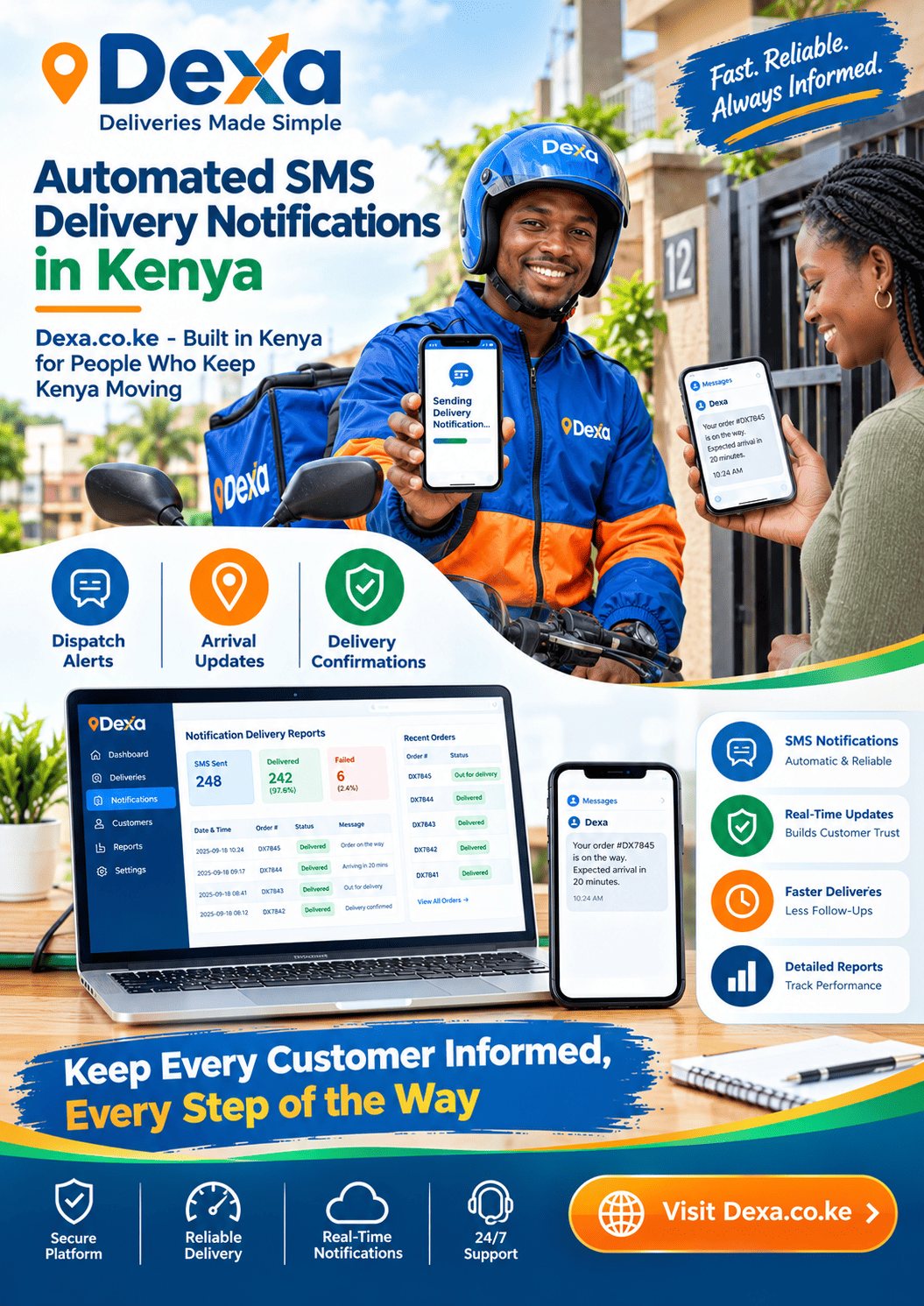
Automated SMS delivery notifications in Kenya have quietly become one of the most powerful tools a delivery business can adopt, largely because they solve a problem that phone calls cannot. A customer who receives a message saying their rider is fifteen minutes away does not need to call anyone. A customer who receives nothing will call, and will keep calling until someone answers. The entire value of automated SMS delivery notifications in Kenya sits in that simple contrast: messages replace enquiries, and enquiries are what consume a delivery team’s day.
Most Kenyan businesses understand this instinctively but handle it manually. Someone sends a WhatsApp message when a parcel leaves the shop. Someone else calls when the rider is close. It works, until volume rises and the person sending those messages has other work to do. Genuine automated SMS delivery notifications in Kenya remove the human step entirely, triggering messages from the delivery record itself so nothing depends on anyone remembering.
Why SMS Still Wins in This Market
There is a tendency to assume messaging has moved on. In Kenya, it has not. SMS remains the most reliable channel for reaching a customer because it works on every phone, requires no data connection, no app installation, and no smartphone. A customer using a basic handset receives the same notification as one using the latest device.
This universality matters enormously for delivery. Businesses cannot assume their customers use WhatsApp, have email they check regularly, or will install an app for a single parcel. They can assume those customers have a phone number, because without one the delivery could not be arranged in the first place. That is why automated SMS delivery notifications in Kenya remain the foundation of customer communication even as other channels multiply.
The second advantage is persistence. An SMS lands in a place the customer will see, and it stays there. A notification buried in an app the customer opens twice a month is functionally invisible. When a parcel is arriving in an hour, invisibility is the problem you are trying to solve. Reliable automated SMS delivery notifications in Kenya reach the customer where they are actually looking.
The Notifications That Matter Most
Not every message is equally useful. Businesses that send too many create noise, and customers stop reading. The strongest approach sends a small number of messages at moments when information genuinely changes.
The first is the dispatch notification. It confirms the order has left and sets an expectation about when it will arrive. This single message removes a large share of early enquiries, because the customer’s most immediate question has already been answered. Delivery businesses that get automated SMS delivery notifications in Kenya right invariably begin here.
The second is the en-route notification. Sent when the rider is close, it gives the customer time to be ready. In a market where landmarks serve as addresses and riders must often call to locate a gate, this message reduces the most common cause of failed delivery: the recipient not being available. The practical effect of well-timed automated SMS delivery notifications in Kenya shows up directly in first-attempt success rates.
The third is the delivery confirmation. Sent once the parcel has been handed over, it closes the loop and includes a reference the customer can keep. For businesses handling cash on delivery, it doubles as an acknowledgment of payment received. The confirmation message is often the last impression a customer has of the transaction, which makes it worth getting right. Strong automated SMS delivery notifications in Kenya treat this final message as part of the product rather than an afterthought.
What a Good Notification Contains
Message length is limited, so every character must earn its place. A useful notification carries four elements: identification of the business, an order reference, a clear statement of what is happening, and a way to respond if something is wrong.
Identification matters because customers deal with several sellers and often cannot recall which order a message refers to. An order reference resolves this immediately. The status statement should be plain rather than technical: not “out for delivery” but “your rider will arrive in about twenty minutes.” The response path matters most for exceptions, such as a customer who needs to change the delivery time.
The most effective automated SMS delivery notifications in Kenya also carry the rider’s name and, where relevant, the amount due for cash on delivery orders. A customer who knows both who is coming and what to have ready is far easier to deliver to than one who is guessing.
How Dexa.co.ke Handles Notifications
Dexa.co.ke was built for the Kenyan market rather than adapted from a foreign model, and its structure reflects how communication actually works here. The platform splits into two products, each suited to a different stage of business growth, and both treat automated notifications as a standard output rather than a feature to be configured.
For sellers working with one or two trusted riders, the independent driver model fits naturally. Notifications matter in this arrangement because they replace the informal calls that a rider would otherwise have to make while riding. For operations that have outgrown informal arrangements and now coordinate several riders, the courier team model provides the consistency that automated SMS delivery notifications in Kenya require at volume, where no single person can track every parcel personally.
For Independent Drivers
A rider using this arrangement creates their own customer channel, sharing a personal booking link with businesses on WhatsApp and receiving direct bookings rather than competing for work in a crowded marketplace. From the seller’s side, this simplifies matters considerably: one known contact, one consistent standard, one person accountable for each parcel.
The rider benefits as well. Rather than chasing one-off trips, a driver builds a roster of regular business clients, plans pickups in advance, and tracks earnings in one place. When notifications go out automatically, the rider spends less time on the phone and more time moving, which is ultimately how the work is paid for. That reduction in distraction is one of the quieter benefits of automated SMS delivery notifications in Kenya for anyone on a motorcycle in traffic.
For Courier Teams
Teams managing several riders and a steady flow of orders need structure that informal arrangements cannot provide. The platform keeps one operating record from request to receipt, so no order has to be reconstructed from scattered chats. Each parcel carries its customer details, assigned rider, agreed price, payment status, proof of delivery, and associated expense along with it.
For a business working with a courier team, this makes automated SMS delivery notifications in Kenya consistent rather than dependent on individual riders remembering to send a message. Dispatch is organised, assignments are clear, and every customer receives the same standard of communication regardless of who is carrying the parcel.
Cutting Failed Deliveries With Better Communication
Failed deliveries are the single largest hidden cost in Kenyan delivery. When a rider cannot locate a customer or the recipient is unavailable, the trip must be repeated. Fuel is burned twice, the rider is paid twice, and the order is delayed. Industry data suggests a substantial share of parcels nationally are delayed or never delivered at all, and poor communication is a leading contributor.
Notifications attack this problem directly. A customer who knows a rider is arriving in twenty minutes is far more likely to be present or to send someone in their place. A customer who has received no message may have stepped out, and by the time the rider calls, the journey has already been wasted.
The improvement in first-attempt delivery rates produced by well-timed automated SMS delivery notifications in Kenya is one of the most measurable returns available to a delivery business. Moving from repeated attempts to single-attempt deliveries changes the unit economics of every parcel, and the effect compounds across hundreds of deliveries a month.
Notifications and Cash on Delivery
Cash on delivery remains widely used among Kenyan online buyers, particularly first-time customers. Notifications play an important role in making this arrangement work smoothly, because the customer needs to be ready with the right amount at the right moment.
A message stating the rider’s arrival window and the amount due removes the awkward doorstep negotiation that otherwise occurs. The customer has the cash ready, the transaction completes quickly, and the receipt is issued immediately. This is one of the more practical ways automated SMS delivery notifications in Kenya improve the experience for both sides of the transaction.
The same message also supports reconciliation. When the notification records the amount due and the collection is logged against the order, the business gains a complete record of what was expected and what was received. Any variance becomes visible immediately rather than surfacing weeks later during an end-of-month review.
Handling Exceptions Gracefully
Not every delivery goes to plan, and the moments when something goes wrong are exactly when communication matters most. A customer who cannot be reached, a gate that is locked, a rider delayed by traffic—each of these situations becomes a dispute only when nobody says anything.
Notifications provide a low-friction channel for these exceptions. A message informing a customer that the rider is delayed by traffic and will arrive thirty minutes later defuses a frustration that would otherwise build into a complaint. The customer feels informed rather than ignored, and the business avoids the call that would have followed.
The strongest implementations of automated SMS delivery notifications in Kenya support two-way communication, allowing customers to respond. A customer who cannot receive a parcel at the scheduled time can say so in advance, and the delivery can be rescheduled before the rider makes a wasted journey.
Cost and Reliability Considerations
SMS costs money, which leads some businesses to treat notifications as a discretionary expense. The calculation is more favourable than it first appears. A single failed delivery costs roughly double a completed one, and a single inbound enquiry costs several minutes of staff time. Against those figures, the cost of a few messages per parcel is trivial.
Reliability deserves equal attention. A notification system is only useful if messages actually arrive, and delivery reports matter as much as the sending itself. Businesses should understand what happens when a message fails to reach a customer, whether retries are automatic, and whether failures are visible in the dashboard. Any serious approach to automated SMS delivery notifications in Kenya treats message delivery as something to be monitored rather than assumed.
There is also the question of network coverage. Some delivery areas experience intermittent service, and a notification that never arrives leaves the customer uninformed. The strongest systems handle this by sending notifications at multiple points in the journey rather than relying on a single message, so a customer who misses one still receives another before the rider arrives.
Choosing the Right Notification System
Businesses evaluating options should focus on a few practical questions. Are notifications triggered automatically from delivery events, or does someone have to send them manually? Do messages include the order reference, the rider’s name, and the amount due where relevant? Can customers reply? What happens when a message fails to deliver?
A platform that answers these well is one that will not create new problems as volume rises. A platform that answers only the first is one that will become a source of inconsistency, because manual sending always degrades when the team is busy. The difference between the two is rarely visible in a demonstration, which is why testing with real orders across a fortnight is worth the effort before committing.
It also helps to consider how notifications connect to the rest of the operation. A messaging tool that stands alone provides partial value. A platform that links notifications to order records, rider assignments, and payment logs provides considerably more, because every message becomes part of a complete delivery history rather than an isolated text.
Where Delivery Communication Is Heading
Several shifts are reshaping how delivery businesses communicate in Kenya. Mobile money integration continues to deepen, and the connection between payment confirmation and customer notification is becoming tighter, so a single automatic action will soon confirm both that a parcel arrived and that payment was received.
Electric motorcycles are becoming more common, and the riders using them spend less time on fuel stops and maintenance, which means more of their working hours go toward deliveries. Better communication supports that efficiency by reducing the time lost to unanswered calls and wasted journeys.
Government investment in intelligent traffic management is gradually improving movement across Nairobi, which will make arrival estimates more accurate over time. More precise estimates make notifications more useful, because a message promising twenty minutes is only valuable if it is close to the truth.
What will not change is the underlying requirement: customers need to know what is happening with their parcel before they feel the need to ask. That requirement sits at the centre of what automated SMS delivery notifications in Kenya should deliver, today and in future.
Automated SMS delivery notifications in Kenya are not simply a courtesy to customers. They are an operational tool that reduces inbound enquiries, cuts failed deliveries, improves reconciliation, and gives a delivery business a consistent voice regardless of who is carrying the parcel.
Whether you are dispatching five orders a week from a single room or fifty a day from a small warehouse, the tools behind automated SMS delivery notifications in Kenya from dexa.co.ke keep customers informed at dispatch, en route, and on arrival. From the first order request to the final confirmation, every customer hears from you without anyone having to remember to send a message.
The businesses that grow are the ones that treat communication as part of the delivery rather than an interruption to it. Build the habit early, let it carry the weight as volume rises, and the phone stops ringing for the right reasons.
- Automated SMS delivery notifications in Kenya
- Automated SMS delivery notifications in Kenya
- Automated SMS delivery notifications in Kenya
- Automated SMS delivery notifications in Kenya
- Automated SMS delivery notifications in Kenya
- Automated SMS delivery notifications in Kenya
- Automated SMS delivery notifications in Kenya
- Automated SMS delivery notifications in Kenya