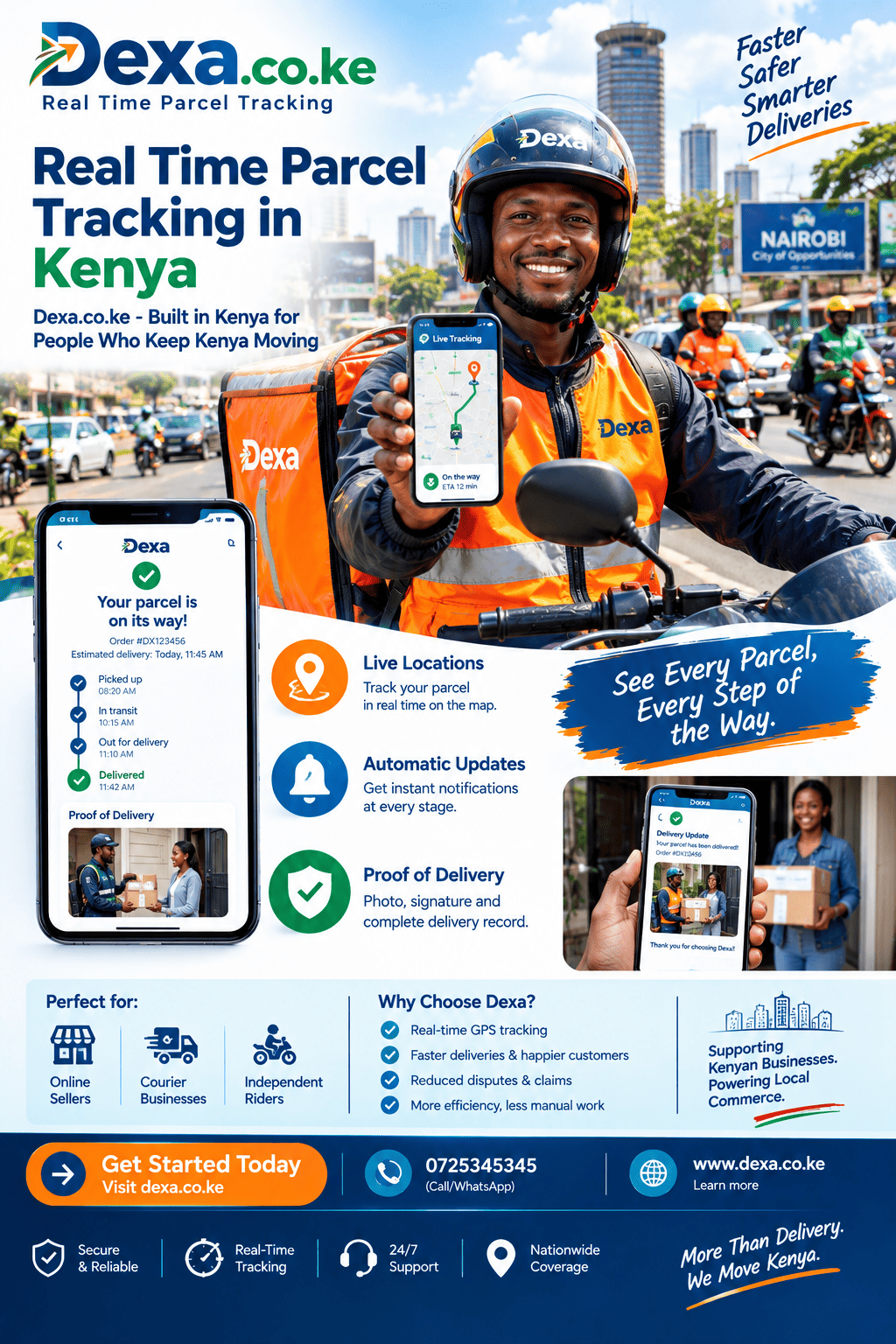
Finding the best app for delivery tracking is the decision that most directly shapes whether a delivery business runs smoothly or spends its days answering the phone. Every courier operation reaches a point where the owner cannot personally know where each rider is, which parcel is on which motorcycle, and whether a delivery was completed. Up to that point, memory works. Beyond it, memory becomes the source of every problem the business has.
The search for the best app for delivery tracking is therefore not about finding the most feature-heavy product on the market. It is about finding the one that keeps the order, the rider, the payment, and the proof attached to the same record, and that works in the conditions Kenyan couriers actually face.
Why Tracking Became Non-Negotiable
Courier businesses once managed riders the way dispatch offices managed taxis: by radio, telephone, and experience. That approach worked when volumes were small and routes were familiar. It breaks down as soon as a business grows beyond a handful of riders, because no dispatcher can hold ten simultaneous journeys in their head while also answering calls and assigning new work.
The first problem tracking solves is assignment. A dispatcher who can see every rider’s location assigns the nearest available person to a new pickup, which reduces travel time and increases the number of deliveries completed per shift. The second problem is customer communication. When a customer calls to ask where their parcel is, the dispatcher should be able to answer in seconds by looking at the map rather than placing a call and waiting.
The third problem is accountability. Without location data, a rider’s performance is judged on impression rather than evidence. A rider who appears slow may simply have been given difficult routes. A rider who appears fast may be cutting corners. Continuous tracking provides the factual basis for fair assessment, which benefits both the business and the rider. These three problems are what make the best app for delivery tracking essential rather than optional.
What the Conditions in Kenya Demand
Any realistic discussion of the best app for delivery tracking in Kenya has to begin with the environment. Nairobi ranks among the most congested cities in Africa, and a peak-hour journey can stretch past an hour for a distance that should take fifteen minutes. An app that assumes clear roads will produce arrival estimates that are wrong most of the time.
Addressing adds a second constraint. Large parts of Kenyan cities have no formal street numbering, so delivery instructions arrive as landmarks—behind the blue gate, opposite the petrol station, call when you reach. Nationally, a substantial share of parcels are delayed or never delivered at all, and the inability to locate a destination precisely is a leading cause. A capable best app for delivery tracking must treat landmark-based navigation as normal rather than as an exception.
Payment habits complete the picture. Cash on delivery remains common, particularly among first-time buyers who want to see a product before paying. Mobile money is near-universal. An app that tracks parcels but ignores payments is only solving half the problem, because a delivery that is tracked but not paid for is a delivery that remains incomplete.
The Features That Actually Predict Performance
Live Location Updates That Refresh Continuously
The foundation of any tracking app is a live map showing where every rider currently is. The critical question is how often that data refreshes. A position that updates every few minutes suits longer journeys. A position that updates only when the rider opens the app is unreliable, because it depends on the rider remembering to do so. The strongest best app for delivery tracking implementations update continuously in the background.
Delivery Status at Every Stage
Location alone does not tell the whole story. A parcel can be picked up, in transit, out for delivery, or delivered, and each stage carries different expectations. A useful best app for delivery tracking updates status automatically as events occur, so the customer sees progress rather than a static pin on a map.
Route History That Can Be Reviewed
Live location answers the question of where a rider is now. Route history answers the question of where they have been. This retrospective view is valuable for resolving disputes, understanding why a delivery took longer than expected, and identifying patterns that suggest training needs. An app that stores route history turns each delivery into a reviewable record rather than a vanishing event.
Proof of Delivery Integrated Into the Journey
Tracking should end with a documented handover. Digital signatures, photographs, and timestamps captured at the point of delivery create a record that protects the business, the rider, and the customer. When tracking and proof are separate systems, the record becomes fragmented. When they are integrated, the best app for delivery tracking produces a complete journey from dispatch to confirmed receipt.
Automatic Customer Notifications
Customers should not have to open an app or call the business to find out where their order is. Notifications should arrive without being requested: when the parcel is dispatched, when the rider is nearby, and when delivery is complete. Systems that handle this automatically save hours each week and reduce inbound enquiries dramatically. This is one of the most valued features of the best app for delivery tracking from a customer’s perspective.
Offline Resilience
Networks fail. A tracking app that stops working when connectivity drops leaves both the business and the customer without information at the moment they need it most. A robust best app for delivery tracking continues recording during outages and syncs automatically when the connection returns, so no part of the journey goes unrecorded.
How to Test an App Before Committing
Demonstrations are unreliable indicators of performance, because vendors show their products in ideal conditions. A business evaluating the best app for delivery tracking should test in the real world instead.
Run a fortnight of live orders through the app with real riders on real routes. Watch the tracking update frequency during that period. Check whether the notifications reach customers reliably. Attempt a reassignment mid-delivery and see how many steps it takes. Test the app in an area with weak connectivity. Then review the records afterwards and check whether they tell a complete story.
An app that performs well across twenty trial orders is far more likely to perform well at two hundred. An app that struggles with twenty will not improve with volume. This trial approach is the practical core of finding the best app for delivery tracking, and it costs very little to run.
Common Mistakes When Choosing
Several mistakes appear repeatedly when businesses select a tracking app without examining the details.
The first is choosing on price alone. A cheaper app that produces unreliable tracking is not cheaper, because unreliable tracking produces failed deliveries, and each failed attempt roughly doubles the cost of that delivery.
The second is confusing location sharing with real-time tracking. Many apps allow a rider to share their position manually. That is not tracking. Tracking is continuous, automatic, and independent of rider behaviour. The best app for delivery tracking removes the dependence on rider behaviour entirely.
The third is separating tracking from payment and proof. A tracking tool that stands alone provides partial value. A platform that links tracking to dispatch, payment, and proof provides considerably more, because every delivery becomes part of a complete history rather than an isolated event.
The fourth is failing to train riders. An app that riders do not understand or trust will not be used consistently, and inconsistent use produces incomplete data. Explaining why tracking protects the rider as much as the business is what makes adoption stick.
The Role of Tracking in Customer Experience
Customers experience tracking primarily as reassurance. An order that can be seen is an order that feels real. Uncertainty is the most common source of anxiety in online shopping, and visibility removes it almost entirely.
The second customer benefit is accurate expectation setting. A delivery window derived from live tracking data is far more reliable than a generic estimate. Customers can plan their day around a realistic arrival time rather than waiting indefinitely.
The third benefit is dispute protection. When a customer receives an automatic confirmation with a photograph and timestamp, both parties have evidence of what occurred. Disagreements that would otherwise consume time and goodwill are resolved instantly. The best app for delivery tracking therefore protects the customer as much as the business.
Why Tracking and Proof Belong Together
Tracking and proof of delivery are complementary capabilities, and an app that connects them produces something neither can offer alone. The location record shows where a rider went. The proof of delivery shows what happened when they arrived. Together they create a complete account of every delivery.
When a dispute arises, the combination is powerful. The route history establishes that the rider reached the correct area. The photographic proof and signature establish that the parcel was handed over. A customer who claims a delivery never happened faces a record that shows otherwise. The continuity between tracking and proof is what makes the best app for delivery tracking genuinely protective.
The Practical Constraints Nobody Mentions
Two practical concerns arise whenever tracking is discussed in the Kenyan market: battery life and data consumption. Continuous GPS use drains a phone faster than ordinary use, and riders working long shifts need their devices to last the day.
The strongest apps address this through efficient background tracking that adjusts update frequency based on context. A rider moving at speed needs frequent updates. A rider stationary at a delivery point needs fewer. Adaptive tracking of this kind reduces both battery drain and data consumption without sacrificing accuracy.
Data consumption is similarly manageable. Position updates are small, and the total volume over a working day is modest by the standards of modern mobile plans. Businesses considering adoption should verify that their chosen best app for delivery tracking is designed for efficiency rather than simply transmitting as often as possible.
What Changes When the Right App Is in Place
The most immediate change is a quieter phone. When customers can see where their parcel is, they stop calling to ask. When riders receive clear assignments, they stop calling for instructions. When payments are recorded automatically, nobody has to reconcile from memory at the end of the day.
The second change is faster problem resolution. A rider who has stopped moving for twenty minutes is visible on the map before the customer notices the delay. Dispatchers can intervene, reassign the delivery, or notify the customer proactively. Incidents that would once have become complaints become minor issues instead.
The third change is confidence in the numbers. A business that knows what it delivered, what it collected, and what it spent can make decisions about pricing, routes, and hiring that a business relying on instinct cannot.
Scaling Without Adding Coordinators
Growth in a delivery business traditionally means adding coordinators. Every few riders requires another person to manage the phone calls, and those coordinators become a fixed cost that grows with the operation. A proper tracking app breaks that link by automating the coordination that would otherwise require additional staff.
A business running five riders can manage with the same app that a business running twenty uses. The tracking updates automatically. The customer notifications send without prompting. The business adds riders without adding coordinators, which means revenue growth translates more directly into profit.
This is why adoption of proper tracking tends to happen at a specific point in a business’s development, usually just after a period of rapid growth has exposed the limits of manual coordination. The businesses that adopt earlier avoid the period of chaos entirely.
Tracking and Rider Trust
Some riders resist tracking, assuming it signals distrust. In practice, the opposite is usually true. A rider who knows their location is recorded has protection against false claims. If a customer says a delivery never arrived, the route history shows that the rider was at the location. If a dispute arises about timing, the record settles it.
The businesses that introduce tracking well explain it in these terms rather than presenting it as surveillance. Transparent tracking that protects both parties is accepted far more readily than tracking presented as monitoring for its own sake. The framing matters, and the strongest implementations treat the data as a shared record rather than a one-way tool.
Where Tracking Technology Is Heading
Several shifts are reshaping how tracking apps work in Kenya. Electric motorcycles are becoming more common, and their onboard telemetry allows richer data than simple GPS pings, including battery status and motor performance alongside location.
Mobile money integration continues to deepen, and the connection between location data and payment records is becoming tighter. In the near future, a single record will confirm where a rider went, when they arrived, and whether payment was collected, all without manual input at any stage.
Government investment in intelligent traffic management is gradually improving movement across Nairobi, which will make arrival estimates generated from tracking data more accurate over time. Regulatory expectations around record-keeping are also tightening, favouring apps that already maintain clean digital documentation.
What will not change is the underlying requirement: a delivery business needs to know where its riders are, and it needs that information to be accurate, continuous, and retrievable. That requirement sits at the centre of what the best app for delivery tracking should deliver.
Building Tracking Into Daily Operations
The businesses that get the most from tracking treat it as a daily discipline rather than a feature. They review the previous day’s routes each morning, looking for delays, unusual stops, and failed attempts. They follow up on patterns rather than isolated incidents. They adjust delivery windows based on what the data actually shows rather than what they wish were true.
This discipline matters because tracking data reveals things that intuition misses. A route that consistently runs late does so incrementally. A rider whose fuel consumption is creeping upward does so gradually. Regular review catches these trends while they are still small, and small corrections are considerably cheaper than large ones.
The best app for delivery tracking is not the one with the longest feature list or the largest marketing budget. It is the one that keeps the customer, the rider, the payment, and the proof attached to the same order, and that works in the conditions Kenyan couriers actually face every day.
Whether you are running a single motorcycle from a single room or coordinating a fleet across the city, the best app for delivery tracking from dexa.co.ke gives you the visibility that makes dispatch faster, customers calmer, and disputes rare. From the first assignment to the final confirmed delivery, every rider stays accounted for.
The businesses that grow are the ones that treat visibility as a foundation rather than a feature. Build the habit early, let it carry the weight as volume rises, and managing riders becomes considerably less stressful than it once was.