To improve last mile customer experience is to work on the single part of an online transaction that customers remember longest. They may forget which advertisement brought them to a shop. They may not recall the exact price they paid. But they will remember whether the parcel arrived when promised, whether anyone told them what was happening, and whether the person at the gate treated them with courtesy.
Most businesses in Kenya understand this in principle and struggle with it in practice. The reasons are rarely about willingness. They are about visibility. A business that cannot see where its riders are cannot tell a customer when their parcel will arrive. A business that has no proof of delivery cannot settle a dispute with evidence. The practical route to improve last mile customer experience runs through fixing those underlying gaps rather than adding another layer of apology.
What Customers Actually Judge You On
Customer experience in last mile delivery rests on a small number of things that customers notice repeatedly. Understanding them precisely is the first step toward improving them.
The first is certainty. A customer who is told a parcel will arrive between two and four in the afternoon and receives it at half past three has had a good experience. A customer told it will arrive “today” and spends the whole day waiting has had a poor one, even if the parcel arrives at noon. Precision matters more than speed in how the experience is remembered.
The second is communication. Customers do not expect perfection. They expect to be told when something changes. A delay communicated in advance is an inconvenience. A delay discovered by the customer after waiting two hours is a grievance. The difference between the two outcomes is often a single automated message.
The third is the handover itself. The rider who calls ahead, arrives when expected, greets the customer properly, and hands over the parcel with a confirmation is creating an impression that outlasts the transaction. The rider who arrives unannounced, cannot find the gate, and leaves the parcel with a neighbour creates the opposite.
The fourth is resolution. Something occasionally goes wrong. A parcel is delayed, damaged, or misdelivered. What customers remember is not the failure but how quickly and fairly it was handled.
Why Visibility Is the Foundation of Everything
Every improvement to last mile customer experience depends on the business knowing what is actually happening. Without visibility, communication becomes guesswork, precision becomes impossible, and resolution becomes argument.
Live tracking is the mechanism that makes visibility practical. When a business can see where every rider is at any moment, it can answer a customer’s question in seconds rather than placing a call and waiting. That single capability removes an entire category of friction from the customer relationship, because the most common reason customers contact a business is to ask where their order is.
The same visibility allows proactive communication. A rider who has stopped moving for twenty minutes is visible on the map before the customer notices the delay. The business can send a message explaining the situation, adjust the delivery window, or reassign the parcel to another rider. To improve last mile customer experience at scale, those decisions have to be made from live information rather than from guesswork.
Communication That Customers Actually Value
Not every message improves the experience. Businesses that send too many updates create noise, and customers stop reading. The strongest communication sends a small number of messages at moments when information genuinely changes.
The dispatch notification is the first. It confirms that the order has left and sets an expectation about when it will arrive. This single message removes a large share of early enquiries, because the customer’s most immediate question has already been answered.
The en-route notification is the second. Sent when the rider is close, it gives the customer time to be ready. In a market where addresses are often landmarks and riders frequently need to call for directions, this message reduces the most common cause of failed delivery: the recipient not being available. It also reduces the number of calls a rider has to make while riding, which is safer for everyone.
The delivery confirmation is the third. Sent once the parcel has been handed over, it closes the loop and includes a reference the customer can keep. For cash-on-delivery orders it doubles as an acknowledgment of payment received. The confirmation message is often the last impression a customer has of the transaction, which makes it worth getting right.
The Role of Proof in Customer Confidence
Customers rarely think about proof of delivery until they need it. When they do need it, its absence is costly for both sides.
A photograph of the parcel at the delivery location, a signature captured on the rider’s device, a timestamp, and a GPS location together create a record that settles most questions before they develop. A customer who claims a parcel never arrived can be shown the evidence. A customer who received the wrong item can be shown what was actually handed over.
This matters for customer experience because uncertainty is uncomfortable. A customer who knows the business has a record feels protected. A customer who suspects the business is relying on memory feels exposed. The presence of documentation changes how the relationship feels, even when nothing has gone wrong. Businesses that want to improve last mile customer experience consistently find that proof is one of the cheapest improvements available.
Payments and the Experience of Trust
Payment handling is rarely discussed as a customer experience issue, but it shapes how customers feel about a transaction. A customer who receives a clear receipt immediately after paying feels the transaction is complete. A customer who hands over cash and receives nothing but a verbal thank you feels the interaction is informal.
Issuing a digital receipt at the point of payment costs almost nothing and changes the perception of professionalism considerably. It also protects the customer. If a question arises weeks later about what was paid, the receipt answers it. In a market where cash remains common and disputes about payment do occur, that protection is worth more than the receipt itself.
The same principle applies to the amount. A customer who knows in advance exactly what they will pay, including delivery charges, experiences the handover differently from one who discovers the total at the gate. Recording the expected amount at the time of booking removes the doorstep negotiation that slows every cash delivery and leaves both parties slightly uncomfortable.
Handling Problems in a Way Customers Remember Well
Every delivery business has failures. The difference between businesses that retain customers and those that lose them is how failures are handled.
The first principle is speed. A customer who reports a missing parcel and receives a substantive response within an hour feels attended to. A customer who waits two days feels abandoned. Speed depends on the business being able to check the record immediately rather than searching through messages.
The second principle is evidence. A business that can show the customer a photograph of the parcel at their gate, with a timestamp, resolves the conversation quickly. A business that cannot must either accept the loss or argue, and neither outcome leaves the customer satisfied.
The third principle is fairness. When the business is at fault, it should say so and resolve it without requiring the customer to push. When the customer is mistaken, the evidence should be presented gently rather than triumphantly. Both responses protect the relationship. The systems that help improve last mile customer experience are the ones that make fairness practical rather than aspirational.
The Rider as the Face of the Brand
The rider is the only human being the customer meets in person. Everything the business has built through marketing and product quality is either confirmed or undermined in that brief interaction.
This is why rider training matters more than many businesses assume. A rider who calls ahead, arrives when expected, greets the customer courteously, and hands over the parcel with a clear confirmation creates an impression that outlasts the transaction. A rider who does none of those things creates the opposite, regardless of how good the product is.
The tools a rider carries shape their behaviour. A rider with a phone that shows the delivery details, the customer’s landmark, the amount due, and a simple way to capture proof is equipped to do the job well. A rider relying on memory and a phone call is equipped to do it badly. Investing in the rider’s tools is investing in the customer’s experience.
Precision Over Speed
There is a temptation to assume that faster delivery always produces a better experience. In practice, precision matters more.
A customer told a parcel will arrive within a two-hour window and receives it at the end of that window is more satisfied than one told it will arrive “sometime today” and receives it early. The first customer could plan their day. The second could not. The parcel arrived at the same time, but the experience was entirely different.
This has a practical implication for businesses. Promising narrower windows requires knowing where riders are and how long deliveries actually take. That knowledge comes from tracking data accumulated over weeks and months. A business that tracks its deliveries can promise precise windows because it knows its own performance. A business that does not track can only offer vague assurances. To improve last mile customer experience credibly, the business must first know its own numbers.
The Compounding Effect of Small Improvements
Customer experience is rarely transformed by a single dramatic change. It improves through the accumulation of small ones.
A tracking link that removes one phone call. A notification that prevents one wasted trip. A proof photograph that settles one dispute. A receipt that answers one question. Each of these is minor in isolation. Together they change how a customer experiences the business, and that change shows up in repeat orders and referrals.
The businesses that understand this treat last mile experience as an ongoing discipline rather than a one-time project. They review what customers complain about, identify the pattern behind the complaints, and fix the underlying process. Over a year, the accumulation of those fixes produces a delivery operation that customers describe as reliable, even though no single change was dramatic.
How Dexa.co.ke Supports Better Customer Experience
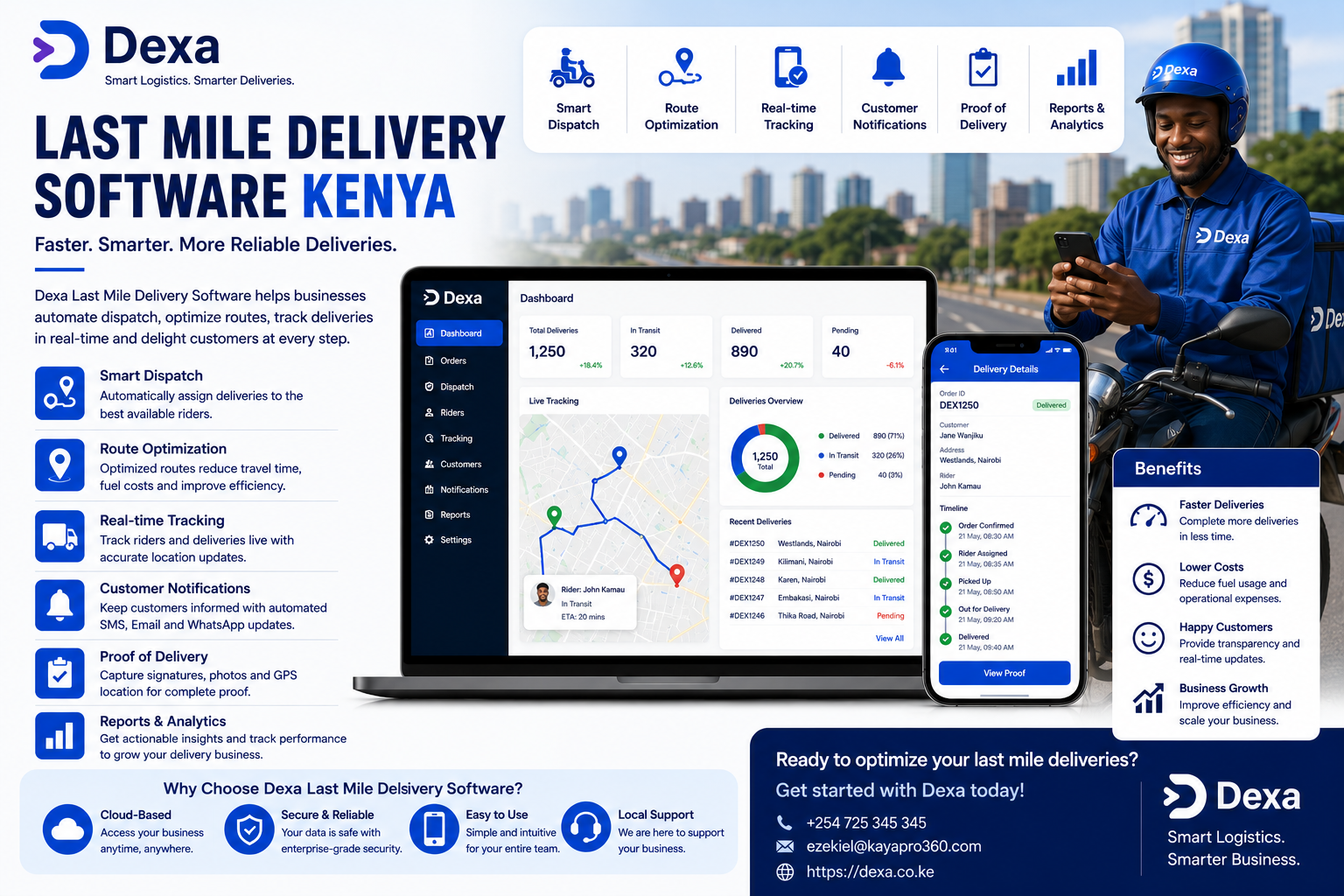
Dexa.co.ke was built for the Kenyan market rather than adapted from a foreign model, and its structure reflects how customer experience actually works here. The platform splits into two products, each suited to a different stage of growth, and both treat the delivery journey as a connected process rather than a set of separate tasks.
For sellers working with one or two trusted riders, the independent driver model fits naturally. This arrangement supports better customer experience because a rider who knows the pickup routine, the packaging habits, and the regular customers makes fewer mistakes and interacts more confidently with the people they serve. For operations that have outgrown informal arrangements and now coordinate several riders, the courier team model provides the coordination that consistent customer experience requires at volume. Both are designed to improve last mile customer experience without requiring the business to rebuild its entire operation.
For Independent Drivers
A rider using this arrangement creates their own customer channel, sharing a personal booking link with businesses on WhatsApp and receiving direct bookings rather than competing for work in a crowded marketplace. From the business’s side, this simplifies matters considerably: one known contact, one consistent standard, one person accountable for each parcel.
The rider benefits too. Rather than chasing one-off trips, a driver builds a roster of regular business clients, plans pickups in advance, and tracks earnings in one place. When a rider works consistently with the same businesses, they learn the customers, the landmarks, and the preferences that make each delivery smoother. That familiarity is one of the most underrated contributors to customer experience.
For Courier Teams
Teams managing several riders and a steady flow of orders need structure that informal arrangements cannot provide. The platform keeps one operating record from request to receipt, so no order has to be reconstructed from scattered chats. Each parcel carries its customer details, assigned rider, agreed price, payment status, proof of delivery, and associated expense along with it.
For a business working with a courier team, this makes consistent customer experience achievable rather than aspirational. Dispatch is organised, riders know their assignments, and the business receives a clean record for every order. When a customer disputes a delivery, the answer is already in the system rather than in someone’s memory.
What Changes in the First Month
The most immediate change is a quieter phone. When customers can see where their order is, they stop calling to ask. When riders receive clear assignments, they stop calling for instructions. When payments are recorded automatically, nobody has to reconcile from memory at the end of the day.
The second change is faster problem resolution. A rider who has stopped moving for twenty minutes is visible on the map before the customer notices the delay. Dispatchers can intervene, reassign the delivery, or notify the customer proactively. Problems that would once have become complaints become minor incidents instead.
The third change is confidence in the numbers. A business that knows what it delivered, what it collected, and what it spent can make decisions about pricing, routes, and hiring that a business relying on instinct cannot. That confidence shows up in how the business communicates with customers, because a business that knows its own performance can promise precisely rather than vaguely. It is far easier to improve last mile customer experience when the business has accurate data to work from.
Common Mistakes That Undermine Experience
Several mistakes appear repeatedly when businesses try to improve last mile customer experience without addressing the underlying systems.
The first is adding communication without adding accuracy. A business that sends more messages but cannot say when the parcel will actually arrive creates more frustration, not less. Messages must be grounded in real data.
The second is treating speed as the only metric. A delivery that arrives early but unannounced is not a better experience than one that arrives on time with clear communication. Customers value predictability over raw speed.
The third is neglecting the rider. A business can install the best software available and still deliver a poor experience if the rider is untrained, unequipped, or unmotivated. The tools and the person using them matter equally.
The fourth is failing to review complaints. Customer experience improves when businesses look for patterns in what goes wrong rather than resolving each complaint in isolation. The same failure repeated fifty times is a process problem, not a customer problem.
The fifth is separating proof of delivery from customer communication. The photograph that protects the business also reassures the customer. Treating it as an internal record rather than a customer-facing confirmation wastes half its value. Businesses that want to improve last mile customer experience systematically treat proof as something the customer also benefits from seeing.
The Direction Customer Experience Is Heading
Several shifts are reshaping how last mile customer experience works in Kenya. Mobile money integration continues to deepen, and the connection between payment confirmation and delivery confirmation is becoming tighter, so a single automatic action will soon confirm both to the customer.
Electric motorcycles are becoming more common, and their lower running costs allow businesses to invest more in rider training and customer communication without eroding margins. Government investment in intelligent traffic management is gradually improving movement across Nairobi, which will make arrival estimates more accurate and delivery windows more reliable.
Regulatory expectations around customer communication and transaction records are also tightening, favouring businesses that already send clear notifications and maintain clean documentation.
What will not change is the underlying requirement: customers need to know what is happening with their parcel before they feel the need to ask, and they need to be treated well when it arrives. That requirement sits at the centre of any effort to improve last mile customer experience.
Building the Discipline Into Daily Operations
The businesses that improve customer experience most effectively treat it as a routine rather than a project. They review the previous day’s deliveries each morning, looking for late arrivals, failed attempts, and customer messages that suggest something went wrong. They follow up on patterns rather than isolated incidents. They adjust their delivery windows based on what the data actually shows rather than what they wish were true.
This daily discipline matters because delivery problems compound quietly. A route that consistently runs late does so incrementally. A rider whose customer interactions are deteriorating does so gradually. A business that reviews its performance regularly catches these trends while they are still small, and small corrections are considerably cheaper than large ones.
The tools that support this discipline are the same ones that support everything else. Tracking data, proof records, payment logs, and customer communication all feed into a picture of how the business is actually performing. A business that looks at that picture regularly can improve last mile customer experience continuously rather than waiting for a crisis to prompt a review.
Measuring What Matters
Customer experience is easier to improve when it is measured. Several indicators reveal whether the business is moving in the right direction.
First-attempt delivery rate is the most direct measure. A high rate means customers are present when the rider arrives and the address information was accurate. A low rate means something in the process is failing, whether that is communication, addressing, or scheduling.
Time from order to delivery is the second. It reveals whether the business is meeting its own promises rather than just its competitors’ averages. A business that consistently delivers within its stated window is more reliable than one that occasionally delivers faster but often misses.
Complaint volume is the third. Not every complaint is a failure, but a rising trend is always a signal. A business that tracks complaints by category can identify which part of the process needs attention.
Repeat customer rate is the fourth and the most revealing. If customers return, the experience was good enough to earn another order. If they do not, no amount of internal improvement will matter. A business that wants to improve last mile customer experience should watch this metric above all others.
To improve last mile customer experience is to work on visibility, communication, proof, and the human interaction at the door. None of these is dramatic on its own. Together they determine whether a customer trusts a business enough to order again.
Whether you are dispatching five orders a week from a single room or fifty a day from a small warehouse, the tools behind improving last mile customer experience from dexa.co.ke keep the customer, the rider, the payment, and the proof attached to the same order. From the first booking to the final confirmation, nothing has to be reconstructed from memory.
The businesses that grow are the ones that treat the last mile as part of the product rather than an afterthought. Build the discipline early, let it carry the weight as volume rises, and delivery becomes the reason customers come back.