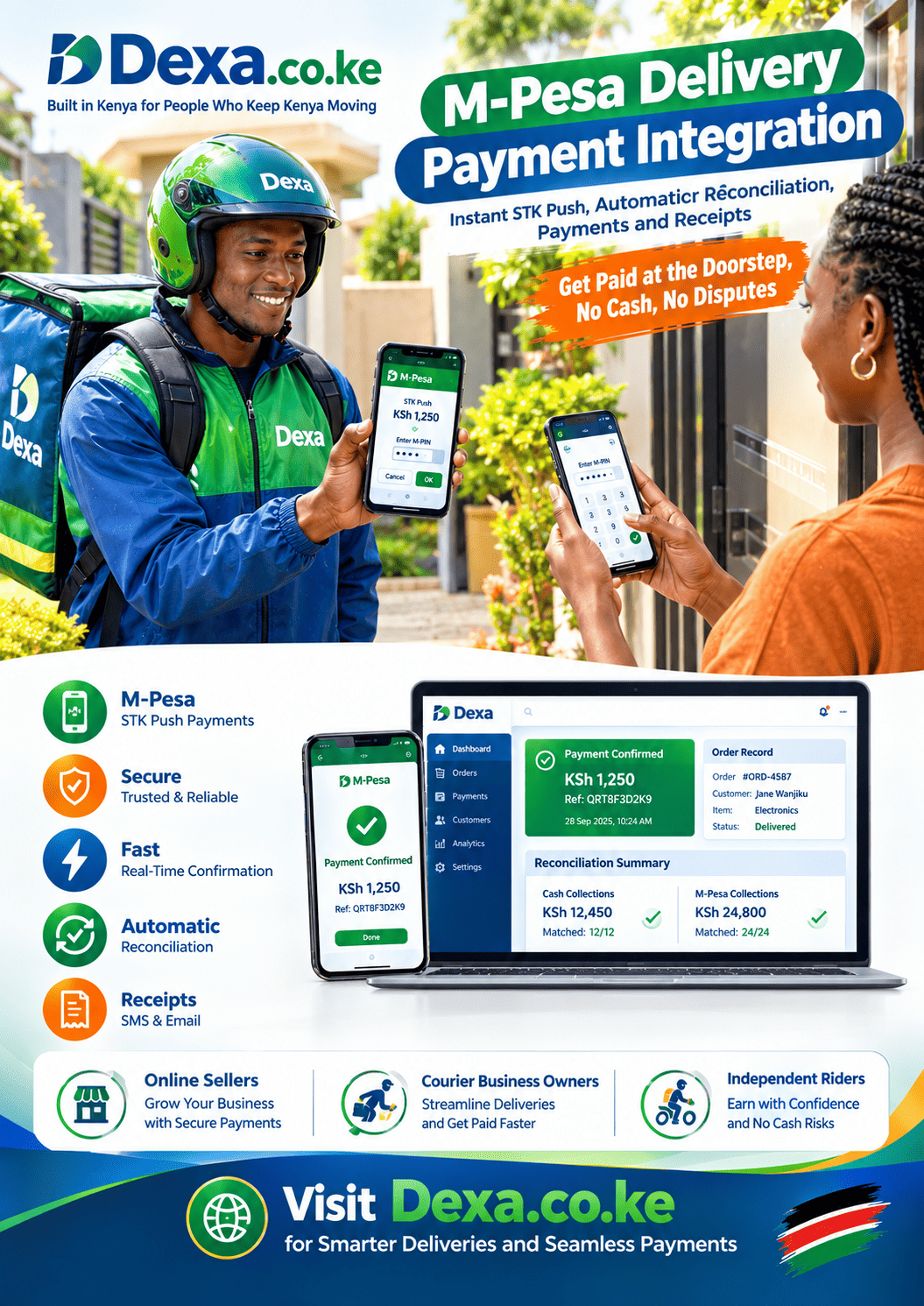
M-Pesa delivery payment integration addresses the single most sensitive moment in any delivery: the exchange of money at the doorstep. Kenya processes tens of billions of shillings through mobile money every day, and delivery businesses that cannot connect to that flow are asking customers to step outside their normal financial habits every time they order. M-Pesa delivery payment integration closes that gap by making payment part of the delivery record rather than a separate transaction that has to be reconciled later.
The problem with cash on delivery has never been the cash itself. It is what happens around it. A rider collects money, carries it across a day of deliveries, and hands over a lump sum at the end. Sometimes the count is accurate. Sometimes it is not, and nobody can establish which. A M-Pesa delivery payment integration replaces that uncertainty with a transaction that clears instantly and attaches to the order it belongs to, so reconciliation becomes verification rather than investigation.
Why Payment Integration Matters More Than It Appears
Most delivery businesses in Kenya recognise payment as important, but few treat it as a system. They handle M-Pesa through a personal number, track collections in a notebook, and reconcile at the end of the week. This works at low volume. It breaks down as soon as several riders are collecting simultaneously, because the business loses the connection between who paid, how much, and for which delivery.
The consequences are quieter than most owners expect. Money does not disappear in large amounts. It disappears in small amounts, repeatedly, and the losses are only visible when every collection is recorded against a specific order at the moment it happens. A M-Pesa delivery payment integration makes that recording automatic, so the gaps that allow small losses simply do not exist.
How the Integration Actually Works
The mechanics behind M-Pesa delivery payment integration are simpler than many business owners assume. Safaricom’s Daraja API provides the infrastructure that platforms use to initiate and confirm payments, and the most common method is the STK Push, which sends a payment prompt directly to the customer’s phone.
When a rider arrives and the customer chooses to pay by M-Pesa, a M-Pesa delivery payment integration triggers the prompt to that customer’s number. The customer enters their PIN, Safaricom processes the transaction, and the platform receives a confirmation callback. The payment is logged against the specific order automatically. The customer receives a receipt. The rider never touches cash.
The sophistication sits in what happens around that single transaction. Real-time callback delivery, timeout handling, and recovery when an app is closed mid-payment are the engineering challenges that separate a working M-Pesa delivery payment integration from one that fails at the worst moment. A customer who has entered their PIN but whose payment is not confirmed creates a dispute before the parcel even leaves the rider’s hands.
What Integration Changes for the Business
The immediate effect of M-Pesa delivery payment integration is faster money. Funds transfer into the business account within minutes rather than accumulating as cash that must be banked. This improves cash flow materially for businesses operating on thin margins, and it reduces the working capital required to operate at a given volume.
The second effect is fraud reduction. Once a delivery is confirmed, payment can be pushed automatically to the rider’s wallet, eliminating cash handling on both sides. Riders are paid accurately and instantly, which improves morale and removes the temptation to take shortcuts with collections. A M-Pesa delivery payment integration that settles rider commissions automatically closes one of the more persistent leaks in delivery operations.
The third effect is accounting clarity. Every payment is recorded, timestamped, and attached to its order. Reconciliation that once consumed an hour each evening takes minutes. For a growing business working through M-Pesa delivery payment integration, this recovered time is often the difference between spending the evening on admin and spending it on growth.
The Customer Experience Advantage
Customers in Kenya trust M-Pesa in a way they trust few other payment methods. It is familiar, immediate, and verifiable. When a delivery platform supports it, the customer pays in the way they already pay for everything else, and the transaction produces a receipt both parties can reference.
This matters more than sellers often realise. A customer who receives an automatic M-Pesa receipt immediately after payment has a record they can refer to. When a dispute arises weeks later, both sides have evidence. The absence of this record is what makes cash disputes so difficult to resolve fairly, and it is one of the clearest reasons to pursue proper M-Pesa delivery payment integration.
The pay-on-arrival model, where the rider triggers a prompt at the doorstep, suits customers who prefer to see the product first. A platform offering genuine M-Pesa delivery payment integration supports this without forcing the customer into an unfamiliar process, and it removes the doorstep negotiation that slows every cash delivery.
How Dexa.co.ke Approaches Payment Integration
Dexa.co.ke was built for the Kenyan market rather than adapted from a foreign model, and its payment handling reflects how money actually moves here. The platform splits into two products, each suited to a different stage of business growth, and both treat M-Pesa as a core function rather than an optional add-on.
For sellers working with one or two trusted riders, the independent driver model fits naturally. Payment integration in this arrangement matters because it lets a rider confirm collection without carrying cash, and it lets the business see receipts in real time. For operations that have outgrown informal arrangements and now coordinate several riders, the courier team model provides the reconciliation structure that M-Pesa delivery payment integration requires at volume.
For Independent Drivers
A rider using this arrangement creates their own customer channel, sharing a personal booking link with businesses on WhatsApp and receiving direct bookings rather than competing for work in a crowded marketplace. From the seller’s side, this simplifies M-Pesa delivery payment integration considerably: one known contact, one consistent standard, one person accountable for each collection.
The rider benefits too. Rather than chasing one-off trips, a driver builds a roster of regular business clients, plans pickups in advance, and tracks earnings in one place. When payments flow through M-Pesa rather than cash, the rider’s own finances become simpler as well, and settlement arrives without the friction that surrounds end-of-day remittance.
For Courier Teams
Teams managing several riders and a steady flow of orders need structure that informal arrangements cannot provide. The platform keeps one operating record from request to receipt, so no order has to be reconstructed from scattered chats. Each parcel carries its customer details, assigned rider, agreed price, payment status, proof of delivery, and associated expense along with it.
For a business working with a courier team, this makes M-Pesa delivery payment integration predictable. Dispatch is organised, riders know their assignments, payments are logged automatically, and the business receives a clean record for every order. When a customer disputes a payment, the answer is already in the system rather than in someone’s memory.
Features That Make Integration Work
Instant STK Push at the Doorstep
The most visible feature of good M-Pesa delivery payment integration is the ability to trigger a payment prompt the moment a rider arrives. The customer enters their PIN, the payment clears, and the receipt is issued without the rider handling a single shilling. The transaction takes seconds, and the customer pays through a channel they already use daily.
Automatic Reconciliation
Every payment should be logged against its specific order the moment it clears. This is the feature that removes the daily reconciliation burden. A M-Pesa delivery payment integration that does this well makes it possible to see at a glance which orders have been paid and which remain outstanding, without opening a spreadsheet.
Payment Records That Survive Disputes
When a customer claims they never paid, or paid a different amount, the platform should already hold the answer. The record includes the transaction reference, timestamp, amount, and the order it belongs to. This documentation is what makes M-Pesa delivery payment integration genuinely protective rather than merely convenient, because it settles questions in seconds rather than days.
Expense Visibility Alongside Revenue
Delivery costs accumulate quietly: fuel, rider commissions, maintenance, airtime. A platform that tracks these alongside payments gives the business a complete financial picture. Without it, pricing decisions are guesses. With it, they become calculations. Any serious approach to M-Pesa delivery payment integration includes this layer, because delivery that cannot be costed cannot be priced correctly.
Offline Resilience
Networks fail. A payment integration that collapses when connectivity drops leaves the rider and customer stranded. Robust M-Pesa delivery payment integration handles timeouts gracefully, retries failed prompts, and recovers sessions interrupted by app closures. The customer should experience no interruption regardless of what the network does.
Cash Still Exists, and Integration Must Accommodate It
A realistic view of M-Pesa delivery payment integration acknowledges that cash has not disappeared. Many customers still prefer it, particularly for smaller orders or in areas where network coverage is unreliable. The right approach is not to eliminate cash but to record it with the same discipline as digital payments.
When a rider collects cash, that collection should be logged against the specific order immediately. The business sees it in the same dashboard as M-Pesa payments, and reconciliation covers both. This unified view is what prevents the quiet losses that accumulate when cash and digital payments live in separate records. A M-Pesa delivery payment integration that treats both methods identically gives the business a complete financial picture rather than a partial one.
Cash Flow and Growth
For a growing delivery business, cash flow determines how fast it can restock, advertise, and expand. Cash tied up in a rider’s pocket until end of day is cash unavailable for operations. M-Pesa settlement into the business account within minutes changes the rhythm of the business materially.
Faster settlement also reduces the working capital required to operate. A business that receives payment immediately after delivery can reinvest that money the same day. Over a month, the compounding effect is significant. This is one of the practical reasons M-Pesa delivery payment integration is not merely a convenience feature but a growth enabler.
Handling Refunds and Reversals
Disputes happen. A product arrives damaged, an order is duplicated, a customer changes their mind. Handling refunds through cash is messy and leaves no trace. Handling them through M-Pesa is clean, recorded, and immediate.
A platform supporting M-Pesa delivery payment integration should handle reversals with the same discipline as collections. The refund is logged against the original order, the customer receives confirmation, and the business has a complete record for its accounts. This symmetry between collection and refund is what makes the payment system trustworthy from both directions, and it protects the business’s reputation as much as its revenue.
What to Look For When Evaluating a Platform
Businesses assessing M-Pesa delivery payment integration should ask four questions. Does the platform trigger STK Push at the point of delivery, or does it require the customer to initiate payment separately? Are payments logged automatically against their specific orders? What happens when a transaction times out or the app closes mid-payment? And does the platform handle cash collections with the same discipline as digital ones?
A platform that answers all four well is one that will not create payment disputes as volumes rise. A platform that handles only the first is one that will become a source of daily friction. The difference between the two is not always visible in a demonstration, which is why testing with real orders across a fortnight is worth the effort before committing.
The Direction Payment Integration Is Heading
Several shifts are reshaping how delivery payments work in Kenya. M-Pesa itself continues to expand, with the open API platform now enabling developers and businesses to build solutions across multiple countries. The infrastructure is becoming more capable and more accessible, which means smaller delivery businesses can access integrations that were previously the preserve of large operators.
Government integration with mobile money for automated reporting is also developing, with M-Pesa, Airtel Money, and T-Kash being connected for transaction-level traceability. For delivery businesses, this points toward a future where payment records serve compliance needs as well as operational ones.
What will not change is the underlying requirement: every shilling collected must be attributable to a specific order, visible in real time, and recoverable in a dispute. That requirement sits at the centre of what M-Pesa delivery payment integration should deliver, today and in future.
Common Mistakes in Payment Integration
Several mistakes appear repeatedly when businesses approach M-Pesa delivery payment integration without proper systems.
The first is using a personal M-Pesa number for business collections. This works initially but creates reconciliation chaos as volume rises, because transaction records become mixed with personal activity.
The second is recording payments separately from orders. A payment that cannot be linked to its order is only marginally more useful than a cash collection from memory. The connection between the two is what makes the record valuable.
The third is treating cash and mobile money as separate processes. Maintaining two reconciliation methods doubles the administrative burden and creates gaps where one method’s records are less complete than the other’s.
The fourth is neglecting to test the integration under real conditions. A demonstration that works on a stable connection may fail in a crowded market with intermittent coverage. Testing with real riders on real routes before committing is the only reliable way to assess whether a M-Pesa delivery payment integration will hold up.
M-Pesa delivery payment integration is not simply a feature checkbox. It is the mechanism that converts a cash-based, dispute-prone delivery operation into a transparent, auditable, and scalable one. Businesses that get this right spend less time chasing payments and more time growing.
Whether you are dispatching five orders a week from a single room or fifty a day from a small warehouse, the tools behind M-Pesa delivery payment integration from dexa.co.ke give you instant collections, automatic reconciliation, and records that hold up when questions arise. From the first order to the final receipt, every payment stays attached to the delivery it belongs to.
The sellers who grow are the ones who treat payment as part of the delivery experience rather than a separate transaction. Get the money right, and the rest of the operation becomes considerably easier to manage.