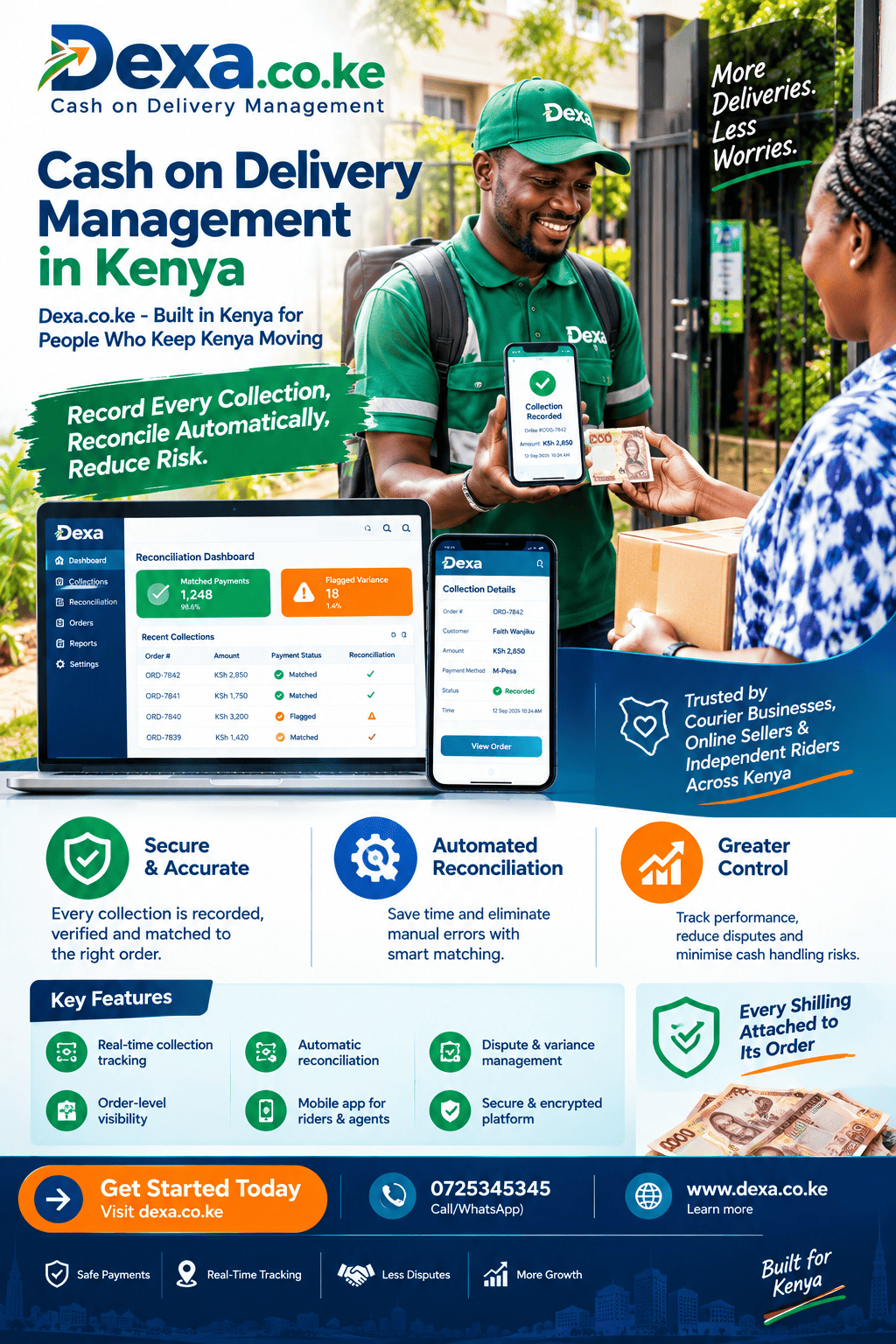
Cash on delivery management in Kenya addresses the most persistent operational challenge in the country’s delivery sector: a payment method that customers continue to prefer despite the near-universal availability of mobile money. First-time buyers want to see a product before parting with money. Older customers trust physical cash in ways they do not trust digital transactions. And in areas where network coverage remains uneven, cash is simply the practical option. Cash on delivery management in Kenya exists because refusing cash means refusing orders, and accepting cash without discipline means losing money quietly.
The problem has never been cash itself. It is what happens around cash when no system holds it accountable. A rider collects money at a doorstep, carries it across a day of deliveries, and hands over a lump sum at the end. Sometimes the count is accurate. Sometimes it is not, and nobody can establish which. Proper cash on delivery management in Kenya replaces that uncertainty with a record created at the moment of exchange, so reconciliation becomes verification rather than investigation.
Why Cash Creates Structural Problems
Cash is unique among the components of a delivery because it leaves no automatic trace. A parcel has an order record. A rider has an assignment. A customer has a phone number. The money, until someone records it, exists only in a pocket and a memory. That absence of a trace is what makes cash so difficult to manage at scale.
The first structural problem is custody. From the moment a rider collects payment until the funds reach the business, the money is unsecured. Riders are not banks. They stop for fuel, take breaks, and move through areas where a large sum of cash attracts attention. When a loss occurs, the business usually absorbs it, because there is no way to establish what actually happened. Structured cash on delivery management in Kenya reduces the amount of cash in circulation at any moment by recording each collection as it occurs and settling rider remittances more frequently.
The second problem is reconciliation. When a rider returns with cash and a rough count of deliveries, matching money to orders becomes an exercise in trust. If a customer later disputes what they paid, or if an order cannot be accounted for, resolving it requires reconstructing the day from fragments. Businesses that have adopted cash on delivery management in Kenya practices log each collection against its order immediately, so reconciliation becomes a matter of verification rather than archaeology.
The third problem is dispute. Cash offers no automatic receipt and no independent record. Customers who pay in cash and later need proof of payment have nothing to refer to. When disagreements reach the business, they arrive with no evidence on either side. Proper cash on delivery management in Kenya gives both parties a record they can check, which resolves most disagreements before they escalate into complaints.
What Proper Management Actually Means
The phrase is used loosely, so it helps to define it precisely. Cash on delivery management in Kenya rests on four principles, and removing any one of them weakens the whole structure.
The first principle is immediate recording. A collection should be logged at the moment it happens, not remembered until the end of the day. Every hour between collection and recording is an hour in which detail fades and ambiguity grows. Reliable cash on delivery management in Kenya practice treats the point of exchange as the point of entry.
The second principle is attachment to the order. Money collected should be linked to the specific delivery it relates to, not recorded as a daily total. Without that link, the business cannot answer basic questions: did this customer pay, how much, and when. The order-level discipline within cash on delivery management in Kenya is what makes the record genuinely useful rather than merely present.
The third principle is verification. The recorded amount should be confirmable by both parties. A customer who receives an automatic receipt and a business that sees the same transaction logged against the order have a shared record. The verification layer in cash on delivery management in Kenya removes the space in which disputes develop.
The fourth principle is auditability. Records should be retrievable months later, in a form that supports reconciliation, tax preparation, and any query from a customer or a regulator. The archive function of proper cash on delivery management in Kenya turns what was once a shoebox of slips into a searchable record.
How Dexa.co.ke Approaches Cash Management
Dexa.co.ke was built for the Kenyan market rather than adapted from a foreign model, and its structure reflects how money actually moves through a delivery business here. The platform splits into two products, each suited to a different stage of growth, and both treat cash handling as a core function rather than a feature added later.
For sellers and operators working with one or two trusted riders, the independent driver model fits naturally. Cash management in this arrangement matters because a solo operator has no finance team to catch what is missed. For operations that have outgrown informal arrangements and now coordinate several riders, the courier team model provides the reconciliation structure that cash on delivery management in Kenya requires at volume.
For Independent Drivers
A rider using this arrangement creates their own customer channel, sharing a personal booking link with businesses on WhatsApp and receiving direct bookings rather than competing for work in a crowded marketplace. From the business’s side, this simplifies cash on delivery management in Kenya considerably: one known contact, one consistent standard, one person accountable for each collection.
The rider benefits too. Rather than chasing one-off trips, a driver builds a roster of regular business clients, plans pickups in advance, and tracks earnings in one place. When collections are recorded rather than remembered, the rider’s own financial picture becomes clearer as well, which reduces the friction that often surrounds end-of-day remittance. Clean cash on delivery management in Kenya practice protects the rider as much as the business, because a documented collection cannot be disputed later.
For Courier Teams
Teams managing several riders and a steady flow of orders need structure that informal arrangements cannot provide. The platform keeps one operating record from request to receipt, so no order has to be reconstructed from scattered chats. Each parcel carries its customer details, assigned rider, agreed price, payment status, proof of delivery, and associated expense along with it.
For a business working with a courier team, this makes cash on delivery management in Kenya routine rather than exceptional. Dispatch is organised, riders know their assignments, collections are logged as they occur, and the business receives a clean record for every order. When a customer disputes a payment, the answer is already in the system rather than in someone’s memory.
Features That Make Cash Manageable
Collection Records Attached to Orders
Every collection should live with the order it belongs to. Not in a separate ledger, not in a rider’s notebook, but in the same record as the customer details and delivery proof. This single design decision is what separates functioning cash on delivery management in Kenya operations from those held together by spreadsheets.
When payment records sit alongside order records, answering a question takes seconds. Did this customer pay? How much? On what date? Who collected it? The answers are in one place rather than distributed across several.
Rider Accountability Without Distrust
A well-built cash on delivery management in Kenya system makes it possible to hold riders accountable without treating them as suspects. The system records what was collected, from whom, and when. A rider who follows process has nothing to worry about. A rider who does not stands out immediately, because the variance shows up against a specific order rather than disappearing into an end-of-week total.
This cuts both ways. Riders benefit from clear records too, because disputed collections can be verified rather than argued. In practice, most businesses find that clear cash on delivery management in Kenya processes improve rider relations rather than damaging them, because ambiguity is removed from both directions.
Automatic Reconciliation
Reconciliation is the task that consumes the most time in cash-heavy operations and produces the most frustration. The system should do it automatically. Each collection is matched to its order, the total collected is calculated, and any gap between expected and actual is flagged.
With the right cash on delivery management in Kenya tools, what once took an hour each evening takes minutes. For a growing business, that recovered time is often more valuable than any fee saved elsewhere.
Expense Visibility Alongside Collections
Delivery costs accumulate quietly: fuel, rider commissions, maintenance, airtime. A platform that tracks collections without tracking costs gives an incomplete picture. Businesses need both to understand true margins, because a delivery that collected correctly but cost more than expected is still a loss.
Complete cash on delivery management in Kenya accounting keeps revenue and cost side by side, which turns pricing from guesswork into a calculation.
Reducing Fraud and Disputes
Fraud in cash deliveries takes two forms, and both are addressed by the same discipline of immediate, order-linked recording.
The first is internal. Without records, a rider can under-report collections or claim a customer refused to pay. Because the business has no independent evidence, the claim usually stands. Once every collection is logged against a specific order at the point of delivery, under-reporting becomes visible immediately. The variance appears against a named order, and the question shifts from accusation to verification.
The second is external. Customers occasionally claim they paid when they did not, or dispute the amount. Without a record, the business usually concedes to preserve the relationship. With a timestamped collection record and a rider confirmation, the business can establish what occurred without confrontation.
In both cases, the protection comes from the same principle: attach the money to the order at the moment of exchange. That principle sits at the heart of what cash on delivery management in Kenya is for.
Cash Alongside Mobile Money
A realistic approach acknowledges that cash has not disappeared from Kenyan online retail, and it will not disappear soon. Network coverage remains uneven in some areas, some customers prefer physical payment for small orders, and some simply do not use mobile money regularly.
The right approach is not to eliminate cash but to manage it with the same discipline as digital payments. When a rider collects cash, the collection is recorded immediately against the order. When a customer pays through mobile money, the transaction is logged the same way. The business sees both in the same dashboard, and reconciliation covers both without separate processes.
This unified view is what prevents the quiet losses that accumulate when cash and digital payments live in separate records. It also gives the business accurate data for decisions about which payment methods to encourage, since the true cost of handling each becomes visible.
Managing Remittance and Cash Flow
Cash collected must eventually reach the business, and the speed of that process affects cash flow materially. Money sitting in a rider’s pocket until the end of the week is money unavailable for restocking, advertising, or rider payments.
When collections are recorded as they happen, remittance can be verified in minutes rather than hours. This makes frequent settlement practical. A business that can verify a rider’s collections at the end of each day can settle daily. A business relying on memory can only settle weekly, because verification takes so long. The record-keeping discipline behind cash on delivery management in Kenya therefore has a direct effect on how quickly money moves through the business.
Mobile money settlement is faster by nature, since funds transfer directly. This is one practical argument for encouraging digital payment where customers have no strong preference. Both methods remain available, but the business benefits from a higher proportion of digital transactions.
Handling Refunds and Reversals Under Cash
Disputes happen. A product arrives damaged, an order is duplicated, a customer changes their mind. Handling refunds through cash is messy and leaves no trace, which is one reason COD disputes escalate more often than they should.
A proper system handles reversals with the same discipline as collections. The refund is logged against the original order, the customer receives confirmation, and the business has a complete record for its accounts. This symmetry between collection and refund is what makes the payment side of a delivery operation trustworthy from both directions. Without it, cash on delivery management in Kenya remains a one-way discipline, protecting revenue but not reputation.
Scaling Cash Operations
As order volumes rise, cash handling becomes more complex rather than merely more frequent. More riders mean more collections, more remittance points, and more opportunities for variance. What worked at ten orders a day becomes unmanageable at sixty.
The transition is easier when the underlying records already exist. Order details, rider assignments, collection logs, and delivery proofs should live in one place from the beginning, so adding riders later does not mean rebuilding the process. The tools that support cash handling at higher volumes are the same ones that make small volumes simpler to manage.
Warning Signs Your Cash Process Needs Attention
Some warning signs build gradually and are easy to miss. If you cannot answer a customer’s question about their payment without making a call, your records are not where they should be. If reconciliation takes more than a few minutes at the end of each day, something is being tracked manually that should be automatic.
Other signs include collections that never quite match expectations, disputes that cannot be resolved either way, riders who prefer not to use the system, and a general sense that money is moving through the business without being fully visible. None of these are unusual for a business that has grown faster than its processes. They are simply what happens when cash is handled without proper structure.
Common Mistakes in Cash Management
Several mistakes appear repeatedly when businesses handle cash on delivery without a system.
The first is reconciling at the end of the week rather than the end of the day. The longer the gap between collection and recording, the more detail is lost and the harder discrepancies become to resolve.
The second is recording collections as a daily total rather than against individual orders. A total tells the business how much was collected but not from whom, which makes it useless for resolving disputes.
The third is treating cash and mobile money as separate processes. Maintaining two reconciliation methods doubles the administrative burden and creates gaps where one method’s records are less complete than the other’s.
The fourth is failing to issue receipts for cash payments. A customer without a record has no way to verify what they paid, and the business has no way to prove what was received. Both sides are exposed.
The Direction Cash Management Is Heading
Several shifts are reshaping how money moves in Kenyan delivery. Mobile money integration continues to deepen, and the connection between payment confirmation and delivery confirmation is becoming tighter, so a single automatic action will soon verify both. Cash will remain part of the picture for some time, but its share will decline as digital alternatives become more convenient.
Regulatory expectations around transaction records are also tightening, which favours businesses that maintain clean digital documentation across both payment methods. Operations relying on paper slips and memory will find compliance increasingly difficult as requirements become more specific.
What will not change is the underlying requirement: every shilling collected must be attributable to a specific order, visible in real time, and recoverable in a dispute. That requirement sits at the centre of what cash on delivery management in Kenya should deliver.
Cash on delivery management in Kenya is not about distrusting customers or riders. It is about removing ambiguity from the moment money changes hands, so that everyone involved has a record they can rely on. When collections are attached to orders, reconciled automatically, and visible in real time, the disputes that once consumed hours simply stop arising.
Whether you are running a single motorcycle from a single room or coordinating a fleet across the city, the tools behind cash on delivery management in Kenya from dexa.co.ke give you the records that protect your revenue, your riders, and your customers. From the first order request to the final remittance, every shilling stays attached to the delivery it belongs to.
The businesses that grow are the ones that treat cash with the same rigour as digital payments. Get the money right, and the rest of the operation becomes considerably easier to manage.