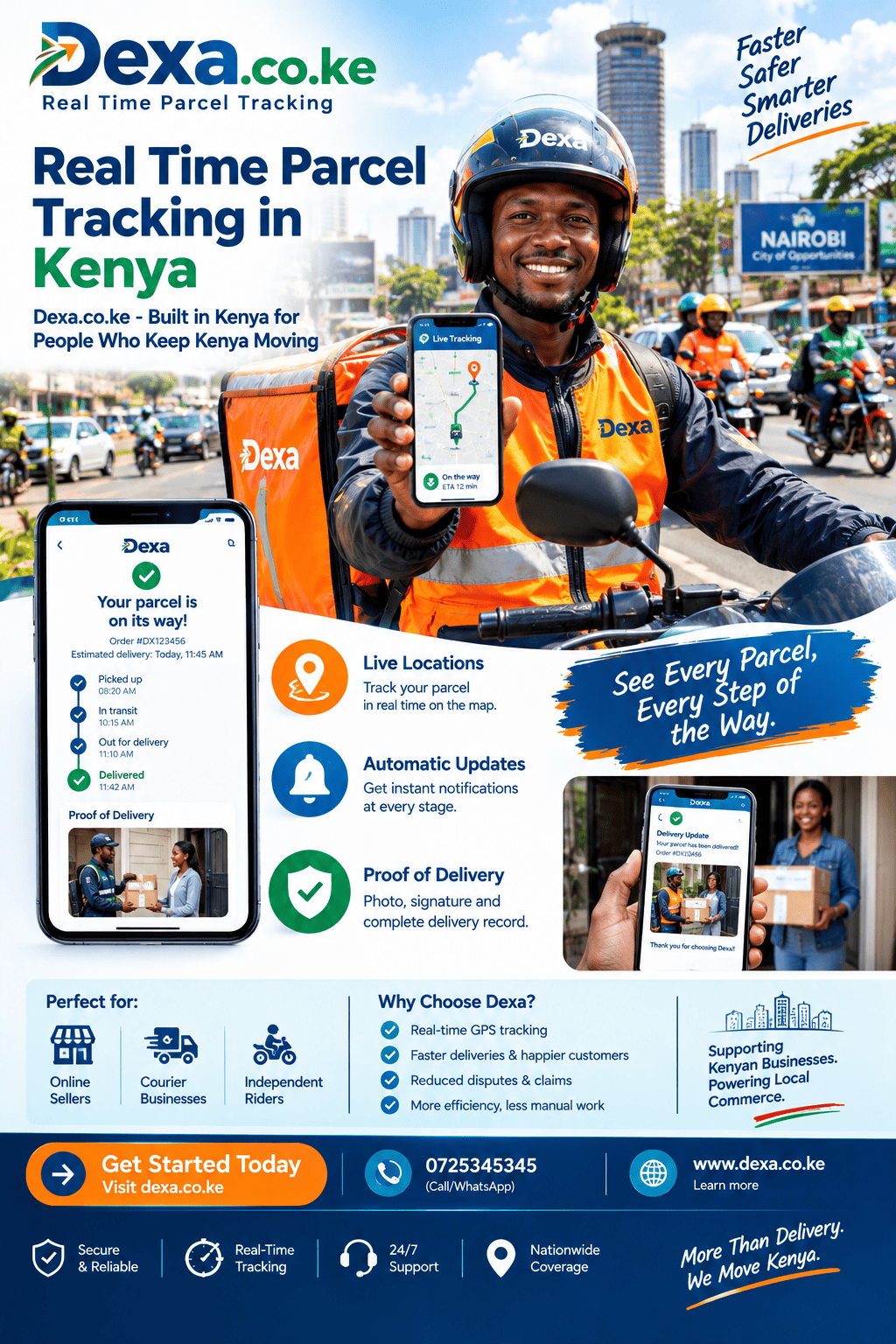
Real time parcel tracking in Kenya addresses the single question every customer asks and most delivery businesses cannot answer without making a phone call: where is my parcel right now? In an informal operation, the answer requires reaching the rider, interrupting a delivery, and waiting for a response. By the time the reply comes, the customer has already formed an impression about how the business operates. Real time parcel tracking in Kenya removes that entire exchange by making the parcel’s location visible to everyone who needs it, the moment they need it.
The gap matters more in Nairobi than in most cities. Traffic congestion ranks among the worst in Africa, and a journey that should take twenty minutes can stretch past an hour without warning. When a business cannot see where its riders are, it cannot answer the one question every customer asks. A real time parcel tracking in Kenya system closes that gap by turning each rider’s position into live information that dispatchers and customers can act on.
Why Tracking Became Essential Rather Than Optional
Courier businesses once managed riders the way dispatch offices managed taxis: by radio, telephone, and experience. That approach worked when volumes were small and routes were familiar. It breaks down as soon as a business grows beyond a handful of riders, because no dispatcher can hold ten simultaneous journeys in their head while also answering calls and assigning new work.
The first problem tracking solves is assignment. A dispatcher who can see every rider’s location assigns the nearest available person to a new pickup, which reduces travel time and increases the number of deliveries completed per shift. A real time parcel tracking in Kenya system makes this possible without guesswork, and the efficiency gain compounds across hundreds of assignments each week.
The second problem is customer communication. When a customer calls to ask where their parcel is, the dispatcher should be able to answer in seconds by looking at the map. Without tracking, the same question triggers a call to the rider, who may be riding and unable to respond. The capability behind real time parcel tracking in Kenya removes that chain of interruption entirely.
The third problem is accountability. Without location data, a rider’s performance is judged on impression rather than evidence. A rider who appears slow may simply have been given difficult routes. A rider who appears fast may be cutting corners. Continuous tracking provides the factual basis for fair assessment, which benefits both the business and the rider.
How Real Time Tracking Actually Works
The technology behind real time parcel tracking in Kenya is more accessible than many business owners assume. Every smartphone contains a GPS receiver, and the rider’s device transmits position data to a central system at regular intervals. No specialised hardware is required for basic tracking, which is why the barrier to adoption has fallen so sharply.
The sophistication lies in what happens to that data. A raw position is of limited value on its own. Useful tracking requires a mapping layer that converts coordinates into recognisable locations, a routing layer that understands the road network, and a display layer that shows dispatchers what they need to see. A real time parcel tracking in Kenya system that handles all three provides genuine operational value, while one that simply plots dots on a map provides considerably less.
Update frequency matters as well. A position that refreshes every few minutes suits longer journeys. A position that refreshes only when the rider opens an app is unreliable, because it depends on the rider remembering to do so. The strongest real time parcel tracking in Kenya implementations update continuously in the background, so the record is complete whether or not anyone is paying attention.
What Businesses Can See With Proper Tracking
Live Rider Locations
The foundation of any tracking system is a live map showing where every rider currently is. Dispatchers can see at a glance who is available, who is on a delivery, and who is heading back. This visibility allows assignments to be made intelligently rather than by rotation. The live location feature within real time parcel tracking in Kenya is the one dispatchers use most, because it directly informs every decision they make during the day.
Delivery Status at Every Stage
Location alone does not tell the whole story. A parcel can be picked up, in transit, out for delivery, or delivered, and each stage carries different expectations. Useful real time parcel tracking in Kenya updates status automatically as events occur, so the customer sees progress rather than a static pin.
Route History
Live location answers the question of where a rider is now. Route history answers the question of where they have been. This retrospective view is valuable for resolving disputes, understanding why a delivery took longer than expected, and identifying patterns that suggest training needs. A real time parcel tracking in Kenya system that stores route history turns each delivery into a reviewable record rather than a vanishing event.
Automatic Customer Notifications
Customers should not have to open an app or call the business to find out where their order is. Notifications should arrive without being requested: when the parcel is dispatched, when the rider is nearby, and when delivery is complete. Systems that handle this automatically save hours each week and reduce the volume of inbound enquiries dramatically. This is one of the most valued features of real time parcel tracking in Kenya from a customer’s perspective.
Proof of Delivery Integration
Tracking should end with a documented handover. Digital signatures, photographs, and timestamps captured at the point of delivery create a record that protects the business, the rider, and the customer. When tracking and proof are separate systems, the record becomes fragmented. When they are integrated, real time parcel tracking in Kenya produces a complete journey from dispatch to confirmed receipt.
Route Optimisation Awareness
Knowing where a rider is has limited value if the route itself is inefficient. The stronger platforms combine live location with routing intelligence, accounting for traffic conditions and delivery sequence. This layer of real time parcel tracking in Kenya reduces journey times and fuel consumption, which matters on thin margins.
Offline Resilience
Networks fail. A tracking system that stops working when connectivity drops leaves both the business and the customer without information at the moment they need it most. Robust real time parcel tracking in Kenya continues recording during outages and syncs automatically when connectivity returns, so no part of the journey goes unrecorded.
How Dexa.co.ke Approaches Parcel Tracking
Dexa.co.ke was built for the Kenyan market rather than adapted from a foreign model, and its structure reflects how delivery actually works here. The platform splits into two products, each suited to a different stage of business growth, and both treat tracking as a core function rather than an optional feature.
For sellers working with one or two trusted riders, the independent driver model fits naturally. Tracking in this arrangement matters because it lets a business see where a rider is without making a call, and it gives the customer confidence that the parcel is genuinely on its way. For operations that have outgrown informal arrangements and now coordinate several riders, the courier team model provides the coordination layer that real time parcel tracking in Kenya requires at volume.
For Independent Drivers
A rider using this arrangement creates their own customer channel, sharing a personal booking link with businesses on WhatsApp and receiving direct bookings rather than competing for work in a crowded marketplace. From the seller’s side, this simplifies real time parcel tracking in Kenya considerably: one known contact, one consistent standard, one person accountable for each parcel.
The rider benefits as well. Rather than chasing one-off trips, a driver builds a roster of regular business clients, plans pickups in advance, and tracks earnings in one place. That stability encourages reliability, and reliability is exactly what a growing seller needs from a delivery partner. For a rider, knowing that the record of every trip is captured also provides protection against false claims, which makes the tracking feature as much a safeguard as a management tool.
For Courier Teams
Teams managing several riders and a steady flow of orders need structure that informal arrangements cannot provide. The platform keeps one operating record from request to receipt, so no order has to be reconstructed from scattered chats. Each parcel carries its customer details, assigned rider, agreed price, payment status, proof of delivery, and associated expense along with it.
For a business working with a courier team, this makes real time parcel tracking in Kenya genuinely useful rather than merely reassuring. Dispatch is organised, riders know their assignments, customers receive automatic updates, and the business has a clean record for every order. When a customer disputes a delivery, the answer is already in the system rather than in someone’s memory.
Benefits for Delivery Businesses
Reduced Inbound Enquiries
The most immediate benefit of real time parcel tracking in Kenya is a quieter phone. When customers can see where their parcel is, they stop calling to ask. For a small team, the hours recovered each week amount to a meaningful increase in capacity, often without any additional hiring.
Faster Problem Resolution
Problems still occur, but they surface earlier. A rider who has stopped moving for twenty minutes is visible on the map before the customer notices the delay. Dispatchers can intervene, reassign the delivery, or notify the customer proactively. This early visibility is one of the practical advantages of real time parcel tracking in Kenya, and it turns potentially damaging incidents into minor ones.
Better Rider Management
Tracking also provides a factual basis for managing riders. Performance becomes visible rather than assumed. A rider who consistently completes deliveries faster may need support understanding what they are doing differently. Tracking data informs these conversations without requiring confrontation, because the record speaks for itself.
Accurate Financial Records
When tracking data connects to payment records, the business gains a complete picture of every delivery. Collections are matched to orders, expenses are tracked alongside revenue, and pricing decisions become calculations rather than guesses. Any serious approach to real time parcel tracking in Kenya includes this financial layer, because delivery that cannot be costed cannot be priced correctly.
Benefits for Customers
Customers experience tracking primarily as reassurance. An order that can be seen is an order that feels real. Uncertainty is the most common source of anxiety in online shopping, and visibility removes it almost entirely.
The second customer benefit is accurate expectation setting. A delivery window derived from live tracking data is far more reliable than a generic estimate. Customers can plan their day around a realistic arrival time rather than waiting indefinitely.
The third benefit is dispute protection. When a customer receives an automatic confirmation with a photograph and timestamp, both parties have evidence of what occurred. Disagreements that would otherwise consume time and goodwill are resolved instantly.
How Tracking Connects to the Broader Operation
Real time parcel tracking in Kenya does not operate in isolation. It sits at the centre of a larger system that includes order capture, dispatch, payment handling, and proof of delivery.
When these elements are connected, the effect compounds. An order is placed and immediately visible to dispatch. A rider is assigned and their location becomes trackable. The customer receives updates without being asked. Payment is logged against the order. Proof of delivery completes the record. Each step reinforces the others, and the business gains a complete picture of its operations rather than fragments scattered across different tools.
When these elements are disconnected, the value of each is diminished. Tracking without payment records leaves financial questions unanswered. Proof of delivery without order history makes disputes harder to resolve. The strongest results come from systems that treat the delivery journey as a single connected process.
Handling the Practical Constraints
Two practical concerns arise whenever tracking is discussed in the Kenyan market: battery life and data consumption. Continuous GPS use drains a phone faster than ordinary use, and riders working long shifts need their devices to last the day.
The strongest systems address this through efficient background tracking that adjusts update frequency based on context. A rider moving at speed needs frequent updates. A rider stationary at a delivery point needs fewer. Adaptive tracking of this kind reduces both battery drain and data consumption without sacrificing the accuracy that makes real time parcel tracking in Kenya useful.
Data consumption is similarly manageable. Position updates are small, and the total volume over a working day is modest by the standards of modern mobile plans. Businesses considering adoption should verify that their chosen platform is designed for efficiency rather than simply transmitting as often as possible.
Tracking and Rider Trust
Some riders resist tracking, assuming it signals distrust. In practice, the opposite is usually true. A rider who knows their location is recorded has protection against false claims. If a customer says a delivery never arrived, the route history shows that the rider was at the location. If a dispute arises about timing, the record settles it.
The businesses that introduce tracking well explain it in these terms rather than presenting it as surveillance. Transparent tracking that protects both parties is accepted far more readily than tracking presented as monitoring for its own sake. The framing matters, and the strongest implementations treat the data as a shared record rather than a one-way tool.
Choosing the Right Tracking System
Businesses evaluating options should focus on a few practical questions. Does the system update location continuously in the background, or only when the rider opens an app? Is the location data connected to delivery status and proof of delivery, or stored separately? How does the system handle network outages? What is the impact on battery life over a full shift?
A system that answers these well is one that will not create new problems as volume rises. A system that answers only the first is one that will produce incomplete data and frustrated dispatchers. The difference between the two is rarely visible in a demonstration, which is why testing with real riders across a fortnight is worth the effort before committing.
It also helps to consider how tracking connects to the rest of the operation. A tracking tool that stands alone provides partial value. A platform that links tracking to dispatch, payment, proof, and expenses provides considerably more, because every delivery becomes part of a complete history rather than an isolated event.
Common Mistakes in Tracking Implementation
Several mistakes appear repeatedly when businesses introduce tracking without examining the details.
The first is treating tracking as a monitoring tool rather than a shared record. When riders feel watched rather than protected, adoption suffers and the data becomes unreliable.
The second is failing to act on the data. A system that records everything but produces reports nobody reviews is not providing value. The discipline of reviewing tracking information regularly is what turns data into decisions.
The third is neglecting offline capability. A tracking system that stops working when the network drops leaves both the business and the customer without information at exactly the moment it is needed.
The fourth is separating tracking from proof of delivery. The location record shows where a rider went. The proof shows what happened when they arrived. Together they create a complete account. Separately, each is only half a story.
The Direction Tracking Technology Is Heading
Several shifts are reshaping how parcel tracking works in Kenya. Electric motorcycles are becoming more common, and their onboard telemetry allows richer tracking data than simple GPS pings, including battery status and motor performance. Government investment in intelligent traffic management is gradually improving movement across Nairobi, which will make live tracking data more predictable and more valuable over time.
Mobile money integration continues to deepen, and the connection between tracking and payment is becoming tighter. The direction is toward systems where every delivery produces a complete record automatically, with no manual input required at any stage.
What will not change is the underlying requirement: businesses and customers both need to know where a parcel is, and they need to be able to prove it arrived. That requirement sits at the centre of what real time parcel tracking in Kenya should deliver, today and in future.
Real time parcel tracking in Kenya is not simply a map with a moving dot on it. It is the operational backbone that connects orders, riders, payments, and proof into a single visible journey. When that journey is visible, most of the daily friction in a delivery business disappears on its own.
Whether you are dispatching five orders a week from a single room or fifty a day from a small warehouse, the tools behind real time parcel tracking in Kenya from dexa.co.ke give you the visibility and records that make delivery predictable. From the first order request to the final confirmation, every parcel stays accounted for.
The businesses that grow are the ones that treat visibility as a foundation rather than a feature. Build the system early, let it carry the weight as volume rises, and delivery becomes the part of the business that brings customers back.