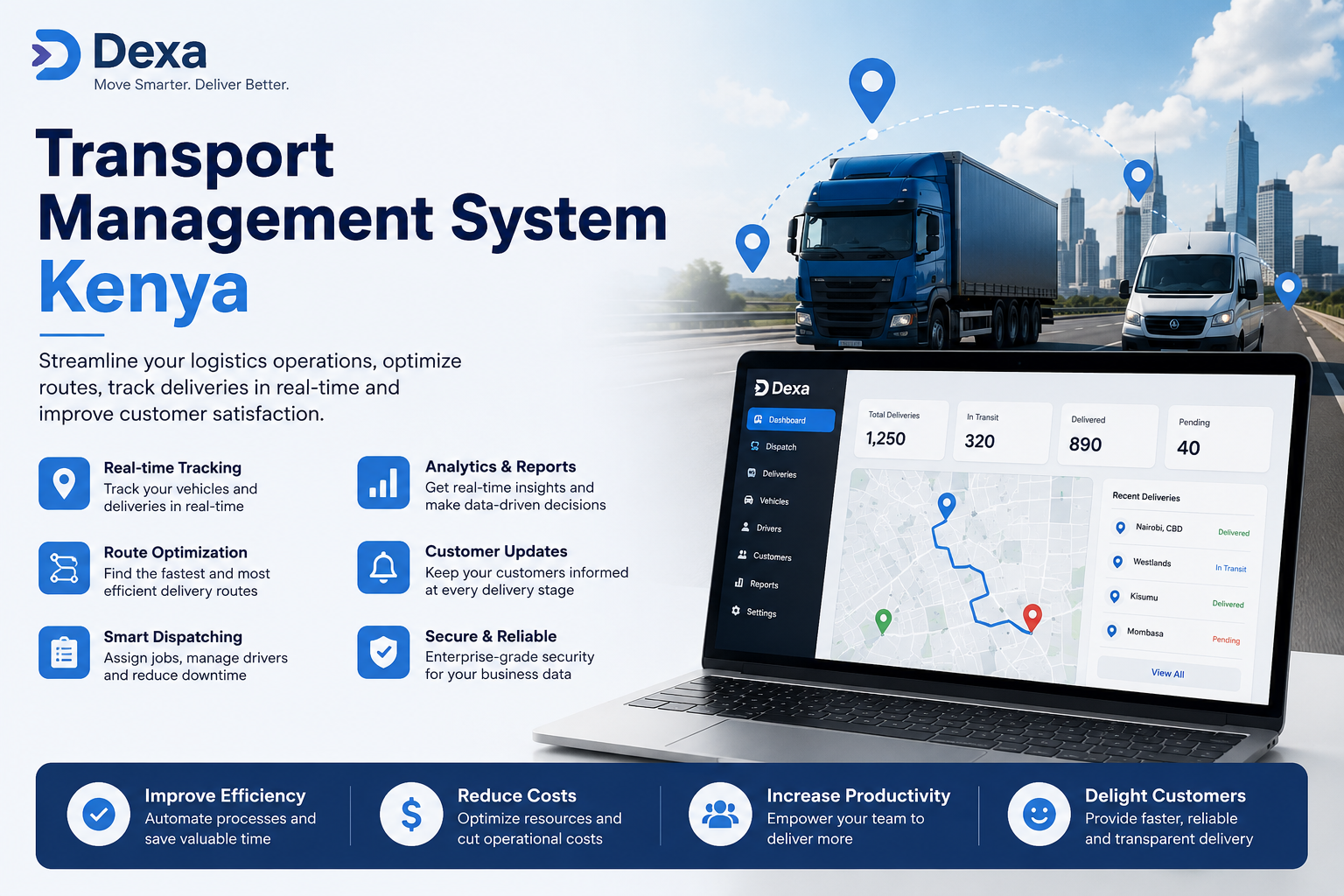
Transport Management System Kenya: A Smarter Way to Manage Logistics
Transportation is an important part of business operations in Kenya. Retailers, manufacturers, distributors, courier companies, e-commerce businesses, and other organizations depend on reliable transportation to move goods from one location to another.
However, managing vehicles, drivers, routes, deliveries, customers, and transportation costs manually can become complicated as a business grows.
Businesses may experience:
- Delayed deliveries
- High fuel expenses
- Poor route planning
- Vehicle breakdowns
- Communication problems
- Inefficient driver allocation
- Limited visibility into operations
- Difficulties tracking transportation costs
A Transport Management System Kenya provides a centralized solution for managing transportation activities more efficiently.
With the right technology, businesses can automate transportation processes, monitor vehicles, manage drivers, optimize routes, track deliveries, and generate useful reports.
Dexa provides digital tools that help businesses modernize their logistics and transportation operations.
What Is a Transport Management System?
A Transport Management System (TMS) is software designed to help businesses plan, execute, monitor, and analyze transportation activities.
Instead of managing different operations using spreadsheets, paper documents, phone calls, and separate applications, businesses can bring important transportation processes together on one platform.
A modern transport management system can help organizations manage:
- Vehicles
- Drivers
- Deliveries
- Routes
- Dispatching
- Customers
- Payments
- Maintenance
- Reports
- Transportation expenses
This creates better visibility and allows managers to make faster decisions.
Why Businesses Need a Transport Management System in Kenya
Transportation costs can have a major impact on business profitability.
Poor planning may result in unnecessary fuel consumption, inefficient vehicle utilization, delayed deliveries, and increased maintenance costs.
A transport management system helps businesses gain greater control over their operations.
With centralized information, managers can determine:
- Which vehicles are available
- Which drivers are assigned
- Where vehicles are located
- Which deliveries are pending
- Which routes are being used
- Which vehicles require maintenance
- How much transportation operations are costing
Challenges of Managing Transportation Manually
1. Poor Route Planning
Manual route planning can result in longer travel distances and unnecessary fuel consumption.
A digital system can help businesses identify more efficient routes.
2. Difficulty Managing Drivers
As the number of drivers increases, manually assigning and monitoring drivers becomes difficult.
A centralized platform makes driver management easier.
3. High Fuel Costs
Fuel is one of the major expenses for transportation businesses.
Monitoring fuel usage and improving route efficiency can help control costs.
4. Vehicle Downtime
Unexpected vehicle breakdowns can disrupt business operations.
Maintenance scheduling helps businesses identify servicing requirements before major problems occur.
5. Limited Visibility
Without real-time information, managers may struggle to understand what is happening across their transportation network.
A digital dashboard provides greater visibility.
Key Features of a Transport Management System Kenya
Vehicle Management
Businesses can maintain digital records for every vehicle in their fleet.
Information can include:
- Vehicle registration details
- Mileage
- Maintenance history
- Insurance information
- Service schedules
- Vehicle availability
This makes it easier to manage fleet resources.
Driver Management
A transport management platform helps businesses organize drivers and their assignments.
Managers can monitor:
- Driver availability
- Assigned deliveries
- Completed trips
- Performance
- Work schedules
- Delivery records
Route Optimization
Route optimization is one of the most important features of modern transportation software.
Businesses can identify efficient routes based on:
- Delivery locations
- Distance
- Traffic conditions
- Driver availability
- Delivery priorities
Efficient routes can reduce fuel consumption and improve delivery times.
Dispatch Management
Dispatch teams can assign jobs to drivers based on availability, location, workload, and delivery requirements.
This reduces manual coordination and improves productivity.
Delivery Tracking
Businesses can monitor deliveries from dispatch to completion.
Tracking provides better visibility and helps customer service teams respond to inquiries more effectively.
Digital Proof of Delivery
Businesses can capture electronic delivery records such as:
- Customer signatures
- Delivery photographs
- GPS information
- Delivery notes
- Completion times
Digital proof of delivery improves accountability.
Maintenance Management
A transport management system can help businesses schedule preventive maintenance.
Managers can keep track of:
- Oil changes
- Tire replacements
- Vehicle servicing
- Inspections
- Repairs
- Maintenance costs
Preventive maintenance reduces unexpected breakdowns.
Reporting and Analytics
Transportation data can provide valuable business insights.
Reports can cover:
- Delivery performance
- Driver productivity
- Fuel consumption
- Vehicle utilization
- Transportation costs
- Revenue
- Failed deliveries
These insights support better decision-making.
Benefits of Transport Management Software
Reduced Transportation Costs
Businesses can identify inefficient processes and reduce unnecessary transportation expenses.
Improved Delivery Performance
Better planning and dispatching can help businesses complete deliveries more efficiently.
Increased Productivity
Automation reduces the amount of time employees spend on repetitive administrative tasks.
Better Customer Satisfaction
Customers benefit from reliable deliveries, accurate updates, and improved communication.
Improved Vehicle Utilization
Businesses can determine which vehicles are being used efficiently and which may be underutilized.
Greater Operational Visibility
Managers gain access to centralized information about transportation activities.
Who Can Use a Transport Management System?
A transport management platform can benefit many industries, including:
- Courier companies
- E-commerce businesses
- Retailers
- Supermarkets
- Manufacturers
- Wholesalers
- Distributors
- Construction companies
- Agricultural businesses
- Pharmaceutical companies
- Logistics providers
- Service companies
Any organization that manages vehicles, deliveries, or transportation operations can benefit from a TMS.
Transport Management for E-Commerce Businesses
The growth of online shopping has increased demand for efficient transportation and last-mile delivery.
E-commerce businesses need to coordinate:
- Customer orders
- Delivery addresses
- Riders
- Vehicles
- Delivery schedules
- Customer notifications
- Proof of delivery
A transport management system brings these activities together and makes it easier to manage growing delivery volumes.
How Transport Software Improves Customer Experience
Customers want more than just a delivered package. They want convenience and transparency.
A modern transportation platform can help businesses provide:
- Delivery status updates
- Accurate delivery information
- Faster communication
- Proof of delivery
- Reliable delivery schedules
Better communication can increase customer confidence and encourage repeat business.
How Data Helps Transportation Managers
Transportation generates a large amount of useful information.
By analyzing this information, businesses can identify:
- Inefficient routes
- High fuel consumption
- Driver performance issues
- Vehicle maintenance trends
- Delivery delays
- Customer service problems
Managers can then use these insights to improve operations.
The Role of Mobile Technology
Mobile devices have become essential in modern transportation operations.
Drivers can use mobile applications to:
- Receive assignments
- View delivery information
- Navigate routes
- Update delivery status
- Contact customers
- Capture proof of delivery
- Submit delivery reports
This creates faster communication between drivers and management teams.
Cloud-Based Transport Management
Cloud-based software allows businesses to access transportation information without being restricted to one physical office.
Managers can access information from:
- Computers
- Smartphones
- Tablets
- Other connected devices
Cloud-based systems also make it easier to scale operations as a business grows.
How to Choose the Right Transport Management System
Before choosing a transportation platform, businesses should consider several factors.
Ease of Use
Employees should be able to understand and use the platform easily.
Scalability
The system should support future growth.
Security
Business and customer information should be protected using appropriate security controls.
Mobile Access
Drivers should be able to access important functions while working in the field.
Reporting
The platform should provide useful reports that support business decisions.
Integration
The system should be able to work alongside other important business tools where necessary.
Best Practices for Transport Management
Businesses can improve transportation performance by:
- Maintaining accurate vehicle records.
- Monitoring fuel consumption.
- Scheduling preventive maintenance.
- Training drivers regularly.
- Optimizing delivery routes.
- Tracking delivery performance.
- Monitoring transportation expenses.
- Reviewing operational reports.
- Improving customer communication.
- Automating repetitive processes.
Future of Transport Management in Kenya
Technology will continue to transform the transportation industry.
Future developments may include:
- Artificial intelligence
- Predictive analytics
- Internet of Things technology
- Advanced GPS tracking
- Automated route planning
- Smart fleet monitoring
- Predictive vehicle maintenance
- Advanced mobile applications
Businesses that adopt digital transportation solutions will be better prepared to respond to changing customer expectations and market conditions.
1. How a TMS Helps Control Transportation Expenses
Transportation costs can quickly reduce business profits when they are not properly monitored. A transport management system gives businesses better visibility into where money is being spent.
Businesses can monitor:
- Fuel expenses
- Driver-related costs
- Vehicle maintenance costs
- Delivery expenses
- Trip costs
- Route-related expenses
- Vehicle utilization
This information helps managers identify unnecessary expenses and develop better cost-control strategies.
2. Automated Trip Management
Managing trips manually can consume significant amounts of time, particularly when a business operates multiple vehicles.
A TMS can help organize:
- Trip schedules
- Pickup locations
- Delivery destinations
- Assigned drivers
- Vehicle information
- Trip status
- Completion records
Automation makes it easier for dispatch teams to coordinate multiple trips simultaneously.
3. Vehicle Utilization Management
Not every vehicle in a fleet is used equally. Some vehicles may be overloaded while others remain idle.
Transport management software helps managers understand:
- Which vehicles are active
- Which vehicles are underutilized
- How many trips each vehicle completes
- Vehicle capacity utilization
- Average distance traveled
Better vehicle utilization can increase productivity without necessarily requiring additional vehicles.
4. Managing Multiple Delivery Locations
Businesses serving multiple towns, estates, branches, or customer locations need efficient coordination.
A centralized system helps organize deliveries according to:
- Location
- Delivery priority
- Customer requirements
- Driver availability
- Vehicle capacity
This reduces confusion and improves delivery planning.
5. Improving Communication Between Dispatchers and Drivers
Communication problems can cause unnecessary delivery delays.
A transport management platform can create a central communication workflow where dispatchers can provide drivers with updated assignments and delivery information.
This reduces dependence on repeated phone calls and manual messages.
6. Managing Failed Deliveries
Failed deliveries can increase transportation costs and negatively affect customer satisfaction.
A good transport system helps businesses record reasons for failed deliveries, such as:
- Customer unavailable
- Incorrect address
- Phone unreachable
- Payment issues
- Customer requested rescheduling
Managers can analyze these records and develop strategies to reduce future failed deliveries.
7. Delivery Scheduling and Priority Management
Not every delivery has the same level of urgency.
Businesses can categorize deliveries based on:
- Standard delivery
- Same-day delivery
- Express delivery
- Scheduled delivery
- High-priority delivery
This allows dispatch teams to allocate resources more effectively.
8. Digital Records Improve Accountability
Paper-based transportation records can easily become lost, damaged, or difficult to retrieve.
Digital records provide a centralized history of:
- Trips
- Drivers
- Vehicles
- Customers
- Deliveries
- Payments
- Maintenance
This makes auditing and reporting easier.
9. Using Transportation Data to Improve Profitability
Data collected by a TMS can help business owners understand which parts of their transportation operations are profitable and which require improvement.
For example, managers can compare:
- Cost per trip
- Revenue per delivery
- Fuel consumption
- Driver productivity
- Vehicle utilization
- Delivery completion rates
These insights can support better strategic decisions.
10. How TMS Technology Supports Business Expansion
When a company grows, transportation operations become more complex.
A scalable transport management system allows businesses to add:
- More vehicles
- More drivers
- More customers
- More delivery locations
- More branches
- More delivery orders
This makes it easier to expand without relying entirely on additional manual administration.
Why Choose Dexa for Transport Management?
Dexa helps businesses simplify logistics and transportation operations through modern digital solutions.
With the right platform, businesses can improve:
- Fleet visibility
- Driver management
- Delivery coordination
- Route planning
- Customer communication
- Operational reporting
- Transportation efficiency
Dexa provides businesses with technology designed to make transportation operations easier to manage and more efficient.
Frequently Asked Questions
What is a Transport Management System?
A Transport Management System is software that helps businesses plan, manage, monitor, and analyze transportation operations.
Can a TMS reduce transportation costs?
Yes. Better route planning, vehicle utilization, fuel monitoring, and automation can help businesses control transportation expenses.
Can small businesses use transport management software?
Yes. A scalable platform can be useful for both small businesses and larger organizations.
Does a TMS help manage drivers?
Yes. Businesses can use the system to assign jobs, monitor performance, and organize driver activities.
Can customers track deliveries?
Depending on the platform and configuration, customers can receive delivery updates and tracking information
Contact Dexa
Website: Dexa.co.ke
Phone: +254725345345
Email: ezekiel@kayapro360.com
Modernize your transportation operations with smarter digital management.